
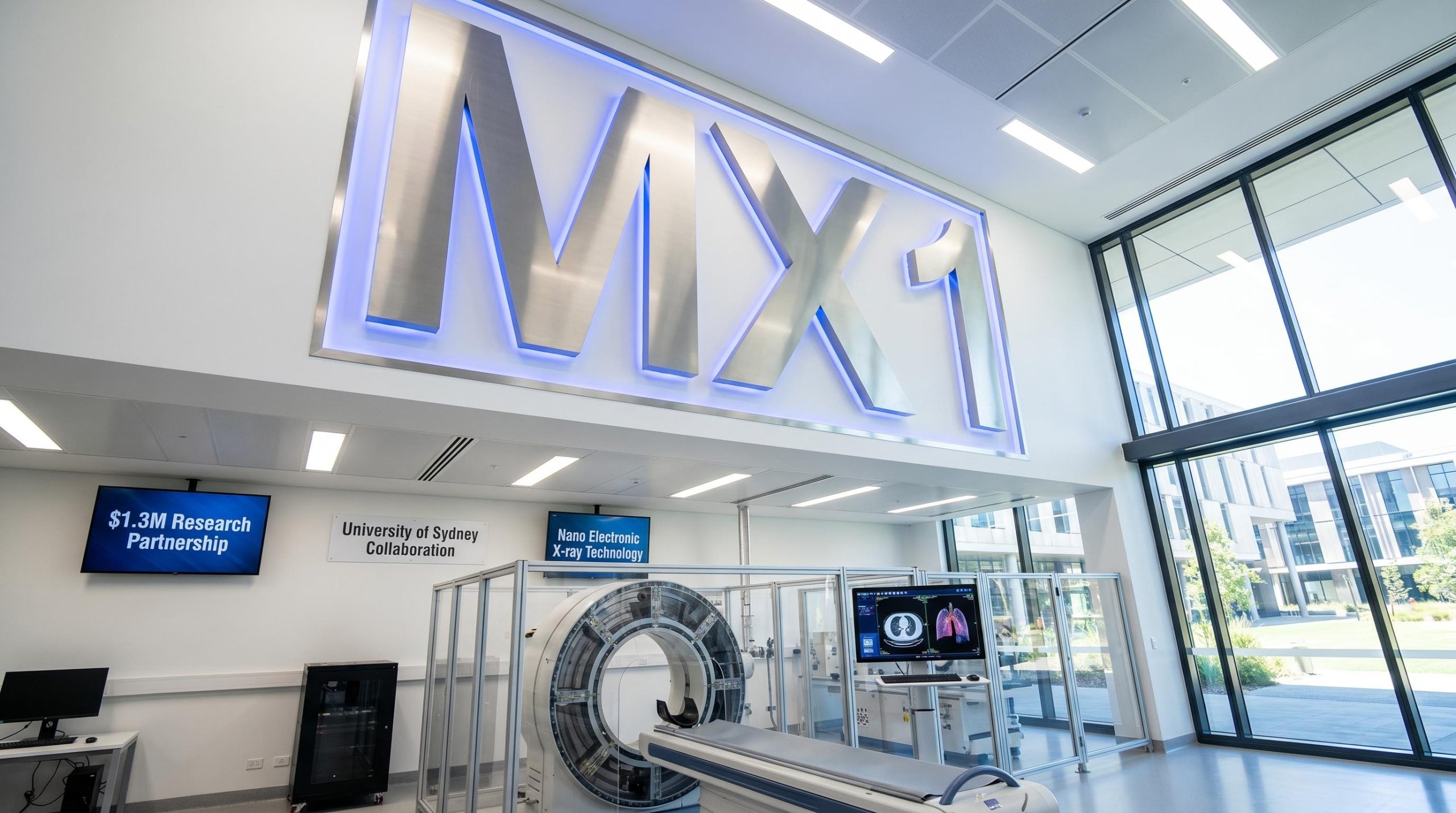
Micro-X secures $1.3 million for lung CT scanner research with University of Sydney
Micro-X has executed a research agreement with the University of Sydney, receiving $1.3 million as part of a $1.9 million research partnership funded by the Australian Government’s Critical Technologies Challenge Program (CTCP), Round 1 Stage 2. The 18-month programme will evaluate the feasibility of a miniaturised stationary CT system for lung imaging applications.
Micro-X’s role centres on providing existing Nano Electronic X-ray (NEX) hardware and technical expertise developed through its earlier Head CT programme, rather than developing an entirely new product from scratch. The Company will supply the imaging chain, high-voltage generation components, and associated technical support for integration into a laboratory-based proof-of-concept test bench.
The research agreement represents a non-dilutive funding opportunity that validates Micro-X’s NEX technology platform whilst extending its research pipeline without requiring shareholder capital. Government backing through the CTCP programme provides external endorsement of the Company’s cold cathode, carbon nanotube emitter technology for potential future deployable medical imaging applications.
When big ASX news breaks, our subscribers know first
What is Nano Electronic X-ray (NEX) technology?
Micro-X’s proprietary NEX technology uses a cold cathode, carbon nanotube (CNT) emitter system that enables electronic control of X-ray generation. This approach delivers significant reductions in size, weight, and power requirements compared to conventional rotating-gantry CT systems, making X-ray products more portable and easier to deploy in diverse clinical settings.
The key innovation lies in the stationary architecture concept. Rather than a single X-ray tube rotating around the patient (as in conventional CT scanners), NEX-based systems use multiple X-ray tubes arranged in a fixed configuration. This eliminates the need for heavy mechanical gantries and associated motors, reducing both system complexity and physical footprint.
NEX represents the core intellectual property underpinning Micro-X’s entire product portfolio across health and security markets. The technology platform enables applications ranging from mobile diagnostic imaging to airport security checkpoints and specialised medical imaging systems.
NEX-based CT vs Conventional CT:
- Size: Substantially smaller footprint versus large fixed gantry systems
- Mobility: Designed for deployable applications rather than fixed installation
- Architecture: Multiple stationary X-ray tubes instead of single rotating source
- Power: Reduced electrical requirements enabling portable deployment
How the research programme will work
The project objective is to establish a laboratory-based proof-of-concept test bench for detecting lung cancer. This test bench will incorporate multiple Micro-X NEX tubes arranged in a stationary configuration and will be used to evaluate imaging geometry, photon measurement techniques, and system integration concepts.
Micro-X’s contribution draws directly on existing IP and R&D work. The Company will supply hardware, high-voltage generation components, and technical expertise developed through its Head CT programme, effectively monetising prior development rather than funding speculative new research.
The Head CT clinical study has already progressed well beyond the feasibility stage the lung programme is now entering, with the Micro-X Stroke Scanner acquiring the world’s first CNT Cone Beam CT human brain images at Royal Melbourne Hospital as part of a 108-patient multi-centre pilot.
The University of Sydney will lead system-level research activities and software development in collaboration with research and clinical partners. The programme builds on Stage 1 CTCP work that demonstrated the feasibility of stationary NEX CT array architecture for lung CT applications in a laboratory setting.
The test bench is explicitly not a medical device intended for clinical use. It serves as a feasibility study to evaluate whether the stationary architecture concept warrants further commercial development. This approach allows Micro-X to validate technical proof of concept before committing significant capital to full product engineering.
Why lung cancer imaging matters
Lung cancer is the leading cause of cancer-related deaths worldwide, accounting for the highest mortality rates among both men and women. Several countries, including Australia, are implementing early screening programmes for high-risk populations to improve detection rates and treatment outcomes.
Conventional CT systems used for lung screening are large, expensive, and require fixed installation in hospital or imaging centre environments. If feasibility is proven through this research programme, a smaller, lighter, and potentially cheaper CT alternative could address unmet clinical needs in community settings, regional centres, or mobile screening programmes where conventional systems are impractical to deploy.
The research programme examines whether a deployable lung CT system based on stationary NEX architecture could provide clinically useful imaging quality whilst offering significant advantages in portability and cost compared to existing solutions. Figure 1 in the Company’s announcement compares the physical footprint of conventional fixed CT gantry systems against the conceptual form factor of a deployable lung CT system.
Anthony Skeats, Chief Operating Officer
“As the leading cause of death from cancer in Australia, lung cancer has a significant impact on families and the community. This funding supports evaluation of our existing NEX Technology in a controlled research environment looking at early lung cancer screening. Our contribution to the programme will be providing the established X-ray hardware and technical expertise developed through our earlier Head CT work. The objective is to assess feasibility and better understand the performance characteristics of a stationary architecture for potential deployable lung CT applications.”
What happens if the research succeeds?
Successful feasibility demonstration would represent only the first step in a multi-stage development pathway. The Company has made clear that any commercial progression beyond the laboratory proof-of-concept stage would require several additional elements before product launch.
Commercial progression requirements:
- Robust commercial use case – Validation of market demand, reimbursement pathways, and competitive positioning
- Further engineering development – Translation from laboratory test bench to manufacturable medical device
- Regulatory approvals – Regulatory approvals in relevant markets
- Additional funding – Capital to support full product development, clinical trials, and commercialisation
This staged development approach protects shareholder capital by validating technical feasibility before committing to the substantial investment required for full product development. The research phase tests proof of concept in a controlled environment, allowing Micro-X to make evidence-based decisions about commercial viability before proceeding to engineering and regulatory stages.
The Full Body CT programme cleared its Critical Design Review in June 2026, triggering a $1.6 million ARPA-H milestone payment and advancing into full-size engineering prototype manufacturing, illustrating how a later-stage NEX programme progresses through the same development gates the lung CT research is now beginning.
Micro-X’s broader technology platform
The lung CT research programme adds another potential application for Micro-X’s NEX platform, diversifying the Company’s commercialisation pipeline beyond existing programmes. Micro-X operates a fully vertically integrated design and production facility in Adelaide, South Australia, with a growing technical and commercial team based in Seattle expanding the Company’s US business presence.
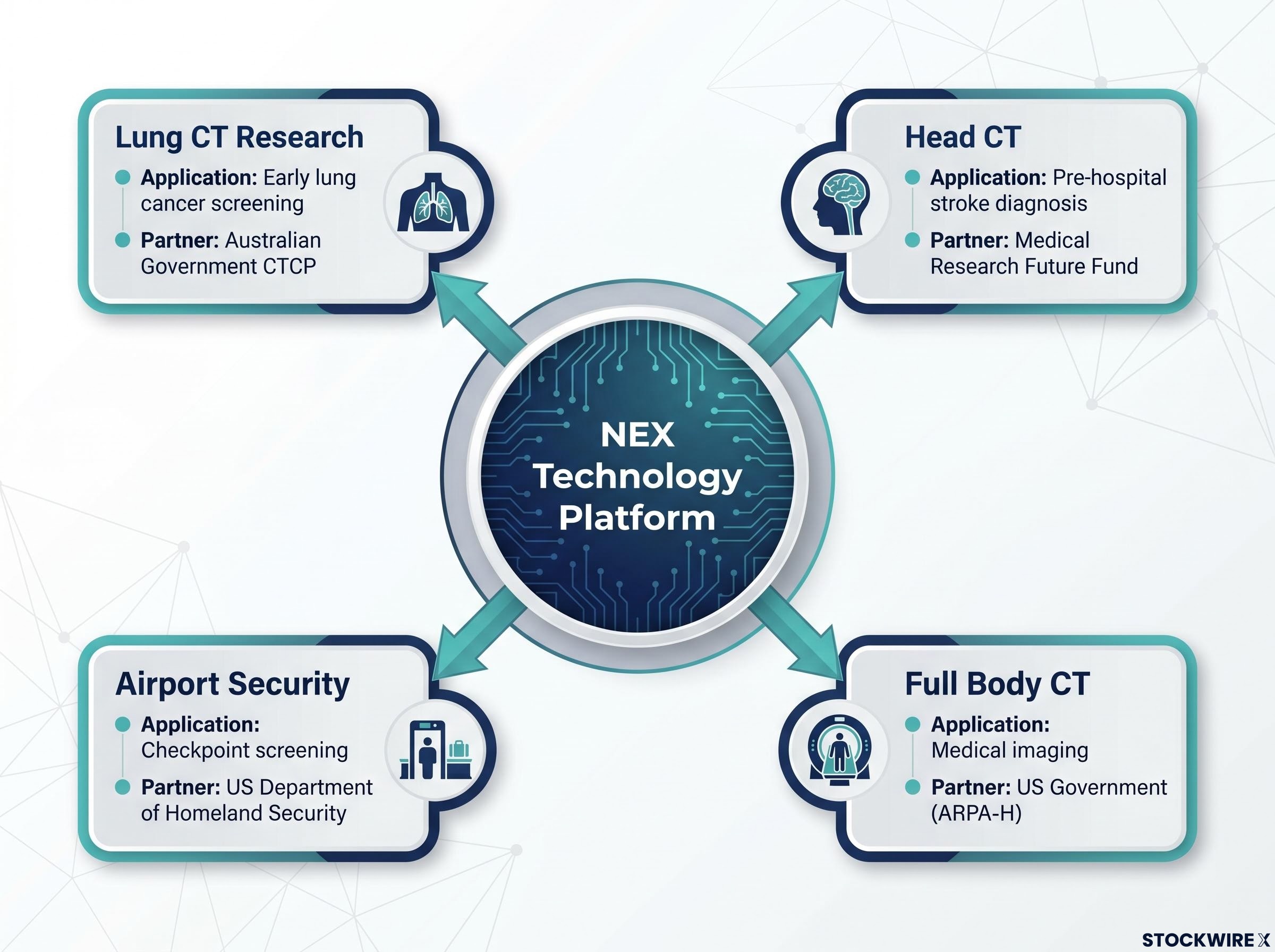
The Company’s product portfolio currently spans four high-margin applications across health and security markets. Mobile digital radiology products are sold for diagnostic imaging in global healthcare, military, and veterinary applications. Other active programmes leverage the same core NEX technology for distinct use cases.
| Programme | Application | Funding Partner |
|---|---|---|
| Lung CT Research | Early lung cancer screening | Australian Government CTCP |
| Head CT | Pre-hospital stroke diagnosis | Medical Research Future Fund |
| Airport Security | Checkpoint screening | US Department of Homeland Security |
| Full Body CT | Medical imaging | US Government (ARPA-H) |
Each programme draws on the same underlying NEX technology platform whilst targeting different regulatory pathways and commercial markets. This approach allows Micro-X to amortise core R&D investment across multiple revenue opportunities whilst managing product-specific development risk through staged, externally funded programmes.
Key details for investors
The research agreement provides non-dilutive funding over an 18-month timeline, allowing Micro-X to validate another potential application for its NEX platform without requiring shareholder capital. The programme structure emphasises feasibility assessment rather than immediate product commercialisation.
Summary of commercial terms:
- Micro-X payment: $1.3 million
- Total programme: $1.9 million
- Duration: 18 months
- Lead partner: University of Sydney
- Funding source: Australian Government Critical Technologies Challenge Program
- Stage: Laboratory feasibility study, not a commercial product announcement
The agreement leverages existing Micro-X hardware and IP developed through prior programmes, particularly the Head CT programme. This approach allows the Company to monetise sunk R&D costs whilst exploring adjacent market opportunities within the lung imaging sector.
Get Healthcare Breakthroughs Before the Market Moves
Join 20,000+ investors receiving FREE ASX healthcare alerts within minutes of release, complete with expert analysis. Click the “Free Alerts” button at StockWire X to get breaking news and in-depth coverage delivered straight to your inbox the moment it breaks.