Australia’s sharemarket accounts for roughly 2% of global equities by market capitalisation, yet it dominates most retail portfolios. For investors looking to close that gap with a single ASX trade, Vanguard launched its S&P 500 US Shares Index ETF (ASX: V500) in March 2026, offering low-cost, passively managed exposure to approximately 500 of the largest US-listed companies.
The appeal is straightforward. Australian investors gain access to the world’s largest equity market without opening a US brokerage account, converting currency, or filing foreign tax forms. But low cost and brand familiarity are not the same as suitability. V500 carries specific trade-offs, particularly around currency exposure, concentration risk, and the absence of franking credits, that every Australian buyer should weigh before purchasing.
This guide explains how V500 works, what it holds, what it costs, the risks unique to Australian holders, how distributions are taxed, and how to determine whether it belongs in a broader portfolio.
What the V500 ETF is and how it works
V500 is an Australian-domiciled, ASX-traded ETF that passively tracks the S&P 500 Net Total Return AUD Index before fees and taxes. Passive index replication means no active stock selection by a fund manager; the fund simply holds the index’s constituents in proportion to their market-capitalisation weighting.
Being Australian-domiciled matters. Investors buy and sell units in AUD through any standard ASX broker, with no US brokerage account required, no foreign currency conversion at the investor level, and no personal US tax forms to lodge.
Vanguard positions V500 for buy-and-hold investors seeking long-term capital growth with a higher tolerance for sharemarket volatility. The key product facts are:
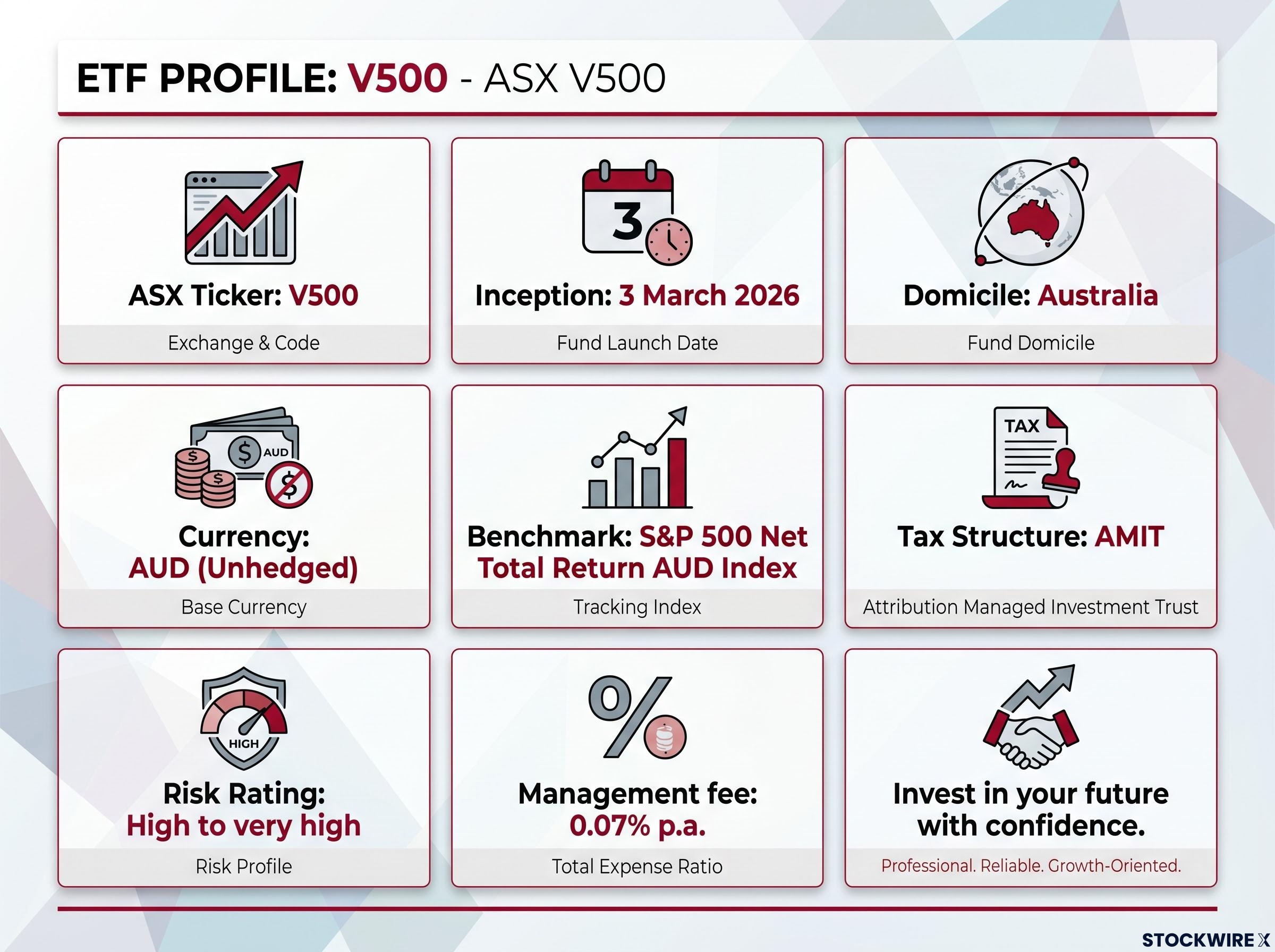
- ASX ticker: V500
- Inception date: 3 March 2026
- Domicile: Australia
- Listed and base currency: AUD
- Benchmark: S&P 500 Net Total Return AUD Index
- Tax structure: AMIT (Attribution Managed Investment Trust)
- Currency exposure: Unhedged (AUD/USD movements embedded in returns)
- Vanguard risk rating: High to very high
How investors access V500 on the ASX
Units are bought and sold like any other ASX-listed share. Investors can trade through an existing broker or directly via Vanguard’s Personal Investor platform. Because V500 is denominated in AUD, there is no need to open a US trading account or arrange currency conversion at the point of purchase or sale.
This structural simplicity is one reason the product appeals to Australian retail investors. However, the AUD denomination does not eliminate currency risk; it simply means the AUD/USD exchange rate is embedded in the fund’s returns rather than managed separately by the investor.
When big ASX news breaks, our subscribers know first
A closer look at the 500 companies inside the fund
V500 holds approximately 500-503 large US companies spanning all major sectors, covering roughly 80% of the US sharemarket by capitalisation. On the surface, that breadth looks like substantial diversification, and in many respects it is. The fund provides exposure to technology, healthcare, financials, consumer retail, and resources in a single holding.
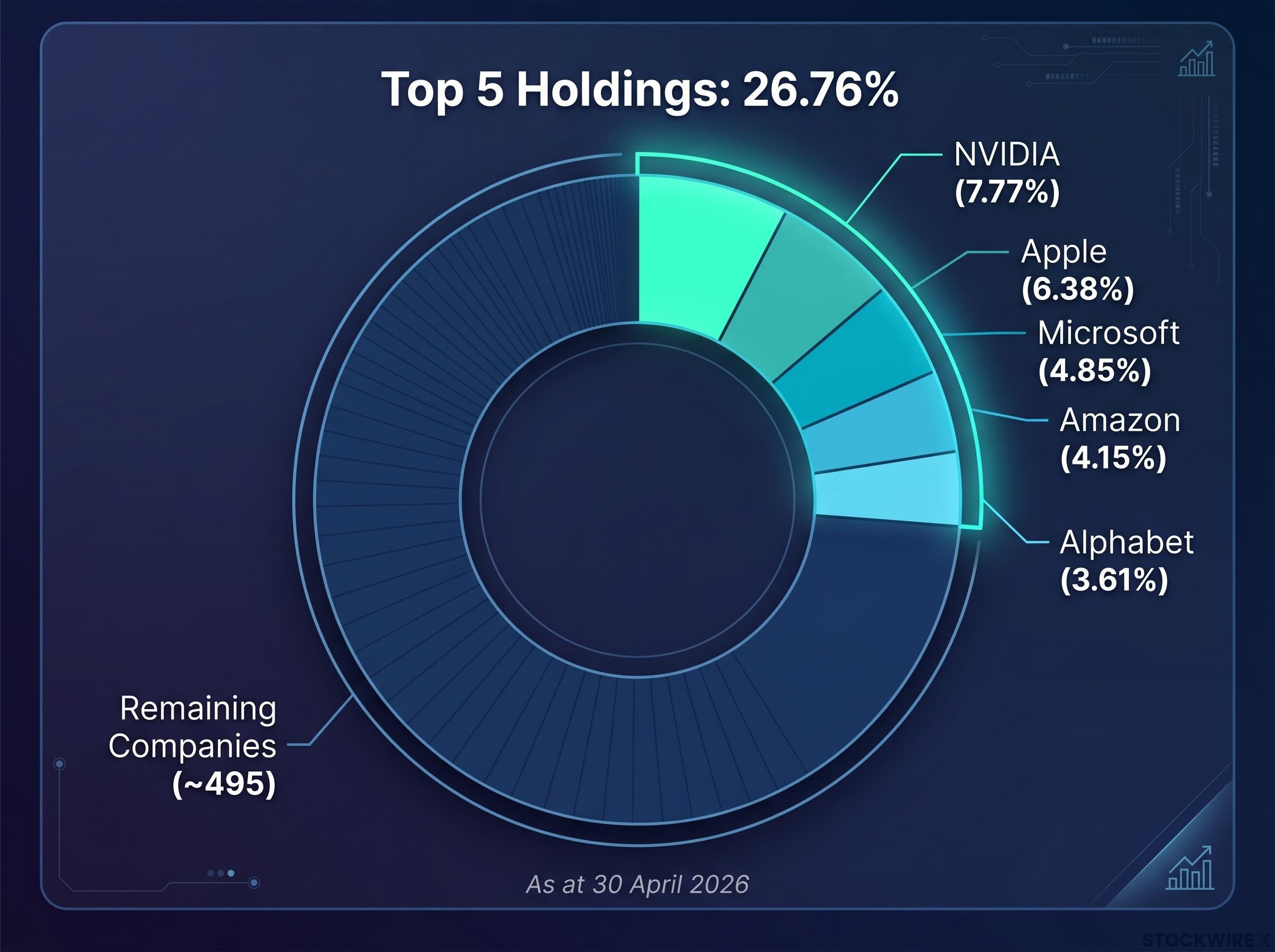
The picture narrows at the top. As at 30 April 2026, the five largest positions accounted for approximately 26.76% of net assets:
| Company | Weight (% of net assets) |
|---|---|
| NVIDIA | 7.77% |
| Apple | 6.38% |
| Microsoft | 4.85% |
| Amazon | 4.15% |
| Alphabet | 3.61% |
All five are mega-cap technology or tech-adjacent names. The fund’s performance is more heavily influenced by this cluster than the raw 500-company count implies.
For Australian investors, the sector mix is where V500 adds the most structural value. The ASX is dominated by banks and miners; V500 fills sectors that are substantially under-represented domestically:
- Technology: Cloud computing, AI, software, digital advertising, and data infrastructure (Microsoft, Apple, NVIDIA, Alphabet)
- Financials: Large-scale lending, payments, capital markets, and corporate banking (JPMorgan Chase, Bank of America)
- Healthcare: Pharmaceuticals, medical products, and health services driven by ageing populations (Eli Lilly, Johnson & Johnson, UnitedHealth)
- Consumer retail: Businesses with significant scale and logistics infrastructure (Amazon, Walmart, Costco)
- Food and beverage: Globally recognised brands with recurring consumer demand (Coca-Cola, Starbucks, McDonald’s)
- Resources and materials: Copper, gold, and raw materials exposure (Freeport-McMoRan, Newmont)
The breadth is real, but the effective risk concentration sits with US mega-cap technology. Investors should understand both dimensions before treating V500 as broadly diversified on the basis of its company count alone.
The fee structure and why it matters over time
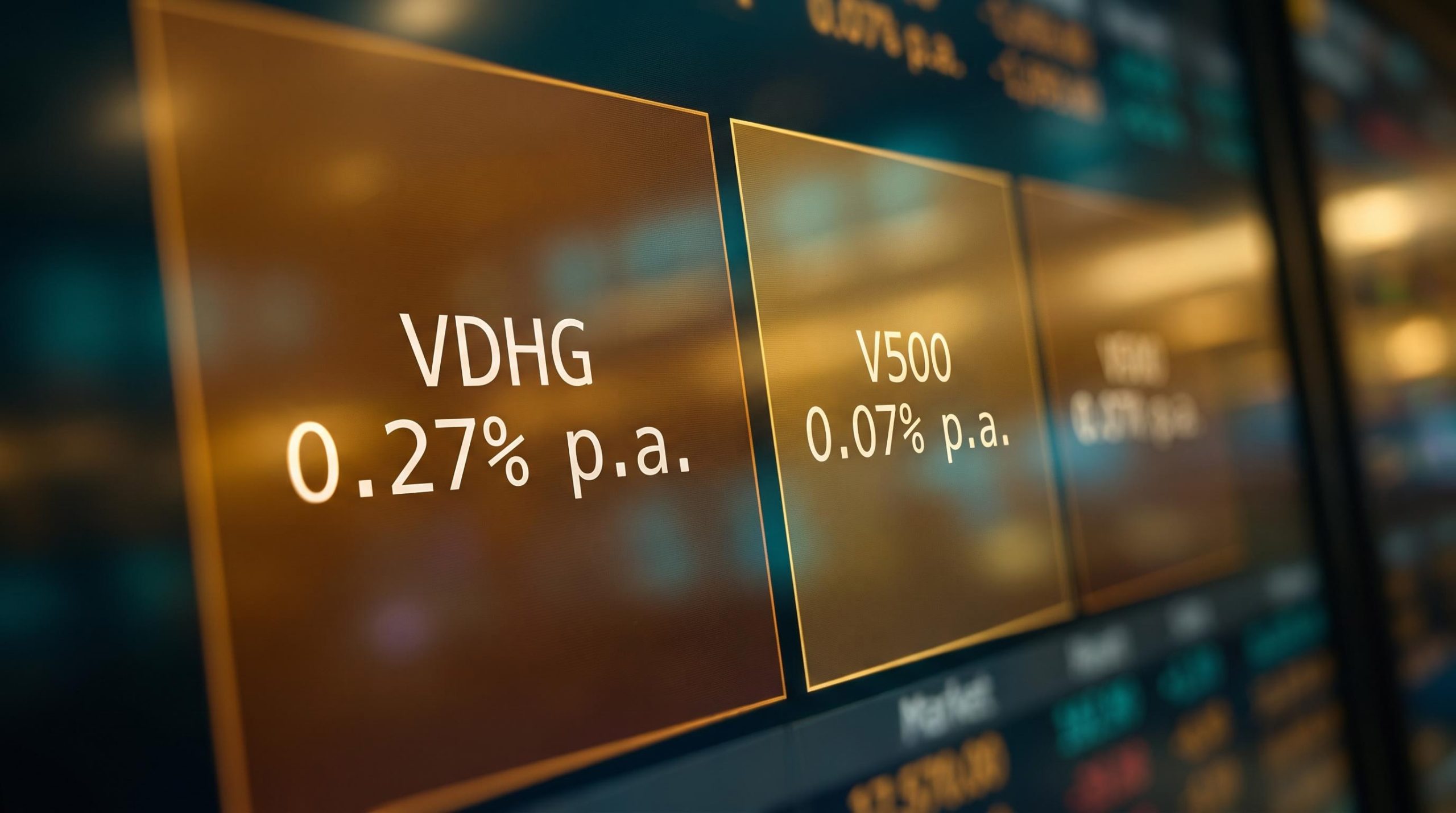
Management fee: 0.07% p.a. With zero disclosed indirect costs and zero net transaction costs, V500 sits at the low end of the ASX-listed international ETF fee spectrum.
At 0.07% per annum, the all-in ongoing cost of V500 is effectively seven cents for every $100 invested each year. That headline number is low. What matters more is how the number behaves over time.
The compounding logic is straightforward: at a lower fee level, a greater share of each year’s return is retained inside the fund and reinvested. Over a long holding period, that retained amount itself generates returns. The S&P 500 has delivered an average annual return of approximately 10% over the very long term (a historical average, not a guarantee of future results). The difference between 0.07% and even moderately higher fee levels compounds into a meaningful dollar amount across a decade or more.
IVV (iShares S&P 500 ETF, ASX) is the most direct category competitor for Australian investors evaluating this fee tier. Both products track the same index; the comparison comes down to fee levels, fund size, and implementation details.
V500 versus V5AH: the hedging decision
Vanguard also lists V5AH (ASX), a hedged version of the same S&P 500 exposure. V500 is unhedged, meaning AUD/USD exchange rate movements are embedded in returns. V5AH aims to reduce that currency impact through hedging.
The choice between the two is a view on currency exposure, not a quality difference. Investors who expect the AUD to strengthen against the USD, or who simply want to isolate US equity returns from currency noise, may prefer V5AH. Those comfortable with, or deliberately seeking, currency exposure as part of their long-term return profile would lean toward V500.
The risks Australian investors need to price in before buying
Every ETF carries risk. What matters for a buying decision is understanding the specific risks that apply to this product held by an Australian investor.
Vanguard risk rating: High to very high. Large drawdowns and extended periods of underperformance are an expected feature, not an anomaly, for growth-oriented equity funds.
The four risk categories worth pricing in:
- Currency risk: This is the risk most Australian retail investors overlook. V500 is unhedged, so AUD appreciation against the USD directly reduces AUD-denominated returns, all else being equal. Conversely, AUD depreciation boosts returns. Domestic equities do not carry this dynamic, and investors accustomed to ASX-only portfolios may find currency-driven performance swings unfamiliar.
- Equity and volatility risk: V500 is almost entirely invested in growth assets. Vanguard rates the fund as high to very high risk. Significant short-to-medium-term drawdowns should be expected at various points in any long-term holding period. Past performance does not guarantee future results.
- Concentration risk: The risk operates on two layers. First, all holdings are US-listed companies, creating single-country exposure. A US-specific economic or market shock has an outsized impact. Second, the mega-cap technology weighting at the top of the index means performance is disproportionately driven by a small group of names. The top five holdings alone represent approximately 26.76% of net assets.
- Portfolio gap risk: V500 does not provide Australian equities (and therefore no franking credits), exposure to other developed or emerging markets, small or mid-cap US companies, or any defensive assets such as bonds or cash. Treating V500 as a complete portfolio leaves material gaps in diversification and income characteristics.
V500 launched on 3 March 2026, giving the ETF itself a short live track record. Investors are relying on the extensive historical record of the S&P 500 index and Vanguard’s ability to track it efficiently within an Australian-domiciled structure going forward.
Tax and structure considerations for Australian holders
V500’s Australian domicile means it is subject to Australian regulatory and tax frameworks. The key structural and tax points:
- AMIT structure: V500 operates as an Attribution Managed Investment Trust. This is a tax framework commonly used by Australian ETFs that allows income to be attributed to unitholders on an annual basis.
- Distribution taxability: Investors receive trust distributions (including dividends and foreign income) that are taxable in Australia in the year they are received.
- US withholding tax: For Australian-domiciled ETFs investing in US shares, withholding tax is typically handled at the fund level. Investors holding V500 in a standard account do not generally need to lodge personal US tax documents.
- No franking credits: Because the underlying holdings are US-listed companies, distributions do not carry Australian franking credits. This has material implications for investors in high tax brackets or those who rely on franking for yield enhancement.
How account type affects your tax position
The type of account used to hold V500 significantly affects the after-tax outcome. SMSFs, individual taxable accounts, and other structures each apply different effective tax rates to foreign income and capital gains distributions.
An investor holding V500 in an SMSF accumulation phase faces a different tax position from an individual holding the same units in a personal brokerage account. Investors should seek advice from a qualified tax adviser for their specific circumstances.
This section provides general information only and does not constitute personal tax advice.
Who V500 suits and how it fits into a broader portfolio
The clearest way to evaluate V500 is to match it against investor characteristics and portfolio context, not to weigh pros and cons in the abstract.
| V500 may suit you if… | V500 may not suit you if… |
|---|---|
| You have a long time horizon and can tolerate significant volatility | You have a short time horizon or low tolerance for market falls |
| You are comfortable with unhedged AUD/USD currency exposure | You want to minimise currency risk (consider V5AH instead) |
| You prefer passive, low-cost index exposure over active management | You primarily seek fully franked income from Australian companies |
| You already hold, or plan to build, complementary Australian and international positions | You want broader global diversification beyond the US alone (consider VGS) |
| Growth orientation is your priority and franking credits are not a primary consideration | You need defensive asset allocation including bonds or cash |
V500 is a portfolio building block, not a standalone solution. For a complete long-term allocation, it would typically sit alongside:
- Australian share ETFs for domestic exposure and franking credits
- Broader international equity funds covering Europe, Asia, and emerging markets (for example, VGS on the ASX provides developed market international exposure beyond the US)
- Fixed income or cash for defensive balance and risk management
V500 covers approximately 80% of the US sharemarket by capitalisation. That is comprehensive within the US, but geographically singular. Investors who want international developed market exposure beyond American equities may find VGS a more appropriate starting point, or a necessary complement.
The bottom line on V500 for Australian investors in 2026
V500 offers genuinely low-cost access to the world’s largest equity market through a single ASX trade. At 0.07% per annum, with broad sector exposure that fills the technology and healthcare gaps in most Australian portfolios, it addresses a real structural need for growth-oriented investors willing to accept unhedged currency exposure.
Two conditions need to hold for V500 to be the right product. The investor can tolerate high-to-very-high volatility over an extended holding period. And they are building V500 into a broader portfolio, not holding it as their only position.
For investors who have weighed the currency, concentration, and tax trade-offs and are satisfied with the fit, the next step is determining how V500 complements existing holdings across Australian equities, broader international markets, and defensive assets. Those uncertain about overall asset allocation should consult a qualified financial adviser before committing.
This article is for informational purposes only and should not be considered financial advice. Investors should conduct their own research and consult with financial professionals before making investment decisions. Past performance does not guarantee future results.