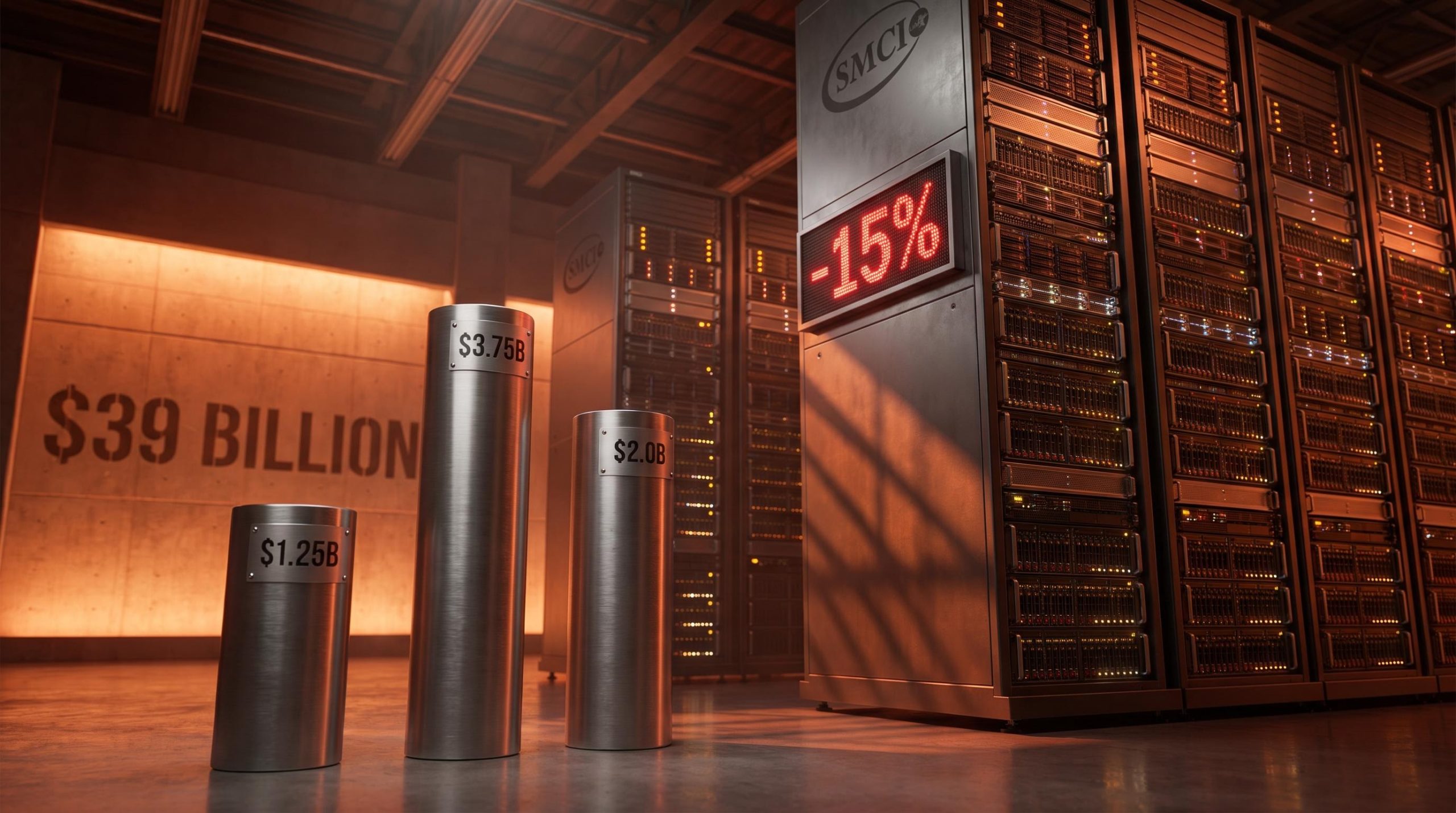
Super Micro Computer announced $7 billion in financing on 9 June 2026 to fund the fulfilment of $39 billion in AI server orders, and the market responded by selling the stock down more than 15% across two sessions. The reaction was not a contradiction. It was equity investors processing dilution mechanics, execution risk, and capital intensity in real time, repricing the stock for what the financing structure means for per-share economics over the next three years. What follows is a breakdown of exactly how the SMCI capital raise is structured, why investors repriced the stock despite a record backlog, and what this episode reveals about the financial realities confronting AI hardware companies throughout the current infrastructure build-out cycle.
Inside the $7 billion deal: three instruments, three dilution timelines
The financing is not one event. It is three separate mechanisms, each with a distinct dilution profile, certainty level, and timeline.
SMCI’s package consists of a $1.25 billion common stock offering, $3.75 billion in depositary shares tied to mandatory convertible preferred stock, and a $2.0 billion at-the-market (ATM) programme for future common stock sales.
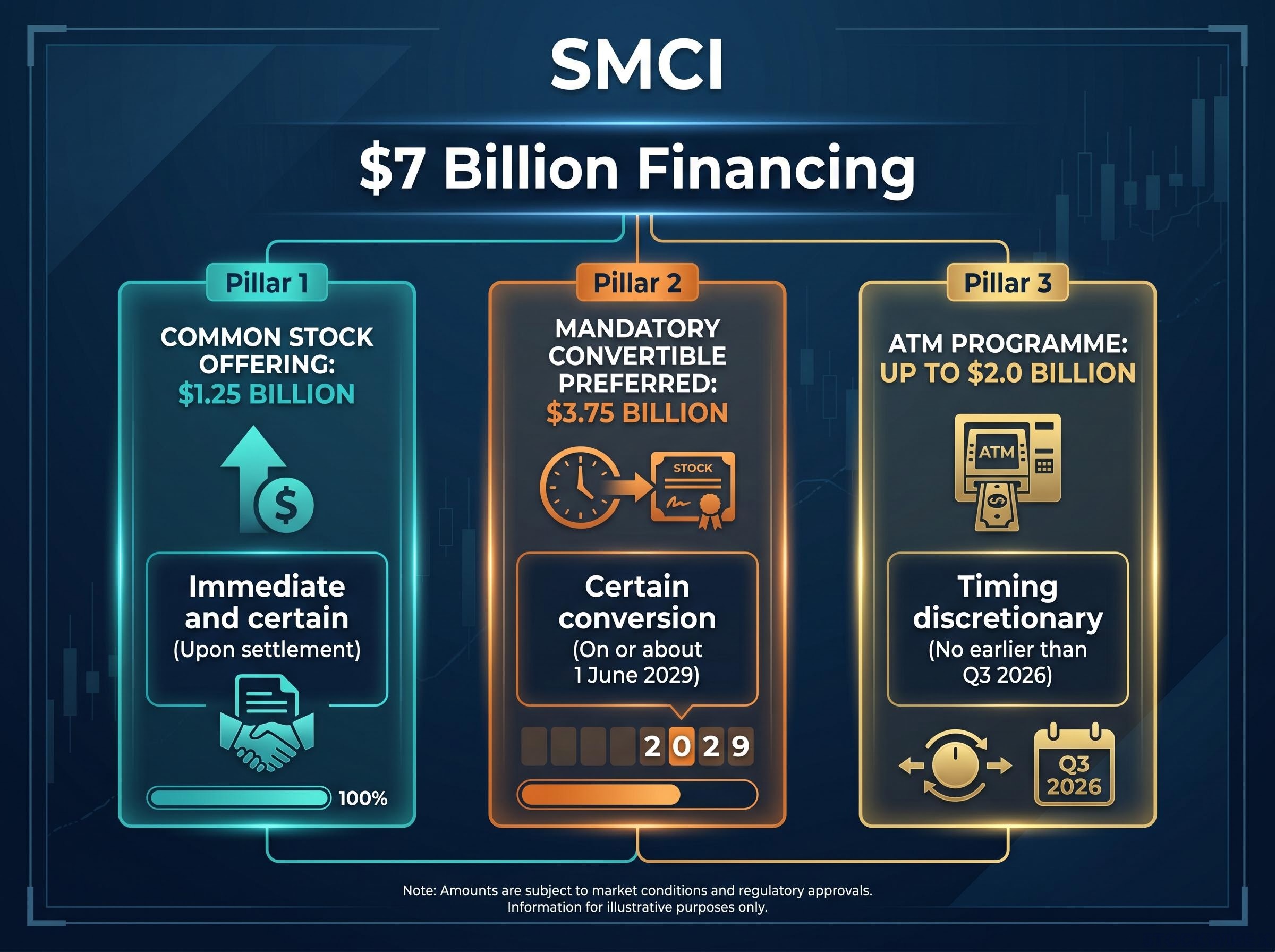
| Component | Amount | Dilution certainty | Timing |
|---|---|---|---|
| Common stock offering | $1.25 billion | Immediate and certain | Upon settlement |
| Mandatory convertible preferred | $3.75 billion | Certain conversion; only ratio uncertain | On or about 1 June 2029 |
| ATM programme | Up to $2.0 billion | Likely but timing discretionary | No earlier than Q3 2026, ongoing |
The mandatory convertible preferred is the instrument that warrants closest attention. Each depositary share represents 1/20th of a Series A preferred share carrying a $50 liquidation preference. The key structural features include:
- Automatic conversion into a variable number of common shares on or about 1 June 2029
- Conversion ratio tied to the common stock price at conversion, meaning the exact share count is unknown today
- Unlike optional convertibles, conversion is not contingent on the stock trading above a strike price; it is certain
The ATM programme compounds the overhang. It gives the company discretion to sell up to $2.0 billion in additional common stock into the open market whenever conditions are favourable. That discretion means investors must assume further dilution is probable, even if the timing remains uncertain.
Three mechanisms, three timelines, and a sustained dilution trajectory stretching to 2029. The market did not reprice for one moment of dilution. It repriced for three years of it.
When big ASX news breaks, our subscribers know first
Why a $39 billion backlog triggers a capital raise rather than a celebration
A $39 billion order book from more than 20 customers is, by any commercial measure, a powerful demand signal. The question the market asked on 9 June was not whether demand is real. It was how much that demand costs to capture.
“Fund the purchase of components to satisfy the AI orders,” including Data Center Building Block Solutions.
That language, from the company’s own disclosure, is direct: the proceeds are earmarked for component procurement, not generic corporate purposes.
The working-capital gap in AI hardware
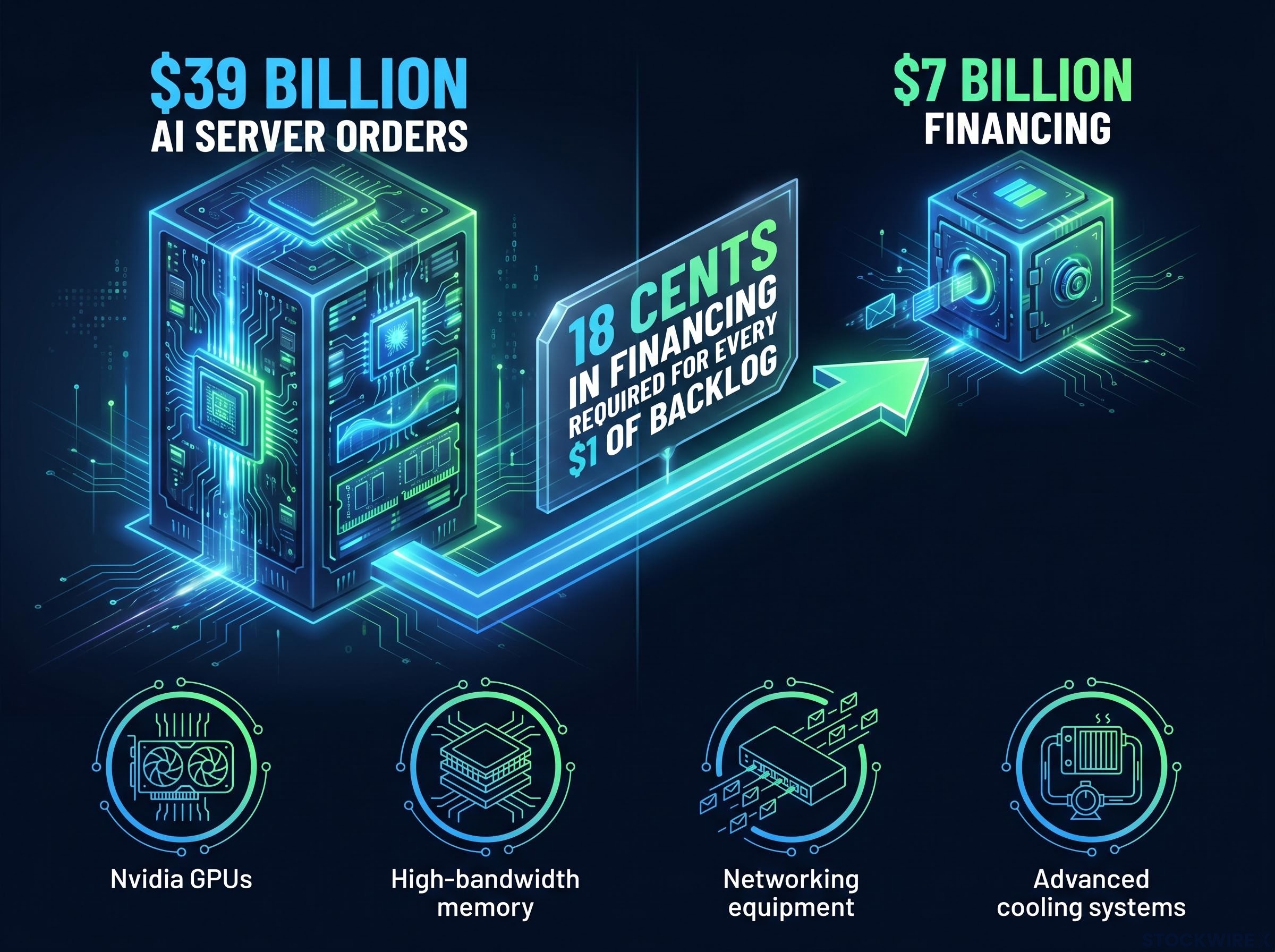
AI server manufacturing operates on a sequence that punishes the balance sheet before it rewards the income statement. Nvidia GPUs, high-bandwidth memory, networking equipment, and advanced cooling systems must be procured and paid for before customers are invoiced and cash is collected. Supply constraints on GPUs make early procurement both necessary and financially burdensome, compressing the window in which the company must deploy capital.
IDC worldwide server market data covering GPU server growth and component price dynamics across 2025-2027 confirms that supply constraints on high-value components like GPUs and high-bandwidth memory are a sector-wide condition, not an SMCI-specific procurement challenge.
The ratio embedded in this deal quantifies the burden: $7 billion raised to support $39 billion in orders. That translates to roughly 18 cents in financing required for every dollar of backlog. A record order book, in this context, is simultaneously proof of demand and a bill for cash. The two are inseparable.
The AI infrastructure build-out cycle that is forcing hardware manufacturers into repeated external capital raises has now pushed US IT spending to 4.9% of GDP in Q1 2026, surpassing both the dot-com era peak of approximately 4.2% and the cloud build-out peak of approximately 3.8%, a scale of investment that has no modern precedent and creates financing pressures across every company in the hardware supply chain.
How dilution math works against high-multiple stocks
The after-hours decline on 9 June reached approximately 8.78%, pushing shares to $37.07. By the close of the following session, the combined sell-off exceeded 15%. That magnitude appears disproportionate to the headline financing amount. The dilution mechanics specific to high-multiple stocks explain why.
The repricing followed a three-step sequence:
- Higher future share count marked in. The common offering, the mandatory convertible, and the anticipated ATM sales increase the denominator in every per-share metric, lowering earnings per share at any given net income level.
- Execution risk discounted. Converting a $39 billion backlog into profitable, cash-generating revenue involves procurement, manufacturing, and delivery risk across multiple quarters. That risk was priced into the equity.
- Multiple compression applied. A company that now clearly requires large, recurring external capital raises is perceived as riskier than one funded by internal cash flows. That perception commands a lower valuation multiple.
For high-multiple stocks, modest changes in per-share metrics produce outsized percentage movements in share price when the earnings multiple is held constant, or compresses due to increased perceived risk.
The mandatory convertible intensifies this dynamic. Unlike optional convertibles, where conversion is contingent on the stock exceeding a strike price, mandatory instruments pre-commit the equity issuance. The only open question is how many shares investors will receive for that $3.75 billion when conversion occurs in 2029. The dilution is not a possibility. It is a certainty with a variable attached.
The structural economics of AI hardware investment: a primer
The SMCI financing is a specific instance of a broader structural pattern. Understanding it requires a comparison between two very different positions in the AI value chain.
Hyperscalers, the companies commissioning AI data centres, fund their infrastructure spending from existing revenue streams. Microsoft, Alphabet, Amazon, and Meta share three characteristics that give them a funding advantage over hardware manufacturers:
- Recurring, high-margin software, cloud, and advertising revenue that generates substantial free cash flow
- Balance sheets with large existing cash reserves and low-cost debt capacity
- Capex spending that is discretionary and can be scaled to match internal cash generation
Why hardware companies cannot self-fund AI demand
Hardware manufacturers lack those recurring, high-margin revenue streams. Companies like SMCI operate in the capital-intensive, lower-margin portion of the value chain, assembling and delivering the physical servers that hyperscalers order. When demand surges, these manufacturers must raise external capital to seize it. That is not a sign of company-specific distress. It is a structural feature of the sector’s economics.
AI supply chain economics are structured so that margin and pricing power concentrate in the semiconductor and foundry layers, with TSMC and SK Hynix retaining structural leverage because every AI chip, whether custom or third-party, depends on the same fabrication and high-bandwidth memory ecosystem, leaving server assemblers like SMCI in the capital-intensive, lower-margin segment that must raise external financing whenever demand accelerates.
This produces a recognisable investment cycle:
- Large orders and backlogs are announced, signalling strong demand
- Large, often dilutive capital raises follow to fund component procurement and capacity
- Share prices reprice as equity holders adjust for dilution and execution risk
- Long-term differentiation depends on actual returns on invested capital and per-share value creation over the fulfilment period
The test for equity holders remains constant across all AI hardware names: EPS and free cash flow per share must grow faster than the dilutive impact of whatever financing mechanisms the company deploys. Strong demand is necessary but not sufficient. The financing method directly determines how much economic value accrues to existing shareholders.
What SMCI investors should track from here
The analytical framework above translates into a specific set of variables that investors holding or evaluating SMCI can monitor as the $39 billion backlog converts into revenue over the coming quarters.
- Gross margin trajectory. The primary indicator of whether the capital raise generates adequate returns. Margin compression on AI server orders would directly erode the economic payoff from the $7 billion in financing.
- Backlog conversion pace. How quickly the $39 billion in orders translates into recognised revenue and cash. Delays would extend heavy working-capital usage and increase liquidity risk.
- Share count evolution. Track issuance across all three mechanisms: the $1.25 billion common offering (immediate), the $2.0 billion ATM (Q3 2026 onward), and the $3.75 billion mandatory conversion (on or about 1 June 2029). Comparing EPS growth against net income growth isolates how much business improvement is being absorbed by dilution.
- Competitive dynamics and customer concentration. More than 20 customers underpin the backlog. Changes in customer mix, or shifts in design wins and losses, will shape both pricing power and volume.
- Free cash flow versus accounting earnings. During heavy inventory-build phases, these two figures can diverge significantly. A company reporting strong net income while burning cash on component procurement can still face financing stress.
- Capital structure sustainability. Whether the financial burden of AI infrastructure expansion remains manageable over multiple cycles is an open question as of June 2026.
Inference cost sustainability is the demand-side variable that the SMCI backlog analysis does not yet resolve; if escalating inference costs make generative AI applications structurally unprofitable for hyperscalers, the capital expenditure programmes underpinning the $39 billion order book could decelerate faster than a three-year dilution schedule can adapt to, creating a scenario where share count expansion and revenue contraction compound simultaneously.
The central analytical question for SMCI equity holders: does the return on the $7 billion raised, once filtered through dilution and execution risk, justify owning the equity at the new, lower per-share economics?
This article is for informational purposes only and should not be considered financial advice. Investors should conduct their own research and consult with financial professionals before making investment decisions.
Strong demand, diluted returns: the lens that matters for AI hardware equity
The market’s reaction to SMCI’s financing was not a rejection of AI demand. The $39 billion backlog confirms that demand is real and substantial. The sell-off was a rational repricing for the dilution, execution risk, and capital intensity required to capture that demand.
The broader implication extends well beyond a single company. For every AI hardware equity, the question that determines shareholder value is not whether orders are growing. It is whether the financing required to fulfil those orders leaves enough per-share economics for existing shareholders after the capital costs are absorbed.
SMCI’s execution over the next several quarters will begin to answer that question. Gross margins, backlog conversion, and share count evolution will collectively reveal whether the $7 billion raise was a sound capital allocation decision or an expensive dilutive event that transferred value from existing shareholders to the company’s growth ambitions. The data will arrive quarter by quarter. The framework for evaluating it is already clear.
Investors wanting to translate this analysis into a structured portfolio position will find our dedicated guide to AI infrastructure stock allocation useful; it walks through a three-layer framework spanning hardware, cloud, and software with specific weighting rationale for each layer, including the valuation and execution risks that make hardware-layer positions like SMCI the highest-risk, highest-conviction segment of any AI equity portfolio.
Past performance does not guarantee future results. Financial projections are subject to market conditions and various risk factors.