Marvell Technology Surges 22% on Nvidia CEO’s Trillion-Dollar Call
5 hrs ago

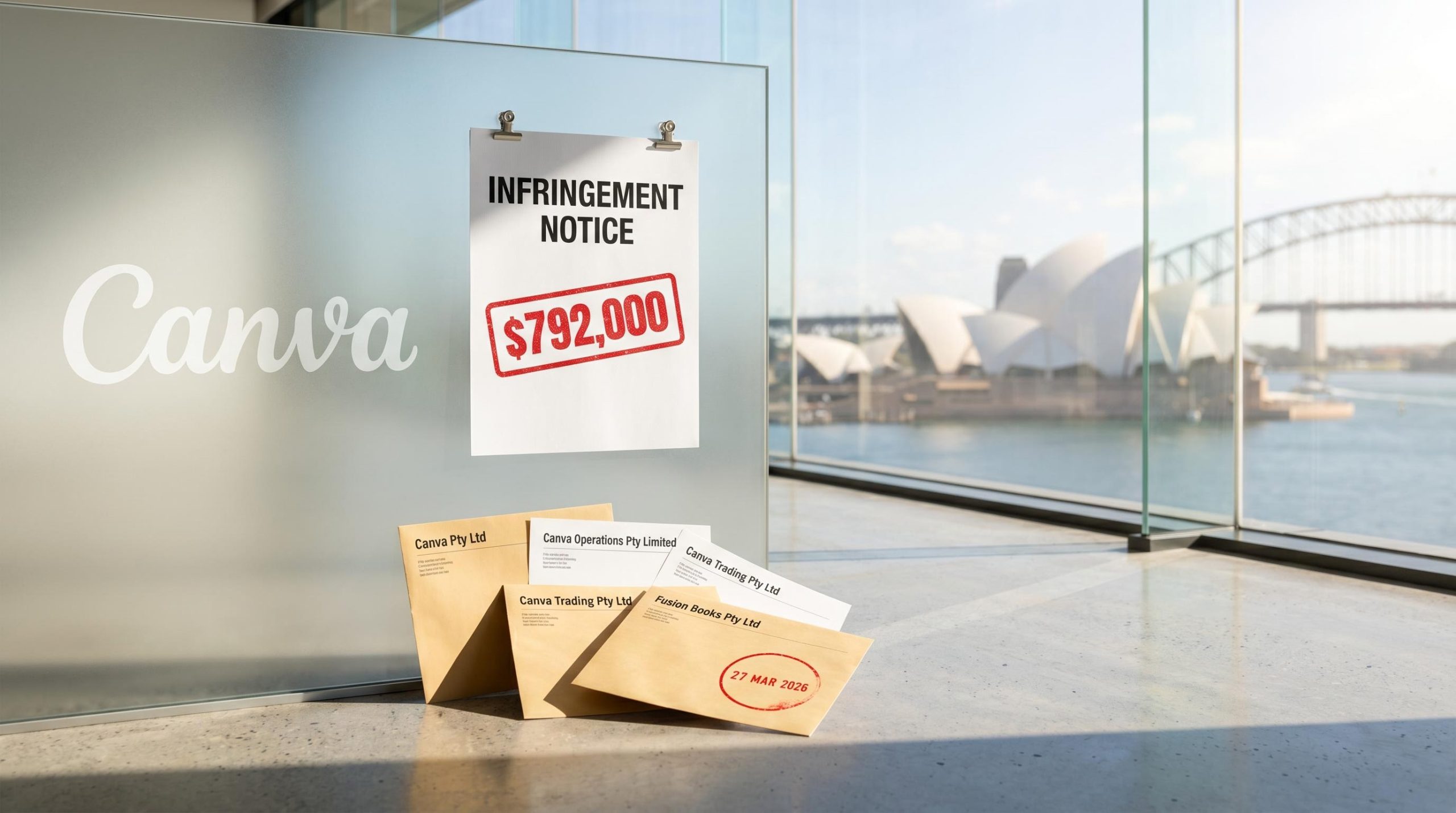
Four subsidiaries of one of Australia’s most valuable private companies have been fined a combined $792,000 by the Australian Securities and Investments Commission (ASIC) for missing a statutory financial reporting deadline by nearly 11 months. ASIC issued four separate infringement notices, each worth $198,000, against Canva Group entities for failing to lodge their FY24 financial reports by the required 30 April 2025 deadline. The consolidated report was not filed until 27 March 2026. What follows is a breakdown of the entities penalised, the timeline of non-compliance, the legal character of the enforcement action, and what the penalty signals about ASIC’s expectations for large private companies.
ASIC’s action was not a single grouped fine. It was four individual infringement notices, each targeting a distinct corporate entity within the Australian Canva Group. The four entities penalised are:
All four operate under the Australian Canva Group umbrella. The financial year in question ended 31 December 2024, with a statutory lodgement deadline of 30 April 2025. Each entity received an identical $198,000 infringement notice, bringing the combined total to $792,000.
| Entity Name | Fine Amount | Financial Year | Lodgement Deadline |
|---|---|---|---|
| Canva Pty Ltd | $198,000 | Ending 31 December 2024 | 30 April 2025 |
| Canva Operations Pty Limited | $198,000 | Ending 31 December 2024 | 30 April 2025 |
| Canva Trading Pty Ltd | $198,000 | Ending 31 December 2024 | 30 April 2025 |
| Fusion Books Pty Ltd | $198,000 | Ending 31 December 2024 | 30 April 2025 |
Each infringement notice is recorded individually on ASIC’s public Infringement Notices Register, creating a separate compliance footprint for every entity named.
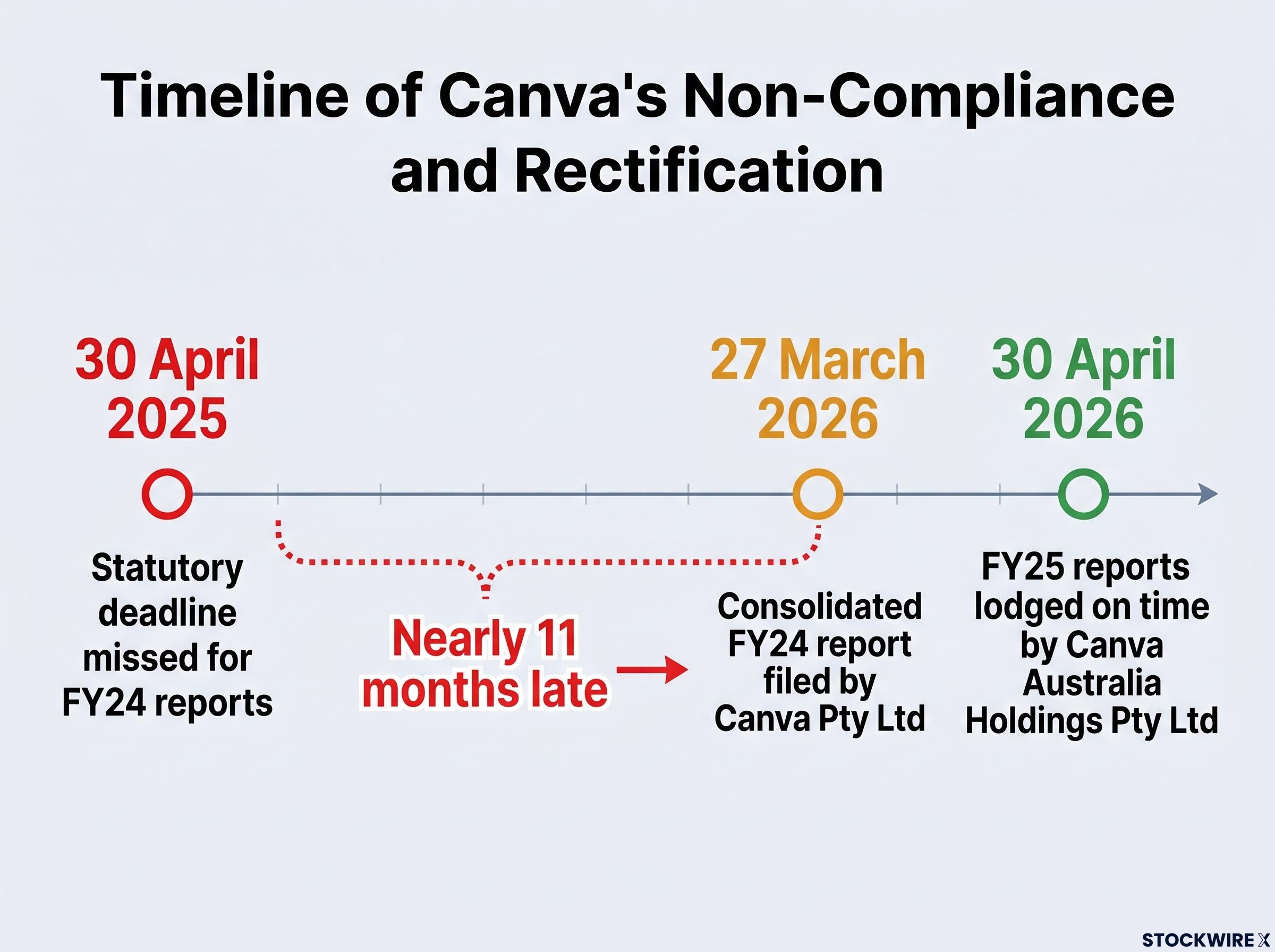
The gap between deadline and actual lodgement tells the story plainly. Three dates define the sequence:
The FY25 filing came through a different reporting entity. Following a corporate restructure, the Australian Canva Group now reports through Canva Australia Holdings Pty Ltd for the financial year ending 31 December 2025. The on-time FY25 lodgement suggests the group has since addressed the compliance failure that triggered the ASIC action, though the infringement notices for FY24 stand regardless.
An infringement notice is a civil regulatory tool, not a criminal charge. ASIC uses these notices to enforce compliance with statutory obligations such as financial reporting deadlines, and they sit within a broader enforcement toolkit that also includes civil penalty proceedings and enforceable undertakings.
The distinction that matters most: settling an infringement notice is not an admission of fault or liability. The paying entity is not considered to have been convicted of the alleged offence.
Payment of an ASIC infringement notice does not constitute an admission of guilt, and the paying entity is not treated as having been convicted of the alleged offence. The details underpinning ASIC’s concerns are recorded on the publicly available Infringement Notices Register.
For readers interpreting this action, the penalty carries a compliance consequence and a public record, but it does not carry the legal weight of a court finding or conviction. The infringement notice mechanism is designed to resolve lower-level statutory breaches without the cost and duration of litigation while still creating a tangible financial and reputational consequence.
For readers wanting to understand how ASIC’s civil enforcement mechanisms sit alongside criminal proceedings and court-ordered penalties, our full explainer on ASIC’s corporate disclosure enforcement toolkit covers the Corporations Act provisions, the personal liability exposure now facing individual executives, and the practical timeline from regulatory awareness through to formal action.
ASIC infringement notices for financial reporting failures issued to large proprietary companies operate under the same framework applied here: payment resolves the regulatory action without constituting a conviction, and the grounds for ASIC’s concern are recorded on the publicly available Infringement Notices Register.
The combined $792,000 penalty lands differently when placed against Canva’s reported scale.
According to the Australian Financial Review, secondary share transactions in 2024 valued Canva at approximately US$26 billion (roughly A$40 billion at the time). An earlier 2021 fundraising round, widely covered by the Australian Financial Review, The Australian, and global business media, placed the valuation at approximately US$40 billion.
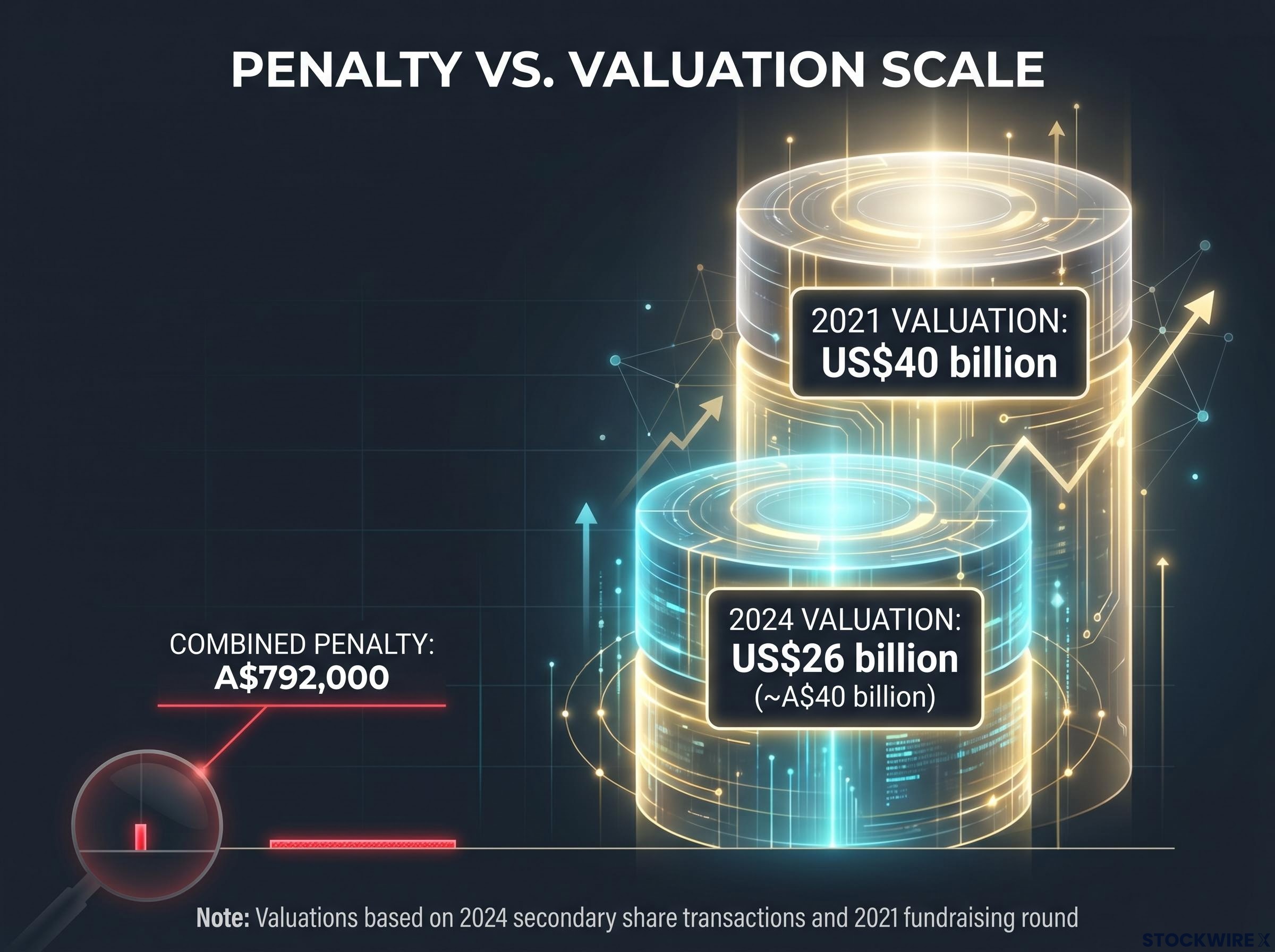
A combined A$792,000 penalty against a company most recently valued at approximately US$26 billion represents a fraction of a fraction of a single day’s imputed revenue at that scale.
The numbers raise an open policy question: whether current infringement notice penalty levels provide meaningful financial deterrence for Australia’s largest private companies. This is not a question specific to Canva; it applies to any entity whose scale dwarfs the maximum infringement notice amount ASIC can issue under existing legislation. General commentary on ASIC’s enforcement toolkit in 2025-2026, published across Australian legal bulletins and governance institute material, has noted this proportionality consideration for significant private entities, even where no commentator has tied it explicitly to this case.
The penalty proportionality debate is not unique to this case; the $35 million civil penalty imposed on Macquarie Securities in March 2026 for systemic short sale misreporting attracted identical commentary, with critics noting the figure was financially immaterial to a firm of Macquarie’s scale while regulators pointed to court declarations and mandatory independent reviews as delivering deterrence beyond the headline number.
The enforcement action fits within ASIC’s broader posture in 2025-2026, which has emphasised that significant entities, including large private companies, are expected to meet financial reporting obligations with the same rigour as listed entities.
This stance has sharpened since the banking Royal Commission, which introduced a “why not litigate?” philosophy into Australian regulatory enforcement. Commentary across Australian legal and governance publications has documented how that philosophy has influenced ASIC’s willingness to deploy its full toolkit, from infringement notices through to civil penalty proceedings, across market misconduct, disclosure failures, and governance breaches by major entities.
Financial reporting non-lodgement has become an explicit 2026 regulatory priority for ASIC, running parallel enforcement pathways that include court proceedings against listed companies and infringement notices against large proprietary companies, with a December 2025 surveillance programme covering 217 companies producing over $2.2 million in notices to 12 entities alone.
No public statement from Canva responding to the ASIC infringement notices has been identified as of 2 June 2026. The details underpinning ASIC’s concerns remain accessible via the Infringement Notices Register. For other large private companies tracking this action, the signal is straightforward: statutory reporting deadlines apply regardless of a company’s ownership structure or stage of corporate development.
Four entities penalised. $792,000 in combined infringement notices. A consolidated FY24 report filed nearly 11 months late, followed by an on-time FY25 lodgement under a restructured reporting entity.
The infringement notices do not constitute convictions. They appear on the public ASIC register. No Canva public response has been identified. The deterrence question, whether a penalty at this level creates meaningful compliance incentive for a company valued in the tens of billions, remains a live policy consideration rather than one this enforcement action resolves.
What the episode does establish is a clear public record: ASIC applied its enforcement toolkit to one of Australia’s highest-profile private companies, and the compliance gap it identified was substantial.
This article is for informational purposes only and should not be considered financial advice. Investors should conduct their own research and consult with financial professionals before making investment decisions.
An ASIC infringement notice is a civil regulatory tool used to enforce compliance with statutory obligations such as financial reporting deadlines. Paying an infringement notice does not constitute an admission of guilt or a criminal conviction, but the details are recorded on ASIC's publicly available Infringement Notices Register.
Four Canva Group subsidiaries, Canva Pty Ltd, Canva Operations Pty Limited, Canva Trading Pty Ltd, and Fusion Books Pty Ltd, each received a $198,000 infringement notice from ASIC for failing to lodge their FY24 financial reports by the 30 April 2025 statutory deadline. The consolidated report was not filed until 27 March 2026, nearly 11 months late.
The combined Canva ASIC fine totalled $792,000, comprising four separate $198,000 infringement notices issued individually to Canva Pty Ltd, Canva Operations Pty Limited, Canva Trading Pty Ltd, and Fusion Books Pty Ltd.
Yes, large proprietary companies in Australia are subject to statutory financial reporting obligations under the Corporations Act, and ASIC's recent enforcement posture has emphasised that significant private entities are expected to meet these deadlines with the same rigour as ASX-listed companies.
Following a corporate restructure, Canva Australia Holdings Pty Ltd lodged its FY25 financial reports on time by 30 April 2026, suggesting the group addressed the compliance failure that triggered the ASIC action, though the infringement notices for FY24 remain on the public register.