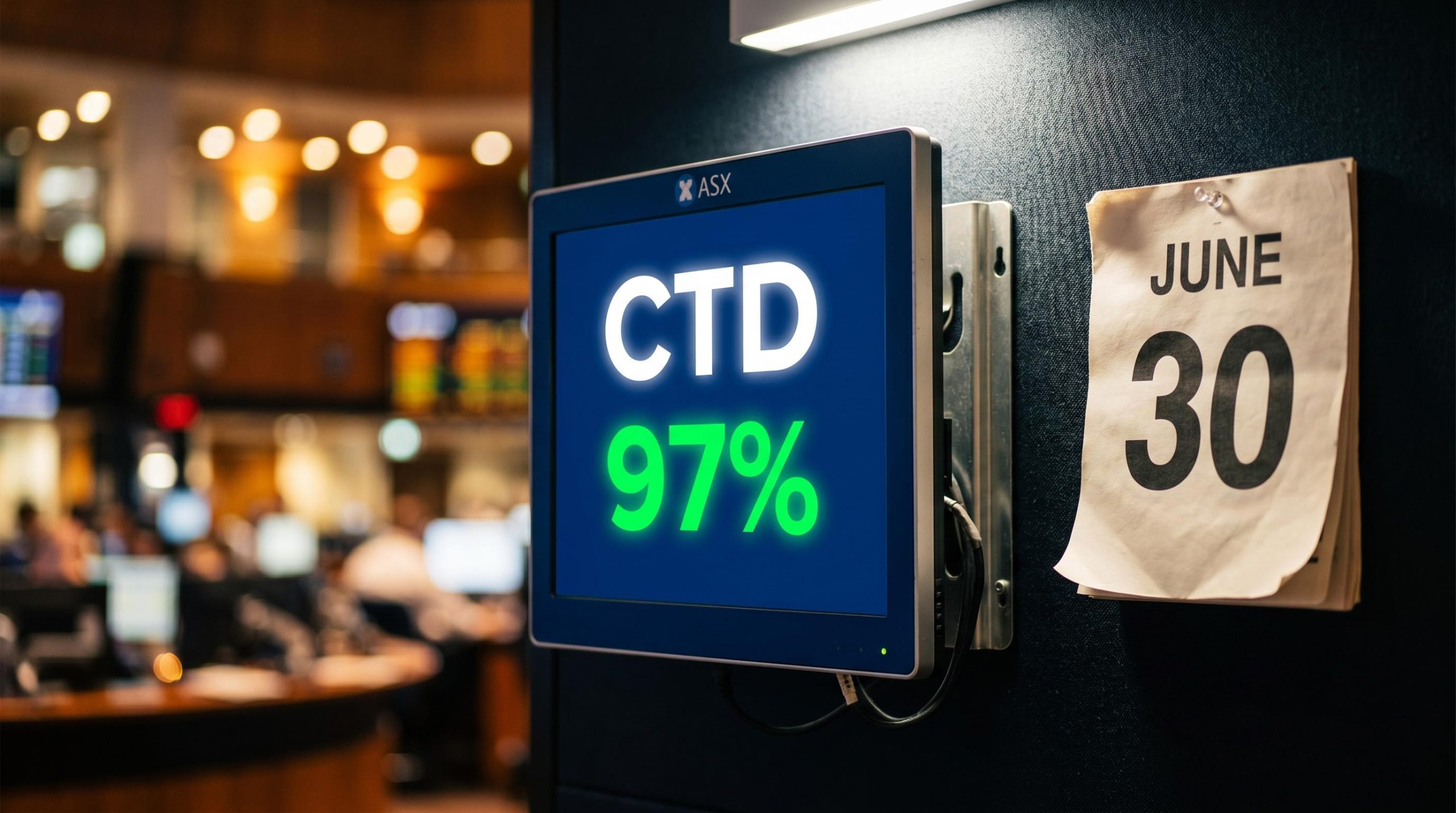
Corporate Travel Management disclosed on 1 June 2026 that it is in the final stages of documenting structured refund agreements with UK customers, is targeting a return to ASX trading by 30 June 2026, and has retained more than 97% of its global client base during the 2025-2026 financial year. The announcement represents the most substantive public update the company has issued since its shares were suspended from trading, covering the UK remediation programme, the path to reinstating its ASX listing, and evidence that the underlying business has continued to operate through the crisis. What follows breaks down each of the three disclosures: what the phased UK refund structure means for the balance sheet, what the retention figure signals about business health, and what must happen before shareholders can trade again.
CTD’s trading suspension and what shareholders have been waiting for
CTD shares have been suspended from ASX trading pending the release of overdue audited financial statements, a process that has been held open because the company could not finalise the quantum of its UK customer refund obligations. For shareholders who have been locked into their positions with no ability to trade, the 1 June 2026 announcement offers the first concrete timeline for a return to the market.
The company has set 30 June 2026 as its target date for releasing both audited FY25 financial statements and reviewed FY26 first-half financial statements. Trading reinstatement is contingent on clearing two conditions:
ASX Listing Rule 17.3 suspension conditions specify the grounds on which the exchange may suspend a company’s securities from trading, with reinstatement under Rule 17.7 requiring the company to satisfy all outstanding compliance obligations, including the lodgement of overdue financial statements and exchange approval.
- Release of the audited FY25 and reviewed FY26 H1 financial statements
- Securing all required approvals from relevant parties, including the ASX
The language throughout the announcement described reinstatement as “subject to” completing these processes, a qualification that matters.
Why the financial statements have been delayed
The audit has remained open because the UK refund liability cannot be accurately booked until commercial agreements with affected customers are finalised. Those agreements set the quantum. Until the number is agreed, the auditor cannot sign off, and until the auditor signs off, the financial statements cannot be released. The 30 June 2026 target implies both the UK agreements and the audit are expected to reach completion within the same four-week window, a compressed timeline that leaves limited margin.
When big ASX news breaks, our subscribers know first
Understanding the UK overcharging situation and why it triggered a crisis
A corporate travel overcharging event occurs when a travel management company bills clients above contractually agreed rates, creating a refund liability. In CTD’s case, the affected parties include key UK customers, among them the UK government. That detail matters: government contracts carry regulatory and reputational weight that elevates a commercial billing dispute into a more complex remediation exercise.
The difficulty is not in acknowledging the obligation but in quantifying it. Each affected customer relationship requires a separate commercial agreement setting out the scope of overcharging, the refund amount, and the payment terms. Until those agreements are signed, the liability remains an estimate rather than a booked figure, which is why the company’s auditors have been unable to complete the financial statements.
CTD described discussions with affected customers as aimed at resolving UK matters “in a thorough and equitable way.”
CTD has indicated that the refund programme will be funded through three sources:
- Existing cash holdings
- Future operational cashflows
- Engagement with lending partners
No quantum of the total refund obligation was disclosed in the 1 June 2026 announcement. The absence of a figure means retail investors cannot yet calculate the balance sheet impact, but the structure of the funding approach, particularly the lender engagement component, provides its own signal about scale.
CTD’s operational resilience through the crisis and what the 97% retention figure reveals
The number that reframes the narrative sits in a single line of the announcement: global client retention above 97%, measured across the period from 1 July 2025 to 31 May 2026. That eleven-month window covers the entire publicly visible phase of the UK remediation crisis. Clients who were going to leave over reputational concerns would likely have done so by now.
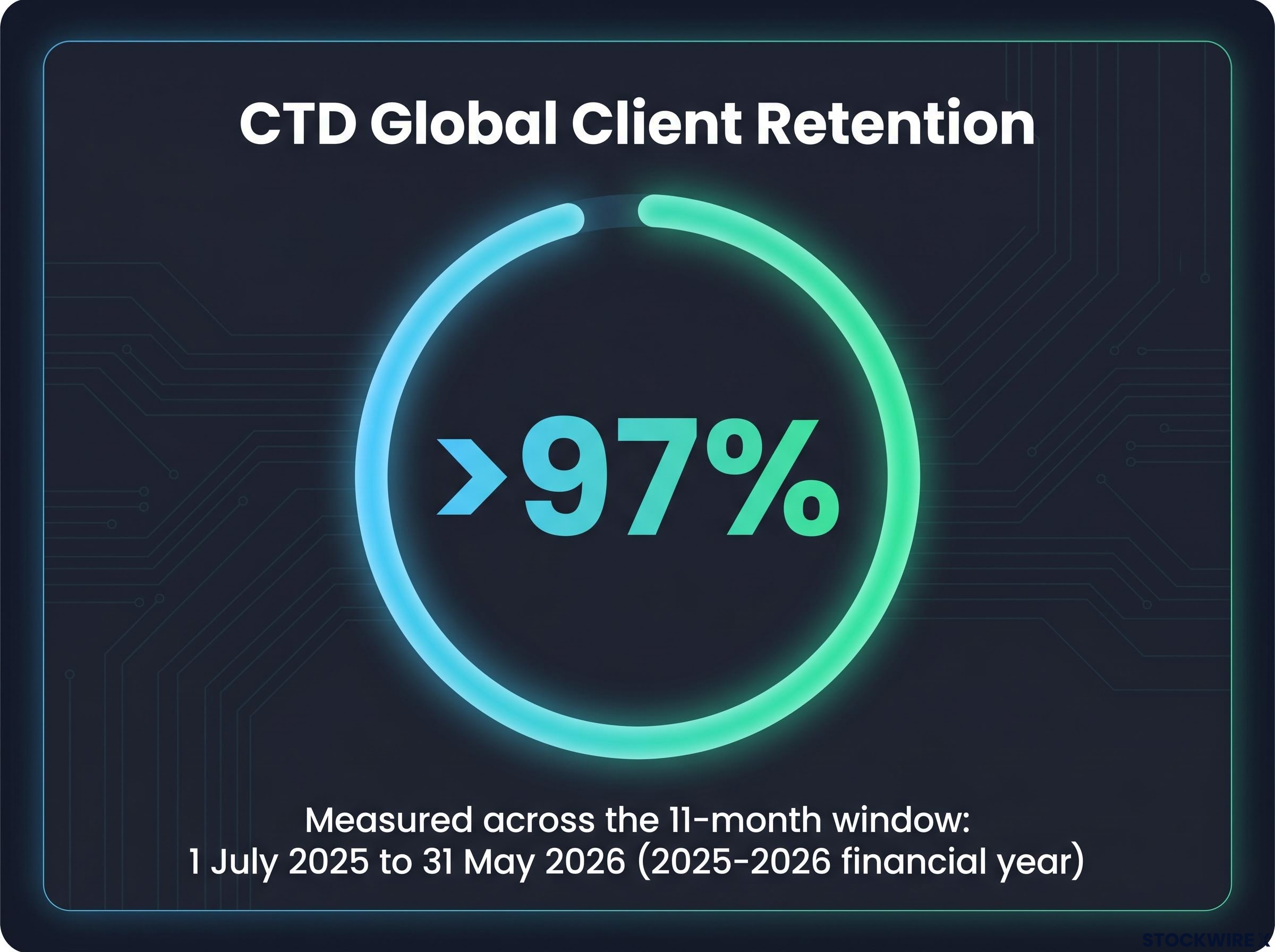
CTD characterised its global operations as resilient, with a continued focus on client support and delivery of travel programme value throughout the UK resolution process.
In a travel management company, client relationships are the primary revenue driver. Retention above 97% across an eleven-month crisis period suggests that service delivery, the day-to-day booking, compliance, and duty-of-care work that corporate clients pay for, has continued without material disruption.
What industry conditions mean for CTD’s recovery window
The broader operating environment provides a supportive backdrop. IBISWorld’s 2025 industry report on corporate travel services in Australia described continued recovery in corporate travel volumes, driven by improved business confidence and resumed demand for face-to-face meetings. Corporate clients are also placing greater emphasis on duty of care and travel risk management, dynamics that create natural switching costs and favour incumbent providers.
A structural shift toward cost-conscious, digitally mediated corporate travel programmes favours scale players with technology capabilities. If CTD returns to trading in an operationally sound state, it re-enters an industry with tailwinds rather than headwinds.
The corporate travel sector recovery is evidenced most clearly in Flight Centre Travel Group’s nine-month results to March 2026, which showed 23% corporate division profit growth on only 4% TTV growth, a margin expansion dynamic that reflects how strongly operating leverage has returned to the industry’s leading incumbents.
How CTD plans to fund the refund programme and what it means for the balance sheet
The three-part funding structure disclosed in the announcement carries more analytical weight than it may appear at first reading. Each source has a different risk profile.
| Funding Source | What It Signals |
|---|---|
| Existing cash holdings | Immediate liquidity is available, but the company has not stated it is sufficient alone |
| Future operational cashflows | Management expects the business to generate enough cash to service phased refund payments over time |
| Engagement with lending partners | Existing debt arrangements may require amendment or additional facility to accommodate the refund liability |
The lender engagement detail is the most material financial disclosure in this thread. CTD described itself as in “constructive dialogue” with lending partners regarding the proposed refund arrangements and associated funding needs. That language signals the refund liability may exceed what cash and operations alone can cover, and that the company’s existing debt covenants or facilities require active management through the resolution process.
CTD’s earlier UK remediation update, published in February 2026, reported $15 million already paid to impacted UK customers and disclosed an unaudited cash position of $121.2 million alongside a $140 million amended debt facility, figures that provide essential baseline context for reading the 1 June funding disclosures.
A further market update is planned once all relevant agreements have been completed. The sequence of steps before that update can be issued is:
- UK commercial agreements finalised with all affected customers
- Audit process completed with the refund liability booked
- Approvals secured from all required parties
- Market update released confirming completion
What happens next and what investors should watch
The 1 June 2026 announcement maps out a clear sequence of events between now and the targeted return to trading. Shareholders should track each milestone in order:
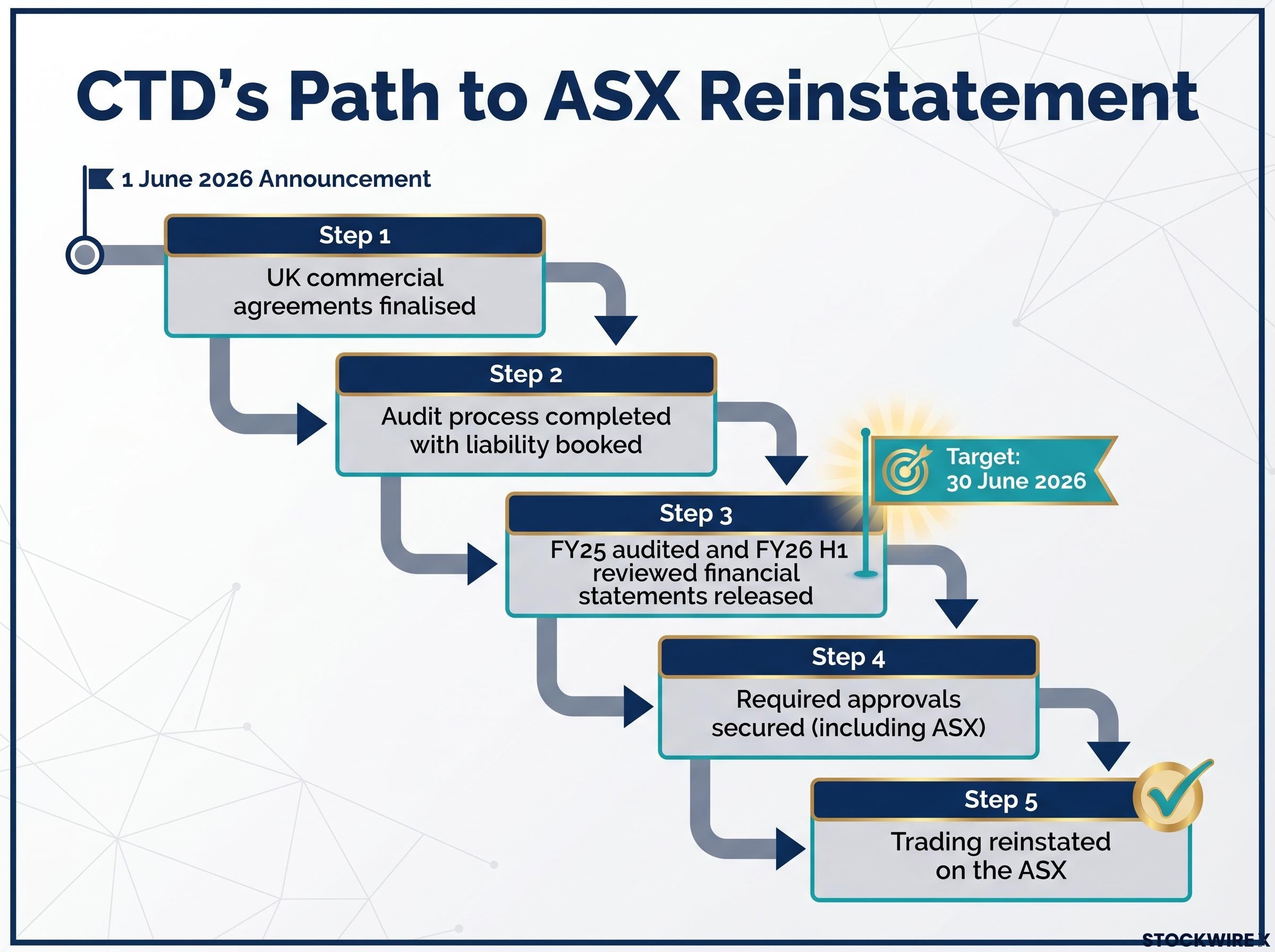
- UK commercial agreements finalised and announced via ASX update
- Audit process completed with the refund liability quantified and booked
- FY25 audited and FY26 H1 reviewed financial statements released (targeted by 30 June 2026)
- All required approvals secured
- Trading reinstated on the ASX
CTD has committed to issuing a further market update once all relevant agreements have been completed. That announcement, not the financial statements themselves, is the next material information event shareholders should watch for.
The 30 June 2026 target for financial statement release and trading reinstatement was described as “subject to completing financial reporting processes and securing all required approvals,” language that frames the date as aspirational rather than confirmed.
The gap between today and the end of June is four weeks. In that window, CTD must close commercial agreements with multiple UK customers, complete an audit that has been held open for months, and secure regulatory and exchange approvals. Each step is dependent on the one before it.
CTD is closer to resolution than at any point since the suspension began
The 1 June 2026 announcement represents measurable progress on the three dimensions that have kept the stock suspended: UK refund agreements are in final documentation, audited financial statements have a target release date, and the underlying business has demonstrably retained 97% of its client base through eleven months of uncertainty.
What remains unknown is substantial. The quantum of the UK refund liability has not been disclosed. The final terms of any lender arrangements are still being negotiated. Whether the 30 June targets will hold depends on a compressed sequence of steps, any one of which could introduce delay.
The next event to watch is CTD’s ASX announcement confirming that UK commercial agreements have been completed. That is the trigger for the final reporting and reinstatement sequence.
This article is for informational purposes only and should not be considered financial advice. Investors should conduct their own research and consult with financial professionals before making investment decisions. Forward-looking statements regarding CTD’s targeted reinstatement date and funding arrangements are subject to change based on the completion of commercial agreements, audit processes, and regulatory approvals.