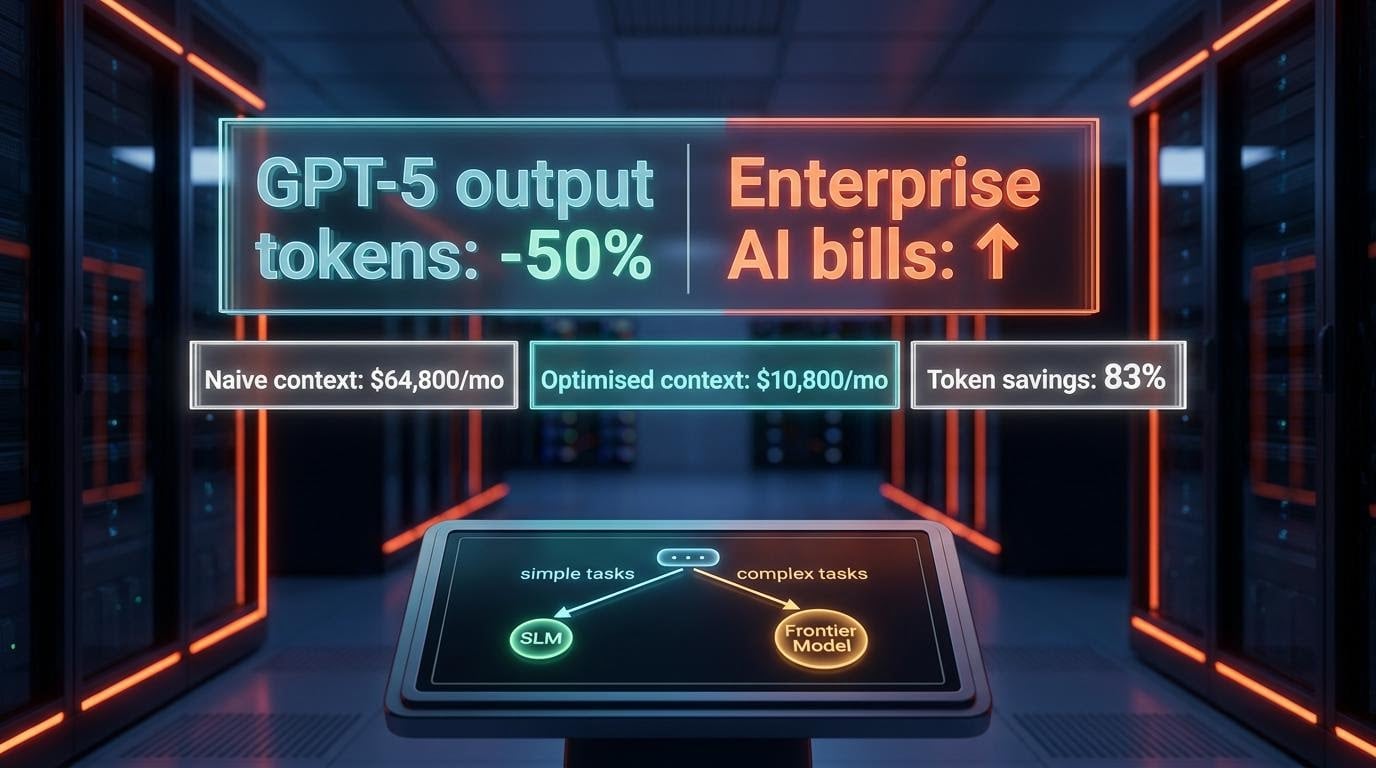
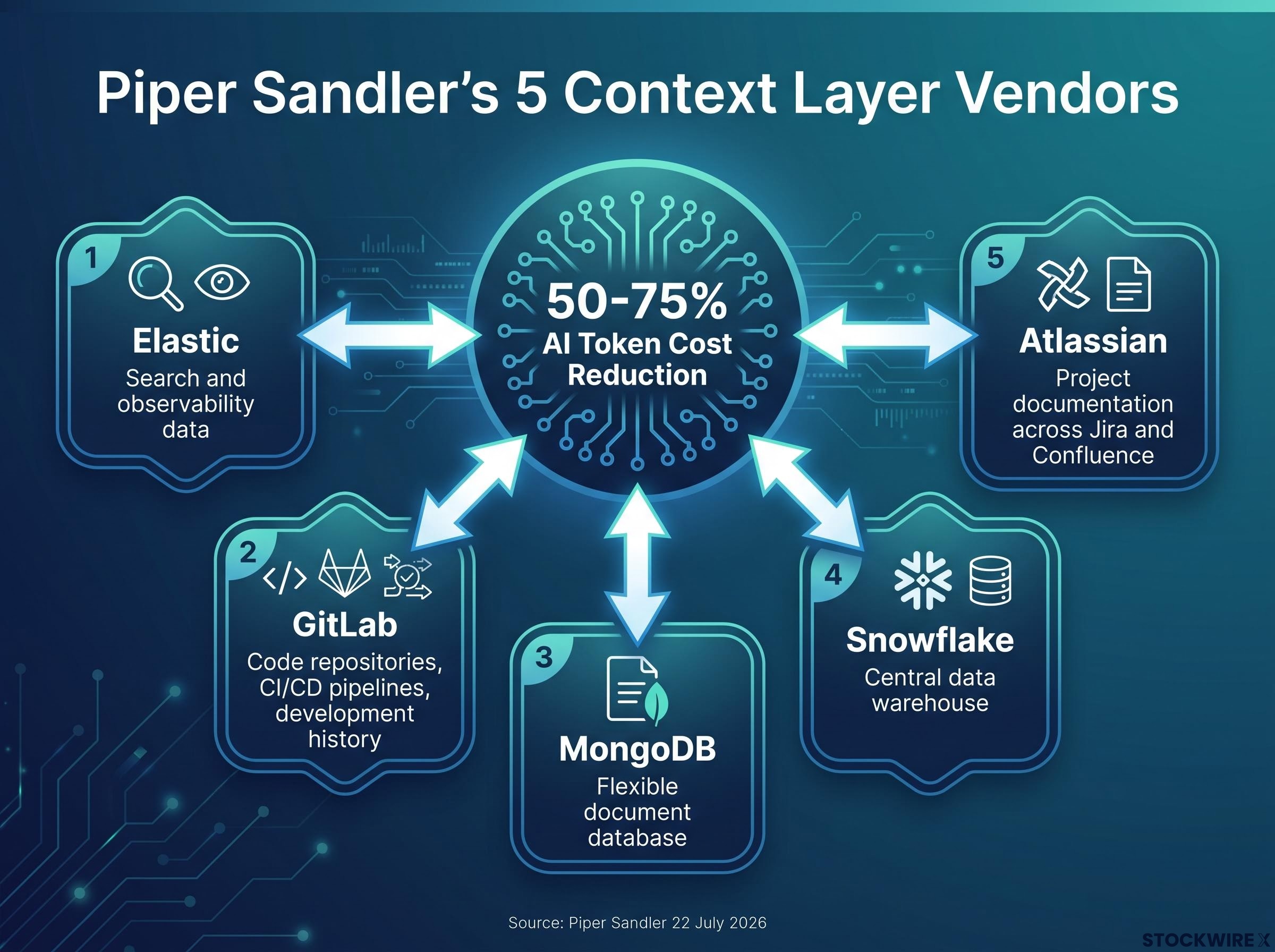
Piper Sandler published a client note on 22 July 2026 naming five infrastructure software companies it believes are positioned to cut enterprise AI token costs by 50-75%. The call targets Elastic, GitLab, MongoDB, Snowflake, and Atlassian, arguing that their proprietary data platforms function as efficiency layers that reduce how many tokens AI agents burn through to get useful answers.
The thesis rests on a structural tension most investors are misreading. Per-token prices have fallen sharply, with GPT-5.6 output tokens priced roughly 50% cheaper than equivalent GPT-4 output tokens. But total enterprise AI spending keeps climbing because newer models consume far more tokens to execute complex reasoning. The gap between cheaper units and a bigger total bill is where Piper Sandler sees the opportunity.
Here is what the note says, which five companies it singles out, and the three-lens framework it gives investors for evaluating any AI infrastructure software stock claiming cost-reduction credentials.
Piper Sandler’s core argument: why AI token costs are the new pressure point
The price of a single AI output token has never been lower. GPT-5.6 output tokens cost roughly 50% less than their GPT-4 equivalents, according to Piper Sandler’s analysis. That sounds like deflation. It is not.
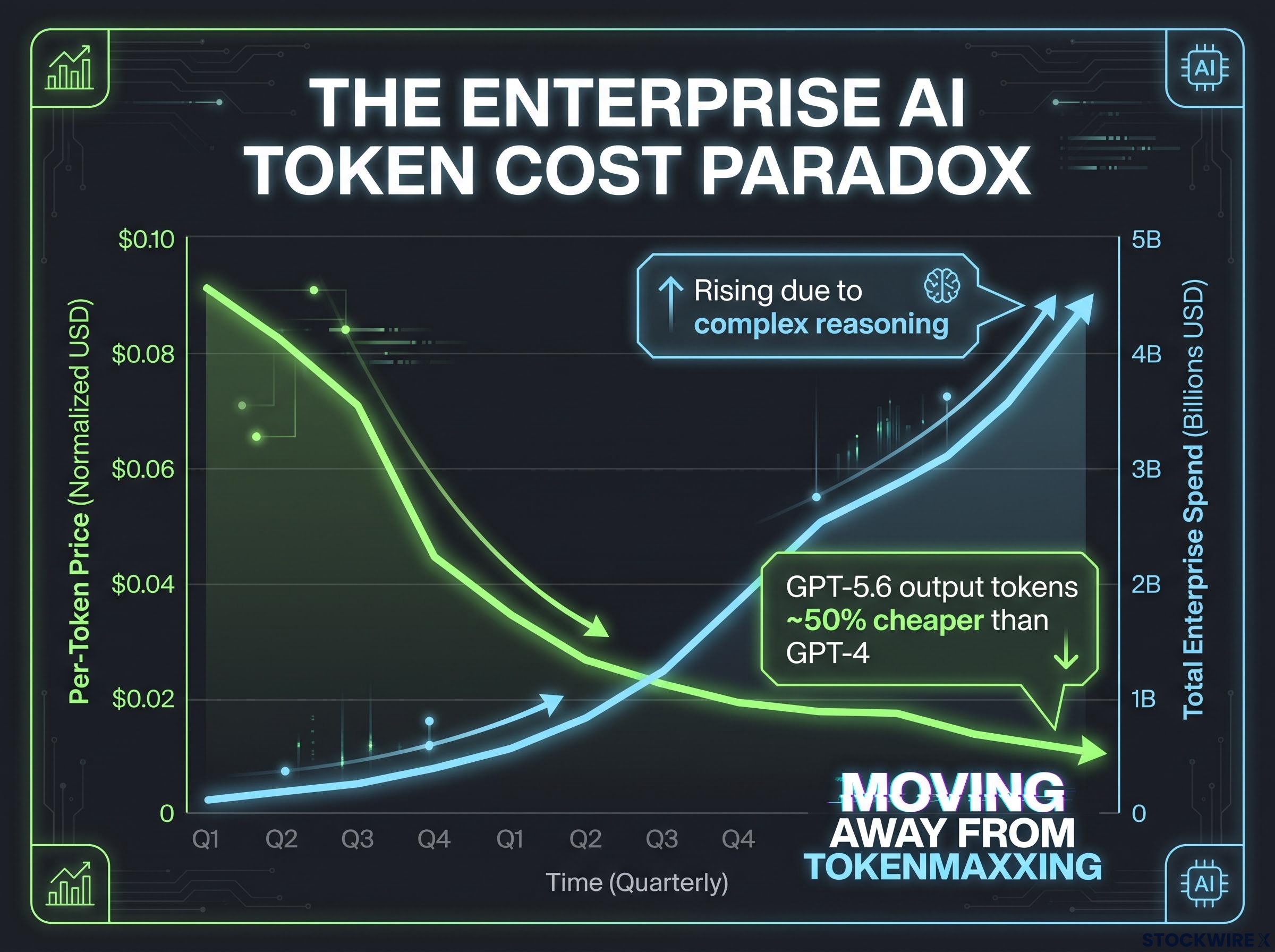
Total enterprise token spend has continued to rise because newer models require dramatically more tokens to deliver advanced reasoning, multi-step workflows, and agent-driven automation. Enterprises are paying less per unit and spending more in aggregate. Rob Owens, the Piper Sandler analyst who led the 22 July 2026 note, described how the surge in token consumption driven by improved model reasoning had pushed enterprises away from “Tokenmaxxing,” a term for the undisciplined practice of piling more tokens at every problem, and toward tighter, more deliberate spending strategies.
Key finding: According to Piper Sandler, token reductions of 50-75% are already emerging in early live deployments across these five vendors’ platforms, a finding the firm attributes to its direct engagement with company management teams and channel partners.
That gap between falling unit prices and rising total bills is not a contradiction. It is the investment thesis. The five companies named in the note are the ones Piper Sandler believes can close it.
When big ASX news breaks, our subscribers know first
Why these five companies were picked: the context layer advantage
The selection logic is specific. Each of these five platforms holds proprietary enterprise data that can be exposed to AI agents as what Piper Sandler calls a “context layer,” a structured feed of company-specific information that lets AI models answer questions accurately with fewer token-heavy iterations.
The mechanism is straightforward. When an AI agent receives a vague prompt, it generates broad, token-intensive responses and often requires multiple back-and-forth calls to reach a useful answer. When that same agent has access to targeted, high-quality data from within the enterprise, it gets to a precise answer faster with fewer tokens consumed. Piper Sandler’s note confirmed that all five companies sit within its existing infrastructure coverage universe, and the 50-75% token reduction figure comes from early live deployments, not theoretical modelling.
One specific technique worth understanding here is Retrieval-Augmented Generation (RAG), a method where an AI model pulls relevant information from an external data source before generating its response. Rather than relying on its own training data (which may be incomplete or generic), the model retrieves targeted facts first, then builds its answer around them. This is the mechanism that makes Elastic a particularly natural fit, but all five companies perform a version of this function within their respective domains.
The pricing model for these context layers is usage-based, meaning vendors charge according to how much of the platform an enterprise actually consumes. Revenue for the vendor scales directly with how much the enterprise uses AI, which means these companies grow as AI adoption deepens.
What each platform brings to the context layer
Elastic sits on enterprise search and observability data. Its platform is built for the kind of targeted information retrieval that RAG requires, surfacing precise, relevant unstructured data instead of broad queries. The AI use case: reducing token volume by giving models the right information before they start generating.
GitLab hosts code repositories, CI/CD pipelines, and development history. That structured engineering data fuels more accurate coding assistants and development agents. Fewer tokens per useful output because the model already knows the codebase.
MongoDB operates a flexible document database used for rapidly evolving application data structures. Its schema flexibility gives AI systems direct access to well-organised, application-level context, the kind of varied data structures that AI agents encounter in production environments.
Snowflake functions as a central data warehouse, widely used as a single source of structured business truth. For AI, that means grounding queries in accurate, company-specific data rather than relying on generalised or hallucinated outputs.
Atlassian stores project documentation and organisational knowledge across Jira and Confluence. AI agents navigating internal workflows can draw on this context to reduce trial-and-error prompting, cutting the iterative back-and-forth that inflates token counts.
The token cost mechanics: how proprietary data cuts enterprise AI bills
Enterprises pay for AI on a usage basis. Every prompt, every response, every agent interaction consumes tokens, and the bill scales with volume. That means reducing token consumption without degrading output quality is a direct operating expense reduction, not a theoretical efficiency gain.
The mechanism works like this: high-quality, targeted proprietary data fed into AI agents means models answer questions accurately in fewer iterations. Instead of vague prompts triggering multiple back-and-forth calls (each one consuming tokens), the model receives the context it needs upfront, collapses the interaction to fewer calls, and delivers a useful answer faster.
| Scenario | Token behaviour | Enterprise cost outcome |
|---|---|---|
| Without context layer | Broad prompts, multiple model iterations, high token volume | Higher aggregate AI spend despite lower per-token pricing |
| With context layer | Targeted retrieval, fewer model calls, reduced token volume | Lower total cost with equivalent or improved output quality |
These context-layer services carry usage-based pricing, a model Piper Sandler describes as “a compelling incremental growth opportunity” for vendors. As enterprises scale AI agent usage, the vendors with the best context layers do not just help customers save money. They grow their own revenue in direct proportion to how useful they become. That is the business model alignment that makes this more than an efficiency story.
Consumption-based pricing is the model Piper Sandler identifies as central to this thesis, and it represents a broader structural shift across enterprise software in which per-seat licence revenue is being displaced by usage volumes that scale directly with AI adoption.
What this means for AI infrastructure valuations
The operational mechanics have a direct valuation implication. If enterprises are shifting from “buy more tokens and experiment” to “prove ROI and optimise costs,” then the infrastructure layer that enables cost discipline becomes the premium category, not the model layer itself.
Piper Sandler frames these five vendors as sitting “at the intersection of AI adoption and cost optimisation.” That positioning matters because the broader Wall Street view increasingly favours consumption-based, governance-capable vendors as AI scales. Agents running continuously, metered events growing, and usage volumes compounding all point toward a pricing model where vendors with demonstrable ROI capture disproportionate share.
The valuation premium Piper Sandler assigns to these five infrastructure vendors rests partly on a contrasting view of foundation model economics, where falling token prices compress margins for model providers while the platforms that reduce token consumption capture the efficiency dividend.
The phase shift is the key variable. Enterprise AI spending is moving from experimentation budgets (where volume is the metric) to operational accountability (where return on spend is the metric). In the accountability phase, platforms that can prove they reduce total cost while maintaining output quality become the vendors enterprises consolidate around. That is where premium multiples could be justified.
Piper Sandler’s note offers three lenses for evaluating these names:
- Data footprint depth: How deeply embedded is the platform’s enterprise data?
- Context layer effectiveness: How well can that data be exposed to reduce AI token usage?
- Consumption-driven growth positioning: Is the vendor priced on usage rather than seats, and does that usage scale with AI adoption?
Three questions to ask before buying the Piper Sandler thesis
The three lenses above work as screening questions, not just for these five names but for any infrastructure software company claiming AI cost-reduction credentials.
- How deeply embedded is the platform’s enterprise data footprint? Look for evidence in earnings reports: customer count growth, net revenue retention rates, and management commentary on data volume hosted. A platform customers rely on daily has a deeper footprint than one used intermittently.
- How effectively can that data be exposed as a context layer to reduce AI token usage? Look for product roadmap disclosures around AI integrations, RAG capabilities, and partnerships with model providers. Concrete deployment metrics (like the 50-75% token reduction figure) carry more weight than general AI positioning language.
- How well is the vendor positioned for consumption-driven growth? Look for revenue model disclosures. Is pricing based on usage volume, or on per-seat licences? Consumption-based models scale with AI adoption; seat-based models do not.
Each of the five companies named falls within Piper Sandler’s established infrastructure coverage universe, giving the analyst team accumulated knowledge of these businesses over time. That adds depth to the call, but investors should also recognise that analyst notes represent one firm’s view, not consensus. These questions help you evaluate the thesis independently.
This article is for informational purposes only and should not be considered financial advice. Investors should conduct their own research and consult with financial professionals before making investment decisions.
What the call signals about where AI infrastructure spending is heading
Piper Sandler’s note is a thesis about a phase change, not a point-in-time trade. Enterprise AI spending is maturing from “buy more tokens and experiment” to “prove ROI and optimise costs,” and the infrastructure layer that enables that optimisation is where the next wave of equity upside may concentrate.
The five companies named span search, development tooling, databases, data warehousing, and project management. That breadth matters. It suggests the context layer opportunity is not confined to one infrastructure category but is a horizontal theme across the software stack. Wherever proprietary enterprise data sits, there is a potential efficiency layer for AI.
Piper Sandler’s focus on data platforms as efficiency layers connects to a broader thesis about binding constraints on AI deployment, where durable equity value accumulates at the stack layers that resolve real bottlenecks rather than at the headline model or chip layer.
The compounding argument is worth watching. As AI agents run more continuously and usage volumes scale, the competitive advantage of a well-populated context layer deepens. Enterprises that embed their data into these platforms generate more context over time, which makes the platform more valuable, which makes switching harder. Consumption-based pricing turns that stickiness into recurring, scaling revenue.
Piper Sandler’s framing: These five vendors sit “at the intersection of AI adoption and cost optimisation,” with proprietary data assets and context-layer capabilities that Piper Sandler believes could reduce token expenditure by as much as three-quarters, generating additional revenue streams tied directly to consumption growth.
Whether this represents a durable investment theme or a single firm’s conviction call depends on whether the accountability phase plays out the way Piper Sandler expects. The data from early deployments suggests it is already beginning.
Past performance does not guarantee future results. These forward-looking statements are subject to change based on market developments and company performance.