How to Hold Chip Stocks Through Volatile Markets Without Panic
3 hrs ago


Both NDQ and HACK track the digital economy, but they represent fundamentally different investment propositions. One owns the companies building the digital world; the other owns the companies defending it. For Australian investors weighing these two Betashares ETFs in June 2026, the distinction matters more than the overlap. The AI-driven expansion of digital infrastructure has simultaneously inflated the value of technology platforms and multiplied the attack surfaces requiring cybersecurity protection. NDQ and HACK are structurally linked by this dynamic, yet they offer meaningfully different sector concentrations, risk profiles, and return drivers. This analysis unpacks how each fund is positioned, where their structural cases diverge, what the major holdings reveal about each fund’s character, and how Australian investors should think about holding one, the other, or both.
The mandate difference between NDQ and HACK is where every portfolio construction decision starts. NDQ tracks the Nasdaq 100, offering broad exposure across the full stack of the digital economy. HACK is a focused, single-theme product concentrated exclusively on cybersecurity companies that service the very infrastructure NDQ‘s holdings represent.
NDQ‘s sector exposures span:
HACK, by contrast, holds companies whose revenues depend on protecting the systems, data, and networks those sectors generate. Both are Betashares products listed on the ASX and accessible to Australian retail investors.
The ASIC RG 282 disclosure standards that govern ASX-listed exchange-traded products require issuers to publish portfolio holdings, fees, and material risk factors in a standardised format, giving retail investors a consistent basis for comparing products before committing capital.
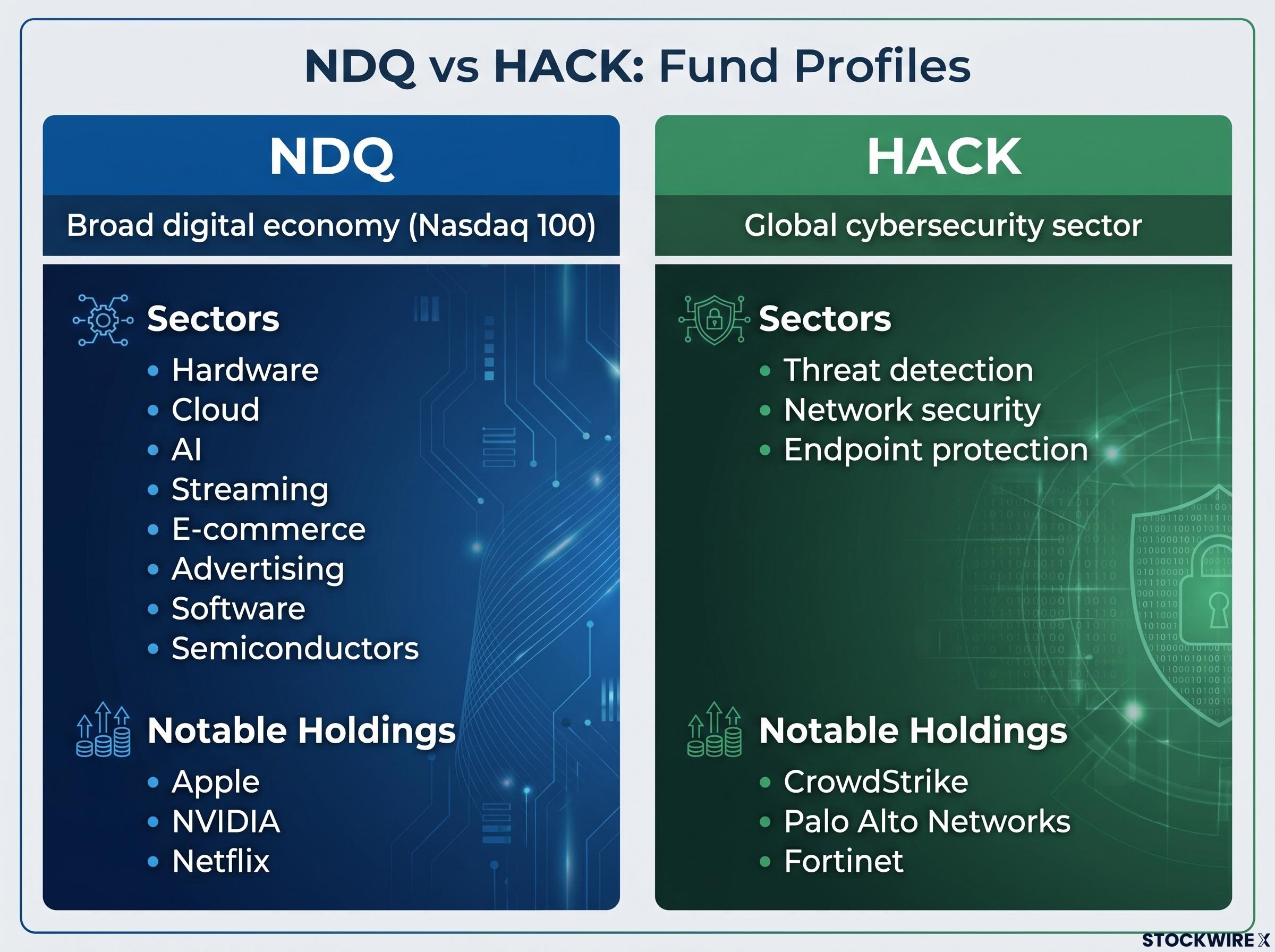
| Feature | NDQ | HACK |
|---|---|---|
| Fund mandate | Broad digital economy (Nasdaq 100) | Global cybersecurity sector |
| Sector focus | Hardware, cloud, AI, streaming, e-commerce, advertising, software, semiconductors | Threat detection, network security, endpoint protection |
| Notable holdings | Apple, NVIDIA, Netflix | CrowdStrike, Palo Alto Networks, Fortinet |
| Thematic exposure | Broad digital economy growth | Cybersecurity demand driven by digital expansion |
An investor who buys NDQ expecting cybersecurity exposure, or buys HACK expecting broad tech upside, will be surprised by what they actually own. The holdings make the mandate difference concrete.
NDQ‘s investment case rests on a straightforward structural observation: the penetration of digital technologies into everyday life, work, commerce, and communication continues to compound over long investment horizons. The fund captures both AI infrastructure builders and AI-adjacent revenue generators within a single product, giving it exposure across the AI value chain rather than a single node within it.
Apple (NASDAQ: AAPL) represents the consumer hardware and ecosystem layer. NVIDIA (NASDAQ: NVDA) represents the semiconductor and AI infrastructure layer. Netflix (NASDAQ: NFLX) represents the content and streaming layer. Together, they illustrate the breadth of digital economy activity the fund covers.
Over extended investment horizons, NDQ offers a straightforward vehicle for owning companies that influence everyday living, work, shopping, and communication across the global digital economy.
According to Motley Fool Australia, the fund is flagged as a potential buy as of June 2026. Current management expense ratios, assets under management, and return figures should be sourced directly from Betashares fund documentation before making allocation decisions.
Nasdaq-100 index composition is itself in structural flux: Nasdaq’s fast-track rule, effective May 2026, allows qualifying mega-cap companies to enter the index within 15 trading days of their IPO, meaning the fund’s AI exposure could shift materially if OpenAI or Anthropic lists before the next scheduled rebalance.
Breadth does not insulate NDQ from broad sentiment shifts against growth equities. The fund’s holdings are weighted toward companies commanding elevated valuations, and that concentration makes it vulnerable during rate-sensitive or risk-off periods.
Software sector dispersion reached a record 133 percentage points between the top and bottom deciles of US technology stocks in 2026, a gap that matters directly for NDQ holders because the Nasdaq 100’s market-cap weighting means the fund’s aggregate return is disproportionately driven by a small number of mega-cap software and AI positions.
Volatility is a structural feature of this fund type, not a temporary condition. Investors seeking exposure to the digital economy through NDQ should size their positions with the understanding that short-term drawdowns are consistent with the nature of growth-focused equity exposure.
The demand logic underpinning HACK is fundamentally different from the innovation-appetite cycle that drives most technology spending. Cybersecurity expenditure is driven by obligation and risk management. Businesses and governments spend on digital security to protect customer data, operational continuity, organisational reputation, and the integrity of systems that cannot afford downtime. This makes cybersecurity budgets more resilient to cost-cutting cycles than discretionary technology investment.
Five distinct demand vectors structurally expand the addressable market over time:
Each of these trends creates new systems, data sets, and access points requiring protection. The same forces growing NDQ‘s holdings are simultaneously expanding the attack surfaces that HACK‘s holdings are paid to defend.
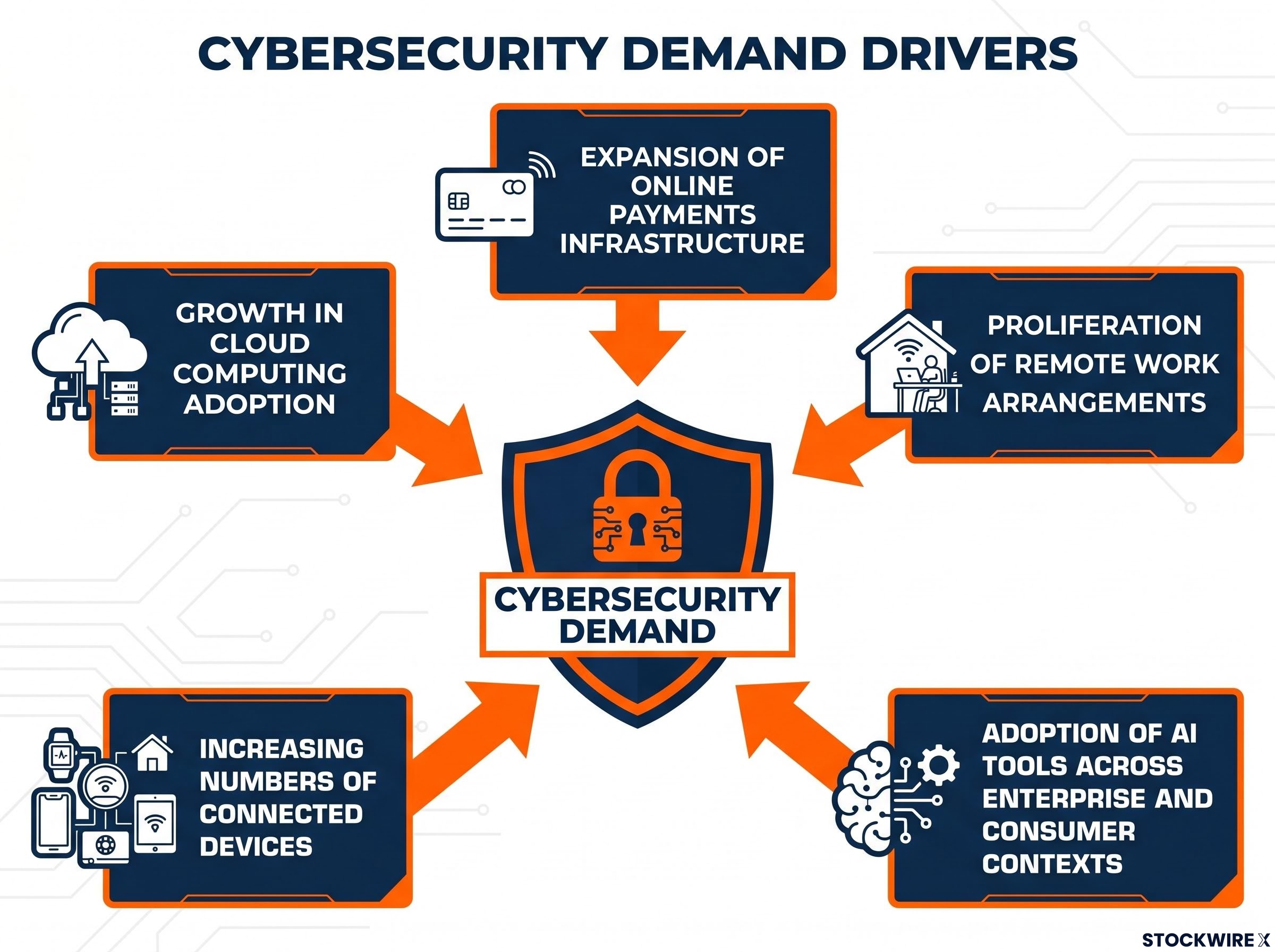
AI tool adoption creates a specific feedback loop for cybersecurity. More AI-generated surface area produces more AI-assisted threats, which in turn drives more AI-powered defence spending. This loop is additive to the general demand drivers listed above and represents a tailwind that is specific to cybersecurity companies. For HACK, the proliferation of AI is not just a background theme; it is a direct revenue catalyst for the companies the fund holds.
HACK‘s three most prominent holdings each occupy a different position within the cybersecurity value chain, reinforcing the fund’s exposure to multiple dimensions of the structural demand thesis rather than concentrating on a single approach.
Each company connects to the structural demand drivers identified above. Cloud adoption expands CrowdStrike‘s addressable market. Connected device growth drives demand for Fortinet‘s network security appliances. AI-powered threat proliferation reinforces the case for Palo Alto Networks‘ platform approach.
Investors wanting the full quantitative picture before allocating will find our dedicated guide to the HACK ETF covers the fund’s A$1.386 billion in assets under management, its five-year annualised return of 10.66% as at 30 April 2026, and the Australian regulatory demand floor created by the SOCI Act and Notifiable Data Breaches scheme that operates independently of global macro conditions.
According to Motley Fool Australia, HACK is flagged as a potential buy as of June 2026. However, the fund’s unit price may still fluctuate with broader sentiment toward growth-oriented equities. Current MER, AUM, return figures, and recent earnings data for these holdings should be sourced from Betashares fund documents and company filings before making allocation decisions.
The commercial question most Australian investors bring to the NDQ versus HACK comparison is not which fund is better, but how they fit together. The analytical answer is that they are genuinely complementary positions within a portfolio that takes a long view on digital economy expansion, not substitutes for each other.
NDQ provides broad upside capture across the digital economy. HACK provides focused exposure to a structurally defensive sub-sector of that economy with distinct demand drivers. Holding both means participating in the growth of the digital world and the growth of its protection simultaneously.
| Dimension | NDQ | HACK |
|---|---|---|
| Primary thesis | Broad digital economy growth | Structural cybersecurity demand |
| Sector breadth | Wide (8+ sub-sectors) | Narrow (cybersecurity only) |
| Demand driver type | Innovation and adoption cycles | Obligation and risk management |
| Volatility profile | Growth-equity sensitive | Growth-equity sensitive |
| Portfolio role | Core digital economy allocation | Thematic cybersecurity overlay |
Both NDQ and HACK are growth-equity products. Holding both does not hedge against sentiment-driven drawdowns; the correlation during risk-off periods means they are likely to fall together.
Australian investors already carry home-bias concentration in resources and financials through superannuation and domestic equities. Global digital economy exposure through ETFs such as NDQ and HACK represents a meaningful diversification lever against that concentration. The appropriate weighting between the two depends on existing portfolio composition, risk tolerance, and investment horizon, and current fund metrics should be sourced from Betashares directly.
The structural insight at the centre of this comparison is that NDQ and HACK are not in tension. The expansion of AI and digital infrastructure creates compounding revenue opportunities for the companies NDQ holds and compounding demand for the cybersecurity services HACK‘s holdings provide. These are two sides of the same structural trade, running in parallel rather than in competition.
One fund owns the companies building the digital world. The other owns the companies protecting it. The same forces drive both.
Neither fund is a short-term trade. Both carry the volatility that comes with growth-equity exposure, and both rest on long-horizon structural theses. Australian investors considering an allocation to either or both should consult current Betashares fund documentation for fees, performance data, and updated holdings before making any decisions.
The relationship between AI adoption and neutral interest rates adds a macro dimension that growth-equity investors in both NDQ and HACK cannot ignore: Goldman Sachs and JP Morgan both project AI could push US equilibrium real rates 25-60 basis points higher over the next 10-15 years, which would structurally increase the discount rate applied to the long-duration cash flows that justify both funds’ elevated valuations.
This article is for informational purposes only and should not be considered financial advice. Investors should conduct their own research and consult with financial professionals before making investment decisions. Past performance does not guarantee future results.
NDQ tracks the Nasdaq 100, providing broad exposure across the digital economy including cloud, AI, semiconductors, and e-commerce, while HACK is a focused thematic ETF concentrated exclusively on global cybersecurity companies such as CrowdStrike, Palo Alto Networks, and Fortinet.
Yes, NDQ and HACK are considered complementary rather than competing positions; NDQ captures broad digital economy growth while HACK provides focused exposure to cybersecurity, a structurally defensive sub-sector with distinct demand drivers rooted in obligation and risk management rather than innovation cycles.
Cybersecurity spending is driven by five structural demand vectors: growth in cloud computing, expansion of online payments, proliferation of remote work, increasing numbers of connected devices, and enterprise AI adoption, all of which create new systems and access points requiring protection.
NDQ's primary risks include its concentration in high-valuation growth equities, sensitivity to rate-driven or risk-off sentiment shifts, and the fact that software sector dispersion reached a record 133 percentage points in 2026, meaning the fund's returns are disproportionately driven by a small number of mega-cap positions.
Nasdaq's fast-track rule, effective May 2026, allows qualifying mega-cap companies to enter the Nasdaq 100 within 15 trading days of their IPO, meaning NDQ's AI exposure could shift materially if major AI companies such as OpenAI or Anthropic list before the next scheduled index rebalance.