
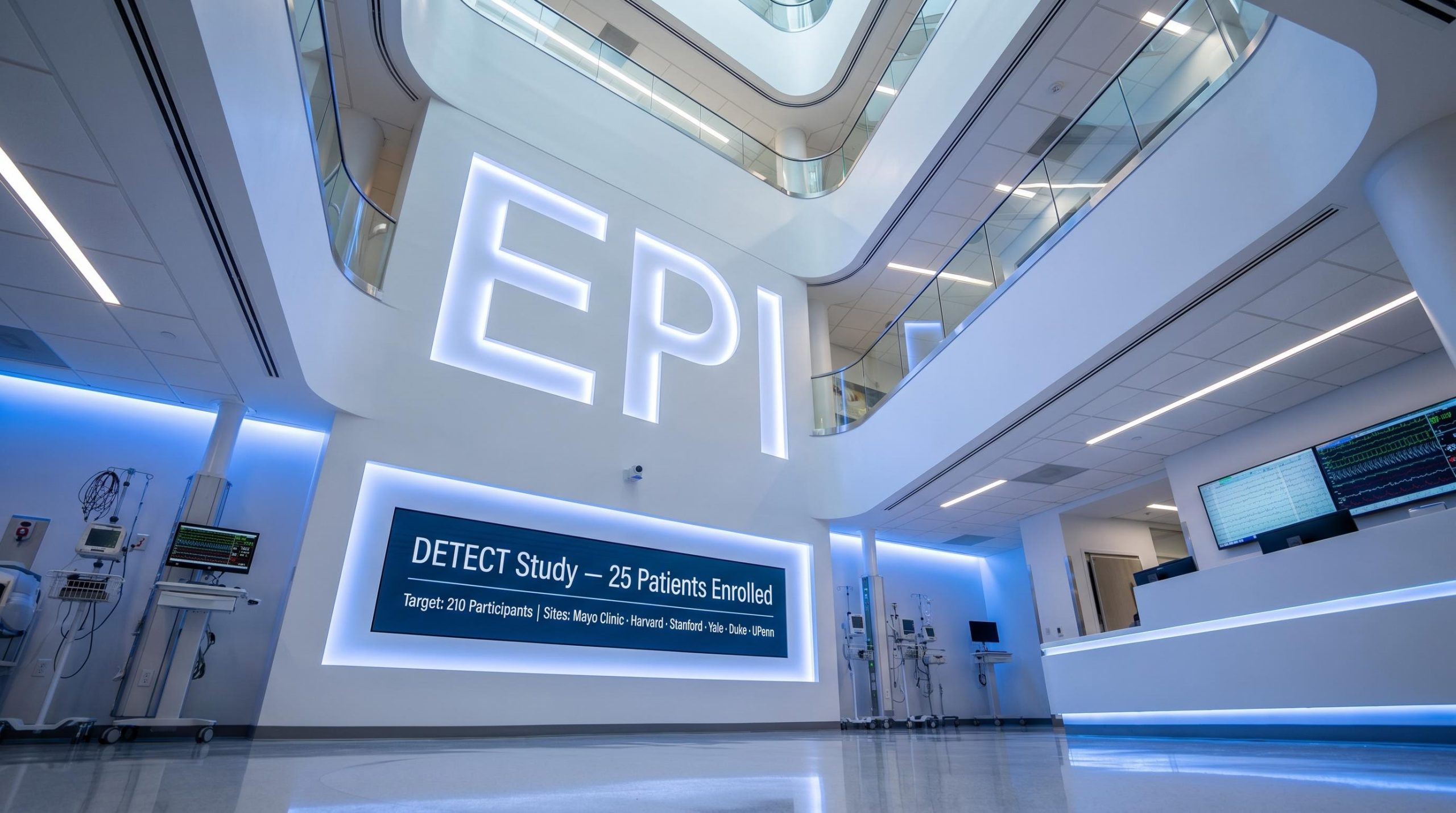
Epiminder hits 25-patient milestone as DETECT study gains pace across US
Epiminder (ASX: EPI) has enrolled its 25th patient in the DETECT study, achieving the milestone in line with the timeline committed to shareholders at the February 2026 investor call. The enrolment advances the company’s commercialisation plan, which targets 210 total patients by end of 1H CY2027, with 19 leading US clinical sites now active, including Mayo Clinic, Harvard, Stanford, Yale, Duke, and the University of Pennsylvania. The next public benchmark is 50 enrolled patients, expected in mid Q3 CY2026.
Rohan Hoare, CEO of Epiminder
“Reaching 25 enrolled patients in DETECT is an important milestone, and one we committed to delivering. With 19 sites now participating across the United States and enrolment continuing to build, we are focused on progressing toward our next target of 50 total enrolled patients, expected in mid Q3 CY2026. DETECT is central to our commercialisation strategy and is designed to generate the clinical evidence needed to support reimbursement and drive broader access to the Minder System for the many patients who remain without answers after inconclusive EEG monitoring.”
When big ASX news breaks, our subscribers know first
What the DETECT study is — and why it matters for epilepsy patients
A gap in epilepsy care that affects millions
Between 30% and 50% of inpatient epilepsy monitoring unit (EMU) stays are inconclusive, leaving a substantial proportion of patients without a confirmed diagnosis or a viable treatment pathway. For those patients, particularly those with drug-resistant epilepsy, the failure to capture and characterise seizure events during conventional monitoring can delay or entirely prevent access to advanced therapies.
That includes epilepsy surgery, one of the most effective interventions available for drug-resistant cases. Without the objective electrographic data needed to support a surgical referral, many patients remain in a diagnostic limbo.
How Minder fills the diagnostic gap
The Minder System is a minimally invasive implantable continuous EEG Monitoring (iCEM) device that provides continuous bilateral subscalp EEG monitoring over extended periods, enabling neurologists to capture objective brain activity data during a patient’s normal daily life, across months or even years. This stands in direct contrast to conventional short inpatient EEG monitoring, which is constrained by the duration of the hospital stay and may simply not coincide with a patient’s seizure events.
The Minder System was authorised by the FDA via the de novo pathway. Clinical evidence supporting its feasibility and signal quality has been published in Epilepsia, including the UMPIRE first-in-human multicentre trial (2025) and a more recent additional publication (doi: 10.1002/epi.70290).
Professor Mark Cook, Founder of Epiminder
“An inconclusive stay at an epilepsy monitoring unit should not mean patients are left without a path to diagnosis. Minder is designed to give clinicians a longer-term view of brain activity during daily life, helping to capture events that may not occur during a short inpatient stay. DETECT is an important step in demonstrating the clinical value of that approach.”
Study design, milestones and the road to commercialisation
DETECT by the numbers
Key parameters of the DETECT study include:
- Target enrolment: Up to 210 participants
- US sites: Up to 25 (with 19 currently active)
- Primary follow-up period: 6 months
- Primary endpoint: The proportion of subjects achieving an actionable clinical event, defined as a confirmed diagnosis, seizure characterisation, surgery evaluation, event classification, or psychogenic nonepileptic seizure (PNES) determination
The DETECT study is being conducted as a prospective, randomised, controlled, blinded, multi-centre post-market study using the Minder System as a marketed device.
| Milestone | Target | Status | Significance |
|---|---|---|---|
| 25 patients enrolled | May 2026 | Achieved | Delivered in line with February 2026 investor call commitment; commercialisation plan on track |
| 50 patients enrolled | Mid Q3 CY2026 | Upcoming | Next public benchmark for investor and clinical progress |
| 210 patients enrolled | End of 1H CY2027 | Target | Full study completion supporting the reimbursement case and broader patient access |
Why hitting the 50-patient mark next matters
Consistent on-time delivery against publicly disclosed milestones builds investor confidence in management execution. The 25th enrolment was achieved precisely when Epiminder said it would be, and with 19 active sites from a potential 25, the study retains meaningful near-term recruitment headroom as site activation continues.
The path to 210 patients represents more than a clinical exercise. Completing the DETECT study to its full enrolment target is the clinical evidence foundation required to support reimbursement claims, which in turn is the mechanism for broadening patient access to the Minder System at commercial scale.
Investment thesis — clinical proof, commercial pathway, elite site network
The key elements of the investment case at this stage of the DETECT study include:
- Milestone delivery on schedule: The 25th enrolment met the February 2026 investor call commitment, demonstrating that management is accountable and executing against a disclosed commercialisation plan.
- Elite institutional validation: With 19 active sites affiliated with Mayo Clinic, Harvard, Stanford, Yale, Duke, and the University of Pennsylvania, DETECT carries the weight of serious institutional clinical endorsement.
- Reimbursement-driven commercialisation: DETECT is explicitly designed as a post-market study to generate the clinical evidence needed to support reimbursement. This positions the study as the commercial pathway to broader adoption, not merely a regulatory formality.
Investors tracking the next milestone can reference the DETECT study at clinicaltrials.gov under study identifier NCT07110337, with the 50-patient enrolment update expected around mid Q3 CY2026.
Don’t Miss the Next Healthcare Breakthrough on ASX
Big News Blast delivers FREE breaking ASX healthcare news directly to your inbox within minutes of release, complete with in-depth analysis. Join 20,000+ investors already staying ahead of the market. Click the “Free Alerts” button at StockWire X to make sure you never miss a market-moving healthcare announcement the moment it drops.