
ASIC removed nearly 12,000 scam websites during 2025, a 90% increase on the prior year, yet Australians still lost $837.7 million to investment fraud over the same period. The gap between those two figures captures the central tension in Australia’s fight against financial scams. The regulator’s takedown programme is expanding rapidly, but losses remain measured in the hundreds of millions, and total scam losses across all categories actually rose to $2.18 billion in 2025, up from $2.03 billion in 2024. What follows explains what ASIC’s enforcement programme achieved, why losses remain high despite that effort, who bears the greatest financial harm, and what new legislative protections are now in place.
ASIC’s takedown programme removed almost 12,000 scam websites in 2025
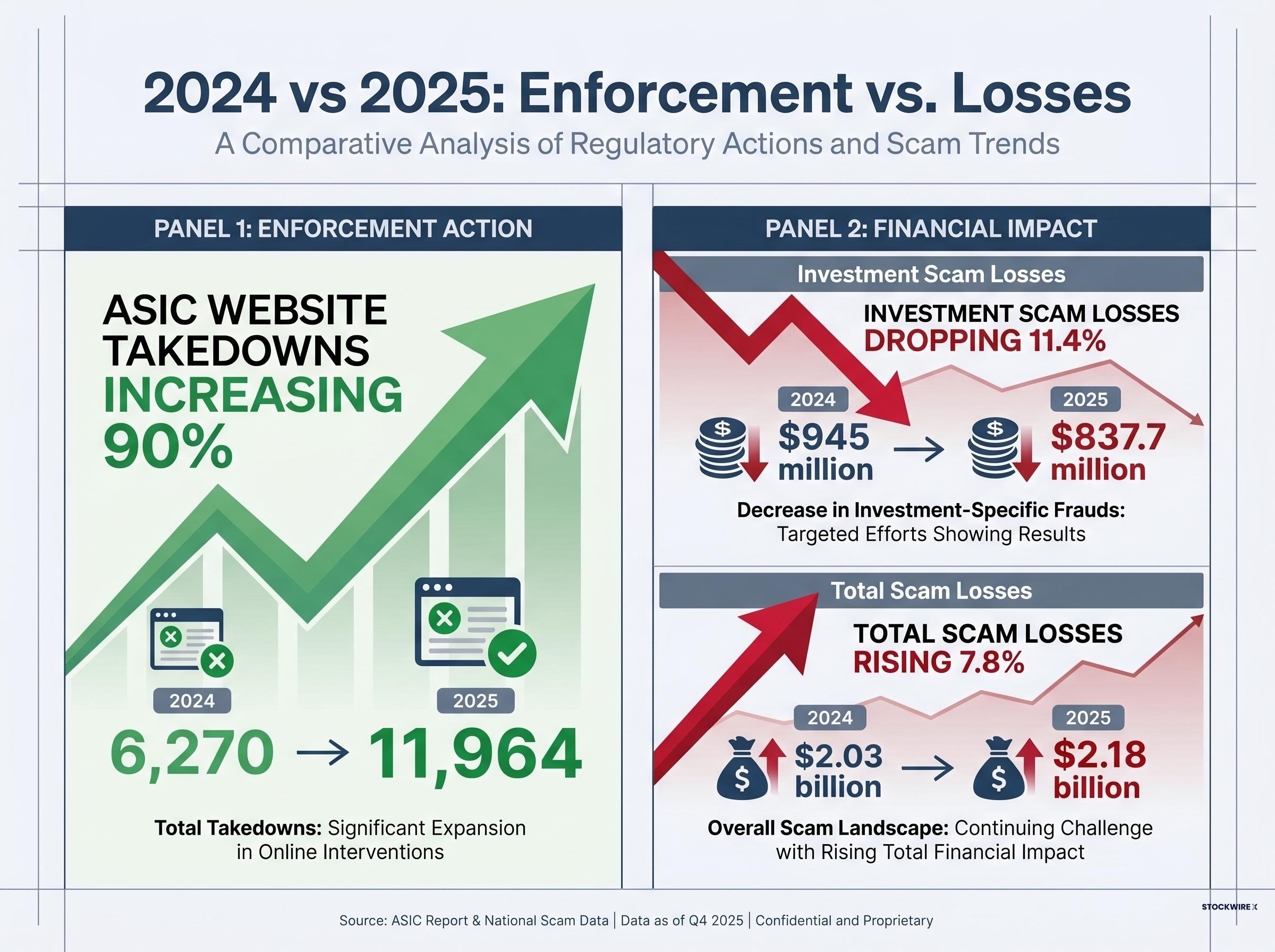
The scale of the operation is best understood in daily terms. ASIC coordinated the removal of 11,964 phishing and investment scam websites during 2025, averaging roughly 32 takedowns per day, or about 230 per week. That pace represents a 90% year-on-year increase from the 6,270 removals recorded in the prior 12-month period.
ASIC’s website takedown activity increased 90% year on year, from 6,270 removals to 11,964 in 2025.
The programme, launched in 2023, works through a third-party cybercrime detection and disruption specialist that conducts 24/7 monitoring. When a malicious site is confirmed, the specialist initiates a takedown by engaging all parties capable of removing the page. Speed is operationally necessary: scam advertisements can appear briefly in social media feeds, be removed, and reappear under a different guise within hours.
Key metrics from the programme’s 2025 activity:
- 11,964 websites removed in 2025
- 90% increase on the prior period (6,270 removals)
- More than 25,000 cumulative removals since the programme launched in 2023
- More than 1,100 social media investment scam advertisements removed in 2025
- Approximately 32 websites removed per day on average, or around 230 per week
Those numbers reflect what the regulator is doing. They also reveal how fast scam infrastructure is being created to replace what is removed.
When big ASX news breaks, our subscribers know first
Australians still lost $837.7 million to investment fraud as total scam losses climbed to $2.18 billion
Total scam losses reported by Australians reached $2.18 billion in 2025, a 7.8% increase from $2.03 billion in 2024, according to the National Anti-Scam Centre’s Targeting Scams report published in March 2026. Investment scams remained the single largest loss category, accounting for $837.7 million.
That investment scam figure did fall 11.4% from $945 million in 2024, which may reflect some benefit from the accelerated takedown programme. But the broader picture complicates that reading: total losses still rose, and total scam reports actually declined 2.3% to 481,523 from 494,732 in 2024. Fewer incidents produced higher aggregate losses, meaning the average financial harm per victim increased.
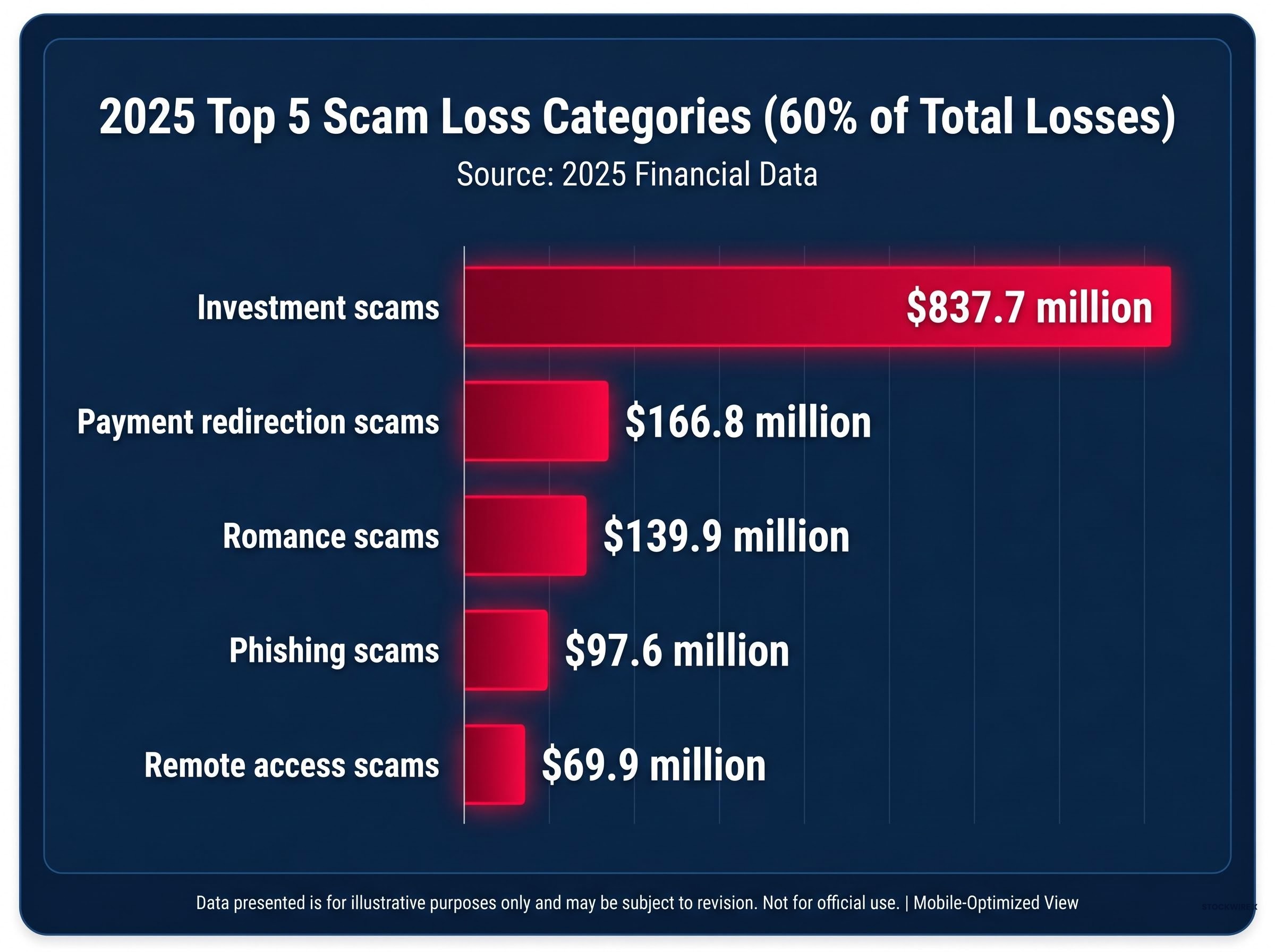
The five highest-loss categories collectively accounted for 60% of total reported losses:
| Scam Type | 2025 Losses |
|---|---|
| Investment scams | $837.7 million |
| Payment redirection scams | $166.8 million |
| Romance scams | $139.9 million |
| Phishing scams | $97.6 million |
| Remote access scams | $69.9 million |
The rising average loss per incident signals something specific about how scam operations are evolving: they are becoming more targeted, more convincing, and more effective at extracting larger sums from each victim.
How investment scams work and why takedowns alone cannot stop the losses
Scam operations targeting Australian investors are run by international criminal networks at industrial scale. These networks deploy persuasive social-engineering scripts, AI-generated content, deepfakes, and fake investment dashboards that closely mimic legitimate Australian financial services firms. The branding increasingly clones known banks and brokers, reducing a consumer’s ability to identify fraud on sight.
The structural reason that website takedowns cannot close the losses gap on their own sits in the gap between where enforcement operates and where victims are first contacted.
Pump-and-dump schemes operate through the same social engineering infrastructure used in investment scams: manufactured urgency, fabricated credibility, and coordinated outreach through messaging platforms that contact targets before any website link is shared.
Why victims are contacted before they ever visit a website
Initial contact with potential victims typically happens through channels that sit outside the website layer ASIC’s programme targets. The most common first-contact vectors include:
- Unsolicited phone calls
- Social media direct messages
- Messaging apps and encrypted channels
- Romance-based trust-building that precedes any investment link being sent
By the time a victim clicks through to a scam website, a relationship of trust has often already been established. Enforcement visibility across phone calls, messaging apps, and encrypted platforms remains limited compared to the website layer, meaning the removal of a domain addresses one node in a larger network that has already initiated its outreach.
The domain regeneration problem
When ASIC’s programme removes a scam website, operators rapidly register replacement domains, often using overseas hosting providers. The result is that the total volume of active scam infrastructure does not shrink proportionally to removal numbers. Targeting is also increasingly data-driven: criminal networks use leaked, purchased, or scraped personal data to identify high-value victims before a single website goes live.
Cross-border enforcement adds a further constraint. Many operations are headquartered offshore, using cryptocurrency transfers and money-mule networks to move funds. Asset recovery remains rare even when sites are successfully removed, because the money has typically moved through multiple jurisdictions before the takedown occurs.
Older Australians bear a disproportionate share of investment scam losses
The demographic data sharpens the picture of who is most affected. Australians aged 55 and over accounted for approximately 26.5% of losses reported to Scamwatch in 2025, despite representing around 17.1% of the population according to Australian Bureau of Statistics data.
Australians aged 55 and over accounted for 26.5% of Scamwatch losses while representing approximately 17.1% of the population.
The disparity has a structural explanation. Investment and romance scams frequently involve significant individual losses, including retirement savings. Older Australians tend to hold larger liquid asset pools, which makes them higher-value targets for data-driven scam operations that pre-screen victims before making contact.
The National Anti-Scam Centre’s Targeting Scams report also identifies higher median losses among First Nations communities and culturally and linguistically diverse communities, indicating that vulnerability to financial fraud extends across multiple demographic dimensions rather than a single age group.
New legislation and what regulators say must change
The most significant policy response to the scale of scam losses is the Scams Prevention Framework Act 2025 (Cth), passed in February 2025. The legislation introduces obligations across three designated sectors to strengthen scam prevention:
- Banks, required to strengthen fraud detection and prevention systems
- Telecommunications providers, required to address scam calls and messages before they reach consumers
- Digital platforms, required to prevent scam advertising and outreach on their services
The framework supports cross-sector intelligence sharing and creates consistent obligations across industries, addressing the longstanding gap around platform and telco responsibility for preventing scam outreach before consumers engage. The National Anti-Scam Centre, which published the Targeting Scams 2025 report in March 2026, coordinates scam disruption across these sectors.
ASIC’s enforcement posture has sharpened considerably beyond scam website takedowns in 2025 and 2026, with the regulator securing a $10 million Federal Court penalty against Binance and pushing purpose-built crypto licensing legislation through Parliament, signalling a sustained expansion of regulated obligations across the digital asset sector.
Further policy discussion is ongoing around mandatory reimbursement models for victims. Cross-border enforcement remains a structural constraint: offshore criminal networks, cryptocurrency transfers, and money-mule arrangements make asset recovery rare regardless of how many websites are removed. International law enforcement cooperation continues, but specific Australian-led cross-border operations with confirmed 2025-2026 details have not been publicly documented.
What $837 million in losses means for the year ahead
Record enforcement activity and a modest decline in investment scam losses are both real. But $837.7 million in annual losses confirms the problem remains at a scale that takedowns alone cannot solve. The structural vulnerabilities, offshore networks, contact channels beyond website visibility, and data-driven targeting, require the full Scams Prevention Framework to mature and for consumers to remain actively cautious.
The consistent warning pattern across investment scam types remains unchanged, regardless of how sophisticated the branding appears: unsolicited contact, high promised returns, and pressure to act quickly.
The consistent warning pattern across scam types, unsolicited contact, high promised returns, and pressure to act quickly, is most recognisable to investors who have already researched legitimate investing pathways and understand what realistic return expectations and regulated product structures actually look like.
This article is for informational purposes only and should not be considered financial advice. Investors should conduct their own research and consult with financial professionals before making investment decisions.