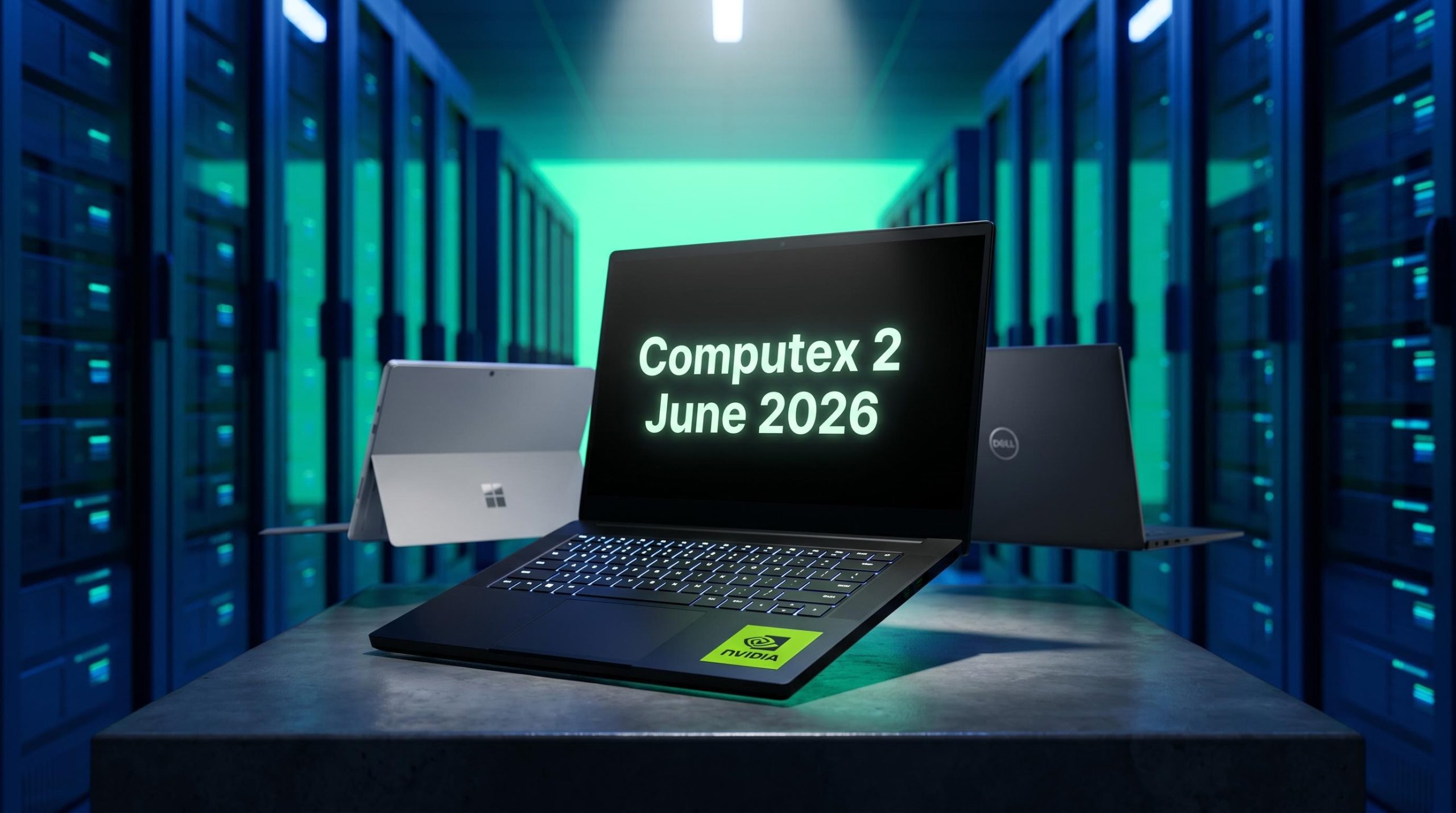
Nvidia, the company whose chips underpin nearly every major artificial intelligence data-centre build on the planet, is days away from announcing its first Windows PCs powered by its own processors. The planned reveal, expected at Computex in Taipei and Microsoft Build in San Francisco during the week of 2 June 2026, would mark Nvidia’s entrance into a consumer computing market it has never directly competed in. Microsoft Surface and Dell are named as the first hardware partners, according to an Axios report citing people familiar with the company’s plans. What follows is an examination of what Nvidia is actually bringing to the PC, why the timing is structurally significant, how Intel, AMD, and Qualcomm are each differently exposed, and what execution risks analysts are flagging before a single benchmark has been published.
A market Nvidia has never entered, and why it is entering now
Nvidia has spent the past three years becoming synonymous with AI infrastructure. Its data-centre revenue dwarfs every other segment it operates in. Entering the Windows PC processor market is a strategic break of a different order: it puts the company in direct competition with Intel and AMD in a product category those two have dominated for decades, and with Qualcomm in the Arm-based Windows segment Qualcomm effectively pioneered.
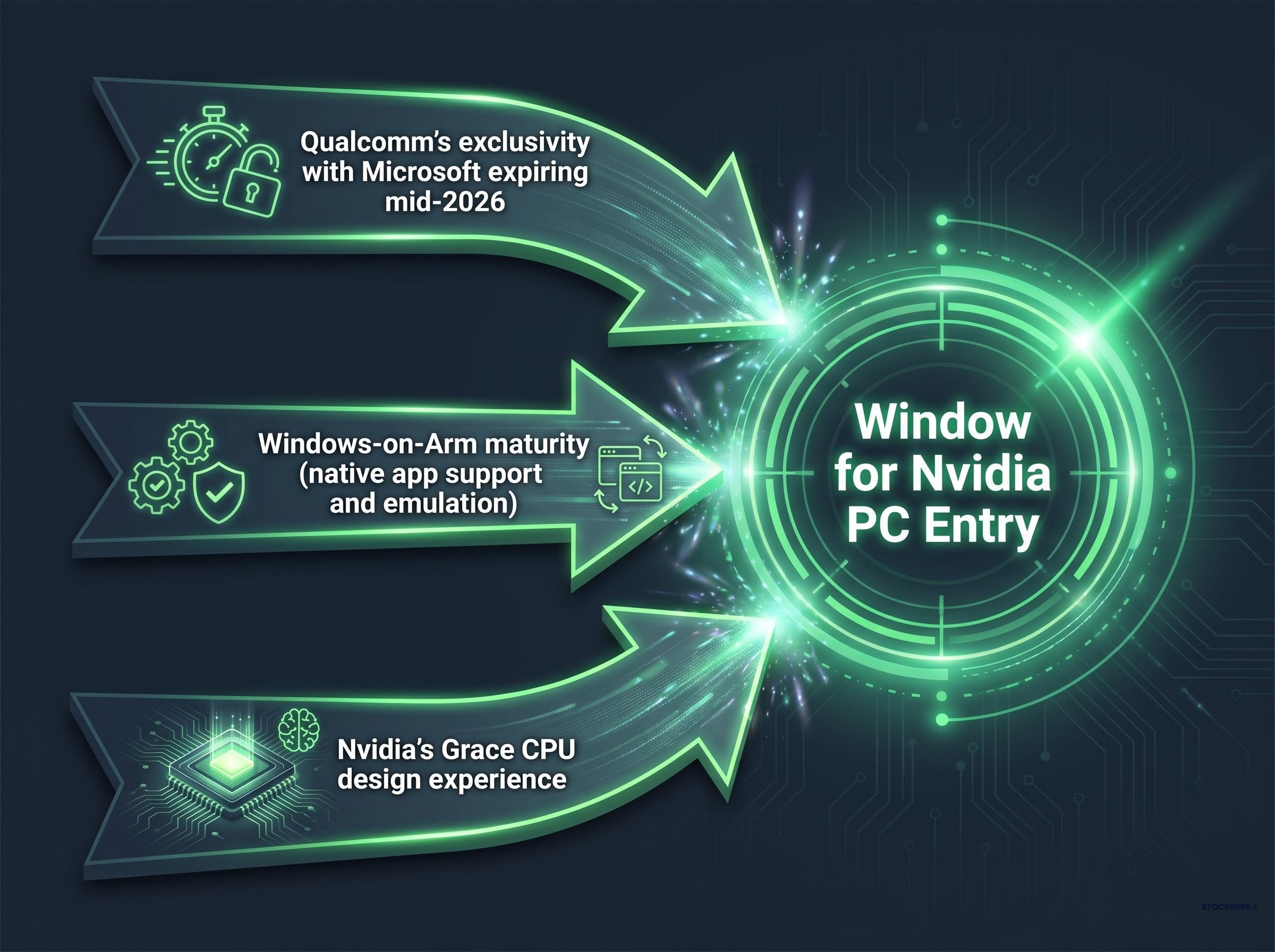
The timing is not accidental. Three structural conditions have converged to open this window:
- Qualcomm’s multi-year exclusivity with Microsoft for certain premium Windows-on-Arm designs is expected to expire around mid-2026, removing the contractual barrier that kept other Arm chip designers out of the highest-profile Windows device partnerships.
- Windows-on-Arm maturity has advanced materially, with Microsoft investing in native app support and emulation performance that makes Arm-based PCs viable for a broader user base than even two years ago.
- Nvidia’s Grace CPU design experience, developed for its server platforms, provides an in-house Arm CPU architecture that can be adapted for client devices rather than built from scratch.
The Qualcomm exclusivity expiry is the single most important enabler. Without it, this week’s planned reveal would not be structurally possible.
CPU architecture convergence toward Arm is reshaping competitive dynamics well beyond the PC market: May 2026 earnings from Arm, AMD, and Intel confirmed that CPU demand for agentic AI workloads is compressing the historical 1:8 CPU-to-GPU deployment ratio toward 1:1, a structural shift that gives any credible new Arm CPU entrant a larger addressable opportunity than the PC category alone implies.
The Arm CEO confirmation of Qualcomm’s expiring exclusivity, reported in early 2024, made clear that the arrangement was always time-limited and that its end would open Windows-on-Arm device partnerships to other chip designers, precisely the structural condition that makes Nvidia’s planned Computex reveal possible.
When big ASX news breaks, our subscribers know first
What Nvidia is bringing to the PC and what remains unknown
The Axios report confirms the unveil timing, the first hardware partners, and the expected Arm-based design direction. Beyond that, the specifics thin out quickly.
Nvidia’s Grace server CPU is the clearest technology precursor. It demonstrates that the company can design high-performance Arm processors and associated memory subsystems, capabilities that could translate to a client chip. However, a server CPU optimised for data-centre bandwidth is a different product from a power-efficient notebook processor, and no reporting has confirmed how much Grace-derived intellectual property carries over.
The following table separates what is confirmed from what remains unreported as of 30 May 2026:
| Product Attribute | Confirmed | Not Yet Reported |
|---|---|---|
| Unveil timing | Week of 2 June 2026 (Computex and Microsoft Build) | |
| Hardware partners | Microsoft Surface and Dell | Additional OEMs beyond the first wave |
| Architecture | Expected to be Arm-based | Official confirmation of architecture |
| Specs and benchmarks | Core counts, TDP, TOPS ratings, performance data | |
| Pricing | Chip or system-level pricing | |
| Availability | Commercial ship dates or preorder windows |
Distinguishing confirmed facts from inference matters here. Until the actual reveal, any performance or pricing claims attributed to Nvidia’s PC chips remain speculation.
How Intel, AMD, and Qualcomm are each differently exposed
Nvidia’s entry does not create a uniform threat. Each incumbent faces a distinct version of the problem, shaped by its strategic position in the PC market. None of Intel, AMD, or Qualcomm has issued a direct public response to the Axios report as of 30 May 2026.
| Company | Current Windows PC Position | Primary Vulnerability | Key Defensive Advantage |
|---|---|---|---|
| Intel | Dominant x86 share, investing in NPU-equipped Core Ultra | Already defending against Arm broadly; a credible new Arm entrant compounds pressure | x86 compatibility, enterprise fleet inertia, deep OEM integration |
| AMD | Growing x86 share via Ryzen AI and XDNA NPU | Cannot ignore an Arm entrant with Nvidia’s AI brand weight in the AI PC category | Strong Ryzen AI positioning, x86 software compatibility |
| Qualcomm | Established Windows-on-Arm leader via Snapdragon X | Nvidia enters the exact lane Qualcomm pioneered, with greater AI ecosystem depth | First-mover app optimisation, existing Windows-on-Arm device track record |
Intel
Intel faces the deepest structural pressure. Its Q1 2026 earnings commentary emphasised defending client share against Arm-based PCs while continuing investment in Core Ultra processors with integrated neural processing units (NPUs), chips designed to handle on-device AI tasks. Nvidia’s entry adds a second well-capitalised Arm competitor alongside Qualcomm at a time when Intel is already managing its own financial recovery.
AMD
AMD’s exposure is more contained. Its Ryzen AI processors and XDNA NPU architecture position it competitively in the AI PC category, and x86 compatibility remains a strong moat. The risk is reputational as much as commercial: if Nvidia captures the AI PC narrative with OEMs and developers, AMD could find its own AI branding diluted even if it retains unit share.
Qualcomm
Qualcomm occupies a unique position as both a competitor and a benchmark. Its Snapdragon X platforms are the established standard that any new Windows-on-Arm entrant would be measured against. The irony is structural: the expiry of Qualcomm’s own Microsoft exclusivity is what opens the door for Nvidia to enter the lane Qualcomm built.
Why Nvidia’s AI ecosystem is both its biggest weapon and a constraint
The strategic logic for Nvidia in PCs starts with its AI software stack. CUDA, TensorRT, and cuDNN form the most widely adopted developer ecosystem for AI workloads. A PC processor tightly integrated with that stack could offer something no current competitor matches: seamless acceleration of local large language model inference and on-device AI tasks using tools developers already know.
Nvidia also brings four structural advantages to the table:
- AI software stack integration: CUDA and TensorRT are industry-standard tools for AI development, and native support on a PC processor could attract OEMs targeting AI-first branding.
- Grace CPU design experience: The Grace server CPU demonstrates Nvidia’s ability to build high-performance Arm processors and memory subsystems.
- OEM relationships: Longstanding partnerships with major PC manufacturers through discrete GPU supply provide an established channel.
- GeForce brand strength: The RTX and GeForce brands carry significant weight with gaming and creator audiences, communities that influence OEM product decisions.
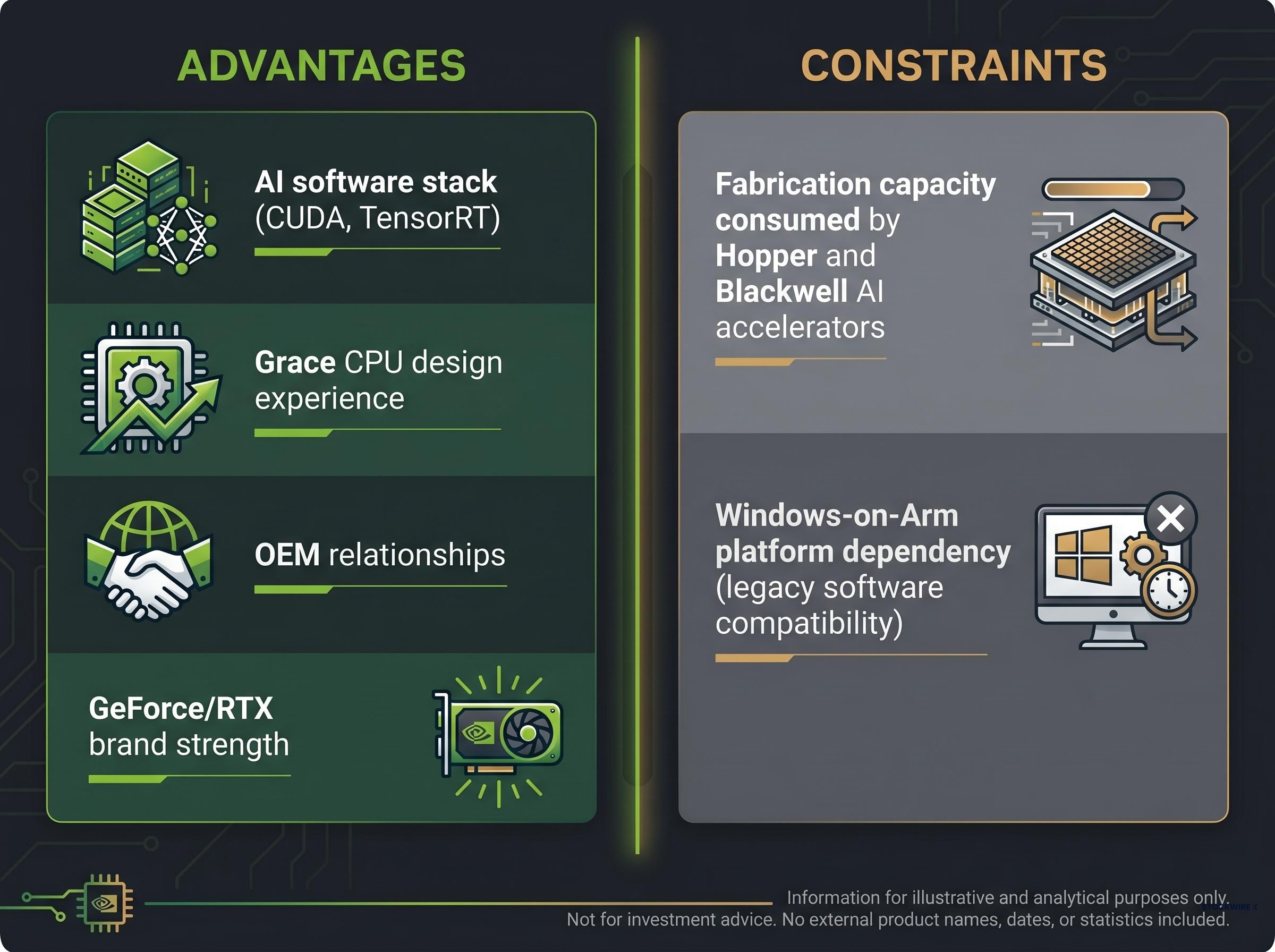
The constraint sits on the other side of Nvidia’s own success. Its advanced-node fabrication capacity is heavily consumed by Hopper and Blackwell AI accelerators, products that generate substantially higher margins than PC processors.
Fabrication capacity constraints sit at the centre of this strategic tension: Nvidia’s most advanced wafer allocations are committed to Hopper and Blackwell AI accelerators generating margins no PC processor can match, a dynamic examined in detail in the context of the broader custom silicon threat from Alphabet, Amazon, and Microsoft.
Analysts covering Nvidia’s AI data-centre business note that the company’s highest-margin wafer allocation to AI accelerators represents a structural limit on how aggressively it can pursue PC CPU volume in the near term.
There is also a platform-level dependency Nvidia cannot solve alone. Windows-on-Arm has progressed in native app support and emulation performance, but legacy software compatibility remains uneven. Any Arm-based Nvidia processor inherits that challenge from Microsoft’s platform, not from its own engineering.
The announcement is days away, but the real test starts after Computex
The Computex and Microsoft Build events during the week of 2 June 2026 will answer some questions. Product names will likely be confirmed. Architecture details may emerge. Partner devices from Microsoft Surface and Dell should be shown.
What the events will not settle is whether this becomes a genuine market disruption or a well-publicised first step. Three forward indicators will matter most in the months following the reveal:
- OEM expansion beyond the first wave. Whether HP, Lenovo, Asus, or Acer confirm partnerships with Nvidia for Windows PC processors would signal broader industry commitment beyond two launch partners.
- Windows-on-Arm ecosystem growth. The pace at which native app support and emulation performance improve will determine whether Arm-based PCs, including Nvidia’s, can compete for mainstream rather than niche adoption.
- Nvidia’s capacity allocation signals. How the company balances fabrication capacity between AI accelerators and PC chips will reveal how seriously it treats this market as a volume business rather than a strategic signpost.
Regardless of immediate sales volumes, the announcement carries strategic weight. It signals Nvidia’s intention to move from a component supplier to a full-stack computing platform company, a shift that, if sustained, would alter the competitive structure of the PC industry over the medium term.
What Nvidia’s PC move really signals about where the company is headed
This announcement is as much about Nvidia’s long-term platform ambitions as it is about any specific PC product. The company is positioning itself to compete across the full computing stack, from data centre to desktop, with an integrated hardware and software ecosystem.
The Nvidia platform investment thesis, now tracked by analysts at Goldman Sachs, Morgan Stanley, and William Blair across four distinct revenue layers, treats the company as an AI infrastructure stack rather than a GPU supplier, and the PC entry reinforces exactly that framing by extending Nvidia hardware into a fifth computing context.
Product details, real-world performance, and volume commitment remain unconfirmed until the reveal and beyond. The week of 2 June 2026 will answer some questions and open new ones. The competitive response from Intel, AMD, and Qualcomm over the following quarters will be the actual measure of whether this entry reshapes the market or remains a contained experiment.
This article is for informational purposes only and should not be considered financial advice. Investors should conduct their own research and consult with financial professionals before making investment decisions.
These statements are speculative and subject to change based on market developments and company performance.