
Three ASX-listed companies were collectively fined $1,170,000 in a single court session for a deceptively basic failure: they simply stopped filing their annual financial reports, in some cases for five consecutive years. The convictions, handed down at Downing Centre Local Court on 17 March 2026, are not an isolated incident. ASIC has named non-lodgement of financial reports by public companies as an explicit 2026 regulatory priority, and a separate December 2025 action already resulted in $2.2 million in infringement notices to twelve large proprietary companies. What follows covers what happened, why these filings are legally required, how this action fits into ASIC’s broader enforcement campaign, and what retail investors should watch for if a company they hold shares in goes quiet on its reporting obligations.
Three companies, five years of silence, and $1.17 million in penalties
Invitrocue Limited, a life sciences company using patient-derived organoids to assist oncologists in tailoring cancer treatment, received the largest single fine at $530,000. Boyuan Holdings Limited, a property development firm, was penalised $400,000. Urban Ecological Systems Limited, which develops food production systems including a commercial-scale agricultural facility in China, was fined $240,000.
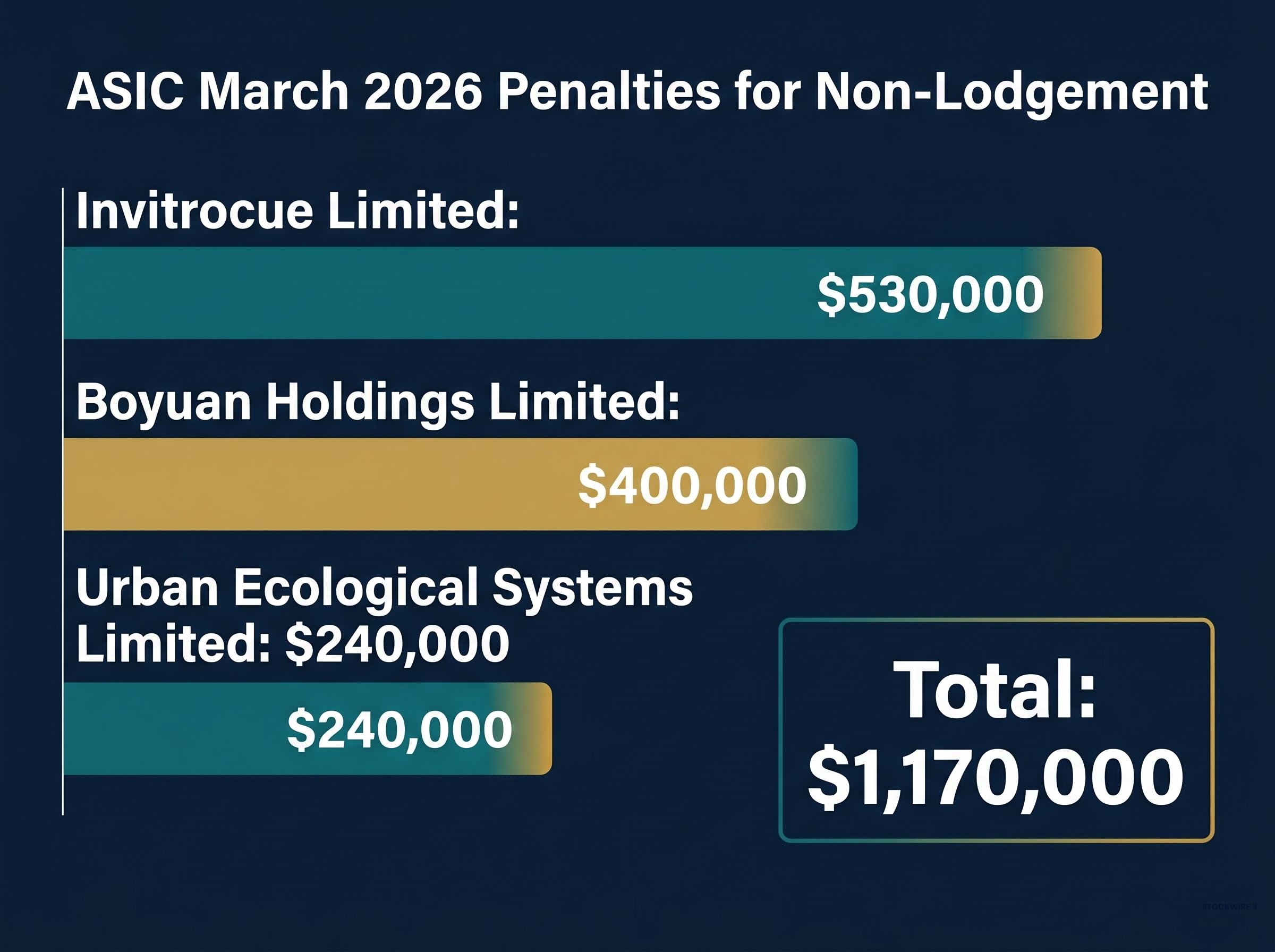
None of these were one-off lapses. All three companies failed to lodge annual financial reports across multiple consecutive years, stretching back to financial years ending in 2020. Invitrocue and Boyuan Holdings also faced separate charges for failing to maintain the minimum number of company officeholders required by law, with gaps running through to January 2026.
ASX listing requirements establish the baseline obligations every public company accepts when it enters the market, and the penalties handed down in this case illustrate what happens when companies treat those obligations as optional rather than as legally enforceable conditions of remaining listed.
The convictions are confirmed in ASIC media release 26-058MR, which sets out the charges against each company, the specific statutory provisions breached, and the penalty amounts handed down at Downing Centre Local Court on 17 March 2026.
| Company Name | Penalty Amount | Years of Non-Lodgement | Additional Violations |
|---|---|---|---|
| Invitrocue Limited | $530,000 | FY2020-FY2025 (30 June) | Failed to maintain three directors (29 May 2023 to 22 January 2026) |
| Boyuan Holdings Limited | $400,000 | FY2020-FY2024 (31 December) | Failed to maintain one company secretary (from 15 July 2023) and three directors (from 15 February 2023), both through 30 January 2026 |
| Urban Ecological Systems Limited | $240,000 | FY2020-FY2025 (30 June) | None |
$1,170,000 in penalties across three companies for failures stretching back to 2020.
When big ASX news breaks, our subscribers know first
What the Corporations Act actually requires and why these charges exist
The penalties were not imposed for a single type of failure. The charges fell under distinct legal obligations, each carrying its own consequences.
Financial reporting obligations
Under sections 319(1) and 1311(1) of the Corporations Act, public companies must lodge annual financial reports, including audited financial statements, with ASIC. This is a statutory obligation, not a discretionary disclosure. The requirement exists so that shareholders and business counterparties have the information they need to make informed decisions, and to protect the integrity of Australia’s financial system.
Financial report lodgement and continuous disclosure obligations operate as parallel statutory duties under the Corporations Act, and ASIC has been prosecuting failures across both frameworks simultaneously in 2025 and 2026; a company that goes quiet on annual reports is frequently exhibiting the same governance breakdown that produces delayed or missing price-sensitive announcements.
Minimum officeholder requirements
Separately, sections 201A(2) and 204A(2) of the Corporations Act require public companies to maintain at least three directors and at least one company secretary at all times. Falling below these thresholds is charged as a distinct offence. When a company loses directors or a company secretary without replacing them, it is not merely an administrative gap; it is a legally separate governance failure.
The three categories of obligation are:
- Annual financial report lodgement with ASIC
- Maintenance of a minimum of three directors for public companies
- Maintenance of at least one company secretary for public companies
Understanding these as separate legal duties helps investors recognise that a company losing directors without replacement is a distinct warning sign from late financial reporting, even when both reflect the same underlying governance breakdown.
This is not a one-off: ASIC’s sustained enforcement campaign explained
The March 2026 convictions are one data point in a pattern that has been building for at least two years.
In December 2025, ASIC issued infringement notices totalling over $2.2 million to 12 large proprietary companies for alleged failure to lodge FY24 audited financial reports on time, with a minimum penalty of $187,800 per company. All 12 notices were paid in full. That action, reported in ASIC media release 25-298MR on 11 December 2025, targeted a different company category from the March 2026 court case, using a different enforcement mechanism.
ASIC media release 25-298MR details the December 2025 infringement notice campaign, including the surveillance methodology, the 217-company review scope, and the finding that 151 of those companies were allegedly non-compliant for FY23 and/or FY24.
“151 of 217 companies reviewed were allegedly non-compliant for FY23 and/or FY24.”
Of those 151 companies identified during a three-month surveillance programme, 103 subsequently lodged their outstanding reports after ASIC made contact. The scale of the compliance gap is substantial, and ASIC has been working through it systematically.
The regulator’s Corporate Plan 2024-28, published 29 August 2024, names non-lodgement as a continuing enforcement focus. Both Issue 3 (November 2025) and Issue 4 (May 2026) of ASIC’s reporting and audit update series reference enforcement for non-lodgement as a current priority. Two enforcement mechanisms are now running in parallel:
ASIC’s financial reporting priorities for FY2026-27 go further than whether a report was lodged at all; the regulator has designated revenue recognition, asset impairment, and financial instrument measurement as its three core scrutiny areas, meaning companies that do lodge reports face a second layer of review focused on the quality and reliability of the numbers inside them.
- Court proceedings for public companies, as seen in the March 2026 convictions
- Infringement notices for large proprietary companies, as seen in the December 2025 action
What retail investors should watch for if a listed company goes quiet
Retail investors have no access to non-public information. Every signal available to them comes from public ASX announcements, ASIC’s registers, or the company’s own disclosures. The following red flags, drawn from ASIC’s 2024-26 corporate plan and reporting and audit update series, translate the regulator’s enforcement framework into signals an ordinary investor can act on:
- Missing or very late annual or half-year reports with no detailed explanation
- ASX announcements about extensions or reporting issues without prompt follow-up financials
- Adverse or modified audit opinions, or sudden auditor resignation close to reporting deadlines
- Frequent board or CFO turnover, or failure to replace departed directors to maintain required minimums
- Announcements of funding stress, covenant breaches, or going-concern uncertainties without corresponding detailed financials
- Significant unexplained adjustments when financials eventually appear after a period of non-lodgement
ASIC’s enforcement framework treats failure to maintain the required number of directors as a charged offence. Board departures without replacements should be treated as a material governance signal, not routine turnover.
For investors in smaller-cap positions where public disclosures are sparse, short interest data as an early warning signal can complement the filing checks described here: institutional short sellers often begin building positions in response to governance deterioration weeks before any formal announcement or regulator action confirms the problem.
How to check a company’s filing status
Investors can search a company’s lodgement history directly on ASIC’s company registers and monitor ASX’s market announcements platform for any financial report delays or trading suspension notices. ASIC’s published reporting and audit updates, available on its website, name enforcement themes and in some cases flag specific compliance concerns.
The cost of silence is rising, and ASIC has said so publicly
The trajectory is clear: a 2025 surveillance programme covering 217 companies, $2.2 million in infringement notices to 12 large proprietary companies in December 2025, and $1.17 million in court-ordered penalties against 3 public companies in March 2026. The enforcement mechanism has escalated from administrative to judicial, and the penalties have followed.
ASIC’s own framing links these actions to investor protection. The regulator’s Corporate Plan 2024-28 describes its strategy as “supporting confident and informed investors and consumers” through enforcement of high-quality, timely disclosure.
ASIC frames its enforcement programme as “supporting confident and informed investors and consumers,” per its Corporate Plan 2024-28.
The compliance data tells its own story: 103 of 151 non-compliant companies lodged their outstanding reports after ASIC made contact in 2025. The threat of enforcement drives compliance. Voluntary lodgement before ASIC contact remains materially preferable to prosecution.
The enforcement calendar is clear, and shareholder protection is the stated reason
Multi-year non-lodgement is no longer a low-enforcement-risk strategy for listed companies. The March 2026 convictions are direct evidence that ASIC is prosecuting, not merely warning. Retail investors holding positions in small or thinly traded ASX-listed companies can take two practical steps: monitor portfolio companies’ lodgement history on ASIC’s registers, and treat board departures without timely replacements as a material governance flag. One limitation bears noting. ASIC enforcement is retrospective; investors who wait for a prosecution to act may find exit options limited in micro-cap stocks where liquidity is already thin.
This article is for informational purposes only and should not be considered financial advice. Investors should conduct their own research and consult with financial professionals before making investment decisions.