

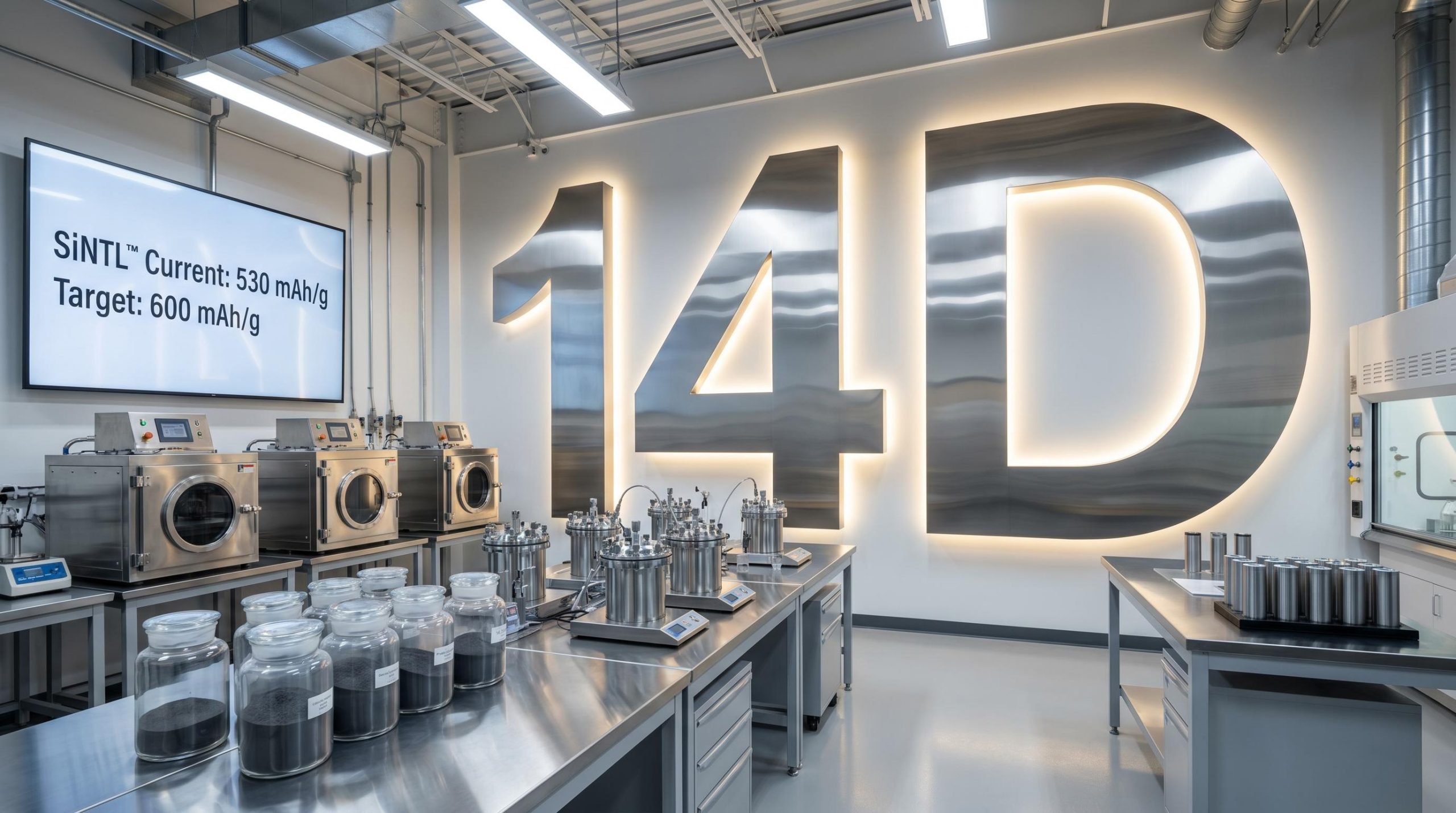
From lab to commercial engagement — SiNTL enters scale-up
1414 Degrees Limited (ASX: 14D) has commenced the scale-up phase of its SiNTL silicon anode material program, purchasing equipment at research partner George Washington University (GWU) in Washington D.C. to produce manufacturer-relevant quantities of the material. The move marks a deliberate transition from laboratory-scale development to the commercial engagement phase of the SiNTL commercialisation program.
Developed under an exclusive global licence with GWU, the program is led by Professor Michael Wagner’s team and has attracted inbound interest from companies seeking to trial SiNTL materials — a signal management has cited as validation of the decision to advance scale-up at this stage. To support the next phase, 1414 Degrees is also expanding its team, seeking industry experts in battery materials commercialisation, OEM engagement, and defence and aerospace market development.
When big ASX news breaks, our subscribers know first
What the scale-up unlocks — and why the market is ready
Scale-up capabilities and the path to OEM qualification
Scale-up is expected to deliver two outcomes: improved material consistency through more disciplined process control, and meaningfully larger production volumes. Both are required to support formal third-party material evaluations and structured OEM qualification processes, which characterise the next stage of the company’s commercialisation pathway.
SiNTL’s process differentiation is a central part of the commercial proposition. The material is produced via a low-temperature (125–180°C), single-step synthesis process with approximately 97% demonstrated yield. The process avoids hazardous reagents such as hydrofluoric acid or silanes and does not require chemical vapour deposition infrastructure, making it compatible with conventional lithium-ion battery production lines.
Full-stack battery development commences
In parallel with scale-up, 1414 Degrees has begun engagement with full-stack contract battery manufacturers to produce complete battery cells incorporating SiNTL anode material. Target applications include drone, UAV, satellite, robotics, and aircraft platforms.
These cells are intended to generate real-world performance data to support commercial and defence-sector qualification processes, providing a tangible evidence base for OEM partners evaluating the technology.
Peter Yaron, Chief Technology and Operations Officer
“The commencement of scale-up is a natural and planned next step for the SiNTL™ program. We have demonstrated the performance of the material at laboratory scale and the focus now shifts to producing consistent, higher-volume quantities that enable formal third-party evaluation and meaningful OEM engagement. This is how laboratory results become commercial outcomes.”
Understanding silicon anode technology and why it matters for batteries
Graphite is the current standard anode material in lithium-ion batteries, with a theoretical capacity of approximately 372 mAh/g. Silicon offers a theoretical capacity of approximately 3,600 mAh/g, nearly ten times that of graphite, making it a significant area of focus for next-generation battery development.
SiNTL’s current demonstrated result is 530 mAh/g, with a near-term target of 600 mAh/g. That target represents more than 50% above conventional graphite anodes and approximately 20% above current commercial silicon-enhanced anode benchmarks. For drone and UAV operators specifically, higher energy density translates directly to longer flight time, greater payload capacity, and faster recharge capability.
| Anode Material | Theoretical Capacity | SiNTL Position | Key Advantage |
|---|---|---|---|
| Graphite (standard) | ~372 mAh/g | Baseline | Established, low cost |
| Commercial silicon-enhanced | ~500 mAh/g | Below SiNTL target | Incremental improvement |
| SiNTL (current) | 530 mAh/g | In development | Clean synthesis, high yield |
| SiNTL (target) | 600 mAh/g | Near-term milestone | 50%+ above graphite |
Market opportunity — drones, defence, and a $25 billion battery materials wave
The drone and UAV market represents the near-term commercial entry point for SiNTL. Commercial and military platforms typically operate within cycle life envelopes well matched to the technology’s current development stage, while placing a premium on energy density, payload capacity, and rapid recharge capability.
Policy momentum is reinforcing the opportunity. The Australian Government committed $5 billion in new defence drone spending in April 2026, citing lessons from conflicts in Ukraine and the Middle East. Separately, US policy has formalised the treatment of small drones as expendable assets equivalent to ammunition, indicating sustained procurement demand across allied defence forces.
The market figures framing this opportunity are substantial:
- Global commercial and military drone market forecast: approximately US$160 billion by 2030
- Silicon anode battery market: projected to grow from USD 0.4 billion in 2025 to USD 25.8 billion by 2035, at a CAGR of 51.7%
With scale-up equipment procurement underway, full-stack battery cell development commencing, and inbound commercial interest already received, 1414 Degrees has indicated that the current pathway is designed to identify and pursue potential early revenue opportunities as OEM qualification processes advance.
Don’t Miss the Next Battery Technology Breakthrough on the ASX
Get FREE breaking ASX manufacturing and technology news delivered to your inbox within minutes of release, complete with in-depth analysis already done for you. Join 20,000+ subscribers who stay ahead of the market the moment news breaks. Click the “Free Alerts” button at Big News Blast to start receiving alerts today.