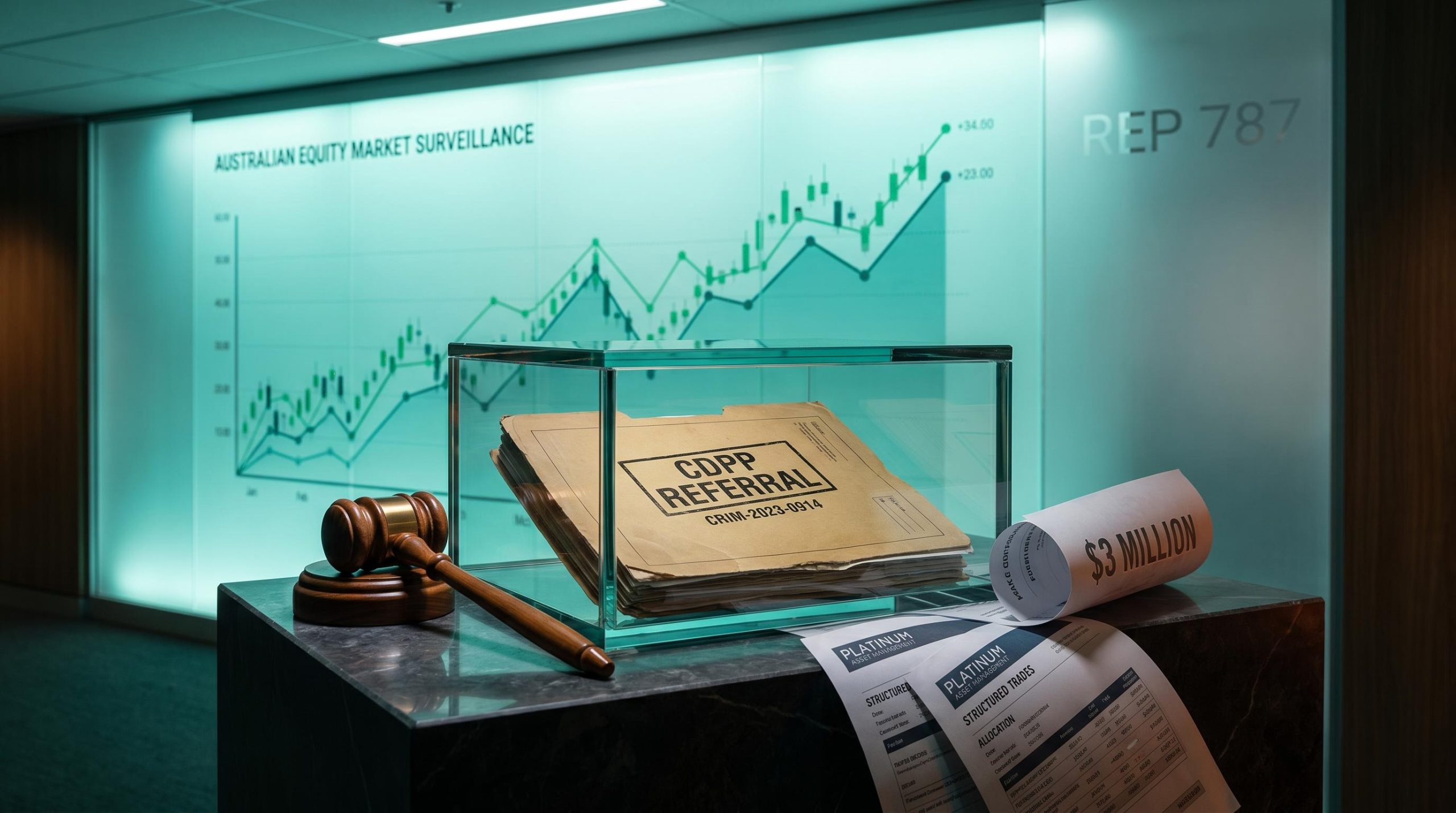
Australia’s equity markets rank among the cleanest in the world. That is not an assumption or a marketing claim; it is the finding of ASIC’s own Report 787 (REP 787), published in July 2024, covering surveillance data from November 2018 through April 2024. The finding raises an obvious question. If the data is that strong, why did ASIC spend the latter months of 2024 building a dedicated insider trading team, then carry insider trading forward as a formal enforcement priority into both 2025 and 2026? The answer lies in how market integrity actually works: it is manufactured by enforcement effort, not inherited. What follows is an analysis of what ASIC has changed structurally, what the Rodney Forrest prosecution reveals about how the new machinery operates in practice, and what the combined signals mean for investors, compliance professionals, and anyone operating in or adjacent to Australian equity markets.
From clean to cleaner: why ASIC is investing more when the data looks good
The paradox dissolves once the causal arrow is pointed in the right direction. REP 787’s finding that Australian equity markets ranked consistently among the world’s cleanest across a six-year measurement period is not evidence that enforcement investment can be reduced. It is evidence that the enforcement investment already deployed was working.

Australian equity markets ranked consistently among the world’s cleanest over the November 2018 to April 2024 period measured in ASIC Report 787, the regulator’s most recent published market cleanliness benchmark.
A clean market creates its own enforcement demand. High integrity scores set a compliance expectation among domestic and international participants that the regulatory environment will continue to detect and punish misconduct. That expectation requires ongoing credibility to sustain. The moment enforcement intensity drops below the threshold needed to maintain deterrence, the cleanliness data becomes a lagging indicator of a deteriorating reality.
REP 787 remains the most recent ASIC-published market cleanliness benchmark as of May 2026; no successor report has been released. The sections that follow examine how ASIC has responded to that baseline not with complacency, but with a structural escalation designed to protect it.
The market cleanliness methodology ASIC applies in REP 787 is narrower than most investors assume: it measures the statistical footprint of informed trading ahead of price-sensitive announcements, and a low score reflects the absence of a detectable pattern rather than a confirmed zero incidence of insider trading.
When big ASX news breaks, our subscribers know first
The structural shift: what building a dedicated insider trading team actually means
In late September 2024, ASIC stood up a specialist insider trading team and aligned it explicitly with the regulator’s 2025 enforcement priorities framework. The decision was not a routine administrative reorganisation. Specialist teams change how enforcement operates at the operational level.
Three specific capabilities shift when a regulator moves from generalist allocation to dedicated resourcing:
- Accelerated investigation timelines, because investigators are not rotating between unrelated misconduct categories
- Higher volume of criminal briefs referred to the CDPP, because the team’s sole mandate is to generate prosecutable cases
- Concentrated expertise, allowing investigators to develop pattern recognition across concurrent and sequential insider trading matters rather than treating each case in isolation
Each of these changes compounds over time. A generalist team that handles insider trading alongside market manipulation, continuous disclosure failures, and other misconduct forms cannot build the institutional memory that a dedicated unit accumulates within months of operation.
Why two consecutive years of priority status matters more than one
A single-year priority listing can reflect a reactive response to a specific incident or a political moment. ASIC’s decision to carry insider trading forward into its 2026 enforcement priorities, after the dedicated team had already been operational for a full year, signals something different: institutionalised strategic intent.
The consecutive-year designation indicates the structural investment is expected to generate sustained enforcement output rather than a one-cycle surge. It also communicates to the market that ASIC views insider trading risk as persistent and systemic, not episodic.
ASIC’s 2026 enforcement priorities documentation confirms that insider trading was carried forward as a designated focus area following the dedicated team’s first full year of operation, providing the formal policy basis for the consecutive-year designation discussed throughout this analysis.
Inside the enforcement pipeline: from investigation to CDPP referral
Understanding how criminal insider trading enforcement works in Australia requires understanding a division of responsibility that is not always visible to market participants. ASIC investigates. The Commonwealth Director of Public Prosecutions (CDPP) prosecutes. ASIC does not bring criminal insider trading charges itself.
The enforcement pipeline operates in four sequential stages:
- ASIC investigation: The regulator gathers evidence, conducts interviews, analyses trading data, and builds the factual basis of a case
- ASIC referral to CDPP: ASIC prepares a criminal brief and refers it to the CDPP for assessment
- CDPP prosecution decision: The CDPP evaluates whether the brief meets the evidentiary threshold for prosecution
- Court proceedings: If the CDPP proceeds, the matter enters the criminal court system

The dedicated team’s design targets the handover point between stages one and two. By increasing both the volume and quality of criminal briefs referred to the CDPP, the team addresses where the prior pipeline bottleneck sat. The implication for market participants is direct: a matter referred to the CDPP is a matter ASIC has already assessed as criminally prosecutable. The referral itself is a significant escalation signal.
| ASIC (Investigation) | CDPP (Prosecution) |
|---|---|
| Conducts surveillance and identifies suspicious trading | Evaluates criminal briefs for evidentiary sufficiency |
| Gathers evidence and conducts formal interviews | Decides whether to proceed with prosecution |
| Prepares and refers criminal briefs to the CDPP | Presents the case in court proceedings |
| Provides ongoing investigative support during trial | Manages sentencing submissions and appeals |
Both the Financial Conduct Authority (FCA) in the UK and the Securities and Exchange Commission (SEC) in the US treated insider trading and market abuse as core enforcement priorities across 2024 and 2025, situating ASIC’s approach within a broader global enforcement posture rather than an isolated national initiative.
The Forrest case as a working demonstration of escalated enforcement
The prosecution of Rodney Forrest, a former investment manager who traded Platinum Asset Management shares using inside information, provides the most concrete available evidence of how ASIC’s enforcement escalation translates into court outcomes.
ASIC investigated the matter in approximately six months before referring it to the CDPP. Forrest entered a guilty plea at first mention in August 2025 at the Downing Centre Local Court. The value of shares involved exceeded $3 million.
The ASIC enforcement pipeline from surveillance through to custodial sentence was completed in approximately one year in the Forrest matter, a timeline that reflects the operational tempo the dedicated team was designed to achieve and that distinguishes it from the longer cycles typical of generalist investigative arrangements.
| Case Milestone | Date | Key Detail |
|---|---|---|
| ASIC investigation | Approximately six months prior to CDPP referral | Evidence gathering and formal interviews conducted |
| Guilty plea entered | August 2025 | Downing Centre Local Court, plea at first mention |
| Original sentence | 23 January 2026 | Six years’ imprisonment (ASIC media release 26-104MR) |
| Appeal outcome | Post-January 2026 | Reduced to five years and three months; appeal succeeded on basis that the original judge incorrectly factored false denials into objective seriousness |
| Earliest parole eligibility | 23 January 2029 | Non-parole period of three years unchanged on appeal |
The original sentence of six years, handed down on 23 January 2026, was reduced on appeal to five years and three months. The appeal succeeded on a specific legal ground: the original sentencing judge had incorrectly factored Forrest’s false denials during ASIC interviews into the assessment of objective seriousness, rather than limiting their consideration to remorse and plea weight. The three-year non-parole period was unchanged, leaving earliest parole eligibility at 23 January 2029.
The Full Court characterised Forrest’s conduct as premeditated, planned, involving a considerable breach of trust, and executed with a high degree of sophistication. General deterrence was identified as the primary sentencing consideration.
The sentencing language sends a direct signal. Courts are treating this category of offending with the weight ASIC’s structural investment implies it deserves.
What “sophisticated misconduct” signals about who ASIC is targeting
The Full Court’s characterisation of Forrest’s conduct is not incidental to the broader enforcement picture. It profiles the type of misconduct ASIC’s dedicated team is structurally positioned to pursue.
“Sophistication” in an enforcement context carries specific meaning. It implies insiders with privileged information access, structured trading designed to avoid detection, and deliberate concealment. The Forrest case exhibited all three:
- Structured information access: Forrest held a position that gave him direct access to material, non-public information about Platinum Asset Management
- Deliberate concealment strategy: Trading was executed in a manner designed to reduce the likelihood of triggering surveillance alerts
- False denials during regulatory interviews: Forrest made false statements during initial ASIC interviews, conduct that itself became legally consequential
Continuous disclosure obligations create the structural condition that makes insider trading possible: the gap between the moment material information becomes known internally and the moment it reaches the market is the window in which informed trading can occur, and ASIC’s enforcement of both regimes is explicitly linked in its corporate plan.
The appeal ground reveals something compliance professionals and legal advisers should note carefully. ASIC’s investigative interviews are a formal evidentiary step, not informal conversations. The original judge’s error was not in considering Forrest’s false denials, but in applying them to the wrong part of the sentencing calculus. The denials themselves remained on the record as evidence of the sophistication and deliberateness of the concealment effort.
General deterrence as the primary sentencing consideration reinforces the point. The court was not only punishing Forrest; it was calibrating the sentence to discourage others who occupy similar positions from similar conduct.
What the enforcement signal means for Australian equity markets going forward
Three layers of signal now sit on top of each other. ASIC has made a structural investment by creating a dedicated team. It has made a policy commitment through consecutive-year priority designation in 2025 and 2026. And the courts have reinforced the deterrence framework through a substantial custodial outcome in the Forrest prosecution.
These signals are not in tension with REP 787’s clean-market findings. They are mutually reinforcing. The strong integrity scores from July 2024 make the enforcement infrastructure more credible, not less necessary. A regulator that protects a good record sends a different signal to the market than one scrambling to repair a damaged one.
The practical implications differ by audience:
- Investors: Heightened enforcement activity strengthens the integrity of the market in which capital is deployed, but it also increases the probability that misconduct by counterparties or portfolio companies will surface, potentially creating short-term price disruption
- Compliance professionals: The dedicated team’s focus on sophisticated, premeditated misconduct raises the standard for insider trading control frameworks, particularly around information barriers, personal trading monitoring, and the treatment of regulatory interviews
- Finance professionals more broadly: The consecutive-year priority and the Forrest sentencing outcome establish a new baseline for how seriously market conduct obligations are being enforced, one that is unlikely to soften while the specialist team remains operational
Australia’s market integrity record is an asset worth defending actively
The high cleanliness scores in REP 787 represent the output of sustained enforcement effort, not an inherent quality of the market that maintains itself without intervention. ASIC’s structural investments, the dedicated insider trading team established in late September 2024, the consecutive-year priority designation across 2025 and 2026, and the substantial custodial outcome in the Forrest prosecution, protect that standing by ensuring the deterrence signal remains credible.
For those seeking to stay current on the regulatory environment, ASIC’s published enforcement priorities documentation and REP 787 remain the primary authoritative resources.
For compliance professionals wanting to map the full scope of ASIC’s current enforcement posture across their organisation, our full explainer on ASIC’s FY2026-27 financial reporting priorities covers the three accounting domains under active surveillance, the new public accountability mechanism for audit remediation, and the first mandatory cycle of sustainability reporting obligations for Group 1 entities.
This article is for informational purposes only and should not be considered financial advice. Investors should conduct their own research and consult with financial professionals before making investment decisions.