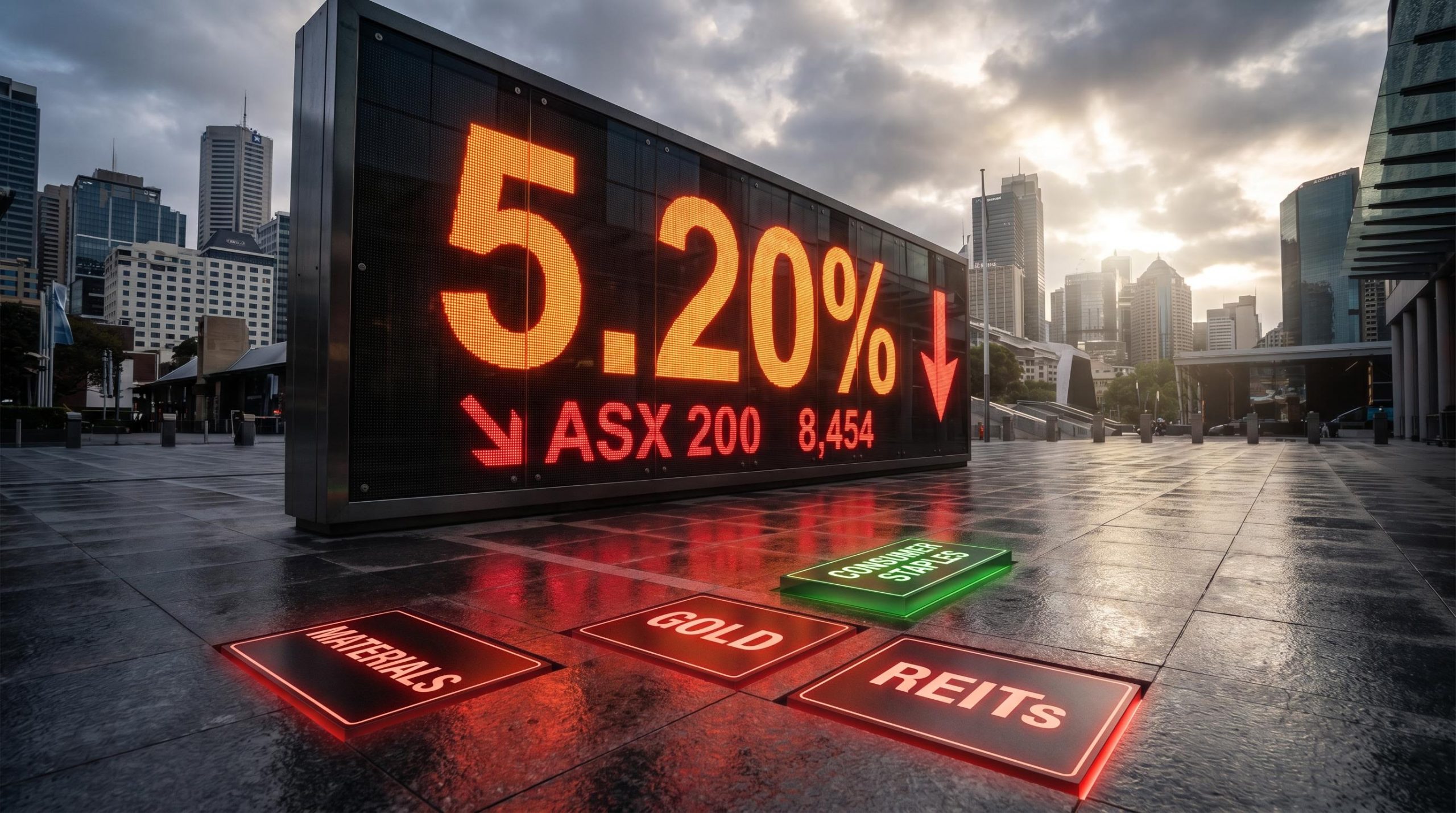
The US 30-year Treasury yield hit 5.20% on 20 May 2026, a level not seen since before the Global Financial Crisis, and Australian equities absorbed the blow in a single session. The S&P/ASX 200 closed at 8,454, shedding approximately 151 points (down 1.75%) as the global bond market repricing collided with an already tightened domestic rate environment. The RBA’s cash rate sits at 4.35% following its third hike of 2026, effective 6 May, meaning investors faced a global yield shock layered on top of a domestic tightening cycle running in the same direction. What follows is a breakdown of how the sell-off transmitted through sectors, why bond yields mechanically compress equity valuations, and how to read the defensive rotation into Consumer Staples as a signal rather than noise.
The 5.20% yield that shook the ASX
The US 30-year yield at 5.20% is the highest level since before the Global Financial Crisis.
The number carries weight on its own. The last time long-dated US government debt demanded this much compensation from investors, Bear Stearns still existed.
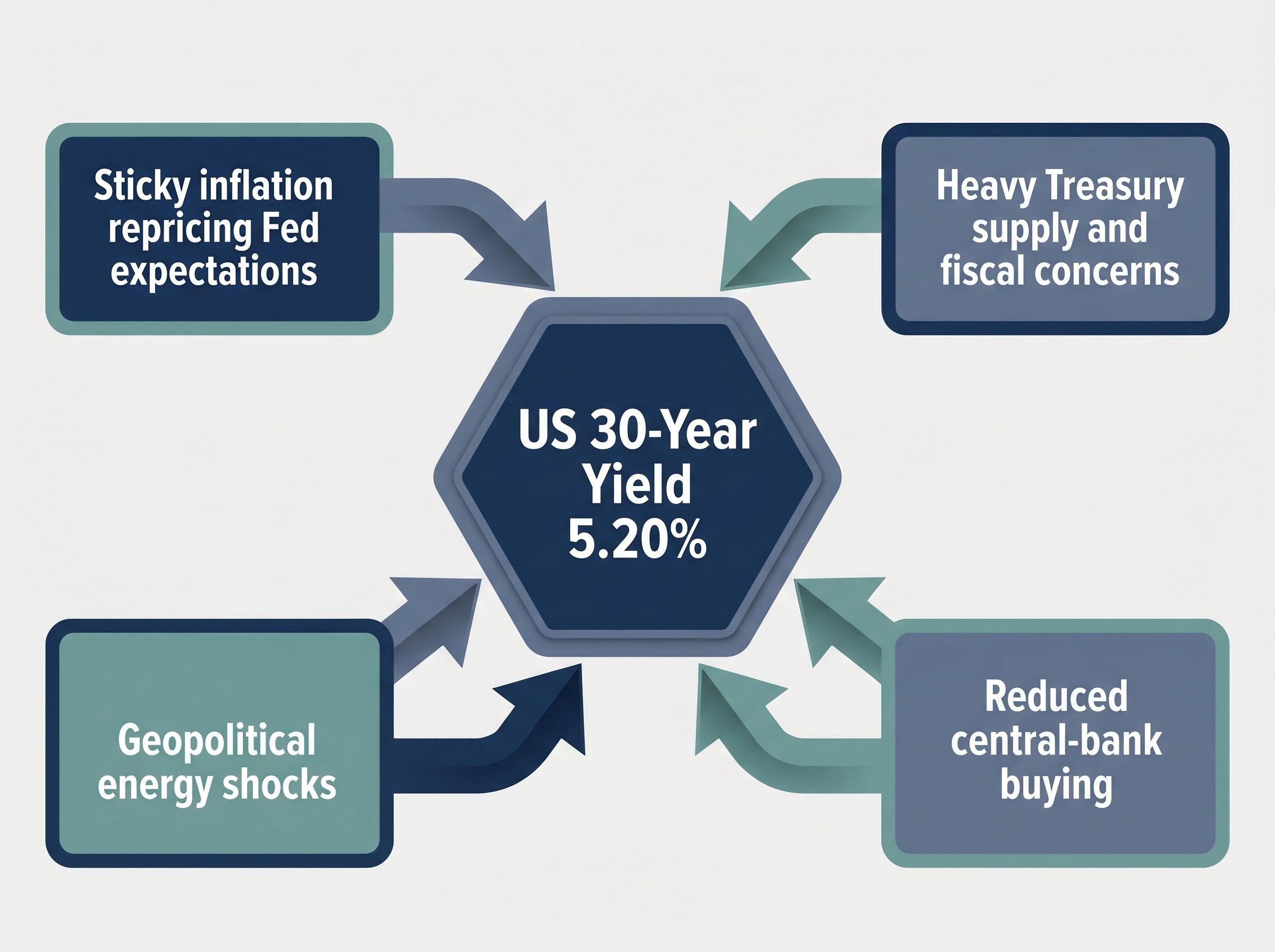
But this was not a single-cause event. The yield surge reflects a pressure system built from four converging forces:
- Sticky inflation repricing Fed expectations: Core US inflation and wage data came in above consensus, forcing markets to push out the timing and scale of Federal Reserve rate cuts, with some probability of renewed hikes priced in.
- Heavy Treasury supply and fiscal concerns: Persistent US fiscal deficits require sustained issuance at the long end. Recent 30-year auctions have seen weak bid-to-cover ratios, lifting the term premium investors demand to hold duration risk.
- Geopolitical energy shocks: The ongoing Middle East conflict has added a risk premium to inflation expectations, pushing both breakeven inflation and real yields higher.
- Reduced central-bank buying: In the post-quantitative-easing environment, CTA strategies, convexity hedging, and lower official-sector demand have amplified the sensitivity of long-end yields to incremental data.
The global trigger hit an Australian market already under pressure. The RBA’s 4.35% cash rate, the third hike of 2026, means domestic investors absorbed the shock with no monetary policy cushion underneath them. The All Ordinaries fell 1.27% to 8,717.0. The Small Ordinaries dropped 2.12% to 3,314.3, reflecting the amplified risk premium smaller companies face when rates rise across both hemispheres.
The RBA’s third consecutive hike to 4.35%, decided on 5 May 2026 with eight of nine Board members voting in favour, produced a domestic tightening overlay that compounds every global yield shock rather than cushioning it, because Australian investors now face no buffer from accommodative local policy.
When big ASX news breaks, our subscribers know first
Why rising bond yields pull equity markets lower
The connection between bond yields and share prices is mechanical, not speculative. Understanding the mechanism converts every future yield-driven sell-off from a surprise into a pattern.
The discount rate explained
The logic runs in three steps:
- Government bond yields rise, lifting the “risk-free” rate of return available to investors.
- The discount rate used to value future company earnings rises in tandem, because equity investors demand a return above the risk-free alternative.
- The present value of those future earnings falls, even if the earnings themselves have not changed, and share prices adjust downward.
The mechanics of discount rate compression are not unique to this session; on 18 May 2026, simultaneous multi-decade yield highs across the US, UK, Japan, and Australia demonstrated that a move from 2% to 5% can reduce the present value of a perpetual income stream by as much as 60% with no change to the underlying business.
Higher yields set a higher bar for equities to clear. When the 30-year Treasury offers 5.20% with sovereign backing, every dollar of future corporate profit must justify a premium above that rate, or capital moves to bonds.
What is a bond proxy?
Certain equity sectors are purchased primarily for their income streams rather than their growth potential. Real estate investment trusts and utilities are the clearest Australian examples; investors hold them for stable dividends, much as they would hold a government bond for its coupon.
When government bond yields rise, these sectors must re-price their own yields upward (meaning share prices fall) to remain competitive with risk-free alternatives. The 20 May session demonstrated this precisely: 239 stocks declined against just 42 advancers in the ASX 300, and the index closed within 0.1% of its intraday low, confirming persistent sell pressure throughout the day rather than a brief panic. The Australian dollar slipped 0.04% to US$0.7104, reflecting the broader risk-off tone.
Sectors that bore the brunt, and one that didn’t
The session sorted the ASX by yield sensitivity with near-mechanical precision.
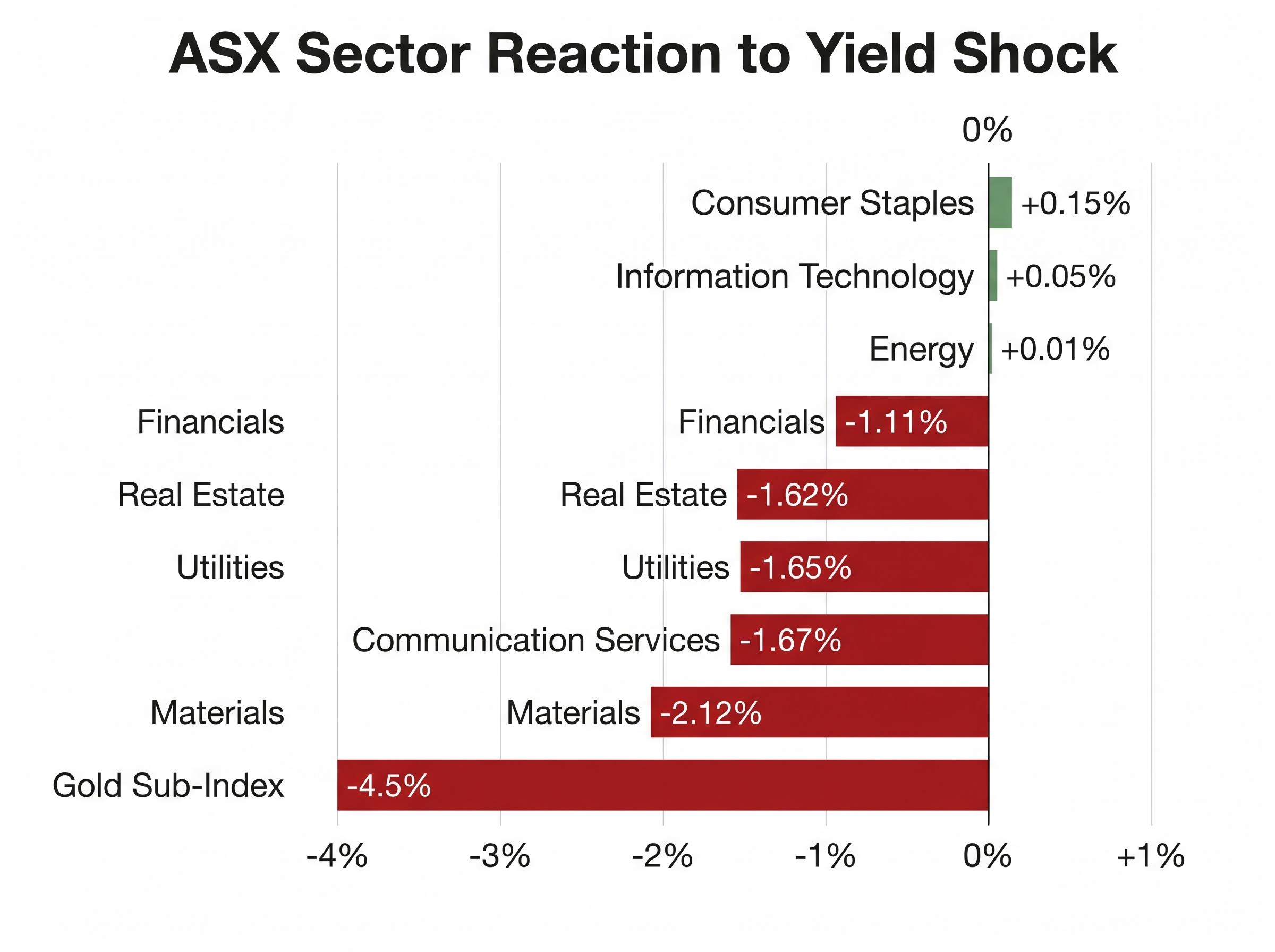
| Sector | Index Code | Session Change (%) | Yield Sensitivity |
|---|---|---|---|
| Materials | XMJ | -2.12% | High |
| Gold Sub-Index | XGD | -4.5% | High |
| Communication Services | XTJ | -1.67% | High |
| Utilities | XUJ | -1.65% | High |
| Real Estate | XPJ | -1.62% | High |
| Financials | XFJ | -1.11% | Medium |
| Consumer Staples | XSJ | +0.15% | Low |
| Information Technology | XIJ | +0.05% | Medium |
| Energy | XEJ | +0.01% | Low |
Materials led the losses. BHP fell 2.3%, Rio Tinto shed 1.5%, and Fortescue dropped 1.2% as SGX iron ore futures declined 0.7% to US$107.20 per tonne, marking a fifth straight session of losses.
Gold miners suffered the sharpest pain. COMEX gold futures fell 1.0% to US$4,467 per ounce as higher real yields reduced gold’s appeal as a non-yielding asset. West African Resources dropped 5.2%, Westgold Resources fell 5.0%, Greatland Gold lost 6.3%, and Evolution Mining declined 4.9%. Producers face a dual squeeze: lower gold revenue alongside rising energy input costs.
Gold’s dual headwind in this environment, stronger US real yields suppressing prices while rising energy input costs compress producer margins, explains why a 1.0% fall in COMEX gold futures produced outsized 5-6% declines in individual ASX gold miners rather than the proportionate moves a simple price-to-revenue model would predict.
Financials present a more complex picture. The sector fell 1.11%, with Westpac down 2.4%, ANZ off 2.1%, and Macquarie losing 2.0%.
Morgan Stanley has warned that the pace of change in operating conditions for Australia’s major banks is the fastest in 25 years, citing the RBA’s rapid policy reversals, potential property tax concession changes, and the global energy shock pushing up inflation and wholesale funding costs.
Consumer Staples was the sole sector to post a gain, rising 0.15%. Woolworths and Coles both edged higher as investors rotated into non-discretionary revenue streams insulated from credit conditions.
Reading the defensive rotation playbook
The Consumer Staples gain was not an anomaly. Defensive rotation into non-cyclical sectors during bond-yield spikes is a repeating, globally documented pattern.
Woolworths and Coles serve as Australia’s domestic equivalents of global defensive names such as Procter and Gamble and Nestlé. Their revenue base is non-discretionary: households purchase groceries regardless of the interest rate environment. The characteristics that define a defensive sector in this context are consistent:
- Non-discretionary revenue that holds up across economic cycles
- Low debt relative to earnings, reducing sensitivity to refinancing costs
- Stable dividend streams underpinned by recurring cash flows
- Low correlation to credit conditions and yield-curve movements
Health Care (XHJ) reinforced the pattern, falling just 0.23%, the second most resilient sector on the day.
ASX 300 breadth: 239 decliners to 42 advancers.
That ratio confirms this was not a targeted sector rotation. It was broad-based risk-off positioning, with capital concentrating into the narrowest set of defensive names. The ASX 200 closed within 0.1% of its intraday low, meaning selling pressure did not ease at any point during the session. When breadth is this negative and the close is this weak, the movement reflects institutional conviction rather than retail panic.
What comes next for Australian investors
Three data releases in the coming days will determine whether the yield pressure is peaking or accelerating:
- US FOMC minutes (Thursday): the detail behind the Fed’s most recent decision will reveal how seriously members discussed renewed tightening, shaping expectations for the US rate path.
- Australian April employment data (Thursday): consensus forecasts +15,700 jobs with unemployment steady at 4.3%. A stronger print would reinforce the case for further RBA tightening.
- US Flash May PMI data: Manufacturing PMI is forecast at 53.6 (prior 54.5) and Services PMI at 51.1 (prior 51.0). Any upside surprise would add fuel to the yield surge.
China’s PBOC held both its 1-year (3.0%) and 5-year (3.5%) Loan Prime Rates steady on 20 May 2026, removing one potential additional headwind from Chinese monetary policy tightening.
Key technical levels to watch
Supply resistance sits in the 8,678-8,745 range, aligned with short- and long-term downtrend ribbons. Demand support lies in the 8,262-8,379 zone. The index closing near its intraday low signals sellers remain in control entering the next session.
If Thursday’s data confirms persistent US inflation and resilient employment, the yield pressure is unlikely to ease quickly. Rate-sensitive sectors on the ASX would face continued valuation headwinds under that scenario.
The bigger picture: when US bond markets write the ASX’s script
The 20 May session is not an exception. It is the transmission mechanism working as designed. US macro data drives yield expectations. Yields drive the US dollar. The dollar drives commodity prices. All three simultaneously feed into the discount rates applied to Australian equity valuations.
This transmission mechanism had already run in an earlier prior ASX selloff episode on 8 May 2026, when a single overnight Strait of Hormuz military exchange erased an estimated $100 billion in Australian market capitalisation through the same two channels operating on 20 May: rising bond yields compressing dividend-paying equity valuations and an oil price spike feeding inflation expectations.
The RBA’s 4.35% cash rate compounds the effect. Three hikes in 2026 mean Australian investors carry a domestic tightening overlay that amplifies every global yield shock in a way that would not apply if rates were accommodative.
When US long-end yields spike, the following checklist applies:
- Bond proxies de-rate: REITs and utilities face immediate valuation compression as their income streams lose competitiveness against risk-free yields
- Gold miners face a dual squeeze: higher US real yields strengthen the dollar and suppress gold prices, compressing earnings for producers across the cost curve
- Risk-off flows favour defensives: Consumer Staples and Health Care attract rotational capital from rate-sensitive and cyclical names
- The domestic rate overlay amplifies all of the above: the RBA’s tightening cycle removes the buffer that lower domestic rates would otherwise provide
The US 30-year yield at 5.20%, against an RBA cash rate of 4.35%, produced a session where 239 ASX 300 stocks fell and 42 rose. The pattern is structural. It will repeat.
This article is for informational purposes only and should not be considered financial advice. Investors should conduct their own research and consult with financial professionals before making investment decisions.
Past performance does not guarantee future results. Financial projections are subject to market conditions and various risk factors.