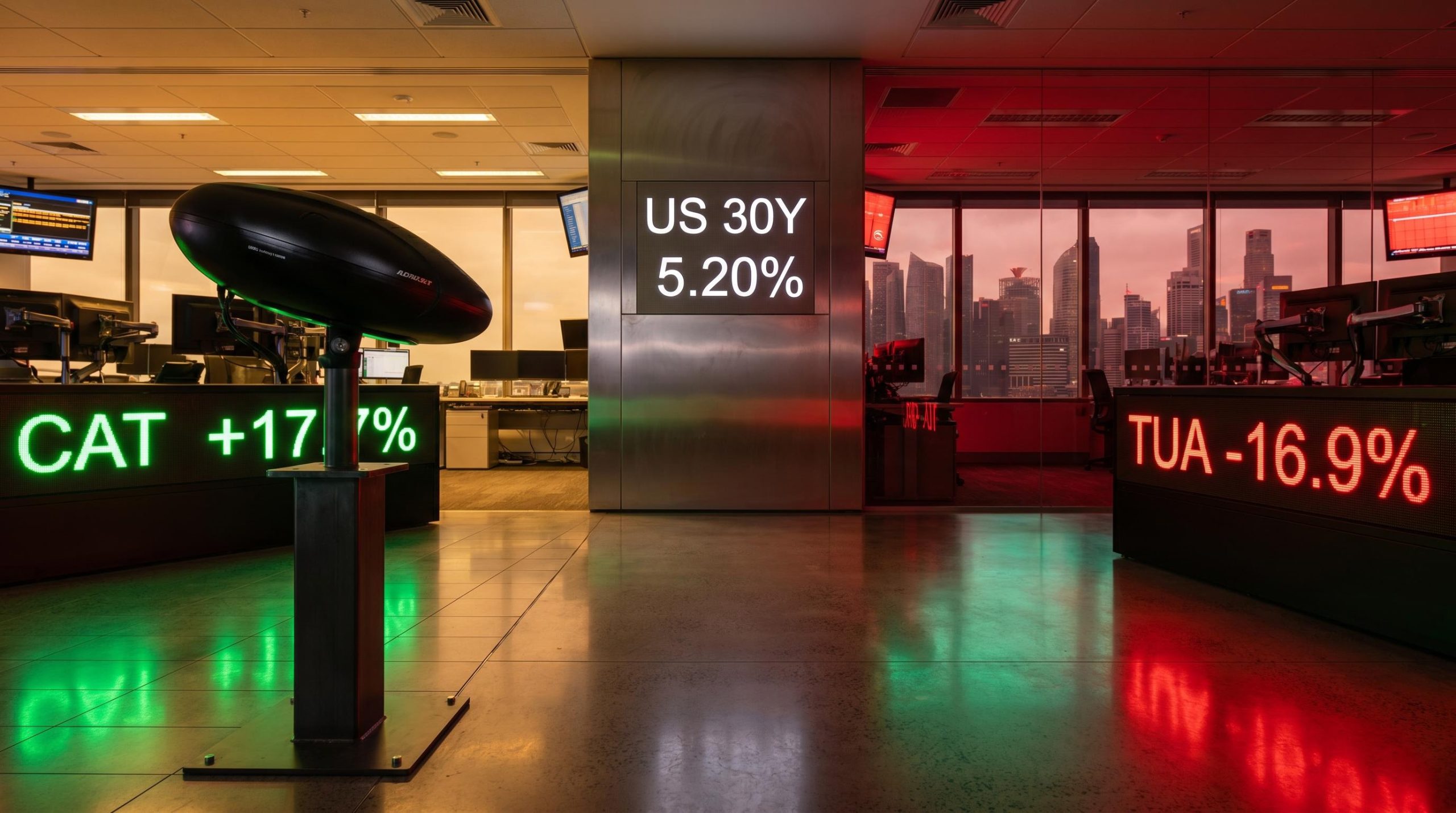
The S&P/ASX 200 fell 1.26% on 20 May 2026, dragged lower by rising global bond yields, but the session’s most striking moves had little to do with the macro backdrop. Catapult Sports surged 17.7% on full-year earnings. Tuas crashed 16.9% under a Singapore regulatory investigation. A profit warning sent Webjet Group down 11.2%, while gold and uranium stocks absorbed broad losses as the US 30-year Treasury yield hit levels not seen since 2007. The headline index number told one story; the individual stock movers on the ASX told several others entirely. What follows is a focused breakdown of each catalyst, the figures behind it, and what the move signals for investors watching these names.
Catapult Sports and Technology One lead the day’s gainers
Catapult Sports (CAT) delivered its FY26 results before the open, and the market’s verdict was immediate: a 17.7% gain by the close. The catalyst was a full-year earnings release lodged with the ASX at approximately 8:37 am, headlined by a management EBITDA figure that removed any ambiguity about the company’s operating trajectory.
Catapult Sports FY26 result: Management EBITDA of US$24.7 million, up 67% year-on-year.
That level of earnings growth, delivered through a period of broader tech-sector volatility, explains the conviction behind the buying. The result positioned Catapult as the session’s strongest individual gainer across the ASX 200.
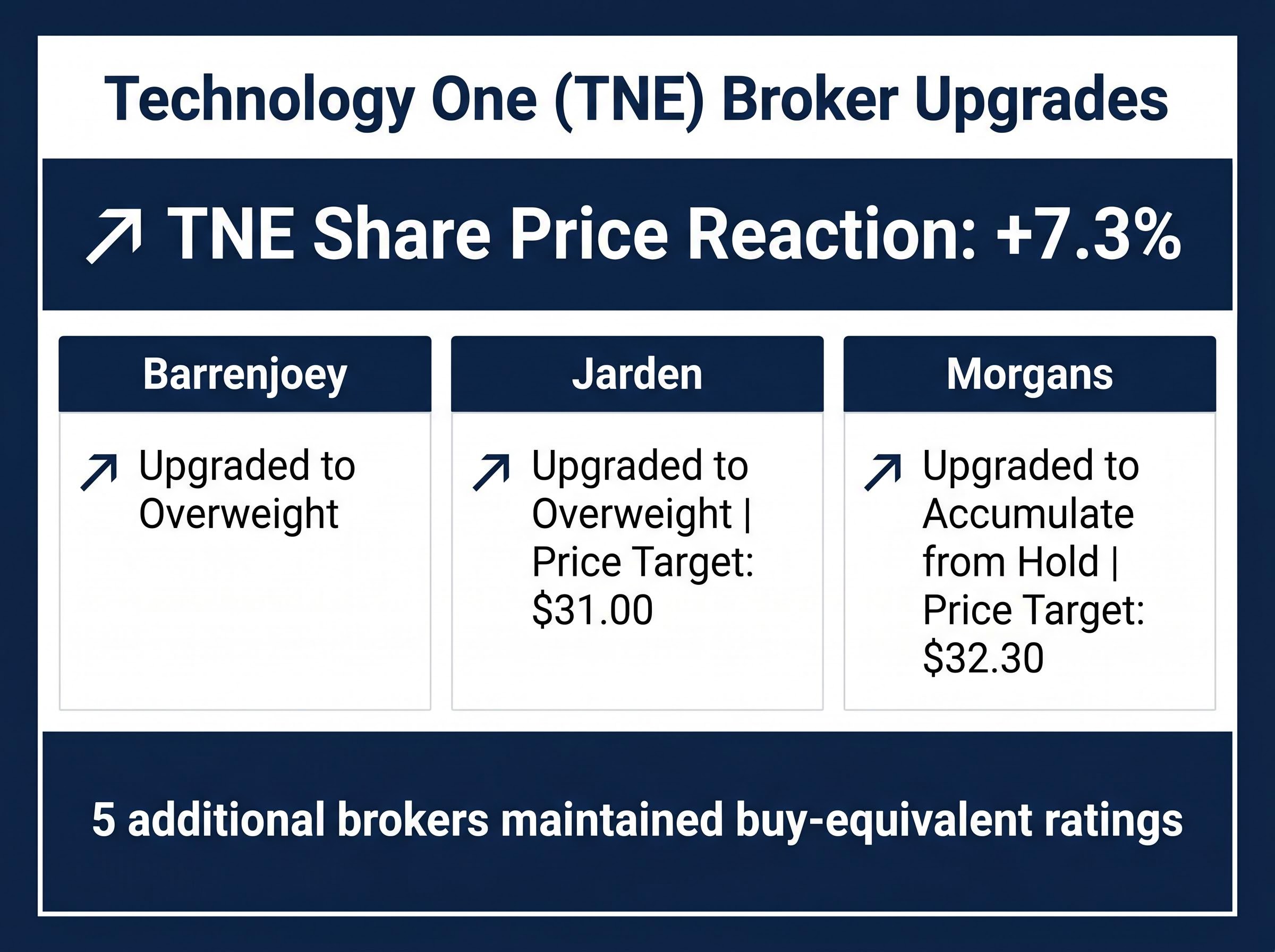
Technology One (TNE) rose 7.3%, propelled by a confluence of broker upgrades that landed on the same morning. Three houses moved simultaneously:
- Barrenjoey upgraded TNE to Overweight
- Jarden upgraded TNE to Overweight, with a price target of $31.00
- Morgans upgraded TNE to Accumulate from Hold, with a price target of $32.30
Five additional brokers maintained buy-equivalent ratings on TNE, reinforcing the post-results conviction rather than introducing fresh speculation. The coordinated upgrades reflect a shared institutional view that the company’s earnings trajectory supports a higher valuation.
Both stocks helped the Information Technology index (XIJ) finish the session up 0.05%, effectively flat while the broader market sold off. In a session dominated by red, these two names demonstrated that strong earnings and coordinated broker conviction can insulate individual stocks from macro-driven selling pressure.
When big ASX news breaks, our subscribers know first
What a Singapore regulator investigation means for Tuas investors
Understanding why Tuas (TUA) fell 16.9% on 20 May 2026 requires starting with the investigation itself, not the share price reaction.
Singapore’s Infocomm Media Development Authority (IMDA), the regulator responsible for overseeing telecommunications and media services in the city-state, is investigating Tuas’ Simba mobile brand for alleged unauthorised use of radio frequency bands. Radio spectrum is a licensed resource; using frequencies outside an operator’s allocation is a compliance matter that can carry penalties ranging from fines to licence restrictions.
The IMDA spectrum management framework establishes the licensing boundaries within which Singapore mobile operators must operate, with the authority explicitly empowered to investigate interference cases and identify transmitters operating outside their allocated frequencies.
No formal decision, fine, or investigation conclusion had been announced as of 20 May 2026. The investigation remains open and unresolved.
The Tuas half-year results published in March 2026 showed 26% revenue growth, a 523% surge in underlying NPAT, and a subscriber base exceeding 1.4 million, a financial profile that makes the investigation’s timing particularly disruptive given how much the Simba-M1 deal’s strategic rationale depends on that growth trajectory continuing.
The 16.9% decline was not a single-day shock. It marked Tuas’ third consecutive session of losses, indicating that investor concern has been building progressively as the regulatory uncertainty persists. Two distinct risk vectors are now priced into the stock:
- Standalone operational uncertainty: The IMDA investigation creates open-ended risk around potential penalties, remediation costs, or operating restrictions for the Simba brand
- Simba-M1 merger complication: The proposed combination of Simba and M1 faces heightened deal uncertainty while the investigation remains unresolved
How the investigation complicates the Simba-M1 merger timeline
The proposed Simba-M1 combination would consolidate two Singapore mobile operators under the Tuas umbrella. Regulatory clearance of the IMDA matter is a gating condition for deal certainty; a finding of non-compliance could delay, alter the terms of, or jeopardise the merger approval process.
No updated merger timetable or ASX announcement was filed by Tuas on 20 May 2026. For investors, this means neither the standalone risk nor the merger risk has a visible resolution timeline, a combination that markets tend to price with sustained, incremental selling rather than a single capitulation event.
The IMDA suspension of the M1 acquisition review, confirmed on 17 May 2026, established a critical timeline pressure point: the Share Purchase Agreement carries a long-stop date of 21 May 2026, meaning the deal could be extended, completed, or allowed to lapse within days of the session covered here.
Webjet Group’s profit warning and the Virgin Australia commission cut
Webjet Group (WJL) declined 11.2% on 20 May 2026 after the company flagged a material earnings headwind for FY27: a reduction in commissions paid by Virgin Australia to Webjet’s platform, effective 1 July 2026.
The mechanics are straightforward. Online travel platforms earn revenue partly through commissions paid by airlines for bookings processed through the platform. When an airline reduces that commission rate, the platform’s revenue per booking falls, and the impact recurs on every transaction going forward. This is not a one-off cost; it is a structural change to the revenue baseline.
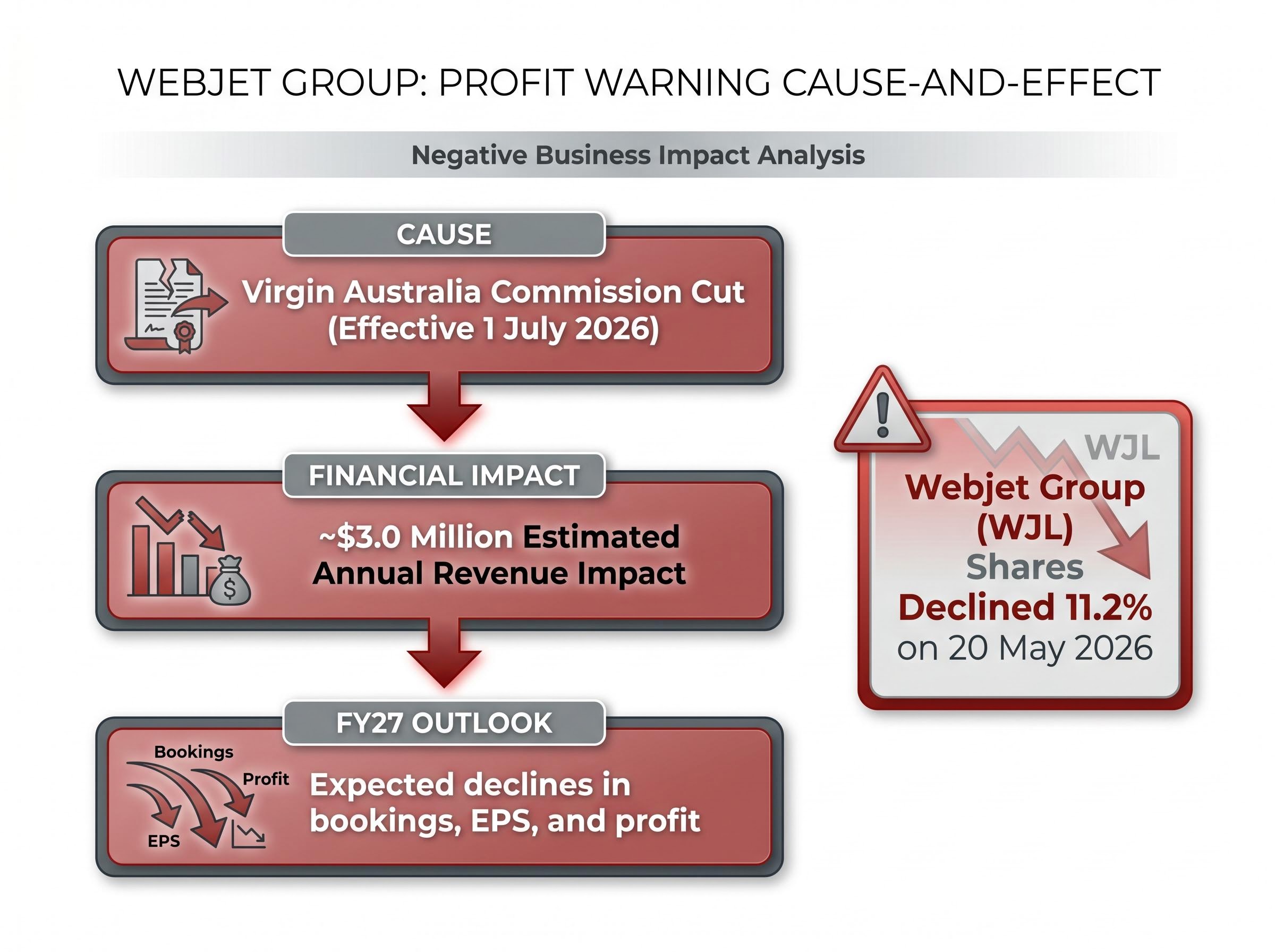
Webjet disclosed that the estimated revenue impact would be approximately $3.0 million if applied for a full prior fiscal year, giving investors a concrete measure of the headwind’s scale. The company also issued a subdued FY27 outlook, flagging expected declines in bookings, earnings per share (EPS), and profit, though no formal numeric guidance for those metrics was filed beyond the headwind disclosure.
| Headwind Factor | Detail |
|---|---|
| Commission change source | Virgin Australia |
| Effective date | 1 July 2026 |
| Estimated annual revenue impact | Approximately $3.0 million |
| Outlook for bookings | Expected decline (no numeric guidance filed) |
| Outlook for EPS and profit | Expected decline (no numeric guidance filed) |
Investors evaluating Webjet’s FY27 earnings trajectory should treat the $3.0 million impact as a recurring baseline reduction rather than an isolated event.
The Virgin Australia commission cut raises a broader structural OTA risk: early FY27 trading data showed OTA bookings already down 12% and total transaction value down 15% year-on-year before the commission reduction even takes effect, suggesting the revenue headwind arrives into a platform that was already contracting rather than growing.
Gold and uranium sectors absorb heavy losses as yields spike
The mechanism is familiar but the scale was not. Rising bond yields reduce the relative appeal of non-yielding assets like gold, and on 20 May 2026 that pressure arrived alongside rising oil prices, which push up diesel-linked operating costs at mine sites. Gold producers faced a two-part squeeze: the metal they sell became less attractive to hold, while the energy required to extract it became more expensive.
The US 30-year Treasury yield reached 5.20% on 20 May 2026, its highest level since 2007, anchoring the session’s risk-off repricing across commodity equities.
The global bond yield surge driving the session’s macro pressure has roots beyond a single data release; a Strait of Hormuz oil shock has been resetting inflation expectations across the US, UK, and Japan simultaneously, forcing markets to price in rate hikes rather than the cuts many portfolios were positioned for.
The Gold Sub-Index (XGD) fell 4.5%, with COMEX gold futures declining 1.0% to US$4,467 per ounce. The damage was broad rather than concentrated in any single name.
| Stock / ASX Code | Session Change |
|---|---|
| Greatland Gold (GGP) | -6.3% |
| West African Resources (WAF) | -5.2% |
| Westgold Resources (WGX) | -5.0% |
| Vault Minerals (VAU) | -4.9% |
| Evolution Mining (EVN) | -4.9% |
| Newmont (NEM) | -4.5% |
| Uranium Stocks | |
| Bannerman Energy (BMN) | -7.1% |
| Deep Yellow (DYL) | -6.4% |
| Paladin Energy (PDN) | -4.5% |
| NexGen Energy (NXG) | -4.0% |
| Boss Energy (BOE) | -4.0% |
The uranium sector’s losses were not driven by a fresh single-day catalyst. The declines represent an extension of a recent multi-session trend, with profit-taking and broader risk-off positioning in commodity equities compounding across consecutive sessions. Bannerman Energy’s 7.1% fall led the group, but the breadth of 4-7% declines across five names confirms the selling was sector-wide rather than stock-specific.
The session in focus: what today’s movers signal for investors watching these stocks
The day’s most extreme individual moves, those exceeding 10% in either direction, were all company-specific. Catapult’s earnings beat, the IMDA investigation into Tuas, and Virgin Australia’s commission cut each produced outsized price reactions independent of the bond yield narrative that drove the headline index decline. The gold and uranium losses were macro-linked, but even there, the dispersion between individual names reflected company-level positioning rather than uniform selling.
Three data releases on Thursday could shift the macro backdrop further for rate-sensitive stocks:
- FOMC May meeting minutes: Could provide fresh signals on the Federal Reserve’s rate trajectory, influencing global yield expectations
- Australian April employment data: Consensus expects +15,700 jobs with the unemployment rate steady at 4.3%; a material deviation could move RBA rate expectations
- US Flash May PMI: Manufacturing forecast at 53.6 (prior 54.5), services at 51.1 (prior 51.0); a softening reading would reinforce the case for policy easing
The PBOC held its 1-year and 5-year Loan Prime Rates at 3.0% and 3.5% respectively on 20 May 2026, as expected. Both the IMDA investigation and the Webjet FY27 outlook remain open stories, with material updates potentially arriving before the week closes.
A day of contrasts, with earnings and regulators outweighing the macro noise
A 1.26% decline in the S&P/ASX 200 was the headline, but the session’s most instructive signals for stock-pickers came from individual company events. Catapult’s 67% EBITDA growth earned a 17.7% re-rating. An unresolved Singapore investigation cost Tuas 16.9% across three sessions. A single airline commission change sent Webjet down 11.2%. Each move carried a catalyst specific enough to trade on its own terms.
The Tuas investigation and Webjet’s FY27 trajectory remain live situations, not concluded events. Investors holding either name face unresolved risk that could produce further price action as new information emerges. For the full bond-yield and sector-rotation context behind the broader market decline, the companion macro article covers that story in detail.
This article is for informational purposes only and should not be considered financial advice. Investors should conduct their own research and consult with financial professionals before making investment decisions.