
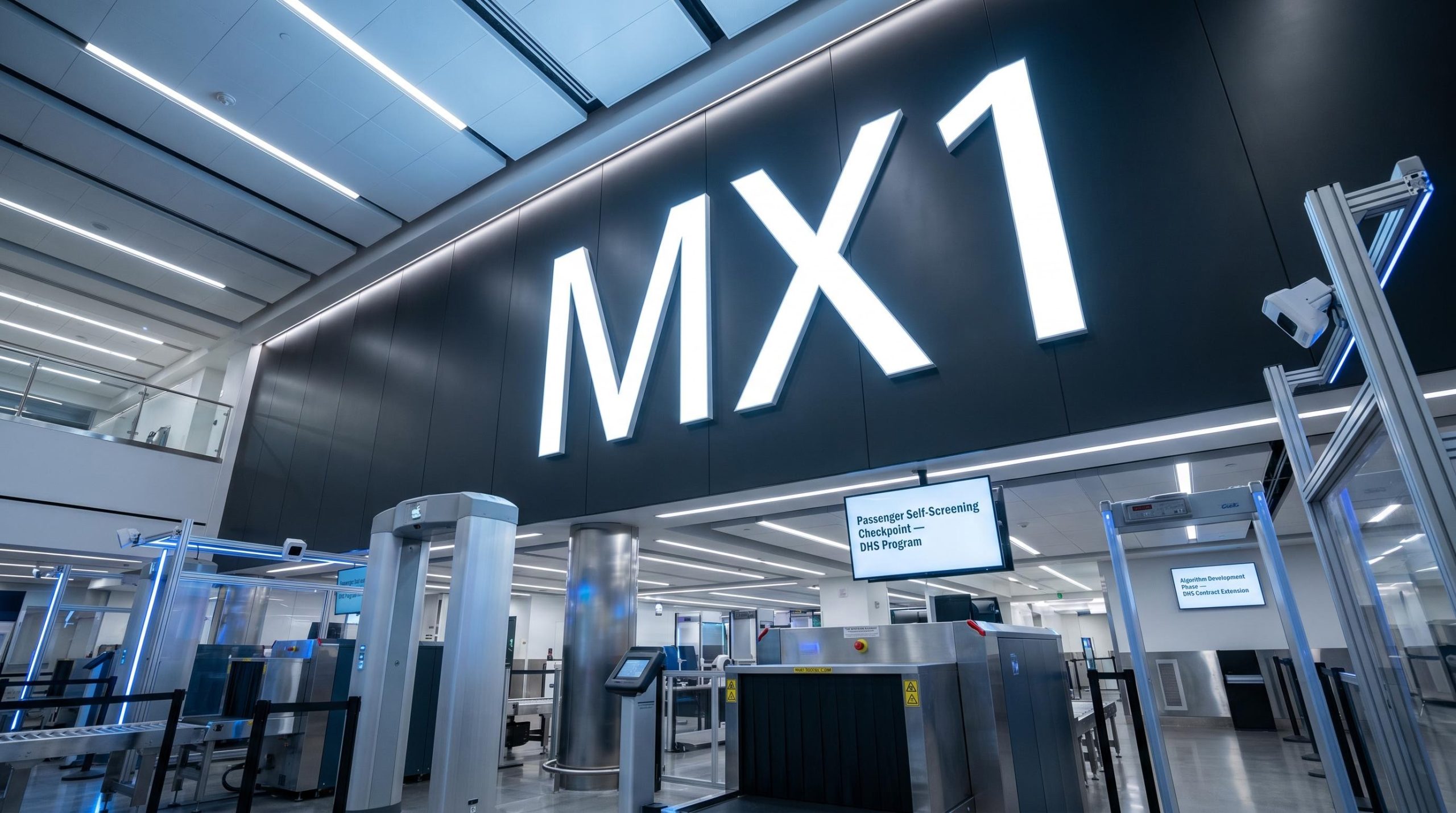
Micro-X secures $1.3M DHS contract extension to advance self-screening checkpoint program
Micro-X Ltd (ASX: MX1) has been awarded a $1.3M (US$0.9M) contract extension by the U.S. Department of Homeland Security (DHS), extending its Passenger Self-Screening Checkpoint program through to 30 September 2026. The extension funds continued testing and algorithm development, keeping the program on track within a total U.S. security contract valued at up to $31.7M (US$20.9M), a figure that remains unchanged.
When big ASX news breaks, our subscribers know first
Algorithm development and expanded hardware manufacturing take centre stage
The extension funds two concurrent workstreams. The first covers software and machine learning activities to further advance the Checkpoint’s threat detection capabilities. The second supports the manufacture of the second and third Checkpoints for subsequent DHS testing.
Current hardware status across the program:
- 1 Micro-X Checkpoint currently in U.S. Government laboratory testing
- 2 Baggage CT Scanners currently in U.S. Government laboratory testing
- 2 further Checkpoints currently under manufacture, ahead of DHS delivery
Brian Gonzales, CEO Americas
“The award of this contract extension by the DHS is excellent news as the department comes out of shutdown, allowing us to continue to progress the Passenger Self-Screening Checkpoint development program. This extension demonstrates the strength of our relationship and a commitment to continue the project, with algorithm development making the system deployable, which is key to advancing our concept through to airport testing. We will continue to work closely with DHS as they progress through their testing program.”
From laboratory to airport gates: what “deployable” really means
Before a passenger security checkpoint can operate in a live airport environment, it must pass through a sequential, regulatory-driven development pathway. Each stage must be validated before the next can begin.
At the core of this process are self-screening detection algorithms. These are the software systems that automatically identify potential threats in scanned baggage or on a person without requiring constant manual review by a security operator. For a self-screening checkpoint, where passengers interact with the system more directly than in a traditional staffed lane, those algorithms must be highly accurate and consistently reliable across a wide range of real-world scenarios.
Until the algorithms reach that standard, the hardware, no matter how advanced, cannot progress to testing with real passengers in a live airport. This is the gating factor the announcement references when it describes algorithm development as making the system “deployable.”
The contract extension directly funds this critical work. Reaching deployable status converts the Checkpoint from a functioning prototype into a product capable of advancing to airport passenger testing, the next major milestone in the program.
Part of a $31.7M U.S. security program with DHS and TSA
This extension sits within Micro-X’s broader U.S. security program with the DHS and the Transportation Security Administration (TSA), contracted at up to $31.7M (US$20.9M). That total program value is explicitly unchanged by this extension.
| Item | Detail | AUD Value | Status |
|---|---|---|---|
| Total DHS/TSA program | Passenger Self-Screening Checkpoint + Baggage CT | Up to $31.7M (US$20.9M) | Ongoing |
| Current extension | Algorithm development + continued testing | $1.3M (US$0.9M) | Through 30 September 2026 |
The DHS relationship is one component of a broader technology platform. Micro-X’s product portfolio also includes mobile digital radiology systems for healthcare and military applications, a miniature stroke CT imager developed with Australian Government funding, and a full-body CT system contracted by U.S. Government agency ARPA-H in November 2024.
Next steps: what investors should watch as the program advances
The path from the current contracted scope to airport passenger testing involves a clear sequence of milestones:
- Completion of manufacturing for the second and third Checkpoints
- Delivery of those additional Checkpoints to the DHS
- Continued laboratory testing with an expanded hardware fleet
- Algorithm development reaching deployable status
- Progression to airport testing with passengers (a future milestone, not yet contracted)
The current contracted horizon runs to 30 September 2026. For investors, each completed step represents verified progress within the larger $31.7M program and brings the Passenger Self-Screening Checkpoint closer to commercial deployment in one of the world’s largest security markets.
Don’t Miss the Next Healthcare & Tech Breakout on the ASX
Big News Blast delivers FREE breaking ASX news straight to your inbox within minutes of release, complete with in-depth analysis already done for you. Join 20,000+ subscribers staying ahead of the market across Healthcare, Technology, and beyond. Click the “Free Alerts” button to start receiving alerts the moment news breaks.