
In the 17th century, nations fought wars over gold and spice routes. In 2026, the battles are over semiconductor fab capacity, AI compute, and battery chemistry. Bob Prince, Co-CIO of Bridgewater Associates, told the HSBC Global Investment Summit in Hong Kong that modern mercantilism is now one of the central structural forces reshaping global financial markets. The language has changed, the weapons have changed, but the competitive logic of states manoeuvring for economic supremacy has not.
A major intellectual and policy shift is underway. Governments in Washington, Brussels, Beijing, and New Delhi are increasingly prioritising domestic production, strategic supply chains, and economic nationalism over the free-trade consensus that shaped the post-Cold War era. The US CHIPS Act, EU anti-subsidy tariffs on Chinese electric vehicles, China’s self-reliance drive in semiconductors, and India’s production-linked incentive schemes all reflect the same impulse: state power deployed to win the industries that will define the next decade.
What follows is a precise explanation of what modern mercantilism actually means, how it differs from the history-book version, which policy tools governments are using right now, and what this structural shift means for portfolio construction in 2026 and beyond.
What modern mercantilism actually means (and what it doesn’t)
The version most readers carry from school is straightforward. Classical mercantilism, dominant in the 17th and 18th centuries, treated national wealth as a fixed stock of gold and silver. Trade was zero-sum: one nation’s surplus was another’s deficit. Governments enforced this logic through tariffs, export bounties, and colonial extraction, all aimed at hoarding bullion.
The modern version shares the competitive, state-first logic but has fundamentally different targets and tools.
The shift in what counts as “wealth”
The WTO World Trade Report 2024 describes a “new era of trade policy interventionism” that is “less about accumulating monetary reserves and more about securing control over key technologies, critical minerals, and strategic value chains.” Adam Posen of the Peterson Institute for International Economics characterises modern mercantilism as “the pursuit of national advantage through targeted protectionism, state direction of credit, and discrimination against foreign firms in strategic sectors.” Martin Wolf, writing in the Financial Times in March 2025, argues that governments now seek “strategic surpluses in critical goods, not just in current accounts.”
The assumption that trade creates winners and losers persists. So does the willingness to use government power to tilt outcomes. What has changed is the prize: not gold, but semiconductors, AI models, and lithium supply chains.
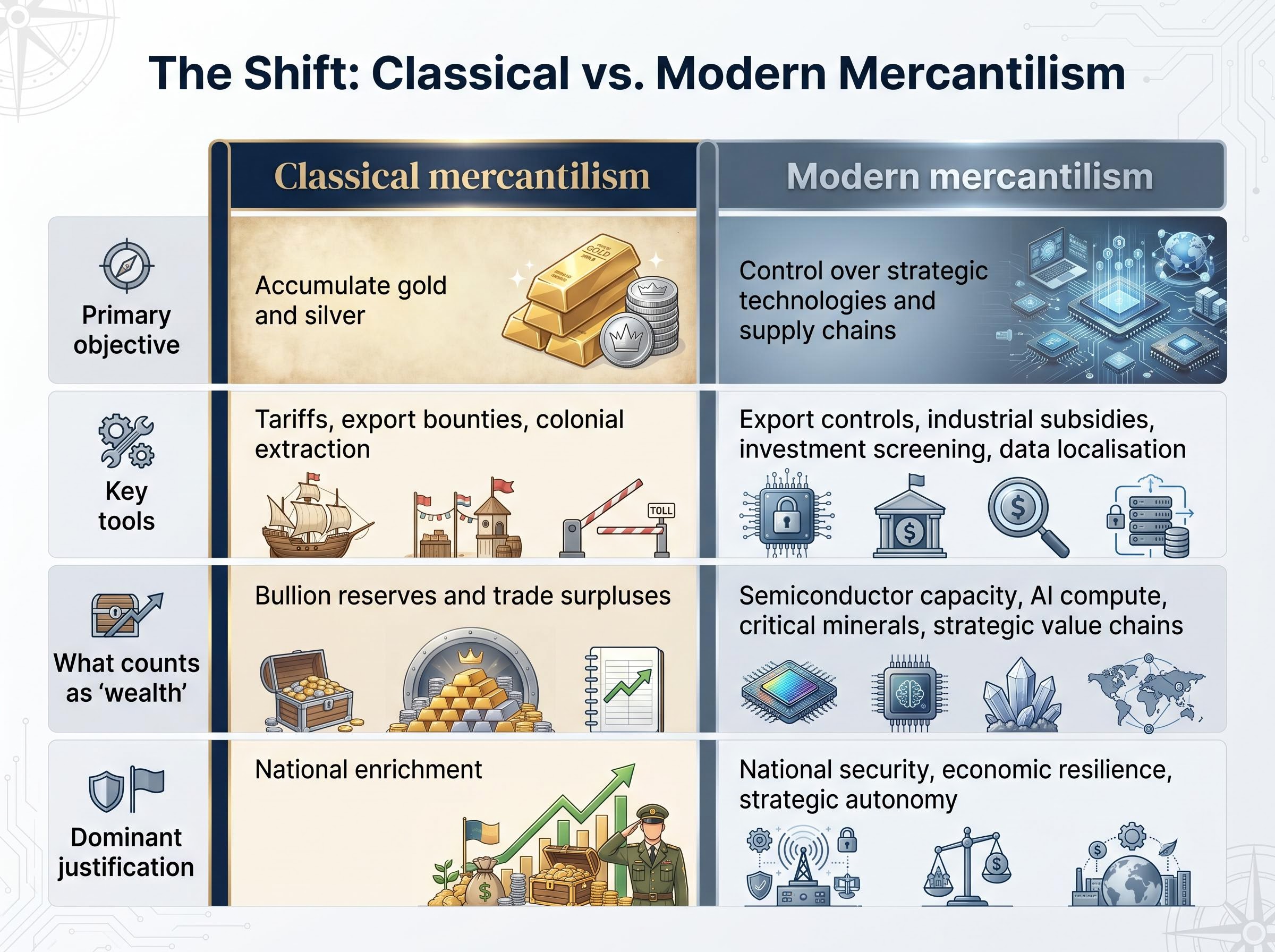
| Dimension | Classical mercantilism | Modern mercantilism |
|---|---|---|
| Primary objective | Accumulate gold and silver | Control over strategic technologies and supply chains |
| Key tools | Tariffs, export bounties, colonial extraction | Export controls, industrial subsidies, investment screening, data localisation |
| What counts as “wealth” | Bullion reserves and trade surpluses | Semiconductor capacity, AI compute, critical minerals, strategic value chains |
| Dominant justification | National enrichment | National security, economic resilience, strategic autonomy |
Investors who conflate modern mercantilism with old-fashioned tariff wars will misread both the nature and the durability of the shift. The distinction is not academic; it is the conceptual foundation for everything that follows.
When big ASX news breaks, our subscribers know first
The policy arsenal: how governments are acting on mercantilist logic right now
The concept becomes concrete when measured by the policy instruments in use today. Four main categories define the modern mercantilist toolkit: export controls and investment screening, industrial subsidies and local-content rules, tariffs and countervailing duties, and data and technology localisation mandates. What makes the current moment structural rather than episodic is that the US, EU, China, and India are all deploying versions of these tools simultaneously.
The WTO World Trade Report 2024 documents the cross-jurisdictional scale of industrial policy expansion, providing the empirical baseline against which the simultaneous deployment of mercantilist tools by the US, EU, China, and India can be assessed.
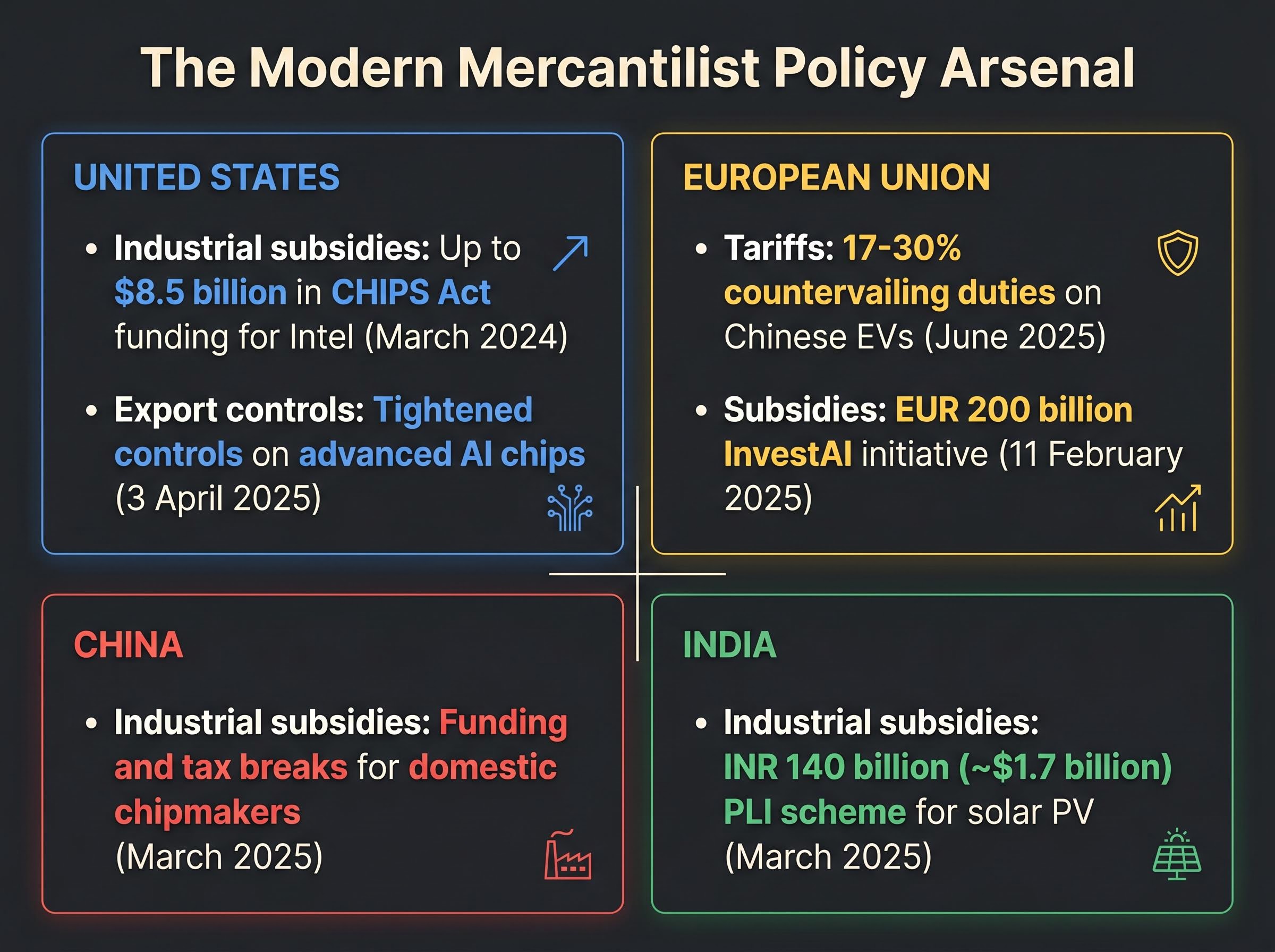
The WTO’s World Trade Report 2024 describes a “new era of trade policy interventionism,” a framing that captures the cross-jurisdictional scale of the shift.
United States:
- Export controls: The Bureau of Industry and Security (BIS) tightened controls on advanced AI chips and chipmaking tools destined for China on 3 April 2025, refining performance thresholds and expanding the Commerce Control List.
- Industrial subsidies: Up to $8.5 billion in direct CHIPS Act funding for Intel, announced March 2024, continues to anchor the US semiconductor re-shoring strategy.
- Investment screening: The Treasury Department proposed rules in January 2025 restricting US outbound investment in Chinese AI, quantum, and advanced semiconductor sectors.
European Union:
- Tariffs: Provisional countervailing duties of 17-30% on Chinese electric vehicles, announced June 2025.
- Subsidies: EUR 3 billion in state-aid approved for battery manufacturing in February 2025; the InvestAI initiative mobilising EUR 200 billion for AI investment, announced 11 February 2025.
China:
- Industrial subsidies: New funding and tax breaks for domestic chipmakers announced March 2025, framed as strengthening self-reliance in key technologies.
- Data localisation: Updated rules on generative AI services issued January 2025, strengthening domestic deployment requirements and limiting foreign models.
India:
- Industrial subsidies: Expanded production-linked incentive (PLI) scheme for solar PV modules worth INR 140 billion (approximately $1.7 billion), approved March 2025.
- Tariffs: Customs duty increases on finished electronics in the FY2025-26 Budget, explicitly designed to encourage local assembly.
Knowing which instruments are being deployed, and where, tells investors which sectors and supply-chain configurations are being structurally advantaged or disadvantaged.
Legal constraints on tariff authority have introduced a new variable into the mercantilist policy calculus: two federal courts struck down the broadest IEEPA-based and Section 122-based duties within three months in 2026, shifting the effective toolkit toward Section 232 national security justifications and legislative channels, which are slower and more predictable for markets to price than executive unilateral action.
Why AI has become the sharpest edge of the mercantilist competition
AI is not a separate trend from mercantilism. It is its most advanced expression. Governments are treating compute, data, and algorithmic capability as strategic national assets in the same way earlier generations treated coal, oil, or steel capacity.
The mercantilist tools being deployed in AI fall into three categories:
- Export controls: The US BIS rule of 3 April 2025 tightened restrictions on advanced AI accelerators destined for China, explicitly aiming to constrain a rival’s compute capacity.
- State-funded AI champions: The EU’s InvestAI initiative (EUR 200 billion, February 2025) includes explicit goals of reducing dependency on foreign AI models. China’s self-reliance programmes channel state financing into domestic AI firms.
- Data localisation: China’s January 2025 generative AI rules favour homegrown providers by ring-fencing data behind sovereignty requirements, limiting foreign models’ market access.
According to The Economist (September 2025), governments are “hoarding compute, subsidising chip fabs and national champions, and ring-fencing data behind sovereignty rules.”
The Brookings Institution argued in May 2025 that AI has become “a central theatre for mercantilist competition,” with policies risking fragmentation into regional AI blocs. A CSIS report described the emerging outcome: a “bifurcated AI hardware and software stack” between US-aligned and China-aligned blocs, with cost and interoperability implications for globally integrated businesses.
For investors, AI mercantilism means the sector’s returns will increasingly depend on which geopolitical bloc a company operates within, not simply on its technological capability. That is a reframe of how to evaluate AI-exposed equities, moving the analysis from product quality to jurisdictional positioning.
The Asian semiconductor beneficiaries of this AI compute competition are already delivering earnings validation at scale: Samsung reported more than an eightfold surge in Q1 2026 operating profit, SK Hynix confirmed strong AI-linked demand, and the MSCI AC Asia Pacific IT Index was trading at approximately half the forward P/E multiple of the Nasdaq 100 despite earnings growth forecasts running nearly three times faster, a valuation gap that mercantilist capex concentration is actively narrowing.
What regional divergence means for where growth and capital are actually going
The asymmetric economic outcomes of mercantilist competition are already visible in the growth data. Asia, particularly India and ASEAN, is growing at a structurally faster rate than the US or Europe, and mercantilist supply-chain re-routing is amplifying the divergence rather than reducing it.
Regional growth divergence is not a forecast but a present reality in the data: the April 2026 composite PMI collapsed to 47.6 in eurozone services while US nonfarm payrolls beat consensus at 115,000, a split that maps directly onto the asymmetric capital flow patterns that mercantilist supply-chain rerouting is amplifying.
| Region | 2025 GDP growth | 2026 GDP growth |
|---|---|---|
| Emerging and Developing Asia | 5.3% | 5.1% |
| United States | 2.1% | 1.9% |
| Euro area | 1.4% | 1.6% |
Source: IMF World Economic Outlook Update, January 2026
Friend-shoring and supply-chain diversification away from China are directing incremental investment toward specific economies. HSBC Global Research identified “under-ownership of Asia in global portfolios relative to its growing share of world GDP and capex” in October 2025. Amundi’s 2026 outlook expressed a preference for Asia-centric regional value chains, naming specific beneficiaries:
- India: PLI-driven manufacturing expansion and domestic demand growth
- Indonesia: Critical minerals processing and downstream battery capacity
- Vietnam: Electronics assembly diversification from China
- Malaysia: Semiconductor back-end packaging and testing hub
BlackRock’s Midyear 2025 outlook adopted a position of modestly overweight US and Asia ex-Japan equities, while underweight on the euro area, citing better earnings growth and industrial-policy tailwinds. IIF Capital Flows Tracker data from March 2026 showed robust non-resident portfolio flows into EM Asia versus more volatile flows into EM Europe and Latin America.
Europe faces specific headwinds: elevated energy costs, weaker industrial policy relative to the US, demographic constraints, and exposure to export-dependent manufacturing sectors now confronting tariff and subsidy competition from multiple directions.
Regional divergence is where mercantilism translates most directly into differential equity returns, currency dynamics, and capital flow patterns.
How to build a portfolio that holds up across competing mercantilist blocs
At the HSBC Global Investment Summit, Bridgewater’s Bob Prince identified two portfolio qualities as responses to a changing, less predictable global order: diversification and agility. In a mercantilist world, both mean something different from what they meant in the free-trade era.
Diversification across blocs, not just asset classes
Conventional diversification spread capital across stocks, bonds, and alternatives. Mercantilist fragmentation demands an additional dimension: diversification across geopolitical blocs, supply-chain configurations, and currency systems.
Bridgewater argued in March 2026 that “neutral” benchmarks underweight real assets and Asia relative to where future nominal growth is likely to be, recommending “balanced exposures across competing blocs.” State Street Global Advisors’ 2026 outlook recommended diversifying funding currencies beyond the dollar and euro, identifying selective opportunities in Asia ex-Japan foreign exchange tied to re-shoring.
Bridgewater (March 2026): Investors should hold “balanced exposures across competing blocs” rather than assuming US-centric diversification suffices.
Agility as a structural requirement
Agility means the capacity to reposition as mercantilist policies shift. JPMorgan Asset Management’s 2026 Long-Term Capital Market Assumptions noted that trade fragmentation raises capex in North America and parts of Asia (positive for industrials) while pressuring margins for globally integrated supply-chain businesses, expecting “wider dispersion of equity valuations across regions and sectors.”
Vanguard advised investors in January 2025 to “stress-test exposures to concentrated supply-chain or sanction risks.”
Four questions an investor can ask of their current portfolio:
- Is geographic exposure diversified across competing mercantilist blocs, or concentrated in a single jurisdiction’s industrial-policy framework?
- Does the portfolio include real assets and commodity producers that may benefit from resource-driven competition between blocs?
- Which holdings depend on globally integrated supply chains that a single export control or tariff action could structurally disrupt?
- Is currency exposure diversified beyond the US dollar and euro to reflect where incremental nominal growth is occurring?
These are not stock tips. They are stress-test prompts for an environment where the rules of capital allocation are being rewritten by governments, not markets.
Investors wanting to translate the mercantilist framework into specific allocation changes will find our full explainer on regime-aware portfolio construction, which covers the structural challenges facing the traditional 60/40 model under tariff-driven sticky inflation, the case for real assets and alternatives, active currency hedging approaches, and country-level precision across Japan, India, China, and Southeast Asia rather than a single regional allocation.
The old playbook is obsolete. The question is what replaces it.
Modern mercantilism is not a temporary political weather pattern. Its simultaneity across the US, EU, China, and India, and the depth of the policy commitments involved, confirm a structural regime shift. Zoltan Pozsar has described the destination as a “commodity-anchored, multipolar system” shaped by “state-driven mercantilism in commodities and technology.” Dani Rodrik’s “productivist paradigm” offers a complementary frame, emphasising domestic productive capacity and good jobs as the real objectives, complicating any simple “trade war” narrative.
Genuine uncertainty remains. The pace of further fragmentation, whether regional blocs will harden or partially re-integrate, and the degree to which AI mercantilism will bifurcate technology markets are open questions. As Bob Prince emphasised at the HSBC summit, both modern mercantilism and AI are structural forces, not cyclical ones, requiring a structural rather than tactical response.
Investors who update their mental models from “efficient global markets” to “competing mercantilist blocs generating asymmetric returns” will be better positioned to identify the winners and losers that this environment is continuously creating. The free-trade playbook served well for three decades. The world it described no longer exists.
This article is for informational purposes only and should not be considered financial advice. Investors should conduct their own research and consult with financial professionals before making investment decisions. Forward-looking statements regarding policy developments and market positioning are speculative and subject to change based on geopolitical developments and government actions.