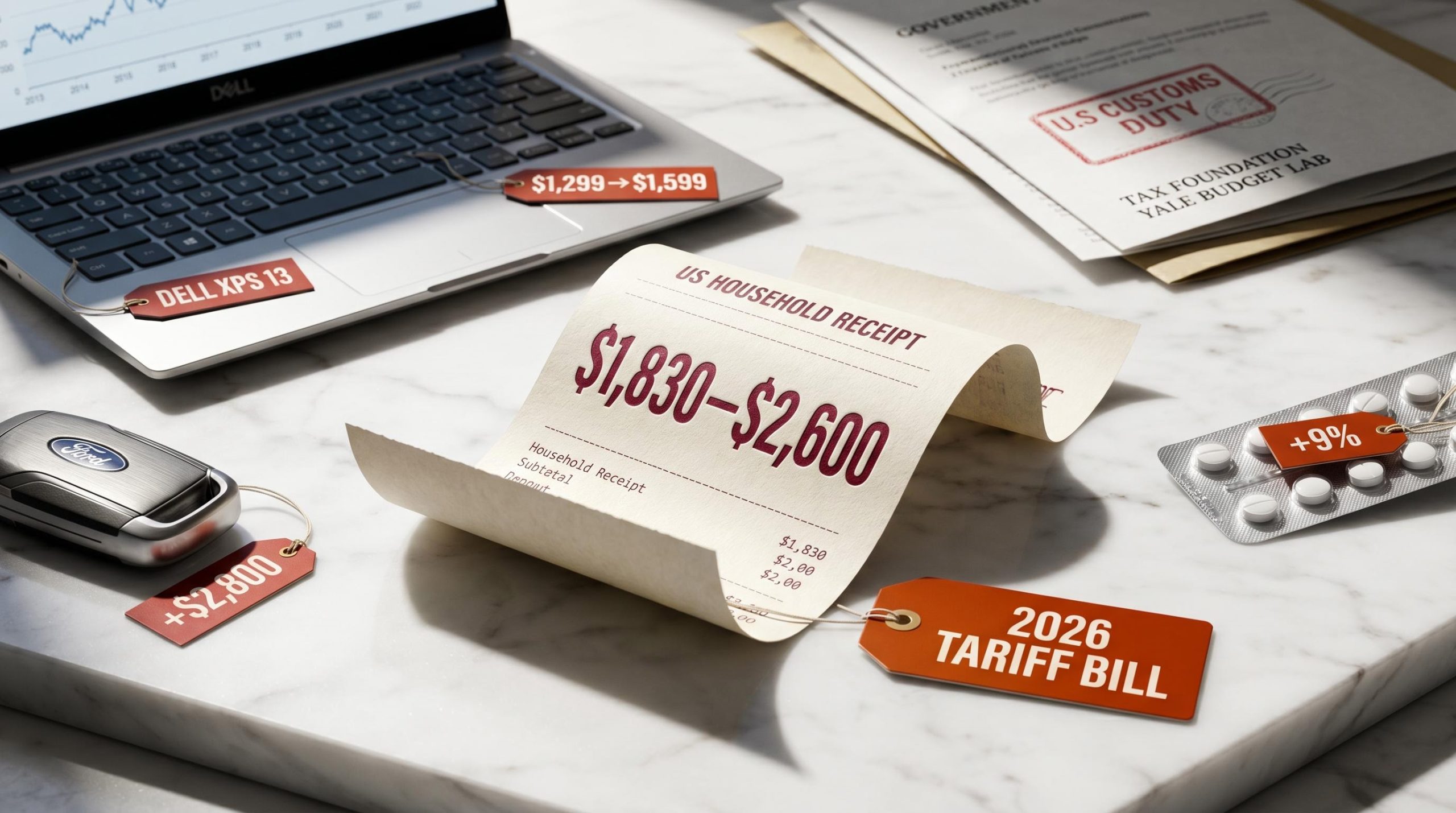
American households are on track to pay between $1,830 and $2,600 more this year than they did in 2025, according to estimates from the Tax Foundation and the Yale Budget Lab. That bill is already showing up at car dealerships, electronics retailers, and pharmacy counters. The current US tariff regime, expanded significantly in 2026 with pharmaceutical tariffs signed in April and electronics price increases accelerating into the second half of the year, is no longer an abstract trade policy discussion. It is a household budget problem. Tariffs function as a consumption tax, and the costs are landing unevenly across spending categories most Americans cannot easily avoid. This guide breaks the tariff impact down category by category, translates the numbers into specific dollar figures readers can compare against their own spending, and closes with five concrete personal finance steps to limit the damage in the months ahead.
What tariffs actually do to your prices: the mechanics behind the bill
Most Americans assume tariffs are paid by the foreign company that made the product. They are not. A tariff is an import duty paid by the US-based company that brings the product into the country. That importer passes the cost downstream to distributors, retailers, and ultimately to the consumer at the checkout counter.
This makes tariffs function as a consumption tax: the burden falls on the households that buy imported goods, not on the foreign manufacturers that produce them.
NBER tariff pass-through research published in April 2026 estimates that US importers bore approximately 94% of the cost of 2025-era tariffs, with foreign exporters making only marginal price reductions, a finding that confirms the consumption tax framing and explains why retail price increases have tracked tariff rates so closely.
The current tariff regime has pushed average US rates from 2.4% to 9.6% across all trading partners, the highest level in approximately 80 years. Sector-specific rates are considerably steeper:
- Automotive parts from Mexico and Canada: 25%
- Electronics components from China and Southeast Asia: 10-25%
- Pharmaceutical ingredients and finished drugs: 10-25% on most imports, up to 100% for non-compliant companies
The Yale Budget Lab estimates the tariff burden at $2,100-$2,600 per household for 2026, its most recent upward revision incorporating vehicle and pharmaceutical cost increases.
In February 2026, the Supreme Court invalidated the legal basis for a portion of these tariffs. The administration responded the same day by invoking separate legal authority, effectively reinstating the duties. Understanding this mechanism matters: there is no scenario in which foreign companies quietly absorb these costs. They are already baked into US retail prices.
The administration’s ability to maintain these duties rests on contested tariff legal authority, and two federal courts struck down the broadest IEEPA-based and Section 122-based pillars within three months, with the administration responding each time by invoking alternative statutory grounds to reinstate the same duties.
When big ASX news breaks, our subscribers know first
Buying a car in 2026 just got significantly more expensive
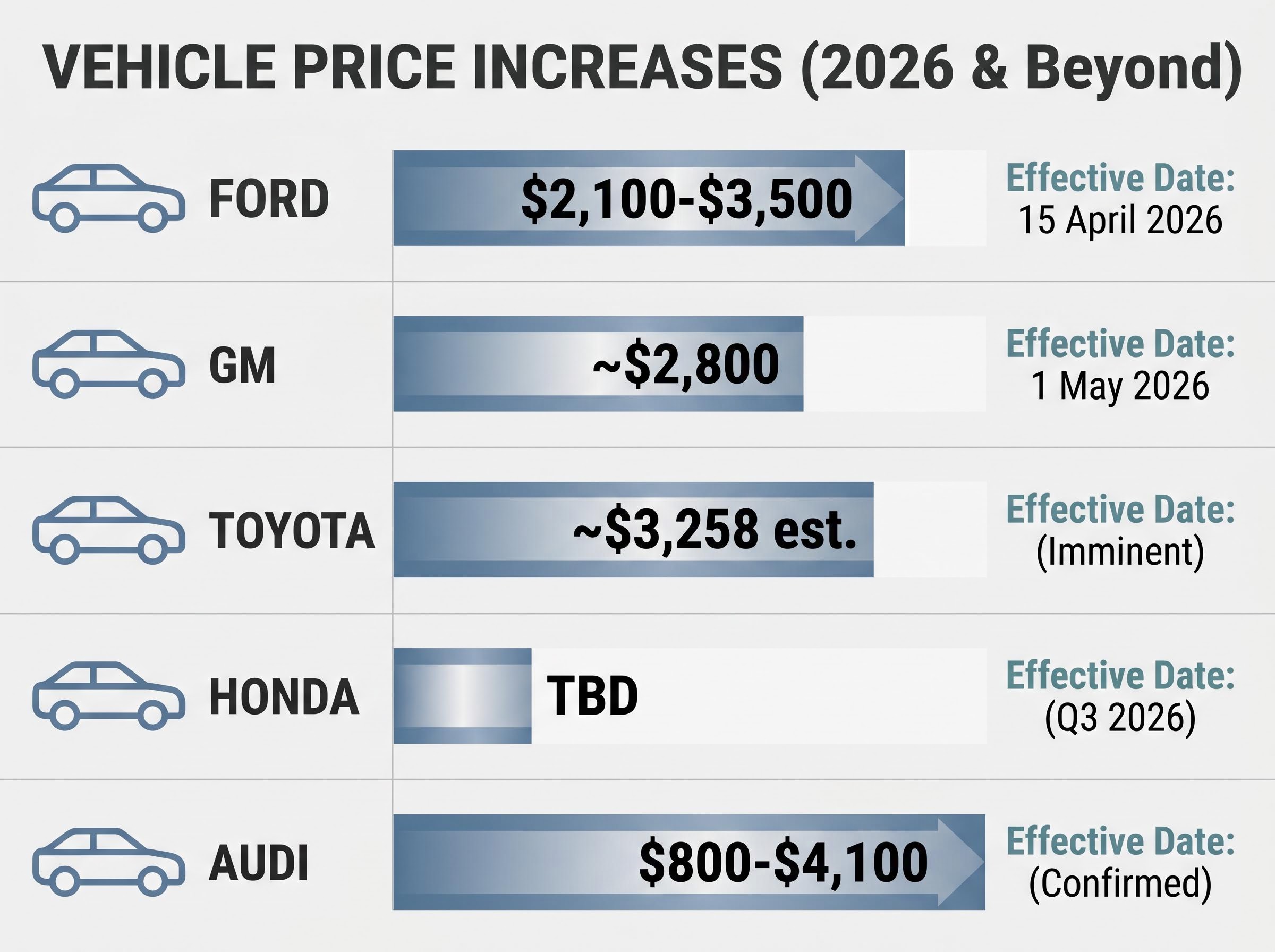
The tariff mechanics described above translate into specific, confirmed price increases from every major manufacturer selling vehicles in the United States. Ford raised prices 3-5% on F-150 trucks and Explorer SUVs effective 15 April 2026, adding approximately $2,100-$3,500 per vehicle, according to the Wall Street Journal. GM followed with a 4% increase on Chevy Silverado and GMC Sierra models from 1 May 2026, adding roughly $2,800 per full-size truck, per Bloomberg reporting.
No US-assembled vehicle is immune. Global supply chains mean even domestically produced cars rely on imported parts, steel, and aluminium, all of which carry tariff surcharges. Toyota held prices steady through April but signalled “imminent adjustments,” with JP Morgan estimating $3,258 in added costs per vehicle. Honda delayed a planned hike to Q3 2026. Audi has confirmed increases in the range of $800-$4,100 depending on model.
Kelley Blue Book estimates that vehicles priced below $40,000 could see up to $6,000 in added costs once all tariff-related surcharges are fully reflected.
| Manufacturer | Model(s) Affected | Price Increase | Dollar Impact | Effective Date |
|---|---|---|---|---|
| Ford | F-150, Explorer | 3-5% | $2,100-$3,500 | 15 April 2026 |
| GM | Silverado, Sierra | 4% | ~$2,800 | 1 May 2026 |
| Toyota | Multiple (pending) | TBD | ~$3,258 (est.) | Imminent |
| Honda | Multiple (pending) | TBD | TBD | Q3 2026 |
| Audi | Multiple | Varies | $800-$4,100 | Confirmed |
Should you buy now, delay, or wait it out?
The University of Michigan’s May 2026 survey found that 55% of consumers are delaying vehicle purchases by an average of 3-6 months. That instinct is understandable but may not help. Honda’s Q3 hike and Toyota’s pending adjustment suggest that waiting is not the same as waiting for relief.
Buyers considering a purchase in the second half of 2026 should compare current dealer inventory, much of which was priced before the latest increases, against incoming MSRP adjustments before committing. Pre-hike stock is still sitting on lots. Once it clears, the new prices are what remains.
Electronics: the price increases already here and the larger ones still coming
The first wave of electronics price increases is already visible on retail shelves. Best Buy reported 15-25% hikes on mid-range laptop models effective 1 May 2026. The Dell XPS 13 rose from $1,299 to $1,599. The HP Pavilion went from $649 to $799. Lenovo cited supply chain costs for a roughly 20% increase across comparable models, according to CNBC.
Smartphones followed. Walmart and Amazon listings as of early May show the iPhone 15 up 12%, from $899 to $1,009, and the Samsung Galaxy S25 up 10%, from $799 to $879, per Reuters. Televisions have also moved: a 65-inch Samsung QLED climbed from $1,199 to $1,599, an 18-30% increase according to Bloomberg.
| Device | Pre-Tariff Price | Current Price | Increase (%) | Projected Year-End |
|---|---|---|---|---|
| Dell XPS 13 | $1,299 | $1,599 | ~23% | $1,800+ |
| HP Pavilion | $649 | $799 | ~23% | $900+ |
| Apple iPhone 15 | $899 | $1,009 | ~12% | TBD |
| Samsung Galaxy S25 | $799 | $879 | ~10% | TBD |
| Samsung 65″ QLED | $1,199 | $1,599 | ~33% | TBD |
These are not the ceiling. Trend Force projects that a standard $900 laptop could exceed $1,200 by year-end, a 40% increase. All five major PC manufacturers have warned of further hikes in the second half of 2026:
- Lenovo: cited ongoing supply chain cost pressure
- Dell: warned of further component-driven increases
- HP: flagged H2 2026 price adjustments
- Acer: indicated tariff pass-through in H2 pricing
- Asus: signalled 15-20% hikes on select models
The University of Michigan found that 62% of consumers stockpiled electronics and appliances in April 2026, up from 45% in March. That instinct aligns with the data. Current prices are elevated, but waiting through the second half of the year is likely to cost more, not less.
Pharmaceuticals: a new and still-evolving cost pressure on household budgets
The pharmaceutical tariff is the most recent addition to the consumer cost burden and the one with the most uncertainty still attached. On 2 April 2026, an executive order imposed tariffs of 10-25% on active pharmaceutical ingredients (APIs) and finished drugs imported from China and India, with rates reaching up to 100% for non-compliant companies. As of 1 May 2026, 70% of targeted imports are subject to the new duties, according to the Associated Press.
The impact is already reaching patients. Pfizer announced 8-12% price increases on 15 drugs effective 10 May 2026, explicitly citing tariffs as the cause. The increases add $0.45-$2.10 per prescription, with Viagra generics rising 11%, per the Wall Street Journal.
Eli Lilly raised insulin prices by 9%, representing approximately $35 per month in additional costs for patients, an increase that compounds across a full year of treatment.
The tariff structure varies based on each company’s relationship with the administration:
Pharmaceutical tariff exemptions under the Section 232 proclamation are structured with significant variation by company and product category, as the experience of large manufacturers securing full exemptions for plasma-derived therapies while facing partial duties on other products illustrates how the same executive order can produce materially different cost outcomes across drug types.
- Companies with pricing agreements (14 of the 17 largest pharmaceutical companies) face lower or graduated tariff rates
- Companies that have committed to expanding domestic manufacturing receive intermediate rates
- Companies with no agreement face the full 25% rate, or up to 100% for specific categories
Why generic drug users need to watch the next 12 months closely
Generic drugs, which the majority of Americans rely on for everyday prescriptions including antibiotics, blood pressure medications, and cancer treatments, are currently exempt from the new tariffs. That exemption, however, is subject to reassessment within one year.
The exposure is significant. 80% of API manufacturing sites are located outside the United States, according to FDA data. China and India supply more than 70% of the APIs used in US generic drug production. Any removal of the exemption would create immediate cost pressure across a broad range of medications that tens of millions of Americans take daily.
FDA filings on API manufacturing concentration, compiled by the US Pharmacopeia and published through the Regulatory Affairs Professionals Society, show that as of 2023 only 4% of active API Drug Master Files cited US facilities, while India held 50% and China held 32%, a supply chain structure that makes the pharmaceutical tariff’s downstream effects on drug prices nearly unavoidable for US patients.
Readers managing ongoing prescriptions should review current costs now to establish a baseline for comparison as the exemption review window approaches.
The full household price tag: what the estimates say and what they leave out
Two widely cited institutions have published per-household cost estimates for the 2026 tariff regime, and they do not agree.
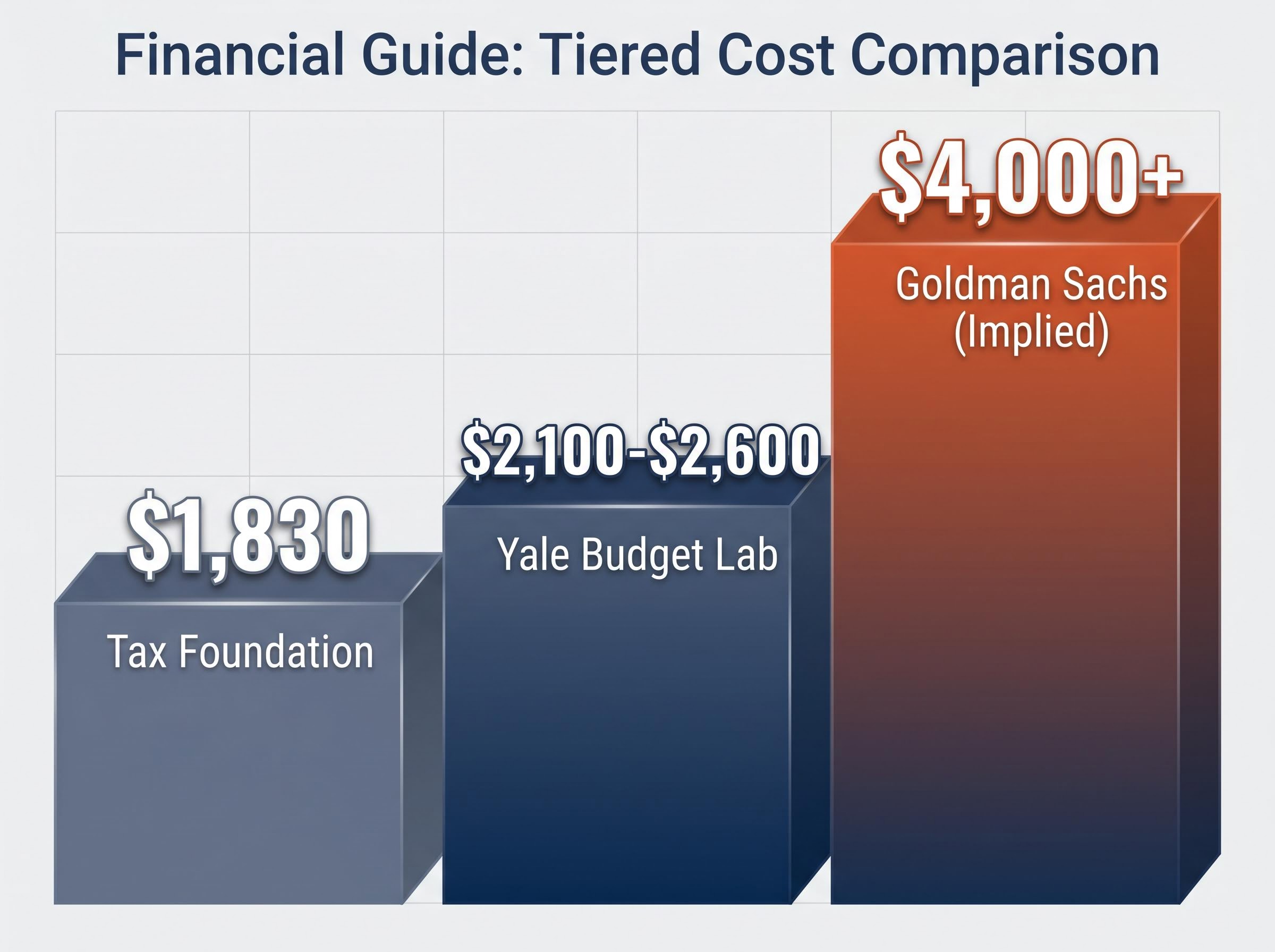
| Source | Estimate | Methodology Notes | Date Published |
|---|---|---|---|
| Tax Foundation | $1,830/household | Revised upward from $1,500; incorporates post-Supreme Court tariff reimposition | 15 April 2026 |
| Yale Budget Lab | $2,100-$2,600/household | Revised upward in late April; incorporates pharmaceutical and vehicle increases | 25 April 2026 |
| Goldman Sachs (implied) | $4,000+/household | Derived from $592B consumer share across 130M households; no explicit figure published | N/A |
The Yale Budget Lab’s upper estimate of $2,600 per household is the most recently revised and most comprehensive figure currently available, incorporating pharmaceutical, vehicle, and electronics tariff impacts through late April 2026.
The gap between the Tax Foundation’s $1,830 and Yale’s $2,600 reflects methodology differences: Yale’s model captures a broader set of tariffed goods and accounts for the most recent executive orders. Goldman Sachs data implies potential costs exceeding $4,000, though Goldman has not published an explicit per-household figure.
Where individual households land within this range depends on what they buy. A household purchasing a new vehicle in 2026 absorbs $2,100-$3,500 in tariff-driven costs from that single purchase alone. Add a laptop, a smartphone, and ongoing prescriptions, and the upper end of the Yale estimate becomes plausible quickly.
Tariff-driven price increases are landing inside a broader inflation environment already under pressure from energy costs, with April 2026 headline CPI projected at 3.7% and the Federal Reserve holding rates at 3.50-3.75%, meaning households are absorbing both commodity and trade-policy cost pressures simultaneously.
Consumer behaviour is already reflecting this pressure. The National Retail Federation (NRF) reported a 28% drop in durable goods sales from April to May 2026. Numerator scan data shows 41% of consumers report switching to US-made apparel and electronics, with Levi’s sales up 15% and imported brand sales down 22%.
How to reduce your tariff exposure: a practical consumer guide for 2026
Consumers cannot control trade policy. They can, however, control their exposure through specific spending and investing decisions. The following five steps translate this guide’s analysis into direct personal action.
- Audit current prescription costs and ask about therapeutic alternatives now. Before the generic drug exemption review window closes, establish a baseline for what prescriptions cost today. Ask a pharmacist or prescriber whether lower-cost therapeutic alternatives exist for any medications sourced from tariff-affected supply chains. This step has a finite window of usefulness; act before the review period concludes.
- Accelerate planned electronics purchases for items confirmed to face H2 2026 hikes. The data supports buying now rather than waiting. All five major PC manufacturers have warned of further increases in the second half of 2026, and Trend Force projects up to 40% total increases by year-end. The 62% of consumers who stockpiled electronics in April 2026 were responding rationally to the same signals.
- Evaluate vehicle purchase timing using manufacturer-specific data. Pre-hike inventory is still available at many dealerships. Compare current lot pricing against the confirmed increases from Ford and GM and the imminent adjustments from Toyota and Honda. Once pre-hike stock clears, the new baseline is permanent.
- Identify domestic-brand substitutes in two or three regular spending categories. Supply chains are already rerouting: imports from 13 Asian nations increased by $193 billion even as China imports fell $135 billion. The 41% of consumers already switching to US-made alternatives, per Numerator data, are finding viable substitutes. Start with apparel and household goods, where domestic options are most readily available.
- Review portfolio for international equity exposure as an inflation and trade-disruption hedge. Persistent tariff-driven inflation erodes the purchasing power of cash savings. While the S&P 500 is near all-time highs, other major economies are actively forming trade agreements that bypass the US, including EU-India and Canada-China arrangements, creating potential return diversification that offsets domestic cost pressures.
Thirty years of data on equity performance under sustained inflation and energy shocks show that the S&P 500 has fallen an average of 11% in the six months following weeks when gasoline exceeded $4.00 per gallon, a historical pattern that adds urgency to the portfolio diversification step outlined here.
Tariffs function as a consumption tax, and the most effective response is to reduce taxable consumption where possible and ensure savings work harder elsewhere.
The tariff bill is real, but how much of it you pay is partly your choice
The category-level data is clear. Vehicle buyers face $2,100-$3,500 in added costs today, with further increases from Toyota and Honda still forthcoming in Q3 2026. Electronics buyers face 15-25% increases at current prices, with projections reaching 40% by year-end. Pharmaceutical costs are rising, and a potentially larger disruption sits within 12 months if the generic drug exemption lapses.
The Tax Foundation and Yale Budget Lab estimates of $1,830-$2,600 per household provide a useful range, but where any individual household falls within it depends on purchasing decisions made in the months ahead. Tariffs are a consumption tax. Informed consumers who adjust their purchasing timing, category mix, and investment exposure can meaningfully reduce their individual exposure relative to those headline figures.
Q3 2026 is the next significant decision window for most households, when Honda and Toyota vehicle hikes take effect, electronics prices face their next escalation, and the pharmaceutical generic exemption review moves closer. Revisiting household budgets with the category-level data from this guide as a framework is a practical first step.
This article is for informational purposes only and should not be considered financial advice. Investors should conduct their own research and consult with financial professionals before making investment decisions. Past performance does not guarantee future results. Financial projections are subject to market conditions and various risk factors.