WTI Jumps 1.6% as Iran Strikes Shatter Hormuz Deal Hopes
26 mins ago


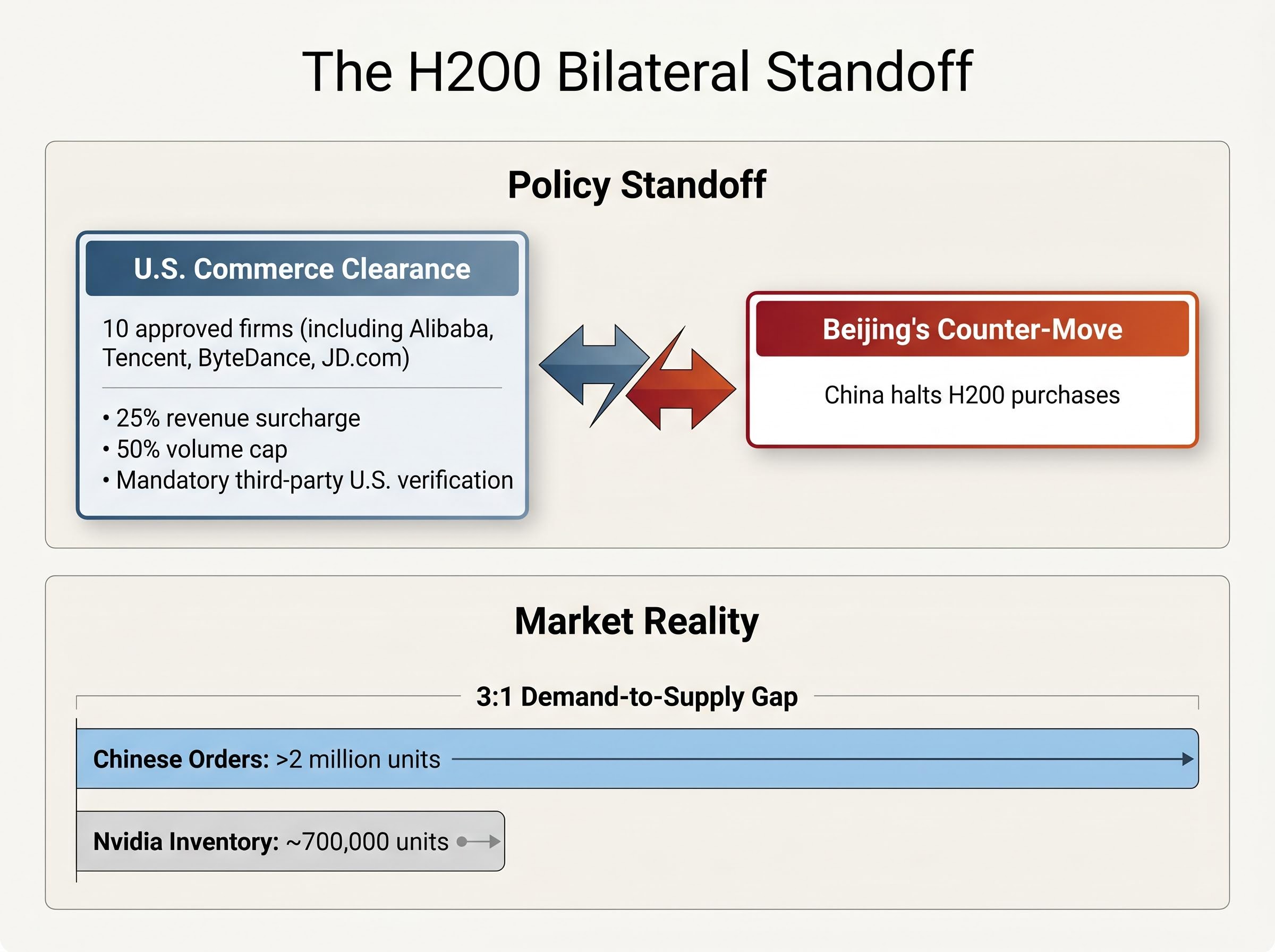
Nvidia CEO Jensen Huang sat at the Trump-Xi summit table on 14 May 2026 as the U.S. Commerce Department simultaneously cleared H200 GPU sales to ten Chinese technology firms, a convergence of diplomacy and commercial policy that sent the chipmaker’s stock surging toward a approximately $5.53 trillion implied market capitalisation in premarket trading. The clearance names four confirmed buyers, Alibaba, Tencent, ByteDance, and JD.com, alongside six additional firms, reopening a revenue channel that had been effectively shut since January’s export restrictions took hold. Yet the headline optimism carries a complication: China has independently halted H200 purchases despite Washington’s green light, introducing a bilateral standoff that explains why the premarket gain was measured rather than euphoric. What follows covers the exact scope of the authorisation, the technical limits that define it, the semiconductor peers riding the same wave, and the policy risks that investors pricing in durable China revenue should weigh carefully.
Nvidia closed at $225.83 on 13 May 2026, up 2.29%, before pushing to $230.29 in premarket trading on 14 May, a further 1.97% gain on volume exceeding 150 million shares. At that premarket price, the implied market capitalisation approached approximately $5.53 trillion.
The implied market capitalisation of approximately $5.53 trillion would represent the highest valuation any publicly traded company has reached, surpassing Nvidia’s own prior record.
The catalyst was specific: the U.S. Commerce Department cleared H200 GPU sales to ten named Chinese companies. Four, Alibaba, Tencent, ByteDance, and JD.com, were confirmed publicly. Six additional firms were included in the authorisation, per Reuters and U.S. News reporting from the same day.
Huang joined the U.S. delegation at the Trump-Xi summit, with Reuters reporting the mission focused on AI chip access and American technological leadership. A corporate CEO seated at a heads-of-state negotiation signals how tightly commercial semiconductor policy has become woven into geopolitical strategy. The last time chip exports carried this level of diplomatic weight was during the original October 2022 restrictions; this time, the CEO of the company most affected was in the room.
The asymmetric risk profile for semiconductor stocks at the summit was well-flagged before Thursday’s session opened: Bloomberg Intelligence had estimated a 70% probability of partial de-escalation, but the same scenario matrix placed the potential downside at roughly double the projected upside if talks hardened.
The Bureau of Industry and Security (BIS) published technical thresholds in January 2026 that determine which chips can and cannot be exported to China. Two numbers matter: a total processing performance (TPP) ceiling of 21,000 and a DRAM bandwidth cap of 6,500 GB/s. Any chip exceeding either threshold is prohibited.
The H200’s specifications place it comfortably within both limits. Its memory bandwidth of 4.8 TB/s (approximately 4,800 GB/s) sits well below the 6,500 GB/s cap, and its TPP rating falls under the 21,000 ceiling. It carries 141GB of HBM3e memory, making it the most capable AI chip legally exportable to China under current rules.
The H200 HBM3e memory specifications confirm 4.8 TB/s of memory bandwidth and 141GB of total capacity, placing the chip comfortably within the BIS export thresholds while making it the most capable AI accelerator currently accessible to Chinese buyers under the January 2026 framework.
Nvidia’s newer architectures do not qualify. Both the Blackwell (B200) and Rubin (R100) exceed both thresholds and remain prohibited.
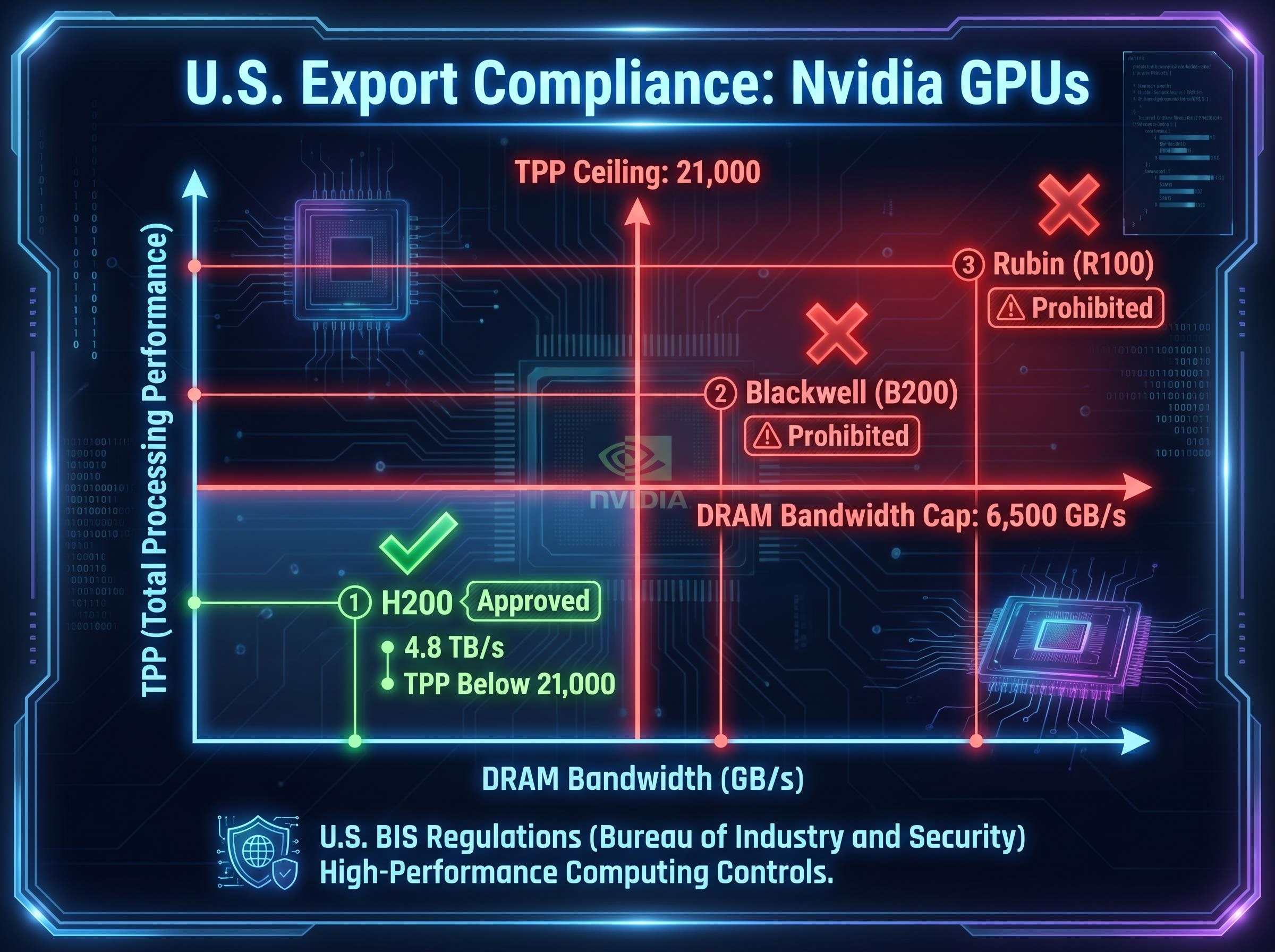
| Metric | H200 | Blackwell (B200) | Rubin (R100) |
|---|---|---|---|
| Export status | Approved (with conditions) | Prohibited | Prohibited |
| Memory bandwidth | 4.8 TB/s (under 6,500 GB/s cap) | Exceeds 6,500 GB/s cap | Exceeds 6,500 GB/s cap |
| TPP compliance | Below 21,000 | Exceeds 21,000 | Exceeds 21,000 |
The approved chip, in other words, is two generations behind Nvidia’s current frontier hardware. The commercial upside from this clearance is real, but it is not uncapped.
The U.S. authorisation was met with an unexpected response from Beijing. China independently halted H200 purchases and imposed its own import restrictions, according to WION reporting on 14 May 2026. The bilateral standoff, American clearance paired with Chinese restriction, goes a long way toward explaining the 1.97% premarket gain rather than a larger surge. Markets are pricing in genuine uncertainty, not just headline optimism.
Beijing’s customs block on H200 imports has prevented any commercial shipments from completing even where U.S. licences exist, a distinction that matters for investors trying to separate authorised revenue from recognised revenue on Nvidia’s income statement.
The January 2026 framework had already placed conditions on any H200 sales to China:
ByteDance committed upwards of $14 billion (approximately 100 billion yuan) in chip spending for 2026, according to Reuters, establishing the scale of Chinese demand now caught between American authorisation and Beijing’s counter-restriction.
Chinese AI chip orders for the H200 were estimated at more than 2 million units, against Nvidia’s approximate 700,000-unit inventory (this figure should be treated as an estimate). The demand exists. Whether supply can legally and physically reach it remains unresolved.
The H200 clearance lifted names well beyond Nvidia. ON Semiconductor posted the largest single-session gain of the group, climbing 11.14% to $115.71 on volume of approximately 21.55 million shares. Marvell Technology gained 3.29% to close at $183.80 on 31.86 million shares, while Micron rose 4.83% to $803.63 on 54.88 million shares. Alibaba, as both a named buyer and a proxy for the China AI demand thesis, gained 8.18% to $145.81 on 40.21 million shares.
| Ticker | May 14 price | Session gain | Volume (approx.) |
|---|---|---|---|
| MRVL | $183.80 | +3.29% | 31.86M shares |
| MU | $803.63 | +4.83% | 54.88M shares |
| ON | $115.71 | +11.14% | 21.55M shares |
| BABA | $145.81 | +8.18% | 40.21M shares |
AMD and Intel carry materially smaller China AI exposure than Nvidia, limiting their relative upside from this specific policy development. The broader market reflected where the enthusiasm was concentrated:
The breadth of the semiconductor sector response confirms this is being read as a sectoral catalyst, not a single-stock event.
White House AI Czar David Sacks articulated the administration’s rationale: controlled sales are preferable to total denial because denial accelerates Chinese domestic chip development, particularly by Huawei and state-backed alternatives. The strategic goal is to keep American companies competitive in the Chinese market while slowing Beijing’s path to chip self-sufficiency.
Bernstein estimated that without the licensing shift, Nvidia’s share of the Chinese AI chip market could fall below 10% (approximately 8%) by end of 2026, as Chinese firms pivoted to domestic alternatives.
Former U.S. national security officials have offered a counter-argument: the approved H200 volume could meaningfully expand China’s AI compute base, potentially providing capabilities comparable to what leading U.S. frontier AI firms currently hold. The policy may preserve Nvidia’s revenue while simultaneously building the capability it aims to constrain.
Three specific risks undermine the durability of the current export arrangement. First, the transactional nature of the Trump-era framework means policy could shift with negotiating dynamics; what is cleared today may be restricted next quarter if summit outcomes disappoint. Second, enforcement credibility remains uncertain. Chinese firms have historically accessed restricted technologies through intermediaries, and the third-party verification requirement is the primary compliance mechanism. Third, the paradox at the framework’s core: large-scale approved shipments may accelerate the very domestic Chinese chip capability the policy intends to contain.
The analyst consensus holds a Buy rating on Nvidia with an outperformance thesis for the second half of 2026.
Analyst consensus: Buy rating with outperformance expected in H2 2026, supported by data centre demand acceleration and the reopened China revenue channel.
That baseline view, however, depends on the bilateral standoff resolving into actual shipments, not just authorisation on paper. Three variables remain unresolved:
The two-day Trump-Xi summit (14-15 May 2026) means further developments are possible within 24-48 hours of publication. Nvidia remains in active focus through the remainder of the week.
Investors wanting to stress-test the durability of China upside against Nvidia’s actual revenue trajectory will find our deep-dive into Nvidia’s China revenue structure examines how data centre revenue collapsed from $6.0 billion in FY2024 to near zero by FY2026 Q1, why institutional investors at BlackRock and Goldman Sachs treat this market as a call option rather than a base-case driver, and what Huawei Ascend’s estimated 70-80% domestic market share implies for any recovery timeline.
The U.S. authorisation of H200 sales to ten Chinese firms at a diplomatic summit represents the most consequential Nvidia export policy moment since the January 2026 licensing framework was introduced. It reopens a revenue door, but it does not guarantee shipments. China’s counter-restriction means the commercial opportunity is authorised but not yet open, and investors should monitor summit outcomes and Bureau of Industry and Security follow-up communications through the remainder of the 14-15 May window.
Nvidia’s official communications and Commerce Department updates will be the most reliable signals of whether this week’s authorisation translates into realised revenue or remains a headline without a delivery date.
This article is for informational purposes only and should not be considered financial advice. Investors should conduct their own research and consult with financial professionals before making investment decisions. Forward-looking statements regarding Nvidia’s revenue outlook and policy durability are speculative and subject to change based on market developments and diplomatic outcomes.
The H200 is Nvidia's AI accelerator that falls within the U.S. Bureau of Industry and Security export thresholds, specifically a TPP ceiling of 21,000 and a DRAM bandwidth cap of 6,500 GB/s. Nvidia's newer Blackwell B200 and Rubin R100 chips exceed both limits and remain prohibited under the January 2026 framework.
The modest gain reflects the fact that China independently halted H200 purchases and imposed its own import restrictions, meaning the U.S. authorisation does not automatically translate into completed shipments or recognised revenue for Nvidia.
Four firms were publicly confirmed as approved buyers: Alibaba, Tencent, ByteDance, and JD.com. Six additional unnamed firms were also included in the Commerce Department authorisation, according to Reuters and U.S. News reporting on 14 May 2026.
The framework imposed a 25% revenue surcharge on all cleared exports, a 50% volume cap limiting total shipments, and a mandatory third-party U.S. verification requirement that must be satisfied before any shipment can proceed.
ON Semiconductor led the peer group with an 11.14% gain to $115.71, while Alibaba rose 8.18% to $145.81, Micron gained 4.83% to $803.63, and Marvell Technology advanced 3.29% to $183.80, reflecting a broad sectoral read-through from the policy development.