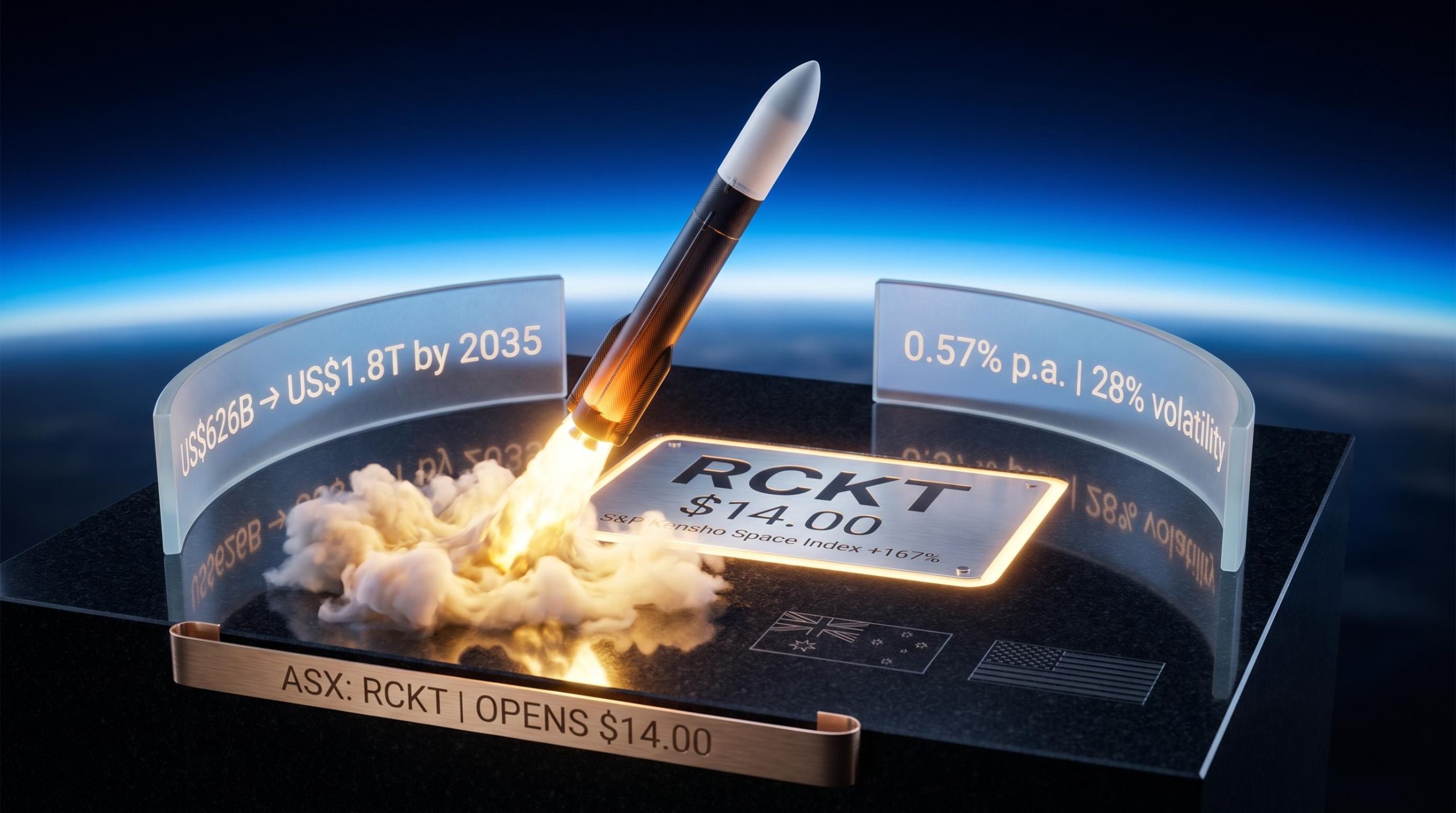
Australia’s first space-focused exchange-traded fund began trading on the ASX this morning. BetaShares’ RCKT opened at $14.00 per unit, tracking the S&P Kensho Space Index, a benchmark that returned 167% in the 12 months to 30 April 2026 but has also recorded a 40% maximum drawdown over its history. The fund gives Australian retail investors and self-managed super funds their first ASX-listed route into the commercial space economy, a sector projected to grow from US$626 billion today to US$1.8 trillion by 2035. Until now, gaining meaningful exposure required purchasing individual US-listed stocks or using international brokerage platforms. This analysis breaks down what RCKT holds, what it costs, how it compares to thematic ETF peers on the ASX, and what the concentration and currency risks mean for investors deciding how to size a position.
What RCKT actually holds and how the portfolio is built
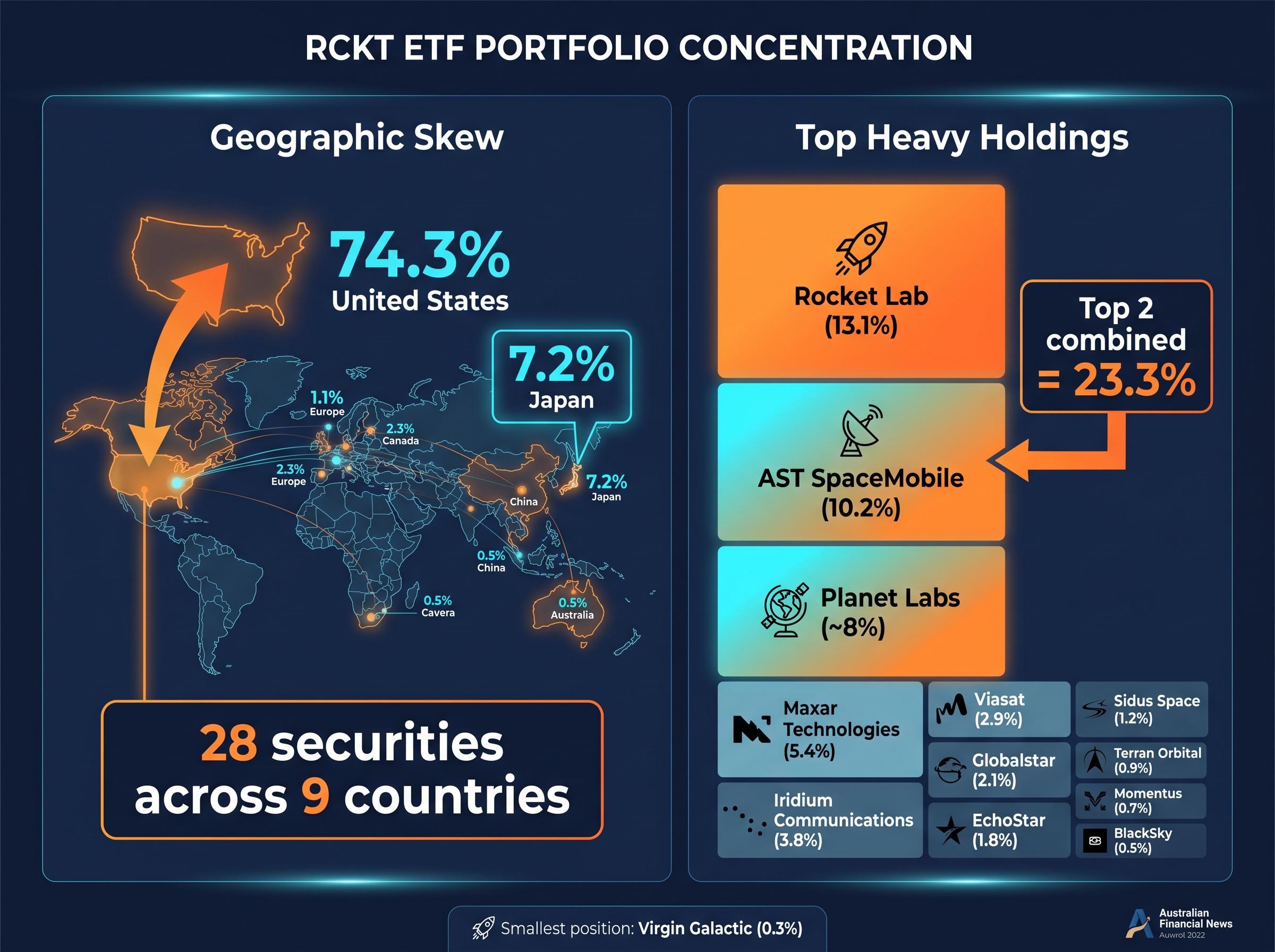
The label says “space.” The portfolio tells a more specific story. RCKT holds 28 securities across nine countries, selected by the S&P Kensho Space Index based on their revenue exposure to commercial and government space activities. The index applies a global mandate, but the geographic reality skews heavily toward a single market.
Geographic composition
US-listed equities account for 74.3% of the fund. The remaining allocation is spread thinly across eight countries:
- United States: 74.3%
- Japan: 7.2%
- Canada, France, South Korea, Sweden, Israel: smaller individual weightings
- Other: remaining allocation
Non-US exposure provides limited diversification. In practice, RCKT functions as a US space sector vehicle with modest international representation.
Top holdings and what they do
The fund’s five largest positions reveal a portfolio spanning launch vehicles, satellite broadband, and Earth observation.
| Ticker | Company | Weighting |
|---|---|---|
| RKLB | Rocket Lab USA (launch vehicles, spacecraft manufacturing) | 13.1% |
| ASTS | AST SpaceMobile (satellite-direct-to-cellular broadband) | 10.2% |
| PL | Planet Labs (Earth observation satellites, defence analytics) | ~8% |
| VSAT | Viasat (satellite communications) | Lower weighting |
| SATS | EchoStar (satellite broadband, video services) | Lower weighting |
Rocket Lab and AST SpaceMobile together represent 23.3% of the fund, meaning nearly a quarter of RCKT’s performance rests on two companies operating in different sub-sectors: orbital launch and satellite broadband, respectively. At the other end of the spectrum, Virgin Galactic sits at 0.3%, the smallest position. The BetaShares PDS caps any single stock at 30%.
When big ASX news breaks, our subscribers know first
The commercial space economy this fund is betting on
RCKT’s thematic case rests on a sector where government budgets and private capital are both accelerating.
The global space economy reached approximately US$626 billion in 2025 and is projected to grow to US$1.8 trillion by 2035, according to industry estimates.
That trajectory is not speculative. Measurable capital flows and operational milestones are already visible across 2025 and 2026:
- Launch volumes: More than 2,400 satellites were launched in 2025, with approximately 650 in Q1 2026 alone. Rocket Lab and SpaceX remain the dominant providers.
- Government spending: The US Space Force’s FY2026 budget request reached US$26.3 billion. In January 2026, Australia committed A$5 billion over 10 years to joint space technology development under AUKUS Pillar 2.
- Spectrum and regulation: The FCC’s LEO broadband spectrum auction in April 2026 raised US$4 billion, while the EU Space Law framework finalised in December 2025 eased private orbital operations.
- Launch capability milestones: SpaceX’s Starship achieved orbital success in November 2025. Blue Origin’s New Glenn made its debut in February 2026.
These are not projected catalysts. They are capital already deployed and regulatory barriers already removed.
How RCKT’s top holdings are performing right now
The fund’s three largest positions each reported earnings within the past quarter, offering a factual basis for the valuations embedded in today’s listing price.
Rocket Lab (RKLB, 13.1%) reported Q1 2026 revenue of US$122 million, a 45% year-on-year increase driven by 14 Electron launches (up from 9 in Q1 2025). In February 2026, NASA awarded the company a lunar lander contract worth US$250 million, and its Neutron rocket test succeeded in March 2026. RKLB closed at approximately US$105.47 on 11 May 2026, below its 52-week high of US$123.94.
AST SpaceMobile and Planet Labs
AST SpaceMobile (ASTS, 10.2%) reported Q4 2025 revenue of US$18 million, representing approximately 300% year-on-year growth. The first BlueBird satellite block launched in December 2025 via SpaceX. A Vodafone partnership expansion in January 2026 for European and Asian coverage and FCC approval for US testing in April 2026 followed. ASTS was trading at approximately US$82.55 on 11 May 2026.
Planet Labs (PL, approximately 8%) delivered FY Q3 2026 revenue of US$62 million, an 18% year-on-year increase, supported by more than 300 defence contracts and the Pentagon’s US$100 million Tanager mission. PL closed at approximately US$41.84 on 11 May 2026.
| Company | Weighting | Recent Revenue Growth | Key Milestone |
|---|---|---|---|
| Rocket Lab | 13.1% | +45% YoY (Q1 2026) | US$250m NASA lunar lander contract |
| AST SpaceMobile | 10.2% | ~300% YoY (Q4 2025) | FCC approval for US testing (April 2026) |
| Planet Labs | ~8% | +18% YoY (FY Q3 2026) | US$100m Pentagon Tanager mission |
All three holdings are showing operational momentum. The question for investors is how much of that momentum is already reflected in share prices that have appreciated substantially over the past 12 months.
Orbital launch and satellite broadband stocks have been among the strongest-performing segments of the public equity market over the past 12 months, with the same companies anchoring RCKT’s portfolio delivering individual returns well above the index’s 167% aggregate figure, a gap that reflects the outsized contribution of two or three names rather than broad-based sector appreciation.
Fee structure, index history, and how RCKT stacks up against ASX peers
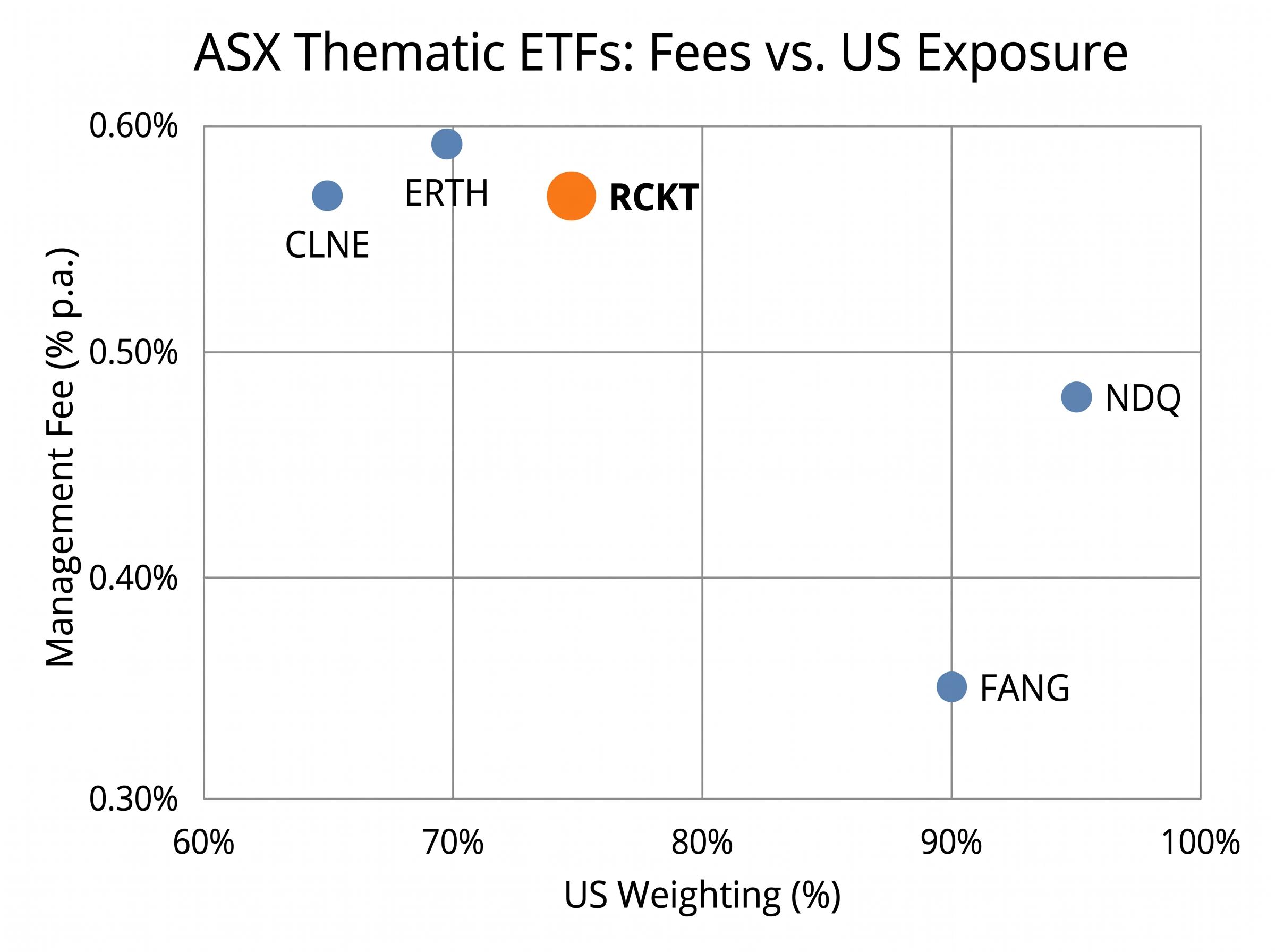
RCKT’s management fee of 0.57% per annum sits in the middle of the ASX thematic ETF range, according to Morningstar Australia, which described it as “mid-pack for thematics” in an April 2026 assessment. The fee is meaningfully higher than broad-market products like VAS at 0.10%, but comparable to VanEck’s CLNE at 0.57% and lower than BetaShares’ ERTH at 0.59%.
| Ticker | Theme | Fee (% p.a.) | AUM | US Weighting |
|---|---|---|---|---|
| RCKT | Space | 0.57% | ~A$40m (Day 1) | 74.3% |
| ERTH | Sustainability | 0.59% | ~A$86m | ~70% |
| NDQ | Nasdaq 100 | 0.48% | A$8.57b | ~95% |
| FANG | Tech/Disruptive | 0.35% | Not verified | ~90% |
| CLNE | Clean Energy | 0.57% | Not verified | ~65% |
The benchmark’s historical performance demands context.
The S&P Kensho Space Index returned 167.25% in the 12 months to 30 April 2026 and 20.46% annualised over five years. It has also recorded a 40% maximum drawdown. Both figures belong in the same evaluation.
VanEck’s Dino Cantinas, writing in the Australian Financial Review on 7 May 2026, noted “thematic fatigue post-2024 AI boom” but argued that the space sector’s total addressable market warrants paying the premium. According to FNArena data as of 9 May 2026, 7 of 12 brokers gave a buy rating, representing a 65% buy consensus. RCKT has no live fund performance track record; all return data references the underlying index.
ASIC Regulatory Guide 282 for exchange-traded products sets out the disclosure, compliance, and market integrity obligations that govern ASX-listed ETFs in Australia, including the product disclosure statement requirements that investors should review before transacting in funds like RCKT.
Concentration risk, currency exposure, and what analysts are flagging
The shift from opportunity to risk begins with structure. Four categories of risk warrant attention:
- Currency exposure: RCKT is unhedged. With 74.3% in US-denominated equities, appreciation of the Australian dollar against the US dollar directly reduces returns in AUD terms, regardless of how the underlying stocks perform.
- Single-stock concentration: The top two holdings represent 23.3% of the fund. Morningstar Australia cited a Herfindahl concentration index of approximately 1,200 for RCKT versus approximately 400 for NDQ, indicating meaningfully higher single-name risk.
- Sector drawdown history: The index’s 40% maximum drawdown is not hypothetical. Analysts at UBS Australia drew a direct comparison to ARKX’s approximately 60% drawdown in 2021 as a cautionary parallel for space-sector funds.
- Geopolitical and policy risk: UBS also flagged RCKT’s US geographic bias as an exposure to US trade policy, including potential tariff impacts on space supply chains.
UBS Australia (10 May 2026) recommended a position of less than 5% of portfolio for RCKT, citing the ARKX drawdown parallel and the fund’s unhedged US concentration.
Thematic ETF drawdowns of 25% or more occurred across technology-themed ASX products in 2026 even as the broader market captured gains from the resources and energy rotation, a pattern that reinforces why UBS Australia recommended capping RCKT exposure below 5% rather than treating the fund’s 167% index return as a forward performance guide.
Morningstar Australia assigned RCKT a Silver rating but attached a “high risk” designation for conservative portfolios, estimating annualised volatility at 28% (as of 11 May 2026). According to FNArena’s analysis on 9 May 2026, 7 of 12 brokers cited top-heavy concentration as a primary risk, expressing a preference for diversified global equity exposure over single-theme vehicles.
A Financial Standard survey of 150 advisers (published 10 May 2026) found that 62% classified thematic ETFs as high-risk satellite positions, recommending 5-10% portfolio allocations for retail investors within a core-satellite framework.
RCKT’s debut in context: who this fund suits and who should wait
BetaShares reported A$25 million in pre-launch subscriptions, with AUM reaching approximately A$35 million at listing and an estimated A$40 million by midday. The demand was real. The question is whether it matches the fund’s risk profile for each investor.
Who is likely to find RCKT suitable
- Growth-oriented investors under 40 with a multi-year investment horizon
- Investors already holding a diversified core of broad Australian or global equity ETFs who want thematic satellite exposure
- Those comfortable with an estimated 28% annualised volatility and the sector’s drawdown history
UBS Australia noted “enthusiasm from growth-oriented SMSFs,” but the fund’s unhedged currency structure carries particular implications for retirees drawing income in Australian dollars. Financial Standard’s adviser survey indicated a preference for positioning RCKT-style funds as growth exposure for younger investors within a core-satellite construction.
Core-satellite portfolio construction, the framework most commonly cited by advisers evaluating RCKT, typically anchors 75% or more of a portfolio in broad index ETFs before allocating a constrained satellite slice to high-conviction thematic positions, which limits the damage from a single-theme drawdown without eliminating the upside exposure.
What to verify before investing
Several information gaps remain on day one:
- AMIT tax treatment: Distribution taxation under the Attribution Managed Investment Trust regime is not yet documented post-launch. The BetaShares PDS and ATO guidance are the recommended references.
- Platform availability: Confirmation of RCKT’s accessibility across major Australian platforms (CommSec, SelfWealth) was not documented at launch. Investors should verify directly with their broker.
- Track record: RCKT has zero live performance history. All return data references the underlying index, including backtested periods that have not been independently verified.
These gaps do not disqualify the fund. They do give investors a legitimate reason to monitor the first few months before committing capital.
Investors exploring whether to complement an RCKT position with direct holdings in individual companies will find our deep-dive into public space equities covers Rocket Lab, AST SpaceMobile, and Intuitive Machines with company-level contract data, analyst price targets, and the specific downside scenarios flagged for 2026, allowing a more granular assessment of the same names embedded in RCKT’s top holdings.
Australia now has a space ETF, but the index’s history tells both sides of the story
The 167% 12-month index return is real. So is the 40% maximum drawdown. Both figures describe the same benchmark, and both belong in any investor’s assessment of RCKT.
The pre-launch subscription interest of A$25 million and steady debut trading suggest the market has already formed a view: RCKT is a high-conviction satellite position, not a core holding. The analyst consensus supports that framing, with UBS recommending less than 5% of portfolio and Financial Standard’s adviser survey pointing to 5-10% as the appropriate thematic allocation range.
The information gaps at launch, particularly around tax treatment and broker platform access, mean investors have a reasonable basis for monitoring the fund’s early months before transacting. Investors considering RCKT should review the BetaShares PDS in full, confirm platform availability with their broker, and consider how the fund’s 74.3% US weighting interacts with any existing USD or US technology exposure already in their portfolio.
This article is for informational purposes only and should not be considered financial advice. Investors should conduct their own research and consult with financial professionals before making investment decisions. Past performance does not guarantee future results. Financial projections are subject to market conditions and various risk factors.