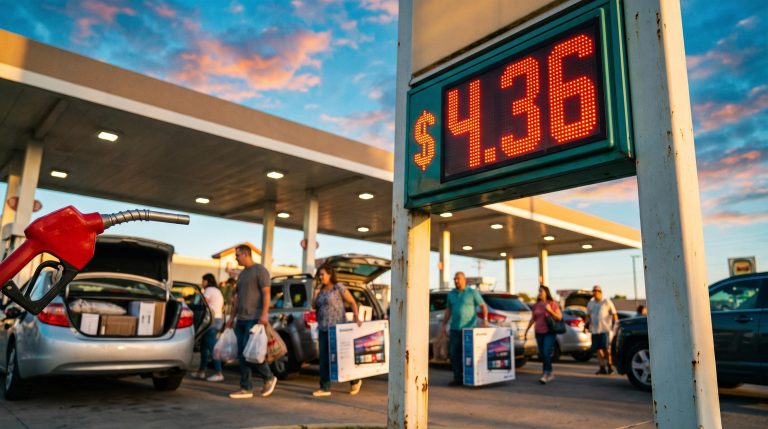
The collapse of U.S.-Iran ceasefire talks on 10 May 2026 has pushed Brent crude to $104.69 per barrel and set the stage for an inflation reading that could mark the fastest price acceleration in over a year. The April Consumer Price Index (CPI) report, due 12 May, is projected by a Bloomberg survey of 78 economists to show headline inflation at 3.7% year-over-year, up from 3.3% in March. The Strait of Hormuz has been effectively closed for more than two months, choking off roughly 20% of global oil supply. With President Trump rejecting Iran’s counterproposal within hours of its submission and the Trump-Xi summit not beginning until 13 May, there is no near-term diplomatic circuit breaker in sight. What follows explains what the supply disruption means for U.S. consumers right now, how energy costs are transmitting into grocery bills, airfares, and utilities, and what the Federal Reserve is doing, and not doing, about it.
Why the Strait of Hormuz breakdown is the supply shock that matters
Under normal conditions, approximately 20% of the world’s oil supply transits through the Strait of Hormuz, a narrow waterway between Iran and Oman. No other single chokepoint carries that concentration of global energy throughput.
20% of global oil supply passes through the Strait of Hormuz under normal conditions, making its closure the most consequential supply disruption since the 1973 Arab oil embargo by volume affected.
Iran’s authority over the Strait’s northern shipping lanes gives this standoff a different character from previous Gulf tensions. The blockade is not a threat; it is an operational reality now exceeding two months. Trump’s social media rejection of Tehran’s counterproposal, posted within hours of its submission on 8 May, eliminated the last active diplomatic channel. Iran had sought a ceasefire on all fronts plus financial compensation for wartime damage, conditions Washington dismissed immediately.
The Hormuz closure supply shock reached its most acute point on 30 April 2026, when Brent spiked above $125 intraday before closing at $111.88 as traders simultaneously priced ceasefire optimism and escalation risk into the same session, a volatility signature the IEA described as without modern parallel in scale.
The cascading supply chain effects extend well beyond the price of a barrel of crude:
- Reduced crude throughput to U.S. and Asian refineries, compressing refined product inventories
- Higher shipping and insurance costs on alternative routing, adding $3-$5 per barrel in transport premiums
- Knock-on shortages in liquefied natural gas (LNG) and petrochemical inputs, particularly from Qatar
When big ASX news breaks, our subscribers know first
How oil at $104 becomes groceries at $4 and airfares at 8% more
The oil price is an abstraction until it arrives in a household budget. It has arrived. April data across four consumer categories shows the transmission is already broad-based, not a forecast risk but a measurable reality.

| Consumer Category | Current Price Level | Year-over-Year Change | Primary Transmission Driver |
|---|---|---|---|
| Gasoline | $4.50/gallon | Elevated vs. pre-conflict levels | Direct crude-to-pump pass-through |
| Airfares | Jet fuel at $3.10/gallon | +8.2% (April preliminary, BLS via Bloomberg) | Jet fuel up $0.85 since 26 February (Delta, United filings) |
| Groceries | +4.1% YoY (USDA weekly, 8 May) | Meat and processed foods +5-7% | Fertiliser and urea shortages from LNG disruptions |
| Natural Gas / Utilities | +12% YoY in Q1 (EIA, 30 April) | Extending into April | LNG export halts from Qatar |
Food and energy costs are leading the pass-through
The grocery line deserves particular attention. When LNG exports from Qatar are disrupted, urea production, which depends on natural gas as a feedstock, falls with them. Urea is a primary nitrogen fertiliser used in meat production and processed food manufacturing. The 5-7% increase in meat and processed food prices reported by the USDA reflects this second-order transmission: not just the cost of trucking food to stores, but the cost of growing and processing it in the first place.
What the inflation transmission mechanism actually is (and why it persists)
Energy costs move through an economy in three distinct channels, each operating on a different timeline.
- Primary (direct): Fuel costs pass directly into consumer prices. Gasoline at the pump, heating bills, and electricity rates move within weeks of a crude price spike.
- Secondary (indirect): Transportation and shipping costs embed in goods prices. The Dallas Fed estimated on 10 May 2026 that the oil shock is adding 0.4-0.6 percentage points to core Personal Consumption Expenditures (PCE) through this channel alone. Bureau of Labor Statistics (BLS) producer price data released the same day showed transportation inputs up 6.4% year-over-year.
- Second-round effects: When businesses and workers adjust wages and services pricing to sustained higher input costs, inflation becomes self-reinforcing. Moody’s chief economist Mark Zandi warned on 9 May that these effects could push core CPI to 3.2% year-over-year, up from 3.0% prior.
Federal Reserve Chair Jerome Powell, speaking at The Economic Club of Chicago on 9 May 2026, characterised the oil spike as “transitory but potent,” a phrase that captures the Fed’s internal tension: acknowledging the shock may not last forever while conceding it is doing real damage now.
JPMorgan analysis from 10 May estimated that core goods excluding housing are up approximately 0.9 percentage points attributable to oil. The distinction matters. If inflation stays in channel one, it fades when oil prices stabilise. If it reaches channel three, it persists regardless of what crude does next.
What the April CPI print is expected to show, and what to watch for
The 12 May CPI release is a real-time test of how far through those channels the oil shock has travelled.
The Bloomberg consensus projects headline CPI at 3.7% year-over-year for April, a meaningful acceleration from March’s 3.3%. Month-over-month, the headline figure is expected at 0.6%, down from 0.9% prior. That sequential deceleration may generate relief headlines, but it would be misleading: the year-over-year rate is still climbing, meaning the cumulative price level continues to rise faster.
Core CPI, which strips out food and energy, is forecast at 0.3% month-over-month. The four sub-components that will be most diagnostic:
- Gasoline: Direct confirmation of pass-through speed
- Airfares: A proxy for how quickly fuel surcharges embed in service prices
- Food at home: Evidence of the LNG-to-fertiliser-to-grocery chain
- Core goods excluding autos: The broadest measure of secondary transmission
Bank of America (10 May 2026) projects a 1.0 percentage point headline inflation addition from a prolonged Hormuz closure, the most aggressive estimate among major Wall Street forecasters.
How the Fed is caught between fighting inflation and avoiding a recession
The Federal Reserve’s standard tool for fighting inflation is raising interest rates. Higher rates cool demand, which eases price pressure. The problem: higher rates cannot reopen the Strait of Hormuz. They cannot increase oil supply. They can only reduce economic activity on top of a supply shock that is already compressing household purchasing power.
Powell’s 9 May signal of a June pause reflects this bind. The Fed’s tools and the nature of the shock are mismatched:
The FOMC dual-mandate conflict became explicit at the 29 April decision, when a historic four-way dissent revealed hawks outnumbering the lone dovish dissenter three to one, with PCE running at 3.5% against a 2% target and unemployment rising to 4.3%, the precise configuration that makes a supply-shock-driven inflation reading like the 12 May CPI print so consequential for committee dynamics.
- What the Fed can do: Raise rates, hold rates, adjust forward guidance to shape expectations
- What the Fed cannot do: Increase oil production, reopen shipping lanes, reduce fertiliser input costs
CME FedWatch data as of 10 May showed June rate-cut odds repriced to just 12%, down from 45% before the conflict. September cut odds stand at 38%. The 2-year Treasury yield rose 22 basis points week-over-week to 4.65%, reflecting a market that has abandoned near-term easing expectations.
Bank of America revised its terminal rate projection upward to 4.75-5%, from a prior 4% estimate.
The stagflation scenario and what it means for investors
Stagflation occurs when high inflation coincides with stagnating economic growth, creating a dual squeeze on household purchasing power and corporate earnings. Goldman Sachs flagged a “stagflation trap” scenario on 10 May that could delay rate cuts until 2027.
The current configuration fits the template: a supply shock driving prices higher while growth softens under the weight of energy costs. For investors holding rate-sensitive assets, including bonds, real estate investment trusts (REITs), and growth equities, this scenario implies an extended period where neither falling rates nor easing inflation provide relief.
The Trump-Xi summit is the only near-term circuit breaker
The Trump-Xi summit, scheduled for 13-15 May 2026 in Beijing, is the one diplomatic event with the structural leverage to shift the supply picture. China is Iran’s largest oil customer, and that dependency gives Beijing a pressure point no other government possesses.
The data is suggestive but ambiguous. Iran’s crude exports to China fell 15% week-over-week to approximately 1.1 million barrels per day, according to Kpler data via Reuters. Beijing officially denies using reduced imports as leverage. Xi Jinping’s 28 April state media op-ed urged “multilateral de-escalation” without committing to oil purchase cuts.
Xi Jinping’s call for “multilateral de-escalation” committed China to nothing specific, a signal of deliberate ambiguity ahead of the Beijing summit.
No pre-summit leaks on the Iran agenda had emerged as of 10 May. Three distinct outcomes and their implied oil price trajectories:
The Hormuz risk premium embedded in current Brent prices is unlikely to decompress quickly even under a diplomatic resolution: the IEA projects a two-year supply chain recovery timeline, and the near-total withdrawal of commercial war risk insurance means that commercial tanker traffic cannot resume at scale until underwriters see a sustained period of incident-free passages.
- Diplomatic breakthrough: Hormuz reopens, Brent falls toward $85-$90/barrel
- Partial progress: Talks continue, prices stabilise at $95-$100/barrel
- No agreement: Hormuz remains closed, Goldman Sachs’ forecast of Brent averaging $110-$115/barrel through Q3 2026 activates

The cost of waiting, measured in basis points and grocery bills
The oil price shock is not a single-variable energy story. It is a multi-channel inflation event already visible in gasoline, airfares, grocery shelves, and utility bills. Two near-term data points will determine whether the trajectory bends or accelerates: the 12 May CPI release and the 13-15 May Trump-Xi summit.
Until the Hormuz blockade resolves, both inflation and rate policy remain in suspension. The Fed cannot cut into a supply shock. Diplomacy has not yet delivered an alternative. For U.S. households and investors, the cost of that limbo is measured in basis points on their mortgages and dollars on their grocery receipts, and it compounds with each week the Strait stays closed.
This article is for informational purposes only and should not be considered financial advice. Investors should conduct their own research and consult with financial professionals before making investment decisions. Financial projections referenced are subject to market conditions and various risk factors. Forward-looking statements regarding oil prices, CPI data, and Federal Reserve policy are speculative and subject to change based on geopolitical developments and economic performance.