
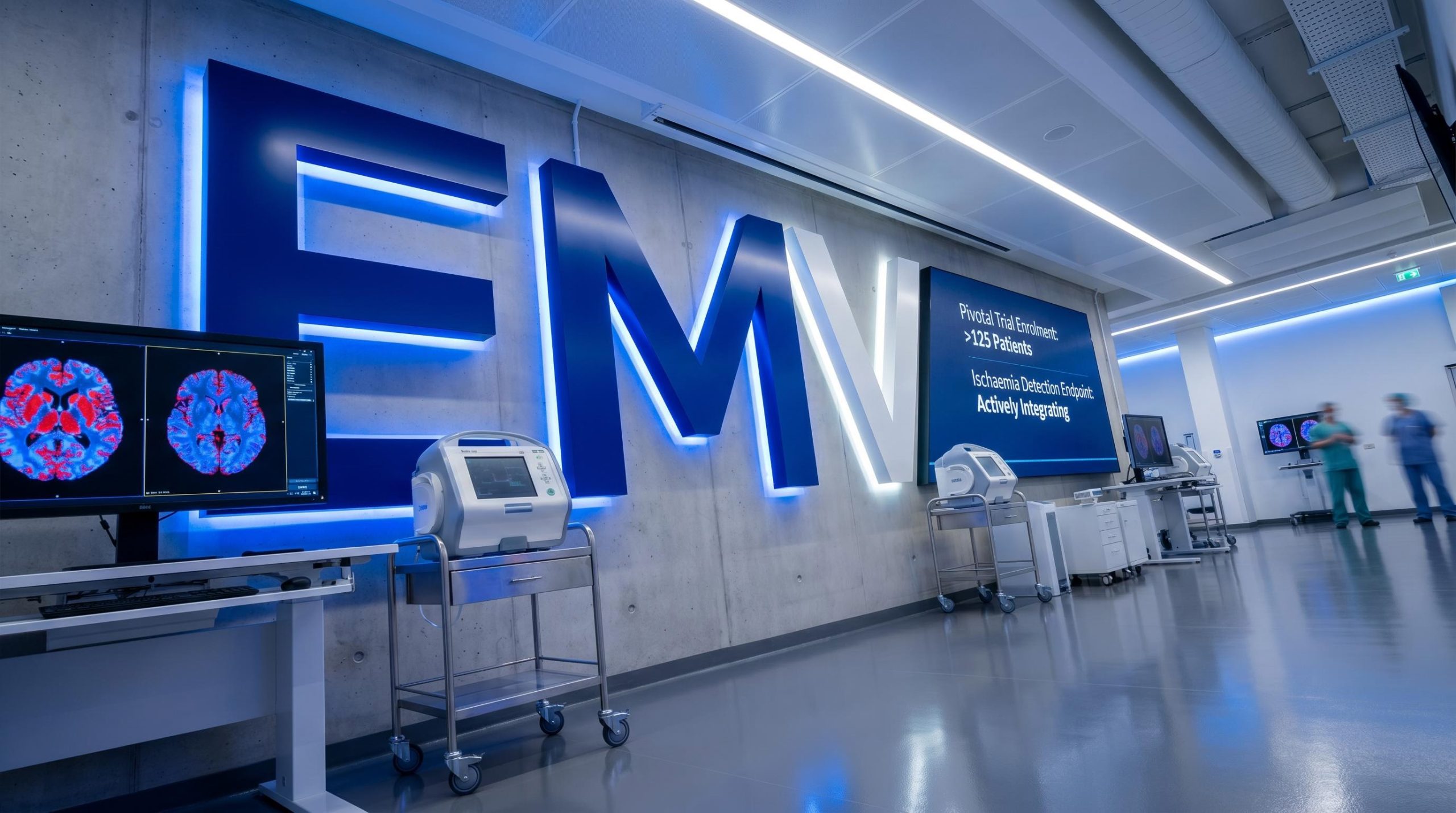
EMVision expands emu™ Pivotal Trial to include acute ischaemia detection, targeting ~80% of stroke presentations
EMVision Medical Devices (ASX: EMV) is actively preparing to add an acute ischaemia detection endpoint to its emu™ Pivotal (Validation) Trial, following significant R&D progress in the parallel Continuous Innovation Study. The expansion materially broadens the device’s clinical and commercial scope, with ischaemic stroke representing approximately 80% of all stroke presentations. FDA engagement via a pre-submission Q-Sub meeting is planned to follow, with full enrolment targeted for late CY2026 or early CY2027.
The trial has surpassed key recruitment milestones, with more than 125 patients enrolled to date across training and primary analysis cohorts, out of a 300-patient total target for the primary analysis cohort. Modifications to the trial protocol are described as “modest and incremental,” and no device-related adverse events have been reported.
What this means for the FDA clearance pathway
Integrating the ischaemia endpoint into the existing Pivotal Trial allows EMVision to leverage the same patient cohorts, infrastructure, and regulatory pathway already in place, rather than funding and enrolling a separate standalone trial. Because ischaemic stroke patients are already being enrolled, the required changes are limited to pre-specifying the ischaemia endpoint analysis plan and making targeted adjustments via a protocol amendment.
The strategic benefits of this approach are significant:
- Time efficiency: Could save up to 2 years compared to a standalone supplementary trial
- Capital efficiency: Avoids multi-million dollar additional trial costs
- Expanded indications from first FDA release: Haemorrhage and ischaemia detection validated within the same regulatory submission
When big ASX news breaks, our subscribers know first
Understanding ischaemia detection — and why it’s technically harder than haemorrhage
Stroke presents in two distinct forms. Ischaemic stroke, which accounts for approximately 80% of all cases, occurs when a blood vessel supplying the brain becomes blocked. Haemorrhagic stroke, accounting for the remaining ~20%, involves bleeding into or around the brain.
Critically, the two types require different treatments. Ischaemic stroke is treated with clot-dissolving drugs (thrombolysis) or clot retrieval (thrombectomy), while haemorrhagic stroke requires entirely different management. Rapid and accurate classification at the point of care is therefore not a clinical nicety — it is a prerequisite for appropriate treatment.
Ischaemic interventions are highly time-dependent. Every minute saved in the door-to-thrombectomy pathway translates directly to preserved brain tissue and improved functional outcomes for patients. Acute ischaemic stroke detection is widely recognised as a more complex clinical and technical challenge than haemorrhage detection, particularly in the hyperacute window and in care settings where advanced multimodal neuroimaging is not immediately available.
The emu™ Brain Scanner is designed to address precisely these diagnostic gaps. Adding ischaemia detection does not represent an incremental feature update. It repositions the device from a haemorrhage-focused triage tool to a whole-of-stroke triage device, materially expanding its addressable clinical utility across the full spectrum of stroke presentations.
Scott Kirkland, CEO and Managing Director, EMVision
“Bringing forward validation of ischaemia detection in the Pivotal Trial is a step-change for our emu™ Brain Scanner, substantially expanding its clinical utility and commercial opportunity from first FDA release, while leveraging the same trial infrastructure for capital and time efficiency. With recruitment past key milestones, growing interest from leading stroke centres, and a clear path through to read-out and FDA submission, our emu™ program is gathering pace while laying critical groundwork for our First Responder device.”
Trial momentum and the road to FDA submission
Recruitment update and site network
The Pivotal Trial is currently active across eight sites in the United States and Australia, with Princess Alexandra Hospital in Queensland transitioning in from the Continuous Innovation Study, bringing existing site readiness, trained staff, and clinical familiarity with the technology.
Current and incoming trial sites include:
- United States: Mayo Clinic (Florida), Mt Sinai Hospital (New York), Mt Sinai West (New York), Ronald Reagan UCLA Medical Center (Los Angeles), Memorial Hermann Texas Medical Centre (Houston), Memorial Hermann Memorial City (Houston)
- Australia: Royal Melbourne Hospital (Victoria), Liverpool Hospital (New South Wales), Princess Alexandra Hospital (Queensland, transitioning)
EMVision is also considering additional leading US stroke centres that have been referred to the company, reflecting growing clinical interest in the programme.
Milestone roadmap to FDA De Novo submission
The forward roadmap moves through several sequential stages, from ongoing recruitment through to FDA De Novo submission. The table below summarises the key milestones and their current status.
| Stage | Activity | Timing | Status | Significance |
|---|---|---|---|---|
| Ongoing recruitment | Site expansion and acceleration initiatives | Now – late CY2026 | In progress | Building statistical power toward 300-patient target |
| FDA Q-Sub engagement | Align on ischaemia endpoint expansion | Upcoming | Planned | Regulatory alignment on expanded clinical claims |
| Ischaemia endpoint integration | Protocol amendment and analysis plan pre-specification | Near-term | Actively preparing | Expands indications within existing trial |
| Full enrolment | Primary analysis cohort complete | Late CY2026 / early CY2027 | Targeted | Triggers read-out phase |
| Sequential read-outs and FDA De Novo submission | Trial results analysis and regulatory filing | Post full enrolment | Targeted | Path to first commercial clearance |
Financial runway and broader program progress
EMVision reported cash reserves of $18.4 million as at 31 March 2026, with a further $6.2 million in non-dilutive funding available under current grant programmes (net of the $0.4 million CRC-P third instalment received in May 2026 for the Regional Benefit Study). Together, this positions the company with a clearly articulated runway to key commercialisation milestones without near-term dilution pressure.
Progress across EMVision’s three parallel workstreams provides additional de-risking context:
- Pivotal (Validation) Trial: More than 125 patients enrolled; ischaemia detection endpoint integration actively underway; full enrolment targeted late CY2026 / early CY2027
- Continuous Innovation Study: Enrolment now exceeds 100 patients; Box Hill Hospital joining as Princess Alexandra Hospital transitions into the Pivotal Trial; John Hunter Hospital continuing; additional site activations underway
- Regional Benefit Study: Site selection well advanced ahead of ethics approval in H2 CY2026; study design validated across multiple modelled deployment scenarios; positioned as a blueprint for global deployment of the emu™ Brain Scanner, not an Australia-only initiative
The breadth of concurrent activity across clinical, regulatory, and real-world evidence workstreams underscores the operational momentum EMVision is building as it advances toward the FDA De Novo clearance pathway.
Don’t Miss the Next Healthcare Breakthrough on ASX
Big News Blast delivers FREE breaking ASX healthcare news directly to your inbox within minutes of release, complete with in-depth analysis already done for you. Join 20,000+ subscribers staying ahead of market-moving announcements. Click the “Free Alerts” button at StockWire X to start receiving alerts the moment news breaks.