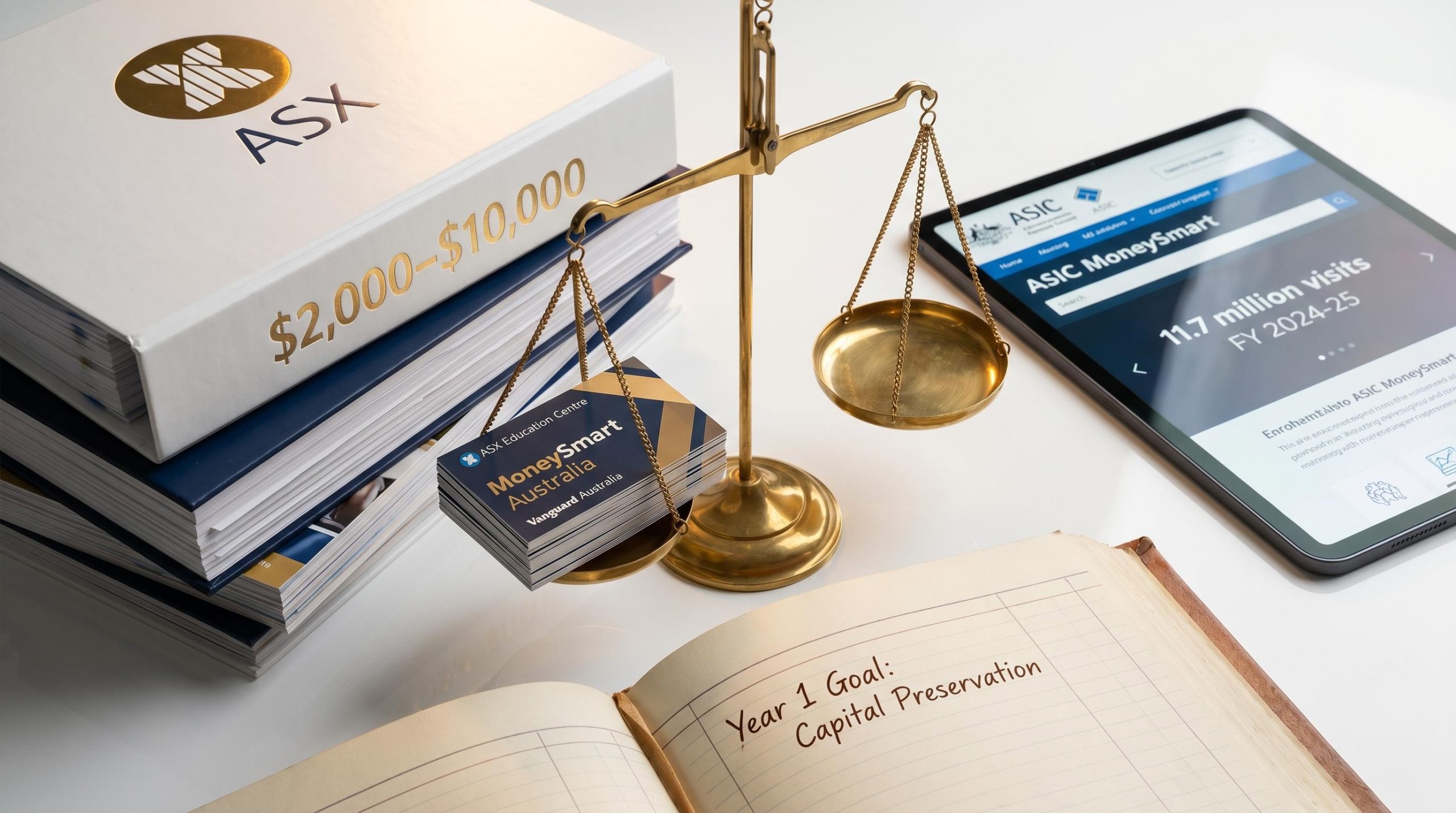
The average paid investment course in Australia costs between $2,000 and $10,000. Most of the content inside, the chart patterns, the indicator explanations, the portfolio construction basics, is available free from ASIC, the ASX, and Vanguard. That gap between price and value is the central problem facing anyone searching for investing education in Australia, and it has only widened as social media has turned financial advice into a content product. ASIC’s ongoing finfluencer crackdown through 2025 and 2026 confirms the issue is structural, not anecdotal.
This guide provides a clear framework for identifying predatory education products, a curated shortlist of free and low-cost resources built specifically for Australian investors, and a practical first step (paper trading) that costs nothing and builds genuine skill. The goal is straightforward: spend less on learning and more on actually investing.
Why expensive investment courses rarely justify their price tag
The logic sounds reasonable. Pay more, learn more. In most consumer markets, price correlates with quality. Investment education is not most consumer markets.
No reliable relationship exists between course cost and content quality in this space. Price reflects how aggressively a vendor monetises attention, not what the buyer receives. Paid investment courses in Australia commonly charge $2,000-$10,000 for content that consists primarily of pre-recorded videos or downloadable documents. Monthly subscription services for signals and ongoing content typically run $49.99-$200 per month, often with auto-renewing structures designed to be difficult to cancel.
Three structural reasons explain why these products consistently underdeliver:
- Price signals vendor aggressiveness, not content quality. The most expensive courses spend their margin on marketing funnels and lifestyle imagery, not curriculum development.
- Completion rates are low. The dynamic mirrors gym memberships: initial enthusiasm fades quickly for underprepared buyers, meaning most expensive courses go unfinished.
- The content is already free. The bulk of technical analysis material in paid courses (charts, indicators, candlestick patterns) is available through the ASX Education Centre and government-backed platforms at no cost.
Community consensus across r/AusFinance reinforces this: a large majority of participants consistently recommend free resources over paid alternatives.
“If it sounds too good to be true, it probably is.” This principle, consistently emphasised by ASIC, applies as much to education products as to investment returns themselves.
When big ASX news breaks, our subscribers know first
The red flags that separate predatory course sellers from legitimate educators
The warning signs are not subtle. Most readers will recognise them from advertisements they have already scrolled past. That recognition is the point: turning instinct into a replicable checklist.
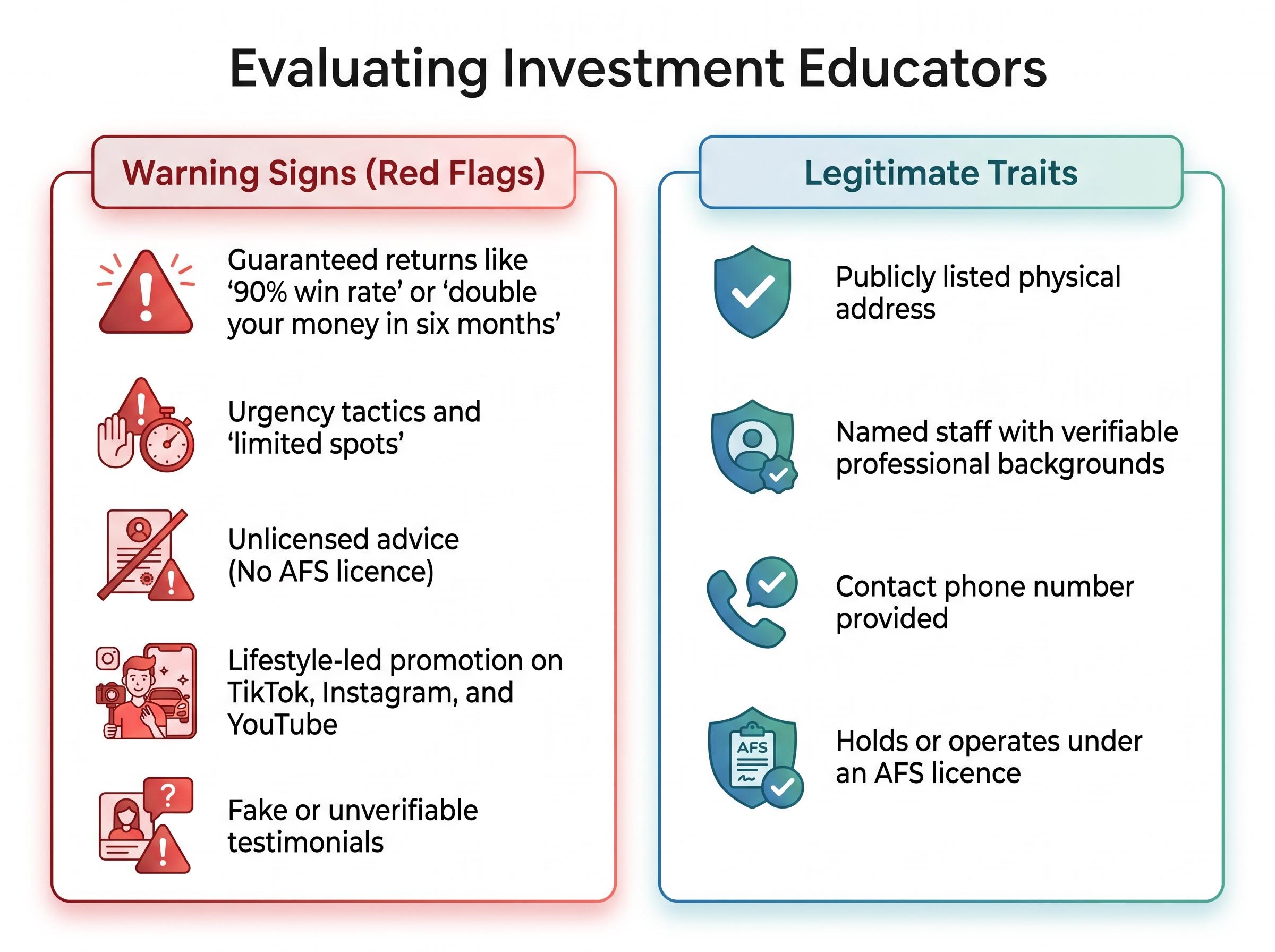
Red flags drawn from ASIC guidance and Australian community experience include:
- Guaranteed or very high return claims. Legitimate educators do not promise specific outcomes such as “90% win rate” or “double your money in six months.”
- Urgency and scarcity tactics. Countdown timers, “limited spots,” and pressure to enrol immediately are marketing techniques, not education signals.
- Unlicensed advice. Courses offering specific stock picks or trading signals without an Australian Financial Services (AFS) licence are likely operating outside the law.
- Lifestyle-led social media promotion. Heavy use of luxury imagery on TikTok, Instagram, and YouTube to sell courses rather than demonstrate knowledge.
- Fake or unverifiable testimonials. Reviews that cannot be independently confirmed through any external source.
Legitimate providers, by contrast, tend to share common traits: a publicly listed physical address, named staff with verifiable professional backgrounds, and a willingness to list a contact phone number.
How to verify whether a provider is legitimate
Any person or business providing financial product advice in Australia must hold an AFS licence or be authorised under one. Verifying this takes under two minutes, and the result is binary: licensed or not.
- Search ASIC Connect Professional Registers for the provider’s name or licence number. This confirms whether they hold a current AFS licence.
- Check ASIC’s MoneySmart finfluencer and scams guidance page (moneysmart.gov.au) for warnings related to the provider.
- Search the provider’s name on r/AusFinance to review community experience and any reported issues.
- Check whether the course content is available free elsewhere. In most cases, it is.
ASIC’s finfluencer enforcement activity has continued into 2026, with confirmed actions targeting Telegram, Discord, TikTok, and Instagram channels promoting paid trading signals and subscription services (ASIC media release 26-081MR).
ASIC media release 26-081MR confirms that the regulator’s finfluencer enforcement program has expanded in 2026 to include coordinated action with global regulators, targeting Telegram, Discord, TikTok, and Instagram channels that promoted paid trading signals and subscription services without an AFS licence.
What investing actually requires you to learn (and why it takes years, not weeks)
No course, paid or free, delivers mastery in weeks. Investment knowledge accumulates over years and requires continuous learning throughout an investor’s lifetime. Accepting this is not discouraging. It is liberating, because it removes the pressure to master everything before making a first trade.
A useful benchmark from Australian investor communities: finishing the first year with the same capital as the starting point is a genuine marker of success, not failure. Capital preservation, not market-beating returns, is the Year 1 goal.
One reason this matters: the psychological impact of financial loss is estimated at roughly three times greater than the equivalent gain. For undercapitalised beginners entering with unrealistic return expectations, this asymmetry can cause panic decisions that compound losses. Starting small and learning gradually is not timidity; it is risk management.
The foundational concepts beginners need to understand centre on the investment types available in Australia:
| Investment Type | What It Is | Beginner Suitability | Where to Access |
|---|---|---|---|
| ASX Shares | Direct ownership of shares in ASX-listed companies | Moderate; requires individual company research | Any ASX broker |
| ETFs | Pooled funds tracking an index or sector (e.g., VAS, VDHG) | High; instant diversification, low fees | Any ASX broker |
| Managed Funds | Professionally managed pooled investments | Moderate; higher minimum investments, not exchange-traded | Fund managers or platforms like Netwealth |
| Superannuation | Australia’s compulsory retirement savings system | High; most employed Australians already participate | Employer-nominated or self-selected fund |
Why fees and risk tolerance matter from day one
Small differences in management fees compound dramatically over time. A portfolio paying 0.07% in annual fees versus one paying 0.85% will produce meaningfully different outcomes over 10-20 years, even with identical market returns. This is one of the few variables a beginner can control from the outset.
Risk tolerance is the match between an investor’s time horizon and their emotional capacity to hold through volatility. MoneySmart’s investor profile quiz offers a free starting point for establishing where that balance sits. Understanding it before committing capital prevents the most common beginner error: buying high, panicking during a drawdown, and selling low.
Investment risk and time horizon are more tightly linked than most beginners assume: 20 years of verified Australian asset class data show residential property delivering 9.16% annualised returns and Australian shares returning 7.55%, while cash produced a negative real return after inflation, a comparison that reframes volatility tolerance as a function of how long capital remains invested.
The free and low-cost resources that actually build investing knowledge in Australia
These are not consolation prizes for those who cannot afford paid courses. They are the resources that serious Australian investors actually use. Government-backed, free of upsell, and aligned to Australian market conditions, they represent the objectively superior starting point.
| Resource | Provider Type | Best For | Access |
|---|---|---|---|
| ASIC MoneySmart | Government regulator | Comprehensive basics: super, shares, ETFs, scam avoidance | moneysmart.gov.au (free) |
| ASX Education Centre | Exchange operator | Sharemarket mechanics, free e-books, glossaries, webinars | asx.com.au (free) |
| Financial Basics Foundation | Non-profit | Investors under 30; budgeting and super fundamentals | financialbasics.org.au (free) |
| Vanguard Australia Education | Fund provider | Low-cost indexing principles and long-term investing | vanguard.com.au/personal/learn (free) |
| Morningstar Australia | Research provider | Free “Investing 101” podcast and beginner article series | morningstar.com.au (free) |
| r/AusFinance Wiki | Community | Practical beginner guide, regularly updated by Australian investors | reddit.com/r/AusFinance (free) |
ASIC MoneySmart received 11.7 million visits in FY 2024-25, according to ASIC’s Annual Report. That figure reflects broad community reliance, not a niche audience.
The Barefoot Investor book remains a commonly recommended low-cost entry point with strong community endorsement. It is not a course product, and its practical tone suits readers who prefer a single starting reference before moving to the resources listed above.
A note on classroom-based courses: group learning tends to progress at the pace of the least experienced participant. Beginners considering in-person options should assess level fit before enrolling.
Paper trading: how to build real skills before risking real money
Paper trading means tracking hypothetical trades using real prices and real dates, either on a spreadsheet or through a dedicated simulator, without committing actual capital. Choosing to simulate first is not timidity. It is the habit that separates disciplined learners from those gambling on instinct.
The ASX Share Trading Game is the most commonly recommended starting point in Australian investor communities. It uses ASX stocks and ETFs with real-time data, includes leaderboards, and is entirely free.
| Platform | Type | ASX Coverage | Cost |
|---|---|---|---|
| ASX Share Trading Game | Standalone simulator | Full ASX stocks and ETFs, real-time data | Free |
| Investopedia Simulator | Standalone simulator | ASX tickers supported; $100,000 virtual portfolio | Free |
| TradingView | Charting and paper trading | ASX focus available; community strategies | Free tier available |
For those ready to explore broker-integrated environments, several Australian brokers offer demo accounts:
- CommSec: Virtual ASX portfolio with trial demo account
- Interactive Brokers AU: Unlimited ASX and global demo with advanced tools
- Webull AU: Virtual funds with ASX real-time data
- Stake: Basic ASX demo for new users
One honest limitation: paper trading removes the emotional dimension of real money. It builds analytical skills and decision-making habits, but not the full psychological experience of watching a real portfolio decline 3% in a day. Real investing should follow simulation, ideally with a modest initial position sized to be educational rather than financially consequential.
Reactive trading patterns among Australian retail investors are measurable and costly: platform trading volumes doubled during the April 2025 US tariff announcement and fell more than 20% after the March 2026 RBA rate hike, a sequence that illustrates precisely why paper trading habits and a defined entry framework matter before real capital is committed.
Choosing your first broker: what Australian beginners actually need to know
Broker selection feels overwhelming because comparison sites list dozens of features. For a beginner, only a handful of factors matter.
The factors worth evaluating first: brokerage fees per trade, whether the broker offers CHESS sponsorship, platform usability, and whether international market access is needed at this stage (for most beginners, it is not).
CHESS sponsorship means shares are registered in the investor’s own name directly with the ASX’s clearing and settlement system. This provides ownership security that custodian models, where shares are held in the broker’s name on the investor’s behalf, do not offer. For Australian investors, CHESS sponsorship is widely preferred.
| Broker | Fee Structure | CHESS Sponsored | Best For |
|---|---|---|---|
| CommSec | $10-$29.95 per trade (size-dependent) | Yes | Beginners wanting integration with Commonwealth Bank |
| SelfWealth | Flat-fee brokerage | Yes | Cost-conscious investors seeking predictable fees |
| Interactive Brokers AU | Low per-trade costs | No (custodian model) | Active or internationally focused investors |
Fee structures and platform features change. Canstar and MoneySmart both maintain free broker comparison tools with live data, and checking these at the time of account opening is a better approach than relying on any static recommendation. Minimum investment requirements also vary by platform and should be confirmed before committing.
The broker chosen determines the actual cost of every trade a beginner makes for years. Compounding fees can meaningfully erode early returns, making this decision worth 10 minutes of comparison rather than defaulting to the first name recognised.
The only investing education framework that consistently works long-term
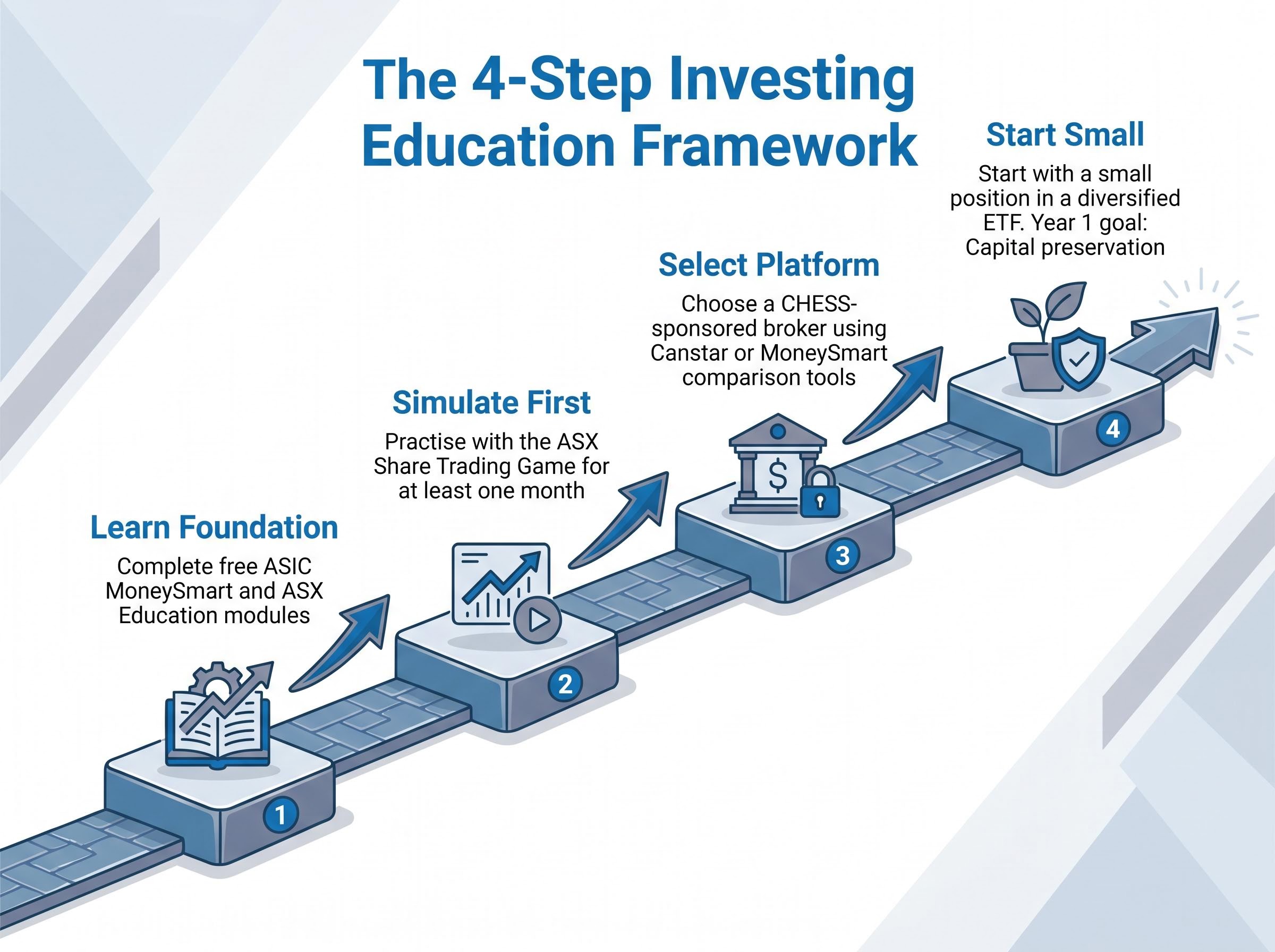
The argument throughout this guide reduces to a simple progression: the best investing education in Australia is layered, free, practical, and patient.
- Complete free ASIC MoneySmart and ASX Education modules. These cover the foundational concepts without upsell, sales funnels, or licensing concerns.
- Practise with the ASX Share Trading Game for at least one month. Build decision-making habits and test strategies without financial risk.
- Choose a CHESS-sponsored broker using Canstar or MoneySmart comparison tools. Evaluate fees, usability, and sponsorship model based on current data.
- Start with a small position in a diversified ETF and continue learning from free resources. The Year 1 benchmark is capital preservation, not market-beating returns. A low-cost diversified ETF is the most commonly recommended vehicle to achieve it.
Instrument selection for beginners is genuinely more consequential than most early guides suggest: the decision between individual shares, bonds, and ETFs determines not just expected returns but also the complexity of research required, the cost structure of ongoing management, and the behavioural demands placed on an investor who is still building their decision-making habits.
MoneySmart’s 11.7 million visits in FY 2024-25 confirm that free resources are the mainstream choice for Australian investors, not the budget alternative. Investing is a lifelong intellectual pursuit, not a certification to obtain. The daily engagement it demands is itself part of the value.
The immediate next step: visit MoneySmart or the ASX Education Centre today, then sign up for the ASX Share Trading Game. The knowledge compounds from there.
This article is for informational purposes only and should not be considered financial advice. Investors should conduct their own research and consult with financial professionals before making investment decisions.