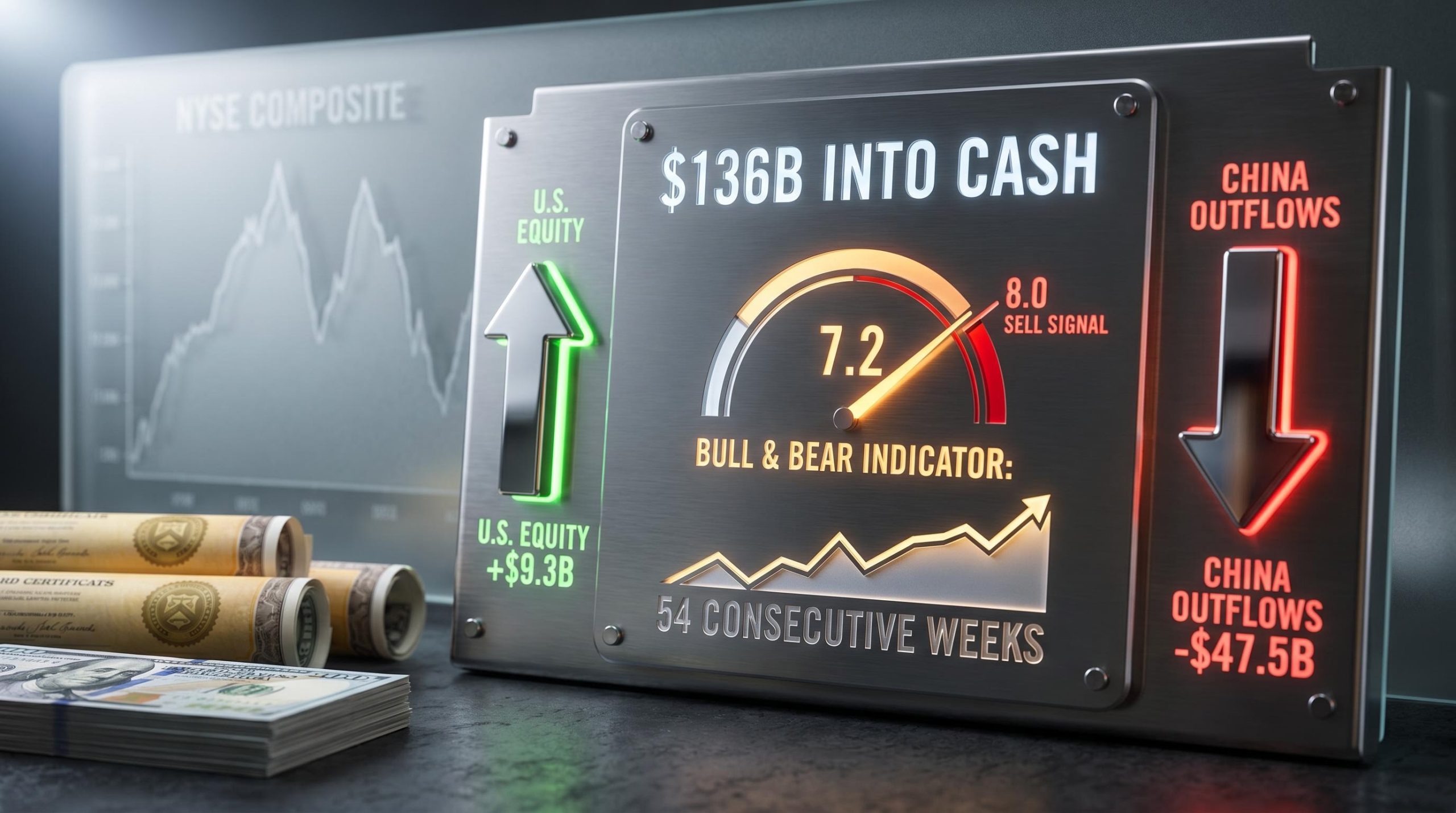
Approximately $136 billion flowed into cash funds in a single week, the largest rush to safety since January 2026. Yet U.S. equity funds recorded their sixth consecutive week of net inflows. That contradiction, defensive capital allocation running alongside a buoyant equity tape, is the signal worth examining. Bank of America’s weekly fund flow report for the week ending 8 May 2026 captures a market where institutional money is moving in two directions at once: toward safety at the asset-class level and toward U.S. stocks at the regional level. The data, combined with BofA’s proprietary Bull and Bear Indicator and a shift in central bank policy direction, offers a layered picture of where risk appetite stands and what threshold would change the assessment. What follows is a breakdown of the specific flow figures, what they signal about sentiment, and the macro variable that could accelerate the move toward a formal sell signal.
The numbers behind the risk-off shift
$136 billion into cash funds in a single week, the largest inflow since January 2026.
The scale of the defensive move is difficult to dismiss. But the full rotational picture is more nuanced than the cash headline suggests.
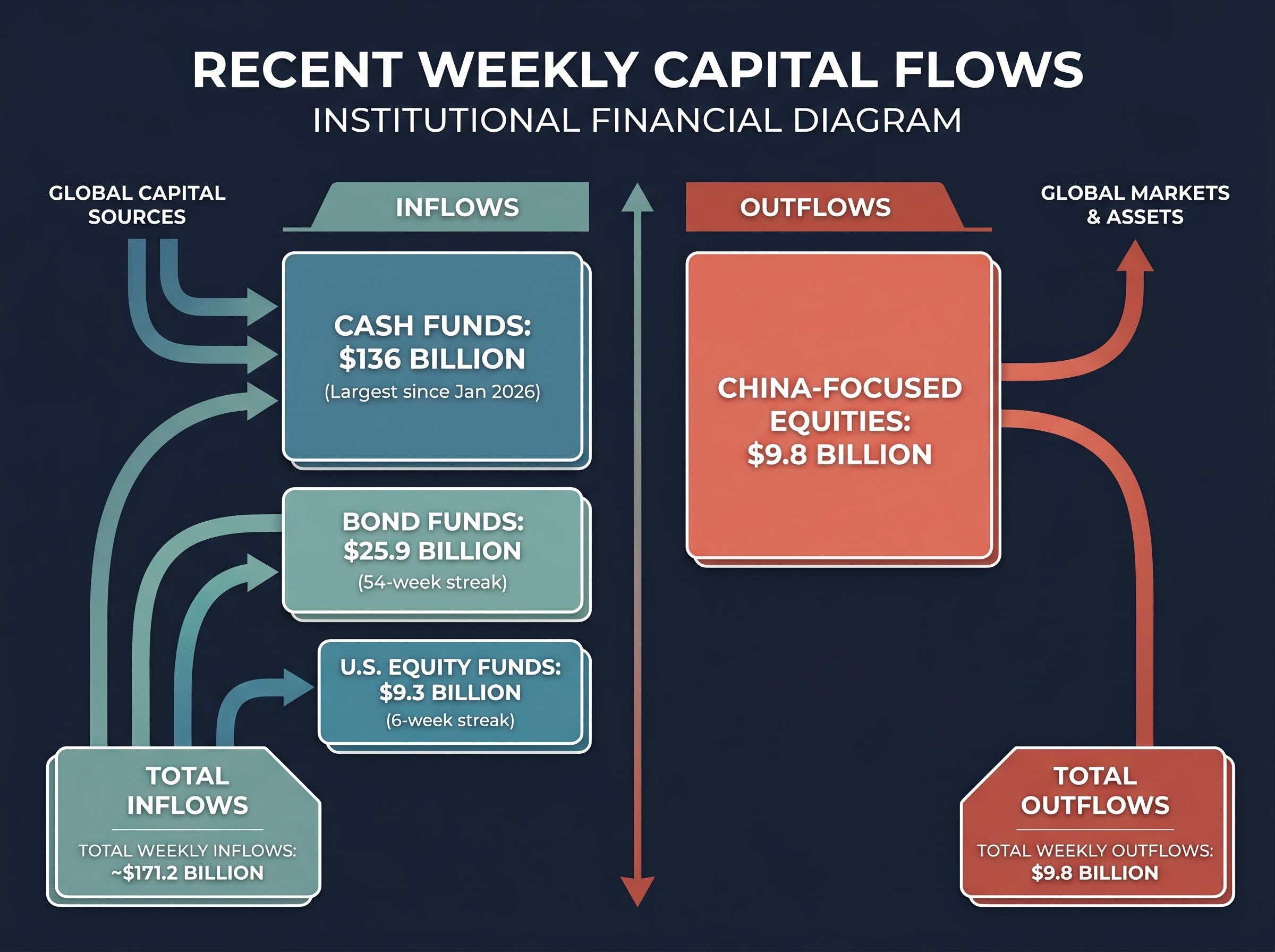
- Cash funds: approximately $136 billion inflow (largest weekly move since January 2026)
- Bond funds: approximately $25.9 billion inflow, extending the positive streak to 54 consecutive weeks
- Equity funds overall: approximately $2.6 billion net inflow
- U.S. equity funds: approximately $9.3 billion inflow, sixth straight week of positive flows
The contrast matters. Cash and bonds absorbed more than $160 billion in combined inflows, yet equities still attracted net new capital. That net figure, however, is almost entirely a U.S. story. Strip out the $9.3 billion flowing into U.S. equity funds and the rest of the global equity universe is in net redemption territory. The surface looks constructive; the composition tells a more defensive story.
Market breadth in April 2026 reinforces the composition argument embedded in the flow data: the S&P 500 posted a 98th-percentile monthly return while only 23% of its constituents outperformed the index, a 5-percentage-point gap between cap-weighted and equal-weighted performance that mirrors the divergence between the U.S. equity headline inflow and the defensive cash positioning running alongside it.
When big ASX news breaks, our subscribers know first
China and emerging markets take the heaviest redemptions
The single-week figures are sharp. The cumulative picture is sharper. Over the past six weeks, approximately $47.5 billion has left China-focused equity funds, a sustained directional shift that distinguishes this move from short-term noise.
In the most recent week alone, China-focused funds saw approximately $9.8 billion in outflows. Broader emerging market equities recorded approximately $11.6 billion in redemptions, the steepest weekly figure since January 2026.
| Region / Segment | Weekly Outflow | Context |
|---|---|---|
| China-focused equities | $9.8 billion | Six-week cumulative: $47.5 billion |
| Emerging markets (overall) | $11.6 billion | Steepest weekly outflow since January 2026 |
| European equities | $11.3 billion | Cumulative over four weeks |
| Consumer sector funds | $1.1 billion | Largest redemption since December 2025 |
Europe and consumer sector join the retreat
European equity funds have now shed approximately $11.3 billion over four weeks, while consumer sector funds recorded approximately $1.1 billion in redemptions, the largest since December 2025. These are not isolated moves. When China, broader EM, Europe, and a cyclical sector like consumer discretionary are all in net outflow simultaneously, the data describes a coordinated risk-off rotation across regions and segments.
What fund flow data actually measures and why it matters
Fund flow analysis tracks net capital movement across asset classes, regions, and investment vehicles. It captures where money is going, not where prices are heading. That distinction is worth emphasising: flow data functions as a sentiment proxy, revealing how institutions are positioning rather than predicting what markets will do next.
When cash and bond inflows surge while equity indices continue to climb, the gap between positioning and price becomes the signal. Sustained inflows into defensive assets indicate institutional risk aversion even when headlines suggest markets are behaving normally. The 54-week bond inflow streak is an example: no single week in that run was dramatic on its own, but the cumulative direction represents a structural preference for fixed income that has persisted across multiple market environments.
For context, the Investment Company Institute (ICI) reported long-term fund net outflows of approximately -$16.84 billion for the week ending 29 April 2026, a verifiable data point that aligns with the broader risk-off pattern.
The ICI weekly fund flow data provides the primary benchmark for tracking net capital movements across long-term mutual funds, with the institute’s methodology distinguishing between equity, bond, and hybrid fund categories in a way that makes cross-week comparisons directly comparable.
A practical approach to reading a weekly flow report involves four steps:
- Compare the current week’s figures against the prior four-to-eight-week average to distinguish signal from noise
- Identify directional clusters, where multiple asset classes or regions are moving in the same direction
- Check streak length, as a single week of cash inflows is less informative than six consecutive weeks of China outflows
- Cross-reference flows with macro context, including central bank decisions, inflation data, and earnings trends
One limitation deserves attention: aggregate flows can mask significant divergences between active and passive strategies, and attribution of flows to specific catalysts requires care.
Market sentiment gauge at 7.2: how close is the sell signal
Bank of America’s Bull and Bear Indicator rose to 7.2 in the latest reading, up from 6.6 the prior week. The firm’s contrarian sell-signal threshold sits at 8.0.
The Bull and Bear Indicator at 7.2 is 0.8 points from the 8.0 sell-signal threshold. The indicator remains in elevated but not extreme territory.
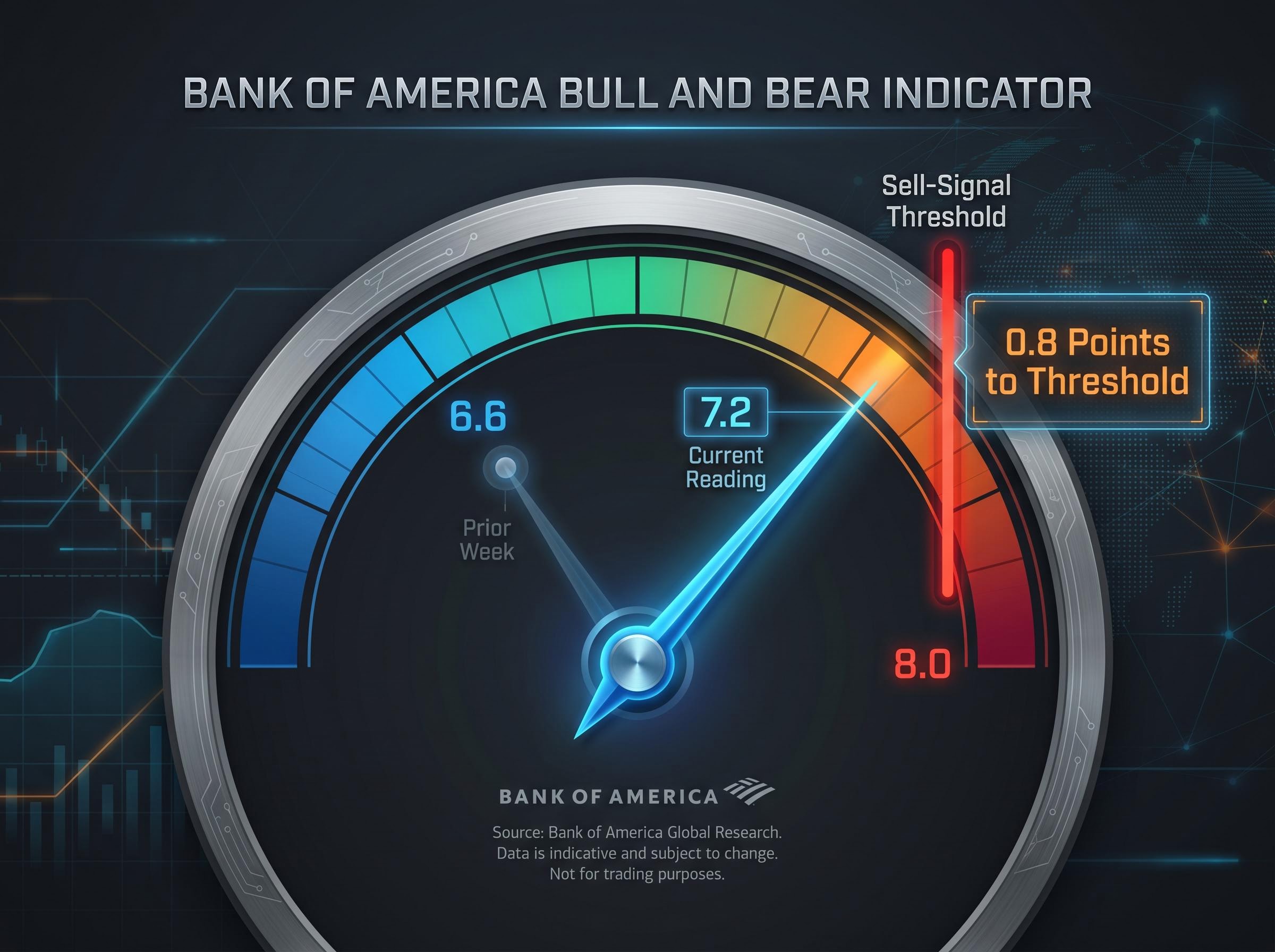
The indicator aggregates multiple inputs, including fund flows, positioning data, and market breadth. The sustained 54-week bond inflow streak and the scale of cash inflows both feed into its calculation. At 6.6, the reading suggested warming sentiment. At 7.2, it signals that optimism has moved meaningfully closer to the zone where BofA’s framework historically flags tactical risk.
The gap between 7.2 and 8.0 is narrow enough to close in one or two weeks of strong equity inflows and further risk-on positioning. It is also wide enough that a reversal in flows, or a geopolitical disruption, could stall the advance. The reading does not prescribe action; it marks a proximity to a threshold that has, in prior cycles, preceded periods of elevated drawdown risk.
BofA’s Bull and Bear Indicator is not the firm’s only sentiment gauge approaching a critical threshold: the Sell Side Indicator held at 55.6% in April 2026, sitting just 1.9 percentage points below the 57.5% sell signal level, and its implied 12-month S&P 500 return of approximately 13% coexists with a warning that only 23% of index constituents outperformed the benchmark in April.
The central bank rate hike turn and the NYSE double-peak risk
For the first time since November 2023, developed market central bank rate hikes have outpaced rate cuts. The Bank of Japan’s move to 0.75% and the broader stalling of easing cycles across developed economies have shifted the policy balance.
The April 29 FOMC dissent, where four committee members publicly diverged on the appropriate policy path for the first time in years, made the rate-hold decision significantly more informative than the rate itself: three hawkish dissenters against a single dovish one reveals a committee leaning toward further tightening, not toward the easing cycle that the prior year’s positioning had anticipated.
The macro conditions underpinning this shift are visible in the data:
- Core PCE (March 2026): 3.2%, above the Federal Reserve’s 2% target
- Fed effective funds rate: approximately 3.64%, with a gentle upward trajectory
- Probability of no Fed rate cut in June: approximately 96%
These three figures describe an environment where monetary easing has stalled and, in some economies, reversed. BofA strategist Michael Hartnett has flagged this inflection as the backdrop for a specific technical risk scenario.
- Rate hikes outpacing cuts for the first time since November 2023
- Bull and Bear Indicator at 7.2, approaching the 8.0 sell threshold
- Defensive flows at the largest scale since January 2026
Why BofA is watching the NYSE composite for a double-peak pattern
Hartnett has identified the NYSE composite, rather than the S&P 500, as the preferred broad market health indicator. The NYSE composite captures a wider set of listed securities, including financials, industrials, and utilities that the more technology-concentrated S&P 500 may underweight. In the current rate environment, where the policy shift affects rate-sensitive sectors disproportionately, the broader index offers a more complete picture. BofA has flagged a double-peak (double-top) formation in the NYSE composite as a near-term risk scenario, a pattern where the index approaches but fails to exceed a prior high, historically associated with subsequent pullbacks when accompanied by tightening monetary conditions.
The signal to monitor, not the alarm to pull
The week ending 8 May 2026 produced a clear picture: $136 billion into cash, a 54-week bond inflow streak, $47.5 billion in cumulative China outflows over six weeks, and U.S. equity funds still attracting capital with the S&P 500 near ~7,377. The Bull and Bear Indicator sits at 7.2, 0.8 points from the sell threshold.
None of this constitutes a sell signal. All of it constitutes a monitoring framework. Three items belong on the weekly watchlist:
- Bull and Bear Indicator weekly reading: the distance to 8.0 is the single most actionable number in BofA’s framework
- Central bank hike-cut ratio: the first reversal since November 2023 is the macro variable most likely to accelerate the move toward the sell threshold
- China and EM weekly flow direction: six weeks of outflows at $47.5 billion is structural; a seventh would reinforce the pattern
The market’s surface remains constructive. The capital flows beneath it are more cautious than the indices suggest. The threshold that would change the assessment is specific, measurable, and one week’s data away from either confirming or receding.
For investors wanting to translate the monitoring framework into portfolio action, our dedicated guide to investing during rate hikes covers how to recalibrate exposure toward high-margin, low-debt equities with strong pricing power, which sectors have historically held up best when developed market central banks are tightening in unison, and how to deploy dollar-cost averaging to manage volatility during a directional policy shift.
This article is for informational purposes only and should not be considered financial advice. Investors should conduct their own research and consult with financial professionals before making investment decisions. Past performance does not guarantee future results. Financial projections are subject to market conditions and various risk factors.