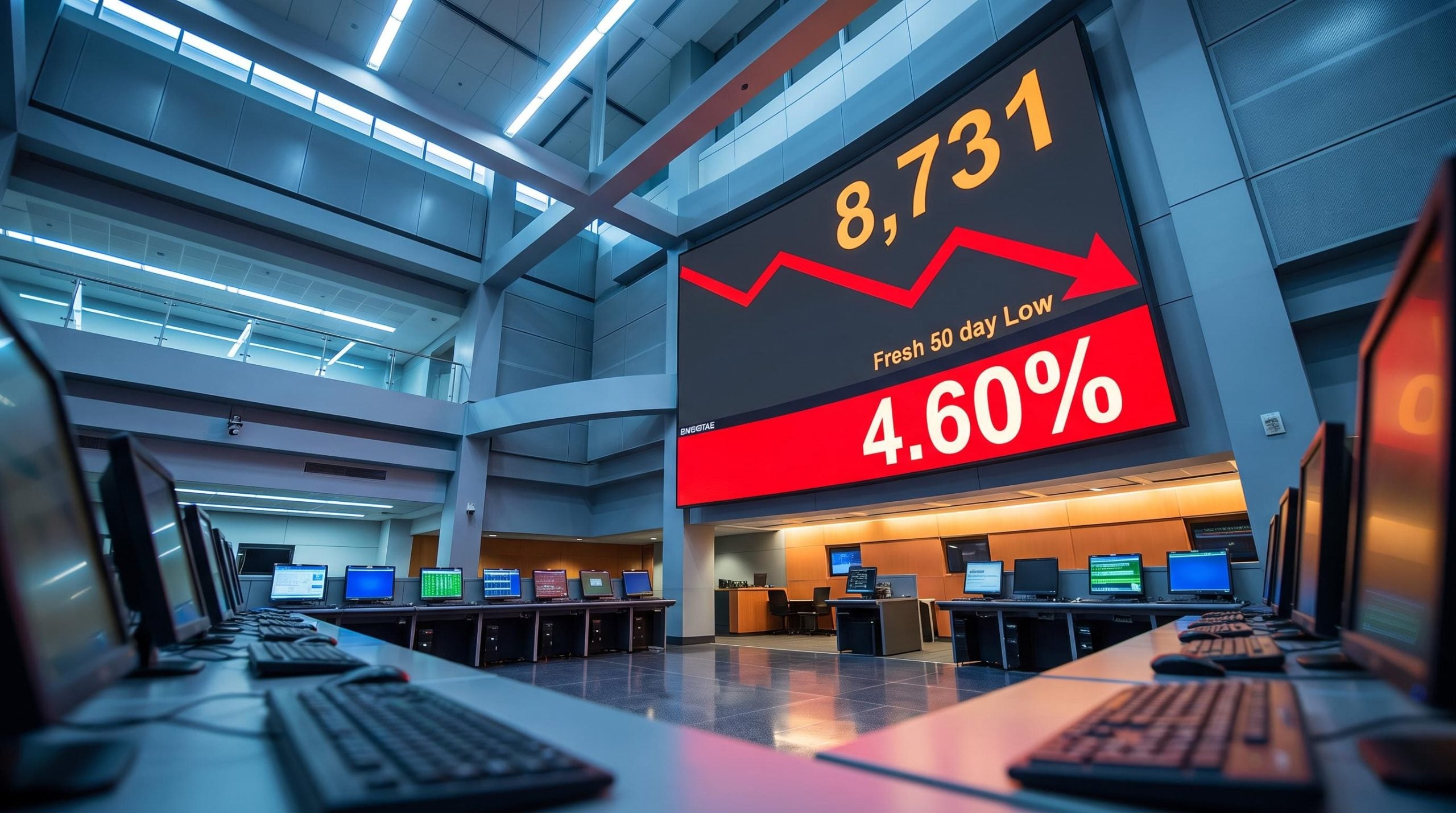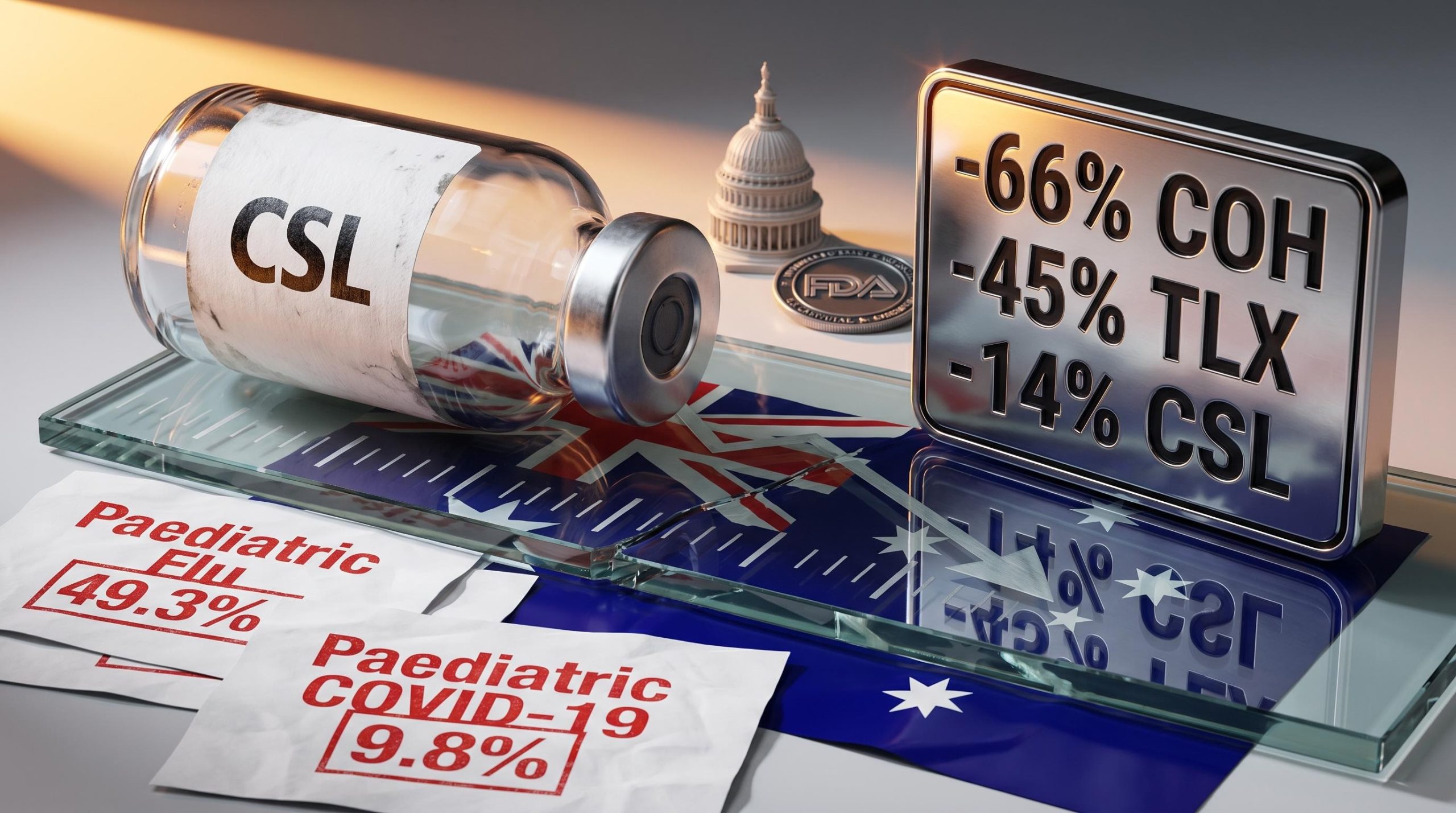
The ASX Health Care Index has reached multi-year lows, and the sector’s largest company is leading the decline. CSL (ASX: CSL) fell from approximately A$144.86 in February 2026 to A$124.61 in early May 2026, a 14% drawdown in three months. Cochlear (ASX: COH) has lost roughly 66% of its value over 12 months. Telix Pharmaceuticals (ASX: TLX) is down approximately 45%. Across the sector’s top 10 companies by market capitalisation, only one, Ramsay Health Care (ASX: RHC), has delivered a positive return.
The standard explanation for this underperformance centres on macroeconomic forces: a stronger Australian dollar compressing offshore earnings, two RBA rate rises in 2026 with a third widely expected, and cost-of-living pressures pushing patients to defer elective procedures. These forces are real. But a second structural risk layer is operating simultaneously, one geographically specific to the United States and rarely analysed in Australian investment commentary: the destabilising effect of the Trump administration’s Food and Drug Administration (FDA) policy shifts and Health and Human Services (HHS) Secretary Robert F. Kennedy Jr.’s anti-vaccine agenda on companies that depend on the US market for growth.
This analysis disaggregates that second risk layer for Australian investors, explaining what has changed at the US regulatory and public health level, which ASX-listed companies carry the most exposure, and why the combination of macro headwinds and US-specific policy disruption creates a more complex risk environment than either factor alone.
A sector in freefall, but the diagnosis matters
The scale of the ASX healthcare sell-off is difficult to overstate. The ASX Health Care Index has been trading materially below its 200-day moving average of approximately 35,016, with the deviation suggesting a drawdown that could sit in the 20-30% range from the long-term average, though some estimates place the figure closer to 39%. The precise magnitude remains unverified from primary index data, but the direction and severity are not in dispute.
Individual company performance tells the story more sharply.
The scale of the drawdown becomes sharper when viewed through ASX market breadth data: in the week ending 1 May 2026, Health Care contributed 5 of the 22 index constituents hitting fresh 52-week lows, with zero offsetting new highs within the sector, a ratio that confirms the sell-off is structural rather than a temporary index-level fluctuation.

| Company (Ticker) | Approx. 12-Month Return | Key Driver Noted |
|---|---|---|
| CSL (CSL) | -14% (Feb-May 2026); directionally weaker over 12 months | AUD headwinds, US vaccine revenue exposure |
| Cochlear (COH) | -66% | Profit guidance revision, US consumer sentiment |
| Telix Pharmaceuticals (TLX) | -45% | Broader biotech de-rating |
| Pro Medicus (PME) | -41% | Valuation compression |
| Sonic Healthcare (SHL) | -24% | Volume softness, currency headwinds |
| ResMed (RMD) | -19% | US regulatory environment, device approvals |
| Ramsay Health Care (RHC) | +18% | Domestic hospital volumes, less US product exposure |
Cochlear revised its FY26 profit guidance from A$435-460 million to A$290-300 million, the single most dramatic downgrade across the sector.
Ramsay Health Care’s solitary outperformance is instructive. Its business model, centred on hospital operations rather than product approvals or vaccination volumes, is structurally different from the rest of the top 10. The macro explanation alone, currency, rates, deferrals, cannot account for why globally exposed, FDA-pathway-dependent companies are underperforming even within an already weak sector. Something else is at work.
When big ASX news breaks, our subscribers know first
How US regulatory and public health policy is shifting in practice
For Australian investors, the changes unfolding inside US health policy institutions are not abstract political noise. They represent concrete shifts across three distinct domains that directly affect ASX-listed companies:
- Vaccine scheduling: Reductions in recommended childhood vaccine schedules and modifications to federal vaccination programme funding
- FDA approval pathways: Increased uncertainty around regulatory timelines and frameworks for drug and device approvals
- Federal health programme priorities: Reallocation of HHS budget resources away from infectious disease prevention toward chronic disease initiatives
FDA approval uncertainty is reshaping biotech capital
Marty Makary was appointed FDA Commissioner in 2025, and his first year has been characterised by vaccine framework modifications and what BioPharma Dive described as leaving drugmakers “guessing on its direction.” According to the Incubate/Manatt report, the regulatory uncertainty has produced a measurable tightening of biotech capital availability. Without clear FDA approval frameworks, early-stage companies face higher risk premiums from investors, reducing the flow of capital into the sector globally.
A rare diseases advocacy group wrote directly to President Trump and Kennedy citing biotech capital-raising difficulties linked to the regulatory environment. The FDA’s directional uncertainty is not a political narrative; it is a documented operating condition.
HHS under RFK Jr. is dismantling established vaccination infrastructure
Robert F. Kennedy Jr. serves as HHS Secretary, leading the Make America Healthy Again (MAHA) initiative. According to PBS NewsHour reporting, MAHA has become the organising framework for reorienting US health policy away from infectious disease prevention programmes toward chronic disease priorities.
This is a structural, not cyclical, shift. Federal vaccination programme funding is a direct revenue input for companies like CSL’s Seqirus division, meaning policy changes translate directly to revenue exposure. The US military’s elimination of its annual influenza vaccination requirement, reported in late April 2026, offered a concrete example of how the policy reorientation produces measurable demand reduction.
The vaccination rate collapse in numbers
CDC data as of 25 April 2026 quantifies what the policy changes are producing on the ground.
CDC vaccination coverage data for the 2025-2026 season confirms that paediatric COVID-19 uptake reached just 9.8% and paediatric influenza uptake reached 49.3%, figures that represent a measurable structural shift rather than normal seasonal variation in demand.

| Vaccine Category | Coverage Rate (2025-2026) | Commercial Relevance to ASX Companies |
|---|---|---|
| Paediatric COVID-19 | 9.8% | Structural revenue erosion for immunology product lines |
| Paediatric Flu | 49.3% | Direct exposure for CSL Seqirus flu vaccine division |
| Adult Flu (as of Feb 2026) | 47% | Seqirus seasonal revenue, federal programme contracts |
Paediatric COVID-19 vaccination at 9.8% is not a seasonal fluctuation. It represents a structural collapse in uptake with direct commercial consequences for companies with immunology and vaccine product lines.
Former CSL CEO Dr Paul McKenzie stated at the company’s October 2025 annual general meeting that US influenza vaccination rate declines had exceeded the company’s own expectations.
That admission is significant. It is the only direct executive voice from an ASX-listed company linking US vaccination trends to company performance. No ASX healthcare company has formally disclosed FDA or Kennedy-related risks in ASX announcements as of May 2026, a gap that itself warrants investor attention.
Understanding why US policy hits Australian shareholders
The transmission mechanism from Washington policy decisions to Australian share registries operates through a specific chain.
- US policy changes reduce vaccination rates, destabilise FDA approval pathways, and redirect federal health programme funding.
- Revenue and regulatory pathway impacts flow through to the US operations of ASX-listed companies, affecting near-term sales and longer-term pipeline valuations.
- ASX stock prices and index effects follow, amplified by company weightings. CSL alone represents approximately 45% of the ASX Health Care Index, meaning US-specific risks affecting CSL become index-level risks for any investor with sector exposure.
Vaccine revenue exposure: CSL Seqirus as the clearest case
CSL’s Seqirus division (flu vaccines) and Behring division (plasma-derived therapies) are the ASX sector’s most direct US exposure points. Seqirus revenue is a function of vaccination volumes, and those volumes are declining for reasons that sit outside normal seasonal variation. This revenue risk compounds existing AUD currency headwinds, meaning the combined effect is more severe than either factor in isolation.
One specific regulatory development does partially offset the US policy headwinds for CSL: a CSL tariff exemption granted under the US Section 232 pharmaceutical import proclamation protects the company’s plasma-derived therapies from import duties, though Seqirus flu vaccines manufactured in the UK retain a residual 10% exposure that compounds the vaccination volume declines already documented in CDC data.
Regulatory pathway risk: a longer-term pressure on pipeline value
FDA approval uncertainty does not only affect near-term revenue. It affects how investors value pipeline assets. When regulatory outcomes become less predictable, the discount rate applied to pre-approval products rises, compressing the present value of future revenue streams. This applies to device makers such as Cochlear and ResMed as much as to pharmaceutical and biologic companies. The absence of formal company disclosures should not be read as an absence of exposure; many of these policy shifts are recent, and companies may not yet have incorporated them into forward guidance language.
The contrast between companies that secured FDA 510(k) clearance before the current period of regulatory instability and those still awaiting approvals illustrates exactly why pathway uncertainty creates unequal risk across the ASX device sector: a cleared product generates predictable US revenue while a pipeline asset must now absorb an elevated discount rate from investors pricing in approval uncertainty.
Why the macro narrative alone is misleading investors
The macro headwinds are real and measurable. The Australian dollar sits at 71.3 US cents, a four-year high representing 12% appreciation over 12 months. The RBA has delivered two rate rises in 2026, with market pricing showing 76% probability of a third as of late April 2026. Cochlear management cited US consumer sentiment at historically low levels when revising FY26 guidance.
These are cyclical forces. They have identifiable turning points. The dollar will weaken when relative rate differentials shift. Rate rises will pause when inflation moderates. Patient deferrals will reverse when disposable income pressure eases.
The US policy shifts are different. FDA structural reform under Makary and HHS public health reorientation under Kennedy’s MAHA initiative are tied to the priorities of a sitting administration, not to an economic cycle. They carry no natural reversal point.
| Headwind Type | Specific Factors | Reversal Likelihood |
|---|---|---|
| Cyclical (Macro) | AUD at 71.3 US cents, two RBA rises, patient deferrals | Moderate to high; tied to rate and currency cycles |
| Structural (US Policy) | FDA instability under Makary, MAHA vaccine policy, HHS reorientation | Low; tied to administration priorities, no clear reversal timeline |
The absence of formal risk disclosures from ASX companies does not mean the exposure is absent. No major ASX healthcare company, including CSL, Cochlear, ResMed, Sonic Healthcare, or Ramsay Health Care, has cited FDA uncertainty or Kennedy’s policies as material risks in ASX announcements as of May 2026.
Investors who attribute all of the sector’s underperformance to macro factors may position for a recovery that arrives only partially.
What ASX investors should be asking their portfolios right now
The preceding analysis translates into a set of diagnostic questions for any investor holding ASX healthcare exposure:
- What proportion of each holding’s revenue comes from the US market?
- Does the company have vaccine, immunology, or FDA-pathway-dependent products?
- Has the company disclosed any US regulatory risk in recent announcements?
- Is the underperformance cyclical (reversible with rate and currency normalisation) or structural (driven by US policy shifts with no clear reversal timeline)?
- How does the holding’s US exposure interact with AUD currency movements, and are these effects compounding?
Ramsay Health Care’s relative outperformance (18% gain over 12 months) offers a reference point: its business model carries a different US exposure profile from companies dependent on product approvals and vaccination volumes. The IMF’s warning on prolonged fuel costs and global recession risk from Middle Eastern instability adds a further compounding factor for investors assessing the broader risk environment.
Not all ASX healthcare exposure to the US market is equally vulnerable: companies with revenue tied to procedural volumes at contracted US hospital network deals, rather than to vaccination programmes or pre-approval pipeline assets, operate with a structurally different risk profile from the Seqirus and device-approval cases examined in this analysis.
The disclosure gap is an active monitoring trigger. If companies begin incorporating FDA or Kennedy policy language into quarterly updates, AGM addresses, or formal ASX announcements, that will signal the risk has moved from background noise to acknowledged operating reality.
The risk Australian investors have not priced in
ASX healthcare stocks face a two-layer risk structure. Cyclical macro headwinds, addressable over a rate and currency cycle, sit beneath a structural US policy disruption tied to the Trump administration’s FDA and HHS agenda, with no clear reversal timeline. The combination is more complex than either factor alone, and the standard macro narrative does not capture it.
The absence of formal company disclosures is itself a data point. It suggests either that companies have not yet assessed this exposure as material, or that they have and are choosing not to disclose it. Neither interpretation should reassure investors.
FDA regulatory direction under Makary and HHS vaccine policy under Kennedy remain in flux as of May 2026. Investors assessing ASX healthcare exposure should monitor US policy developments alongside Australian macro indicators. The sector’s pain is real. Its causes are more layered than the headline narrative suggests, and understanding the distinction is the first step toward making clear-eyed decisions about what comes next.
This article is for informational purposes only and should not be considered financial advice. Investors should conduct their own research and consult with financial professionals before making investment decisions. Past performance does not guarantee future results.