More than 85% of Binance Australia Derivatives’ entire client base was exposed to high-risk crypto derivative products they were legally prohibited from accessing. That finding, accepted by the Federal Court of Australia on 27 March 2026, underpinned a $10 million penalty against the platform’s operating entity for systematically misclassifying 524 retail investors as wholesale clients between July 2022 and April 2023. The ruling arrived more than two years after the Australian Securities and Investments Commission (ASIC) began scrutinising the platform’s onboarding practices, and it followed $13.1 million in compensation already returned to affected clients. For retail investors using crypto derivatives platforms in Australia, the case is a direct warning: client classification determines which legal protections apply, and when it fails, the financial consequences can run into the millions.
The $10 million ruling and what the court found
The Federal Court imposed the $10 million penalty on Oztures Trading Pty Ltd, the entity operating as Binance Australia Derivatives, on 27 March 2026. Binance admitted all violations alleged by ASIC in civil proceedings first filed in December 2024. Justice Moshinsky also directed the company to contribute to ASIC’s legal costs.
The penalty figure sits against a backdrop of investor harm that exceeded the fine itself. Across the 524 retail clients who were wrongly classified as wholesale investors, combined losses totalled approximately $12.56 million: $8.66 million in trading losses and $3.89 million in fees. Before the court ruling, ASIC had already overseen $13.1 million in compensation returned to affected clients in 2023.
ASIC’s media release on the Federal Court ruling confirms that Justice Moshinsky accepted the agreed facts in full and that the penalty reflects both the scale of the misclassification and the direct financial harm caused to retail clients who were denied the protections they were legally entitled to.
“This wasn’t just a technical breach, it directly resulted in over $12 million in client losses.” ASIC Chair Joe Longo, 27 March 2026
The following table summarises the key financial and case details.
| Detail | Figure |
|---|---|
| Federal Court penalty | $10 million |
| Total client harm (losses + fees) | $12.56 million |
| Compensation returned (2023) | $13.1 million |
| Retail investors misclassified | 524 |
| Violation period | July 2022 to April 2023 |
When big ASX news breaks, our subscribers know first
How the onboarding system failed: unlimited retakes and missing checks
The misclassification was not one error repeated 524 times. It was a series of distinct control failures across multiple assessment categories, each one allowing clients to pass through gates that should have stopped them.
Clients seeking classification as sophisticated investors were permitted to retake a multiple-choice assessment an unlimited number of times until they passed. The assessment, intended to verify whether an applicant genuinely understood derivative products, functioned instead as a test that could be brute-forced through repetition.
The 524 wrongly categorised clients broke down as follows:
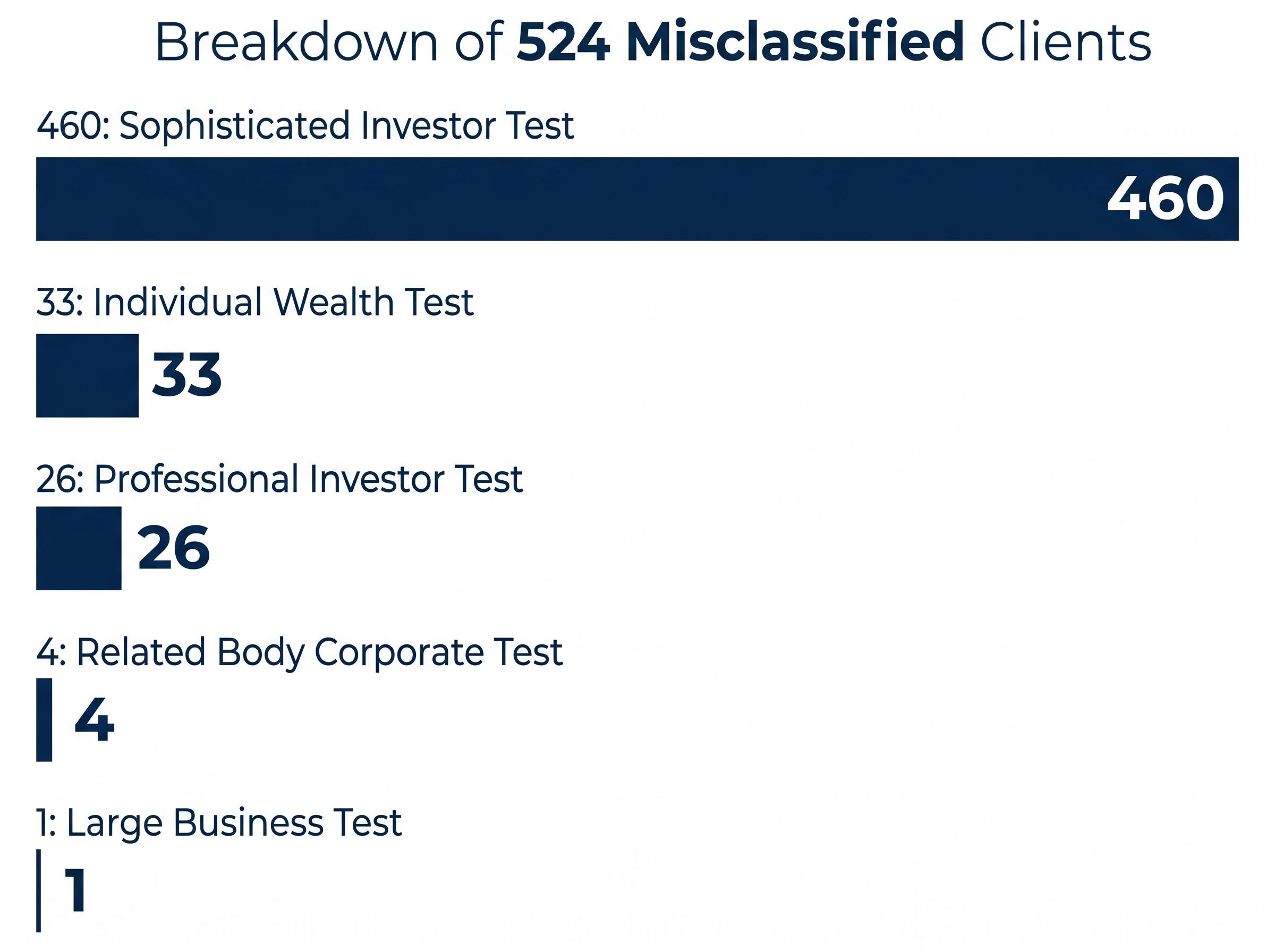
- 460 incorrectly assessed against the Sophisticated Investor Test
- 33 incorrectly assessed under the Individual Wealth Test
- 26 lacked sufficient evidence for the Professional Investor Test
- 4 lacked sufficient evidence for the Related Body Corporate Test
- 1 lacked sufficient evidence for the Large Business Test
When compliance oversight was absent
Beyond the assessment design, senior compliance personnel failed to provide adequate scrutiny of submitted documentation. In one case accepted by the court, a client was approved as a professional investor based solely on their own self-declaration as an “exempt public authority,” with no verification conducted.
Binance acknowledged that these failures were not merely procedural. They directly caused financial harm to hundreds of retail clients who should never have been granted access to wholesale derivative products.
Retail vs wholesale: what these classifications actually mean for your protections
The distinction between retail and wholesale investor status is not administrative shorthand. It is the legal line that determines which protections a platform must provide.
Under Australian financial services law, wholesale investor status generally requires meeting one of two thresholds: net assets of at least $2.5 million, or gross income of at least $250,000 per year for each of the previous two financial years. Clients who do not meet these thresholds are retail investors, and platforms are required to treat them as such.
The protections that retail clients are entitled to, and that the 524 misclassified Binance clients were denied, include Product Disclosure Statements (PDS), Target Market Determinations (TMD), access to internal dispute resolution, and the obligation that financial services be delivered efficiently, honestly, and fairly.
The scale of harm in the Binance case reflects a broader reality across leveraged crypto and derivative products: retail CFD loss rates documented by ESMA in Q1 2026 show between 74% and 89% of retail accounts losing money, with average losses reaching up to 29,000 euros per client, which is precisely the risk profile that Product Disclosure Statements and Target Market Determinations are designed to put in front of investors before they trade.
| Protection | Retail client | Wholesale client |
|---|---|---|
| Product Disclosure Statement required | Yes | No |
| Target Market Determination required | Yes | No |
| Internal dispute resolution access | Yes | No |
| ASIC conduct obligations enforceable | Yes | Reduced |
ASIC’s Information Sheet 225 (INFO 225) provides guidance on how crypto products are treated under Australian financial services law. Investors can review ASIC’s digital assets resources at asic.gov.au for further detail on how these classifications apply to crypto derivative products specifically.
The regulatory obligations Binance admitted to breaching
Binance did not contest the allegations. The company admitted to all six breaches identified by ASIC in the Statement of Agreed Facts, and each one compounded the picture of a compliance framework that was absent rather than merely deficient.
The six admitted breaches were:
- Failure to provide Product Disclosure Statements to retail clients
- Failure to establish Target Market Determinations for its products
- Non-compliant internal dispute resolution procedures
- Financial services not delivered efficiently, honestly, or fairly
- Australian Financial Services Licence (AFSL) conditions not met
- Inadequate staff training and competency assurance
ASIC initiated its targeted review in December 2022. Binance subsequently requested cancellation of its AFSL, which ASIC formally cancelled on 6 April 2023. The derivatives business was wound down the same year.
For investors wanting to understand what a properly structured ASIC licensing arrangement looks like for a crypto-related financial product, our full explainer on ASIC AFSL licensing in the crypto sector covers Novatti’s AUDC subsidiary obtaining an AFSL for its regulated AUD stablecoin, detailing the compliance framework that now governs institutional onboarding and the obligations that come with that licence.
“The issue was self-identified, reported to ASIC, and fully remediated in 2023. Oztures ceased its derivatives business and voluntarily gave back its Australian financial services licenses in 2023.” Binance spokesperson, 27 March 2026
The scope of the admissions, spanning onboarding, product disclosure, dispute resolution, staff competency, and licence conditions, is what led ASIC to characterise the matter as a structural compliance failure rather than an isolated oversight.
A pattern of enforcement: where the Binance ruling fits in ASIC’s crypto crackdown
The Binance penalty did not arrive in isolation. In December 2024, ASIC secured an $8 million fine against Bit Trade, the Australian operator of the Kraken exchange, for failures related to design and distribution obligations on a leveraged crypto product. Together, the two rulings form a sequence that signals a sustained enforcement posture rather than a one-off action.
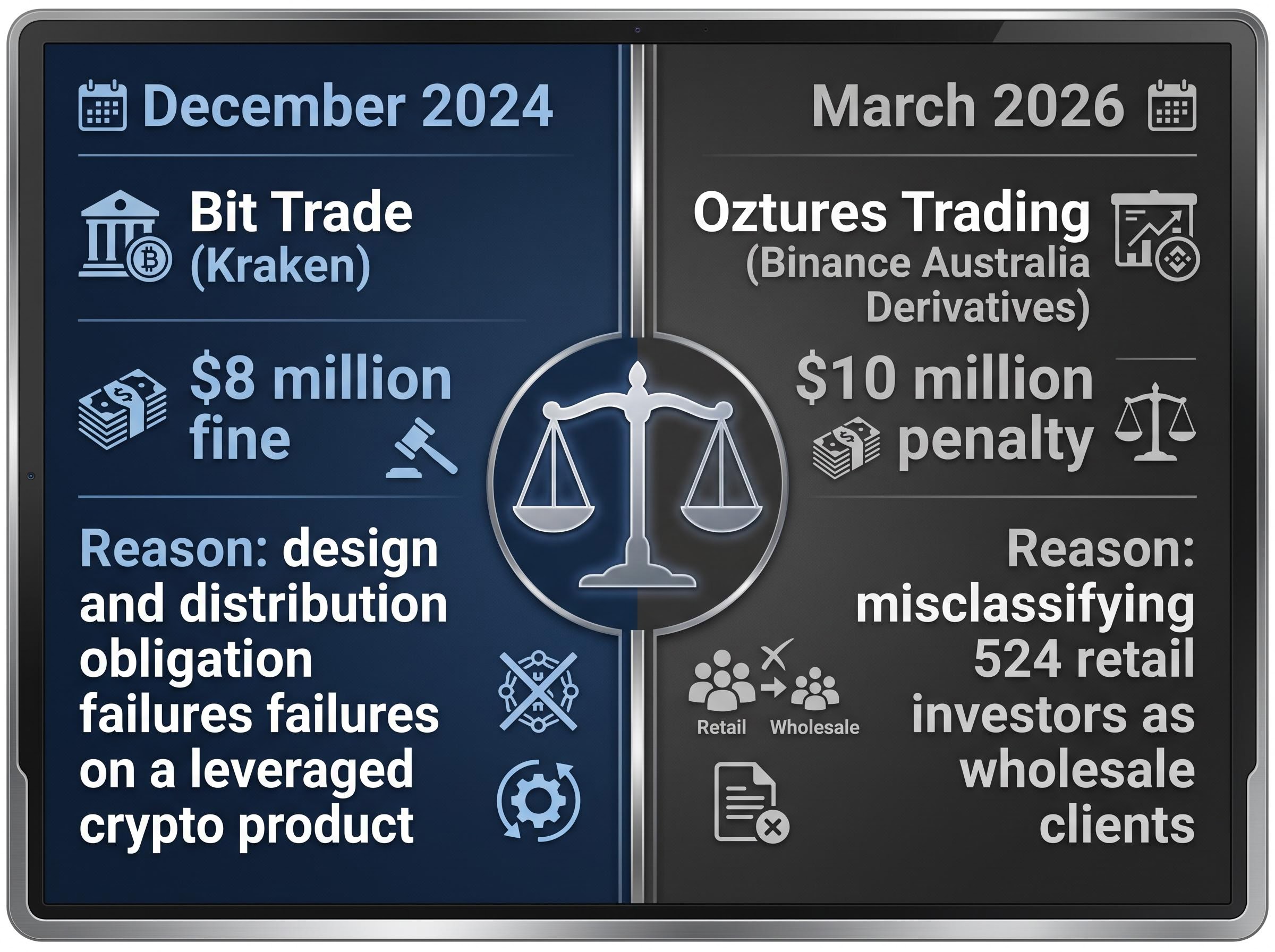
- Bit Trade (Kraken): $8 million fine, December 2024, for design and distribution obligation failures on a leveraged crypto product
- Oztures Trading (Binance Australia Derivatives): $10 million penalty, March 2026, for misclassifying 524 retail investors as wholesale clients
“This is a clear warning to global financial services entities looking to set up shop in Australia. All financial services companies must follow the law from day one, and have proper client onboarding systems and processes in place. This includes financial services that relate to crypto and digital assets.” ASIC Chair Joe Longo, 27 March 2026
ASIC’s position is that crypto products meeting the definition of financial products under Australian law are subject to the same regulatory obligations as traditional financial products. There is no carve-out for digital assets. For retail investors on any crypto derivatives platform, the enforcement pattern signals that compliance failures across the sector carry real and escalating financial consequences.
ASIC’s enforcement posture toward leveraged derivative products is not limited to crypto platforms; the regulator’s January 2026 CFD review identified leverage as a material ongoing risk for retail investors across traditional and digital asset markets alike, and the Binance ruling sits within that wider supervisory framework.
What affected investors and crypto platform users should do now
The court has ruled and the compensation process concluded in 2023, but the implications extend well beyond the 524 directly affected clients. Any retail investor currently using an Australian crypto derivatives platform can take concrete steps to verify their own position.
- Check your classification status. Review any onboarding documents or account settings on your platform. Confirm whether you were classified as a retail or wholesale client during sign-up.
- Verify you meet the legal thresholds. Wholesale investor status requires net assets of at least $2.5 million, or gross income of at least $250,000 per year for each of the previous two financial years. If you do not meet these thresholds and were classified as wholesale, the classification may not be legally valid.
- If affected by Binance specifically, consider formal recourse. The Australian Financial Complaints Authority (AFCA) provides a complaints pathway for Australian investors. Federal Court records may also contain related filings.
- Seek licensed financial advice if uncertain. Misclassification can eliminate access to Product Disclosure Statements, Target Market Determinations, and dispute resolution rights. A licensed adviser can help assess whether your current platform classification is correct.
ASIC’s digital assets guidance is available at: asic.gov.au/regulatory-resources/digital-transformation/digital-assets-financial-products-and-services
Australia’s crypto compliance era has arrived: there is no grace period left
The Federal Court’s $10 million penalty against Binance Australia Derivatives, combined with the prior $13.1 million in supervised compensation, represents more than $23 million in financial consequences flowing from a failure to correctly classify 524 retail investors. Through two successive Federal Court actions targeting Binance and Kraken’s Australian operator, ASIC has demonstrated it will apply the same enforcement tools to crypto platforms that it applies to traditional financial services providers.
For anyone using crypto derivatives products in Australia, investor classification is not administrative paperwork. It is the legal foundation for every protection available, or not available, on a platform. Reviewing onboarding documents, confirming classification status, and consulting ASIC’s digital assets guidance page are steps worth taking before a compliance failure makes them urgent.
This article is for informational purposes only and should not be considered financial advice. Investors should conduct their own research and consult with financial professionals before making investment decisions.