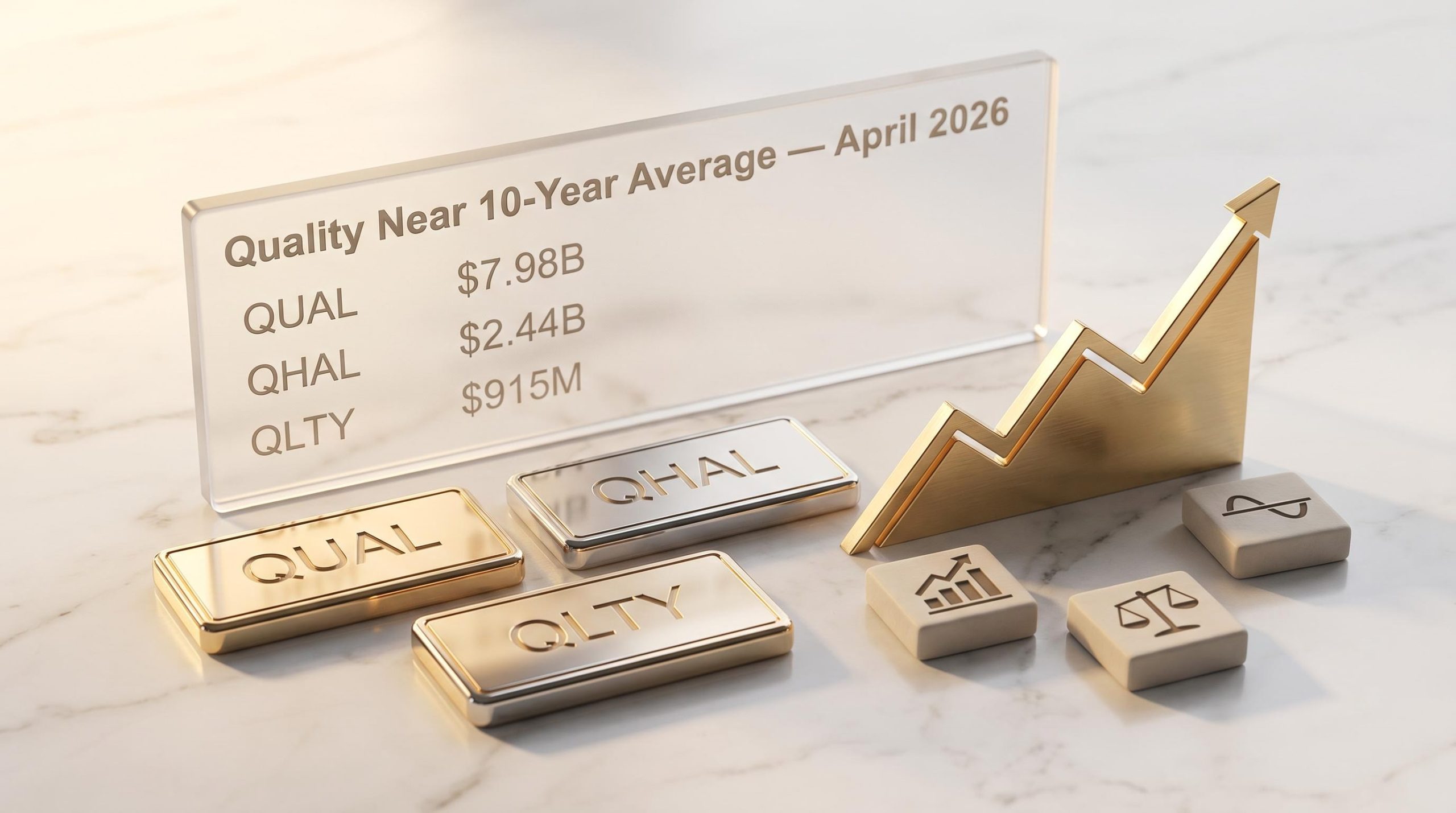
Quality companies, those with high returns on equity, low debt, and stable earnings, are trading near their 10-year average valuation relative to the broader market. VanEck flagged this in April 2026 as a potentially more attractive entry point than investors have seen in recent years. For Australian investors encountering quality investing for the first time through ETF marketing materials, the label can feel vague. It is not. Quality investing is a systematic, factor-based strategy with a long track record, and the current macro backdrop, including deteriorating consumer sentiment, rising inflation expectations, and downward-revised global growth forecasts, is precisely the kind of environment where the strategy has historically earned its keep. This guide covers what quality investing means in practice, why the current environment may suit it, and which ASX-listed ETFs provide access to it, along with the differences between those products that actually matter for portfolio decisions.
What quality investing actually means (and where the idea comes from)
Quality investing is a factor-based strategy that screens for companies with measurable financial characteristics. It is not a subjective judgement about brand strength, management charisma, or market sentiment. The approach has deep intellectual roots in the value investing tradition associated with Benjamin Graham and Warren Buffett, both of whom emphasised balance sheet discipline and return on invested capital as the foundation for durable compounding.
In practice, major index providers identify quality companies through three core screens:
- High return on equity (ROE): a measure of how efficiently a company generates profit from shareholders’ capital. Higher ROE suggests the business can grow without constantly raising new funds.
- Low financial leverage (debt-to-capital ratio): companies that rely less on borrowed money face lower refinancing risk and have more flexibility during downturns.
- Stable or consistent earnings growth: businesses with predictable earnings are easier to value and tend to experience less severe share price drawdowns during periods of market stress.
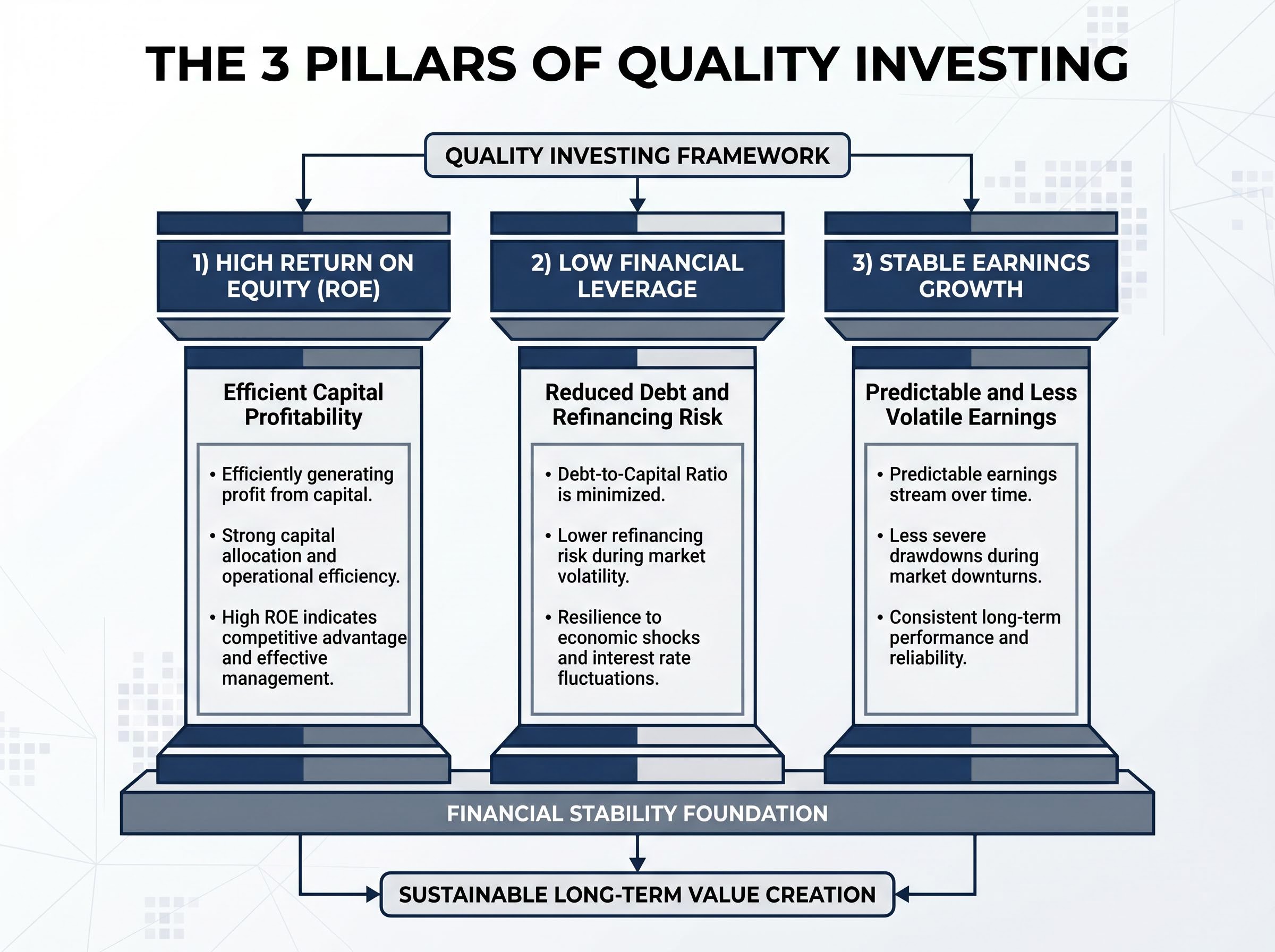
These three screens form the basis of the MSCI Quality Index methodology, which underpins both the QUAL and QHAL ETFs offered by VanEck on the ASX. Understanding the mechanics matters because it allows investors to evaluate whether any given “quality” product is genuinely implementing the strategy or simply using the label as a marketing shorthand.
When big ASX news breaks, our subscribers know first
Why quality tends to outperform when conditions get difficult
The defensive reputation of quality stocks is not accidental. It follows directly from the financial characteristics the screen selects for. Low debt means lower refinancing risk when credit tightens and borrowing costs rise. High ROE means less dependency on external capital to fund growth, so these companies can continue investing in their operations even when equity and debt markets become hostile. Earnings stability means cash flows are more predictable, which gives both management and analysts a firmer basis for decision-making under pressure.
MSCI research on quality factor performance across different macro regimes shows that quality indexes have historically outperformed the broader market during periods of elevated volatility and falling growth, providing empirical backing for the defensive reputation that quality factor strategies carry.
The flip side deserves honest treatment. Quality tends to lag during periods of cheap money and risk-on sentiment, when highly leveraged or speculative companies benefit most from easy credit conditions. Investors who adopted a quality allocation in the middle of a momentum-driven rally may have experienced frustrating relative underperformance.
The current macro environment, however, looks more like quality’s preferred conditions. VanEck has pointed to several converging signals as of April 2026:
QUAL appears among a shortlist of ASX ETFs for inflation resilience precisely because its constituent companies tend to carry pricing power and strong balance sheets, characteristics that allow earnings to hold up when input costs rise and consumer spending softens, two pressures the current macro environment is delivering simultaneously.
- US consumer sentiment sitting at historically low levels
- Inflation expectations rising across major developed economies
- Global growth forecasts revised downward
- Equity markets continuing to advance despite geopolitical disruption, including the Strait of Hormuz situation and oil trading above US$90 per barrel
VanEck has argued that equity markets may be underpricing the risk of an economic slowdown, a condition that has historically favoured quality factor strategies over the broader market.
The firm notes that quality has historically delivered superior performance during economic contractions and over extended investment horizons. Valuations for quality companies relative to the broader market have narrowed toward their 10-year average, which VanEck frames as a more attractive entry point than investors have had access to in recent years.
The three ASX ETFs that implement quality investing for Australian investors
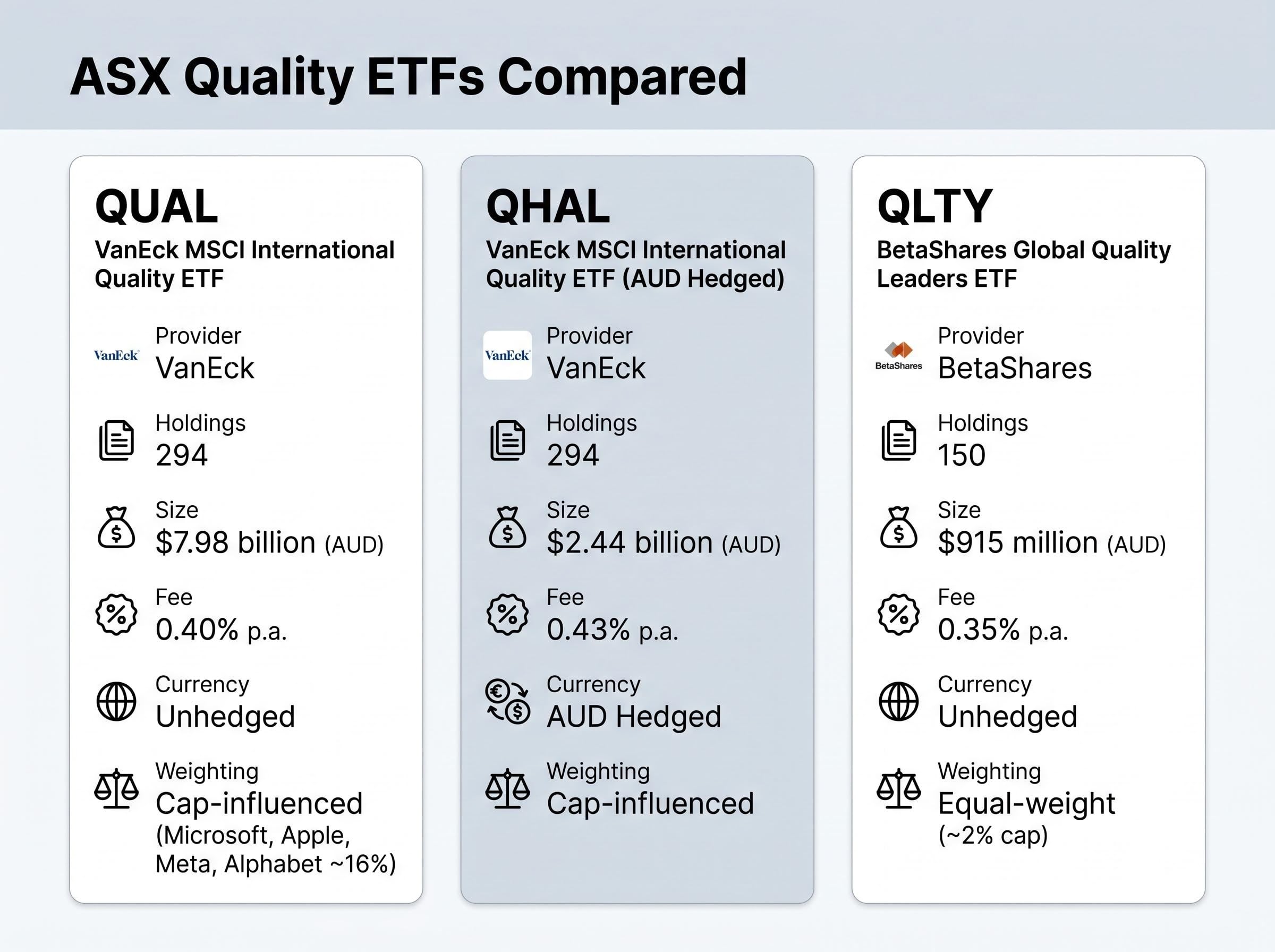
Three primary vehicles are available on the ASX for quality factor exposure: QUAL (VanEck MSCI International Quality ETF), QHAL (VanEck MSCI International Quality AUD Hedged ETF), and QLTY (BetaShares Global Quality Leaders ETF).
All three exclude Australian domestic equities. This is worth understanding upfront: adding any of these ETFs to a portfolio increases international equity exposure. They function as global equity allocations, not as replacements for ASX-focused holdings.
QUAL and QHAL track the same underlying MSCI index and hold the same 294 stocks, with identical selection methodology. The difference is currency treatment. QLTY uses a different index altogether, holds 150 companies, and applies a distinct stock selection and weighting approach.
The following table summarises the key differences:
| ETF Ticker | Provider | Holdings | Fund Size | Management Fee |
|---|---|---|---|---|
| QUAL | VanEck | 294 | $7.98 billion | 0.40% p.a. |
| QHAL | VanEck | 294 | $2.44 billion | 0.43% p.a. |
| QLTY | BetaShares | 150 | $915 million | 0.35% p.a. |
These are not interchangeable products. The differences in currency treatment, portfolio concentration, and cost structure create meaningfully different investor experiences over time.
How to choose between QUAL, QHAL, and QLTY: the decisions that actually matter
Selecting between these three ETFs is not a matter of picking the cheapest or the largest. Three genuine investor decisions separate them, and each one interacts with individual portfolio circumstances.
Currency exposure
QUAL and QLTY are unhedged, meaning Australian investors absorb the full effect of movements in the AUD against the US dollar and other developed market currencies. If the Australian dollar strengthens, returns are reduced when converted back to AUD. If it weakens, returns are amplified.
QHAL hedges its currency exposure back to AUD, which removes most of this variability at the cost of a marginally higher fee (0.43% versus 0.40% for QUAL).
- Hedging tends to add value for investors with shorter time horizons who want more predictable AUD-denominated returns.
- Over holding periods beyond five years, currency effects tend to revert toward long-term averages, making hedging less beneficial for patient investors.
- The 0.03% fee difference between QUAL and QHAL reflects the operational cost of maintaining the hedge.
Portfolio concentration
QLTY applies a maximum weight cap of approximately 2% per individual stock. The result is a more evenly distributed portfolio where no single company dominates returns.
QUAL and QHAL are market-cap influenced. Microsoft, Apple, Meta, and Alphabet collectively represent approximately 16% of the portfolio. This means these ETFs will track the fortunes of large US technology companies more closely than QLTY does.
- Equal-weight-style construction in QLTY reduces single-stock risk but produces a portfolio that looks quite different from the broader benchmark.
- QUAL and QHAL will track broader market movements more closely due to their heavier weighting in the largest global companies.
The weighting of Microsoft, Apple, Meta, and Alphabet at roughly 16% of QUAL and QHAL is not an anomaly specific to quality ETFs; index fund concentration risk across cap-weighted global products means many Australian investors already hold significant exposure to these same companies through other funds, making an audit of combined mega-cap weightings a practical step before adding a second or third international ETF.
Cost and performance context
QLTY is the cheapest option at 0.35% p.a., compared with 0.40% for QUAL and 0.43% for QHAL. Over a decade, fee differences compound meaningfully. However, cost should be weighed against currency treatment and portfolio construction rather than treated as the sole deciding factor.
QLTY’s trailing returns as of 31 March 2026 show underperformance relative to its MSCI World ex-Australia (AUD) benchmark: a 2.23% one-year return versus the benchmark’s 8.14%, and a 10.12% annualised five-year return versus the benchmark’s 12.71%. Short-term underperformance against a broad benchmark does not necessarily indicate strategy failure. Quality strategies are designed to outperform in specific conditions, and a period of strong momentum-driven market gains can mask the defensive characteristics the strategy is built to deliver.
| Decision | QUAL | QHAL | QLTY |
|---|---|---|---|
| Currency hedged | No | Yes | No |
| Equal-weight construction | No | No | Yes (~2% cap) |
| Lowest fee | No (0.40%) | No (0.43%) | Yes (0.35%) |
Is this the right moment to consider a quality allocation?
Several factors are converging in a way that makes the case for quality worth serious consideration. Macroeconomic fragility is visible across multiple indicators: revised growth forecasts, weak consumer sentiment, and inflation expectations that remain elevated. VanEck has argued that equity markets may be underpricing the risk of a slowdown, continuing to advance even as the data deteriorates beneath them.
Quality valuations have added a timing dimension to the structural case. Relative to the broader market, quality companies are trading near their 10-year average valuation as of April 2026, a narrowing that VanEck identifies as a more attractive entry point than investors have had in recent years.
VanEck has described quality investing as a strategy designed to “compound portfolio value while simultaneously reducing overall investment risk.”
Honest framing is warranted here. Quality is not a recession hedge in the strict sense. It is an equity strategy that still falls in a genuine market downturn. What the historical record suggests is that quality tends to fall less and recover more consistently than lower-quality benchmarks. The distinction matters: investors should not expect capital preservation, but they may reasonably expect better risk-adjusted outcomes over a full market cycle.
One practical consideration deserves emphasis. QUAL, QHAL, and QLTY all invest entirely in international equities. Australian investors adding any of these products are increasing their global equity exposure, not substituting a defensive version of an existing international holding. Portfolio fit depends on what is already there.
This article is for informational purposes only and should not be considered financial advice. Investors should conduct their own research and consult with financial professionals before making investment decisions. Past performance does not guarantee future results.
Quality investing in 2026 and beyond: what Australian investors should take away
The framework covered in this guide rests on three pillars: what quality is (high ROE, low debt, earnings consistency), when it tends to work (periods of economic stress and over extended horizons), and how to access it on the ASX. Each of the three available ETFs suits a different investor profile:
- QUAL for simplicity and scale, with the largest fund size and broadest adoption among Australian investors.
- QHAL for investors who want the same portfolio with currency risk removed.
- QLTY for those who prefer equal-weight diversification at the lowest management fee.
How a quality ETF fits depends on the broader portfolio: international diversification needs, hedged versus unhedged preference, and investment horizon all shape which product is appropriate. All three are available on the ASX through standard brokerage accounts, and direct comparison on the VanEck and BetaShares websites will surface the most current fee and performance data before any allocation decision.
For investors who want to understand the structural shift driving demand for internationally focused funds before committing to an allocation, our deep-dive into Australian home bias in ETF portfolios covers the platform-level data, generational adoption patterns, and the behavioural forces that are reshaping how Australian retail investors construct diversified portfolios in 2026.