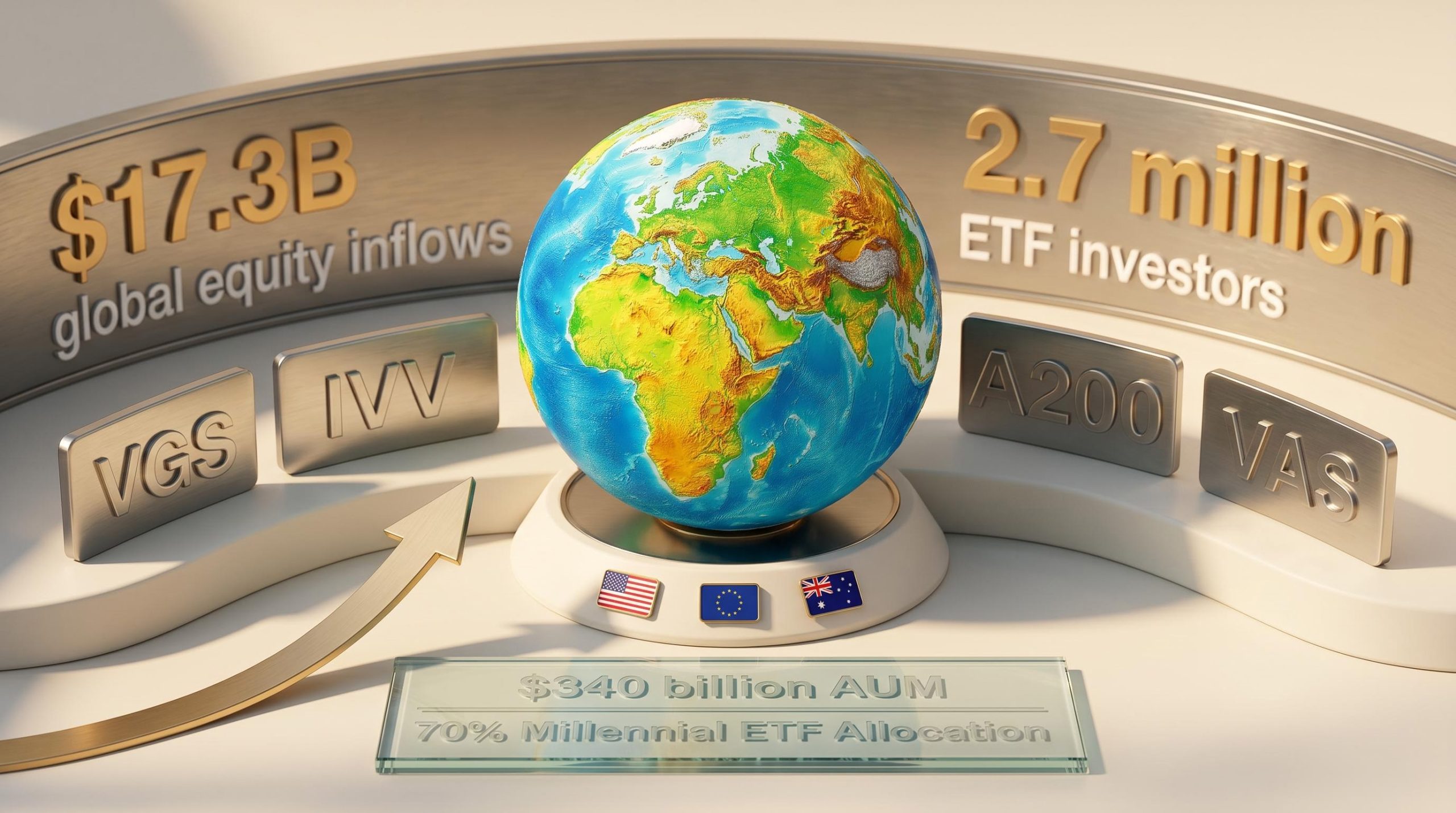
Australian ETF portfolios are undergoing a structural transformation. Millennials now direct approximately 70% of their holdings into ETFs, international funds have overtaken domestic equivalents as the most purchased category on major platforms, and the total market has swelled past an estimated $340 billion in assets under management. The shift is not incremental. Q1 2026 platform data from Selfwealth by Syfe reveals a generational divide in how Australians construct portfolios, a decisive turn toward global diversification, and behavioural patterns that expose the tension between long-term discipline and reactive trading. What follows is a breakdown of exactly how each generation is allocating, why international ETFs have surged, what the data signals about concentration risk awareness, and what these trends mean for portfolio resilience across the Australian retail market.
Inside the numbers: How Australia’s ETF boom reached $340 billion
The scale of the Australian ETF market is no longer a forecast. It is an observable fact reshaping how millions of retail investors build wealth.
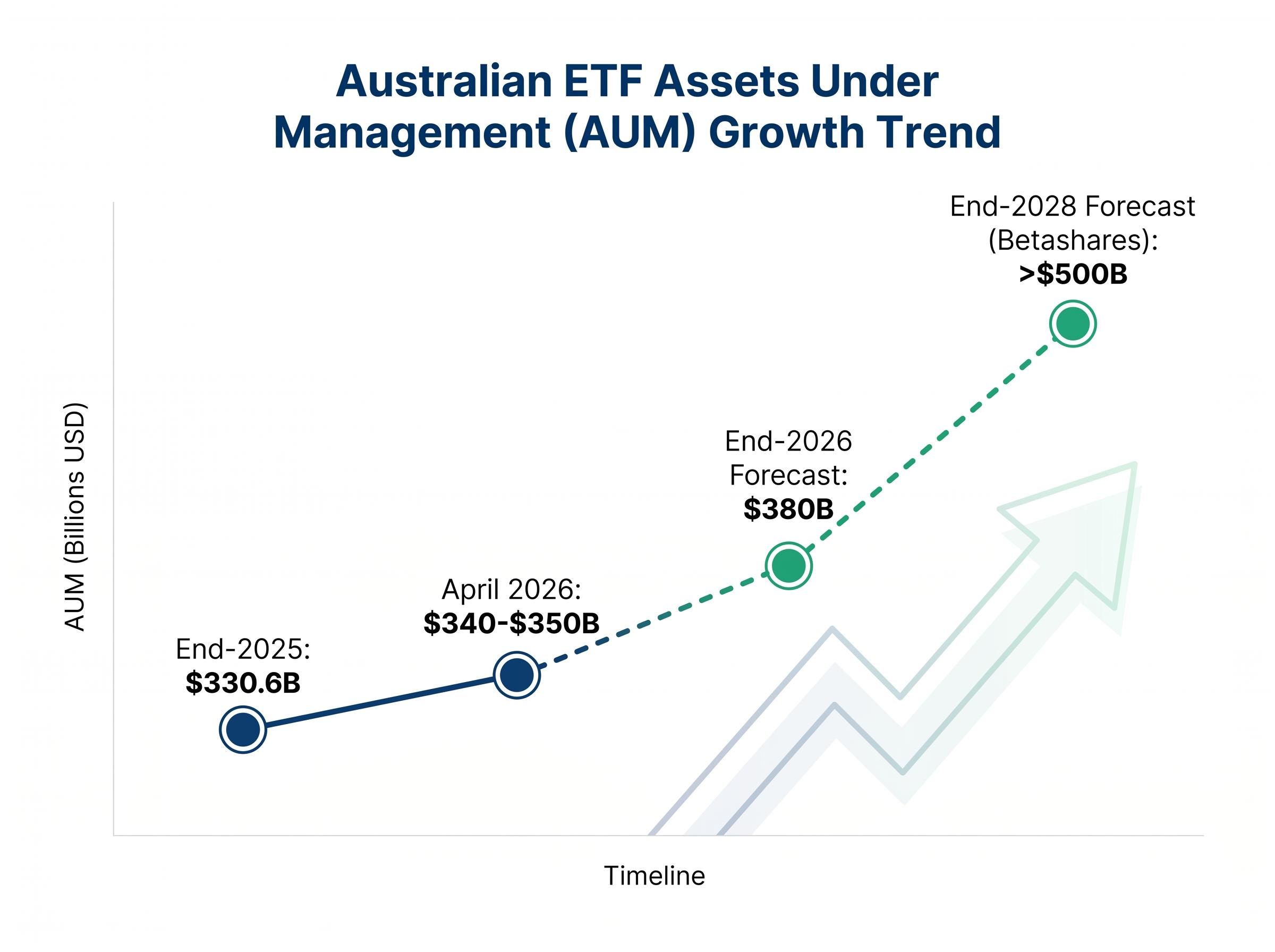
In March 2026, the industry recorded $5.6 billion in net inflows, the third-highest monthly figure on record. Total assets under management stood at approximately $330.6 billion at the end of 2025 and are estimated at $340-$350 billion as of April 2026. The velocity matters as much as the total: ETF usage grew 20% in 2025, driven by 411,000 first-time buyers who brought the national user base to 2.7 million.
The Betashares 2025 annual industry review recorded total market capitalisation of $330.6 billion across ASX and CBOE-listed ETFs at year-end, establishing the baseline from which the estimated $340-$350 billion April 2026 figure is derived as inflows continued into the new year.
Key milestones underscore the momentum:
- ETFs now comprise 17% of average portfolios, the highest share on record
- An additional 300,000 ETF users are forecast for 2026, pushing the total past 3 million
- Total AUM is on track to reach $380 billion by the end of 2026
Betashares forecasts Australian ETF assets under management will exceed $500 billion by end-2028, a figure that would represent a near-doubling from end-2025 levels.
This is not an institutional phenomenon. The first-time buyer surge and rising portfolio share confirm that retail investors are driving the structural shift, making platform-level data on portfolio construction a meaningful signal for the broader market.
When big ASX news breaks, our subscribers know first
The generation gap in ETF adoption: Why Millennials lead and Boomers are catching up
The headline figure belongs to Millennials. Selfwealth by Syfe Q1 2026 data shows this cohort allocates approximately 70% of portfolio holdings to ETFs, the highest proportion of any generation on the platform.
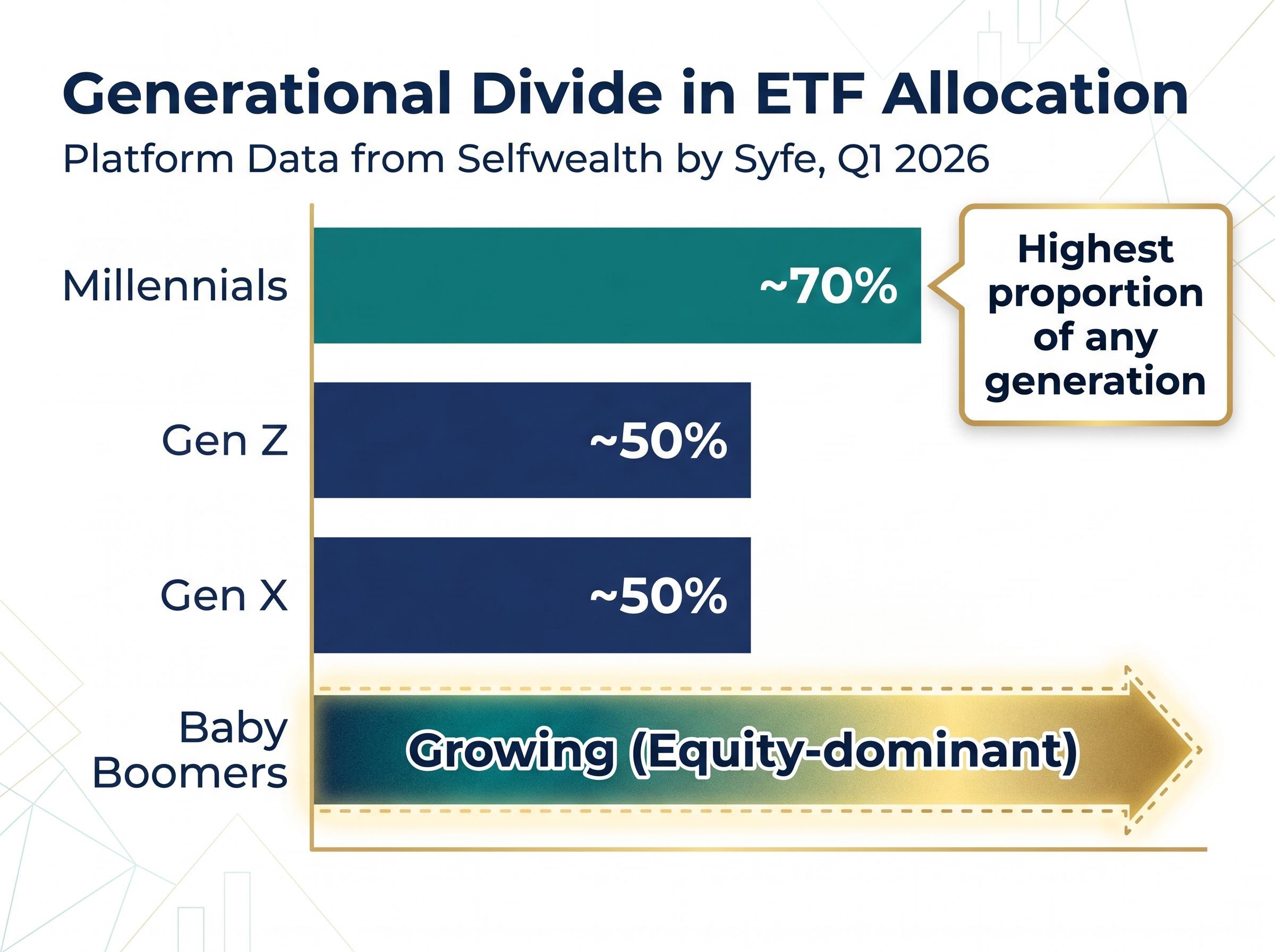
Gen Z and Gen X converge at roughly 50% ETF allocation, with the remaining half in individual stocks. Baby Boomers remain predominantly equity-focused, though ETF incorporation is growing steadily within this cohort.
| Generation | Approximate ETF Allocation | Remaining Allocation | Key Characteristic |
|---|---|---|---|
| Millennials | ~70% | Individual stocks, fixed income | Highest ETF adoption; diversified core from the outset |
| Gen Z | ~50% | Individual stocks | Active engagement; balanced ETF/stock split |
| Gen X | ~50% | Individual stocks | Moderate adoption; diversification discipline emerging |
| Baby Boomers | Growing (from low base) | Direct equities dominant | Late-adoption momentum; equity-heavy legacy portfolios |
What drives the generational divide?
The gap is not simply about risk appetite or age. It reflects when each cohort entered investing and what infrastructure was available to them.
Platform accessibility, commission-free trading, and social media financial education have shaped Gen Z and Millennial allocation patterns from day one. Reduced entry barriers mean younger investors build diversified core portfolios as their default, rather than gravitating first toward individual stock selection. The 411,000 first-time buyers in 2025 overwhelmingly constructed portfolios combining Australian equities, global equities, and fixed income ETFs from the outset.
Boomer adoption, by contrast, is growing from an equity-heavy base. This reflects a gradual incorporation of ETFs into established portfolios rather than a wholesale reallocation, a pattern consistent with investors who built wealth through direct share ownership before ETFs became widely accessible.
Why ETFs work the way they do: A plain-language primer on portfolio construction
The Millennial 70% figure raises a natural question: what is it about ETFs that has made them the default building block for a generation of Australian investors?
An ETF, or exchange-traded fund, is a single security that holds a basket of assets, typically shares, bonds, or a combination. It trades on a stock exchange like an individual share but provides exposure to dozens or hundreds of companies in one purchase. Where buying individual shares requires selecting and monitoring each company, an ETF spreads that exposure across an index or asset class automatically.
First-time buyers on Australian platforms in 2025 consistently built portfolios around three components:
- Australian equities ETF: Provides exposure to ASX-listed companies and, uniquely, access to franking credits, a structural tax advantage that keeps domestic equity ETFs relevant within diversified portfolios
- Global equities ETF: Delivers diversification across international markets, reducing dependence on a single economy or sector
- Fixed income ETF: Adds a defensive allocation; Vanguard’s VAF, for example, charges a management fee of just 0.10% per annum, illustrating the cost efficiency available at the fixed income level
Franking credits remain a structural tax advantage for Australian equity ETFs, allowing investors to receive a tax credit for corporate tax already paid on dividends. This keeps domestic equity ETFs a relevant allocation within globally diversified portfolios.
This three-component structure mirrors what long-term investors call a core diversified portfolio. The cost efficiency, instant diversification, and simplicity of ETFs explain why new entrants default to this construction rather than assembling portfolios one stock at a time.
Inflation-aware portfolio construction adds a further layer to this framework: with Australia’s CPI at 4.6% as of March 2026 and real returns on standard cash holdings negative, the choice between fixed income ETFs, quality-factor international equity funds, and cash ETFs involves trade-offs that a standard three-component diversified portfolio does not automatically resolve.
International overtakes domestic: The data behind Australia’s diversification turn
The numbers leave little room for ambiguity. In 2025 (year to October), global equity ETFs attracted $17.3 billion in inflows, according to Betashares and Investment Trends data. Australian equity ETFs received $10.6 billion over the same period. International ETFs then became the leading purchase category on the Selfwealth by Syfe platform in Q1 2026, overtaking domestic funds for the first time.
The shift reflects a rational response to identifiable features of the ASX. Australia’s benchmark index carries high concentration in banks and mining, limited exposure to the technology and healthcare sectors that have driven global equity returns, and constrained dividend growth relative to international peers. For investors evaluating where the next decade of returns might originate, the domestic market presents a structural gap.
ASX home bias has historically concentrated Australian retail portfolios in banks, mining, and domestic income assets, a structural feature that the 2025-2026 inflow data suggests investors are actively working to correct through international ETF allocations.
| ETF Category | Key Examples | 2025 Inflows | Primary Role in Portfolio |
|---|---|---|---|
| Australian equities | A200, VAS, IOZ | $10.6 billion | Domestic core; franking credit access |
| US-focused international | IVV, VTS | Portion of $17.3B global equity flows | US large-cap growth and broad market |
| Broader international / ex-US | VGS, BGBL, VEU, EXUS | Portion of $17.3B global equity flows | Developed world diversification; US concentration reduction |
How investors are responding: Portfolio allocation patterns in practice
Morningstar recommends an approximately 40% US / 60% ex-US split within an 80% total equity allocation, a framework that reflects the case for diversification beyond US concentration. Survey data shows global equities now represent the top category for next planned purchases among ETF investors, ahead of Australian equities.
Growing interest in international ex-US ETFs such as VEU, EXUS, and BGBL indicates that investors are not simply buying “international” as a single bloc. They are actively managing geographic weighting within their global allocations. Quality factor ETFs (QUAL, QHAL) and small-cap international exposure (QSML) are also attracting flows, a sign of increasing portfolio sophistication among Australian retail investors.
Reactive trading and the discipline gap: What platform data reveals about investor behaviour
The same platforms that make disciplined investing accessible also expose investors to real-time catalysts that test that discipline.
Platform trading volumes doubled during the US tariff announcement in April 2025, the clearest example of event-driven reactive behaviour recorded on Australian retail platforms in the past twelve months.
That spike was not representative of a sustained pattern, however. Following the RBA rate increase in March 2026, trading activity declined by more than 20%, suggesting investors selectively amplify activity around specific event types rather than trading reactively as a default.
Gold purchasing offers another behavioural signal. After surging in late 2025, gold-related trades on the Selfwealth by Syfe platform fell to below 70% purchase-to-total ratio in Q1 2026, indicating a rotation from defensive positioning back toward growth-oriented allocations.
The tension at the heart of modern retail investing is visible in the data: faster information access means macroeconomic events are incorporated into prices nearly instantaneously, yet the same speed of access makes emotional discipline harder to maintain. Platform guidance identifies three common investor mistakes:
- Panic-selling during market downturns
- Excessive trading frequency in response to short-term news
- Over-concentration in a single asset class or geographic region
Understanding these patterns provides an external benchmark for any investor who has felt the pull to act during volatile periods.
Investors wanting to understand why these reactive patterns persist despite their documented cost will find our full explainer on reactive trading and behavioural bias, which examines loss aversion, recency bias, and the specific mechanisms by which macroeconomic news triggers transaction spikes that erode long-term returns.
The portfolio Australia is building: What 2026’s data signals for the years ahead
The threads converge into a coherent picture. Australian retail investors are building portfolios that are more globally diversified, more structurally weighted toward ETFs, and more deliberately constructed than at any previous point.
The trajectory is quantifiable:
- AUM is heading toward $500 billion: From an estimated $340-$350 billion in April 2026, the market is forecast to reach $380 billion by year-end and exceed $500 billion by end-2028
- The user base is crossing 3 million: An additional 300,000 users are projected for 2026, building on the 2.7 million recorded at the end of 2025
- The regulatory environment is maturing: ASIC released a new regulatory guide for exchange-traded products in November 2025, and the Corporations Amendment (Digital Assets Framework) Bill 2026 was introduced in February 2026, signalling that policy infrastructure is keeping pace with market growth
ASIC Regulatory Guide RG 282, released in November 2025, sets out the obligations applying to issuers and market operators of exchange-traded products, covering admission standards, product disclosure requirements, and the conditions for regulatory relief, forming the compliance framework within which Australia’s rapidly expanding ETF market now operates.
Building discipline into the process: Tools that support long-term strategy
The reactive trading data from the prior section makes one point clear: access alone does not produce discipline. Platform tools, however, are increasingly designed to build it in structurally.
Dollar-cost averaging, the practice of investing a fixed amount at regular intervals regardless of price, reduces the temptation to time entries and exits around short-term market events. Auto-invest features on major platforms now allow recurring investments at daily, weekly, biweekly, or monthly intervals, converting a behavioural intention into an automated process.
Platform simplicity has been a driver of first-time buyer behaviour. New entrants in 2025 and 2026 defaulted to diversified core portfolios rather than speculative single-stock positions, a pattern that suggests the tools themselves are shaping better construction habits from day one.
This article is for informational purposes only and should not be considered financial advice. Investors should conduct their own research and consult with financial professionals before making investment decisions. Past performance does not guarantee future results. Financial projections referenced in this article are subject to market conditions and various risk factors.
Australia’s ETF era has arrived, and the data suggests it is only getting started
The Q1 2026 data does not describe a cyclical trend driven by a single market event. It describes a structural shift in how Australians build portfolios. Millennial-led ETF adoption, the decisive swing toward international diversification, and the growing user base all point in the same direction: the ETF has moved from a niche tool for cost-conscious investors to the default architecture of the modern Australian portfolio.
The generational data shows where this is heading. Younger cohorts are building globally diversified, ETF-heavy portfolios from their first trade. Older cohorts are progressively incorporating the same tools. The $500 billion AUM forecast by end-2028 is not aspirational; given the current trajectory, it appears a matter of arithmetic. For individual investors, the practical question is no longer whether ETFs belong in a portfolio. It is how to construct around them with the discipline the data says most investors still need to develop.