The five-year performance gap between Norwegian Cruise Line Holdings and the broader market reveals a staggering divergence. According to market data, the maritime operator suffered a 37.8% equity decline over the period, while the S&P 500 benchmark delivered an 84.3% gain. This structural underperformance set the stage for an activist investor to target Norwegian Cruise Line, initiating one of the most aggressive maritime governance shakeups in recent history.
In February 2026, Elliott Investment Management intervened to force a sweeping oversight restructuring. Trading at $17.77 in late April 2026, the equity now prices in a complex battle between turnaround optimism and operational reality. What follows is an analytical framework to evaluate whether this newly installed leadership can actualise the projected upside. Investors must assess if the current premium valuations present a viable opportunity or too high a risk ahead of the impending May 2026 earnings release.
The Elliott Playbook and the March Governance Reset
The initial disclosure of the institutional intervention arrived as an immediate shock to the maritime sector. Regulatory filings revealed that Elliott Management crossed a 10% equity stake threshold in February 2026, confirming a massive accumulation strategy that immediately pressured existing governance structures. The activist fund moved swiftly from accumulation to calculated execution, leaving existing management little room to manoeuvre.
On 27 March 2026, a formal cooperation agreement finalised the transfer of corporate control. Five board seats shifted to hand-picked nominees, demonstrating the rapid pace at which activist capital can force strategic recalibration. Market participants initially reacted with heavy optimism, driving share prices near $21 in early March on the assumption of immediate operational pivots.
The Form 8-K regulatory disclosure outlines the specific governance modifications that allowed the activist fund to bypass a prolonged proxy contest and swiftly seat its preferred directors.
That initial momentum cooled as the reality of complex restructuring set in for equity holders. As of 28 April and 29 April, the equity retreated to $17.77, reflecting a recalibrated market that requires concrete execution over theoretical upside.
The chronological timeline of this governance reset highlights the speed of the transition:
February 2026: Elliott Management discloses crossing the 10% ownership threshold, initiating the activist campaign. Early March 2026: Speculative capital drives equity valuations near $21 on restructuring hopes. 27 March 2026: A formal cooperation agreement secures five out of nine board seats for new nominees. Late April 2026: Market enthusiasm cools, with shares stabilising at $17.77 pending actual strategic updates.
When big ASX news breaks, our subscribers know first
Decoding Activist Capital in the Maritime Sector
Activism in capital-intensive industries requires a specific methodology to extract value from heavy asset operators. When a hospitality or travel enterprise exhibits severe historical underperformance compared to sector rivals, it creates the ideal entry point for restructuring initiatives. Activist funds identify these valuation gaps and deploy capital to force structural changes that existing management has proven unable or unwilling to execute.
Elliott Management operates with a five-decade history of generating outcomes for equity holders across complex sectors. The typical activist lifecycle begins with securing committee control, followed by implementing rigorous expenditure reductions and demanding passenger satisfaction upgrades. In maritime operations, these interventions focus on optimising existing fleet assets rather than simply expanding capacity.
The fundamental mechanics of activist investing rely on rapid equity accumulation to pressure entrenched leadership, a tactic that successfully forced the departure of four incumbent directors during this specific maritime restructuring.
The Activist Mandate The primary objective of institutional activism in the travel sector is closing the historical performance gap with direct competitors through margin expansion, disciplined capital allocation, and immediate board-level accountability.
This educational framework provides context for assessing the current situation. The new oversight committee is not tasked with reinventing maritime travel entirely. They are tasked with aggressively closing the margin deficit that allowed rivals to expand while this operator stagnated over a five-year period.
Evaluating the New Oversight Committee and Operational Hurdles
The transition from abstract turnaround strategy to human execution rests entirely on the credentials of the incoming leadership. The incoming directors must close immediate operational gaps using expertise sourced from adjacent global travel sectors. Their specific backgrounds in global aviation and theme park experiences translate directly to the scale and logistical complexity of maritime hospitality.
The enterprise faces pressing internal headwinds that require immediate operational attention. According to company data, in 2025, cabin utilisation dropped to 103.5% from a prior 104.9% benchmark, indicating a slight decline in passenger density. According to financial reports, while profitability managed a marginal climb to $301.52 per available traveler day, the operator needs a leadership team capable of reversing the utilisation slide to generate meaningful free cash flow.
The official full-year 2025 financial results validate this operational friction, confirming that despite broad travel demand recovery, the fleet struggled to maintain the peak occupancy rates achieved in previous cycles.
The top new board appointees bring specific pedigrees to these operational challenges:
- Alex Cruz: Appointed as lead independent director, bringing rigorous cost management and logistical expertise from his tenure at British Airways.
- Kevin Lansberry: The former Disney Experiences Chief Financial Officer, offering deep experience in premium pricing strategies and capital allocation within consumer hospitality.
Evaluating these specific executives helps clarify whether the board possesses the actual operational expertise to execute the proposed cost reduction strategies. Their backgrounds suggest a deliberate focus on financial discipline and premium consumer experiences.
Valuation Realities and the Premium Pricing Dilemma
The maritime operator’s equity remains expensive relative to its peers, turning optimistic momentum into a stark calculation of risk versus reward. Investors paying for the turnaround must confront the reality that the stock trades at a notable premium despite its historical underperformance. The current price-to-earnings multiple forces the market to price in the success of the new board before any concrete initiatives materialise.
This pricing dilemma frequently emerges with valuations reflecting high growth potential, as the inflated share price demands flawless execution of operational improvements rather than relying on current profitability metrics.
In late April 2026, the stock commanded a P/E ratio of approximately 21.72. This valuation presents a glaring disparity when compared against major industry rivals that currently demonstrate superior operational efficiency. According to company reports, the enterprise exhibits stagnating unit profitability, even as it achieved a 3.8% top line expansion, bringing total incoming capital to $9.8 billion for 2025.
Financial observers advise caution regarding new equity purchases at these levels until the new oversight committee delivers a proven restructuring plan. Paying a premium multiple for an underperforming asset requires immense faith in the incoming executives.
| Operator | Estimated P/E Ratio (April 2026) | Recent Top Line Revenue |
|---|---|---|
| Norwegian Cruise Line | 21.72x | $9.8 billion (2025) |
| Royal Caribbean | Reportedly 17.00x | Industry Outperformer |
| Carnival | Reportedly 12.00x | Industry Average |
Ticking Clocks and Imminent First Quarter Catalysts
A sense of urgency is building as the market approaches the first quarter earnings report, forcing participants to weigh massive price target upside against immediate operational warnings. On 23 April 2026, the company announced its upcoming earnings call, scheduled for 4 May 2026. This release serves as an important catalyst for setting forward guidance under the new governance structure.
Internal metrics suggest a challenging short-term environment that the new board must immediately address. Analyst commentary indicates the company’s Chief Financial Officer noted the enterprise entered 2026 slightly behind the ideal booking curve. This booking softness contrasts sharply with the aggressive upside projections modeled by financial institutions banking on the activist execution.
Weighing the 52 Percent Upside Potential
Despite the recent equity decline to $17.77, market analysts maintain elevated expectations based on EBITDA projections. TIKR Terminal commentary sets a price target of $26, reflecting optimism in the activist strategy. Similarly, an 20 April 2026 note from Stifel Nicolaus confirms a target of $27.
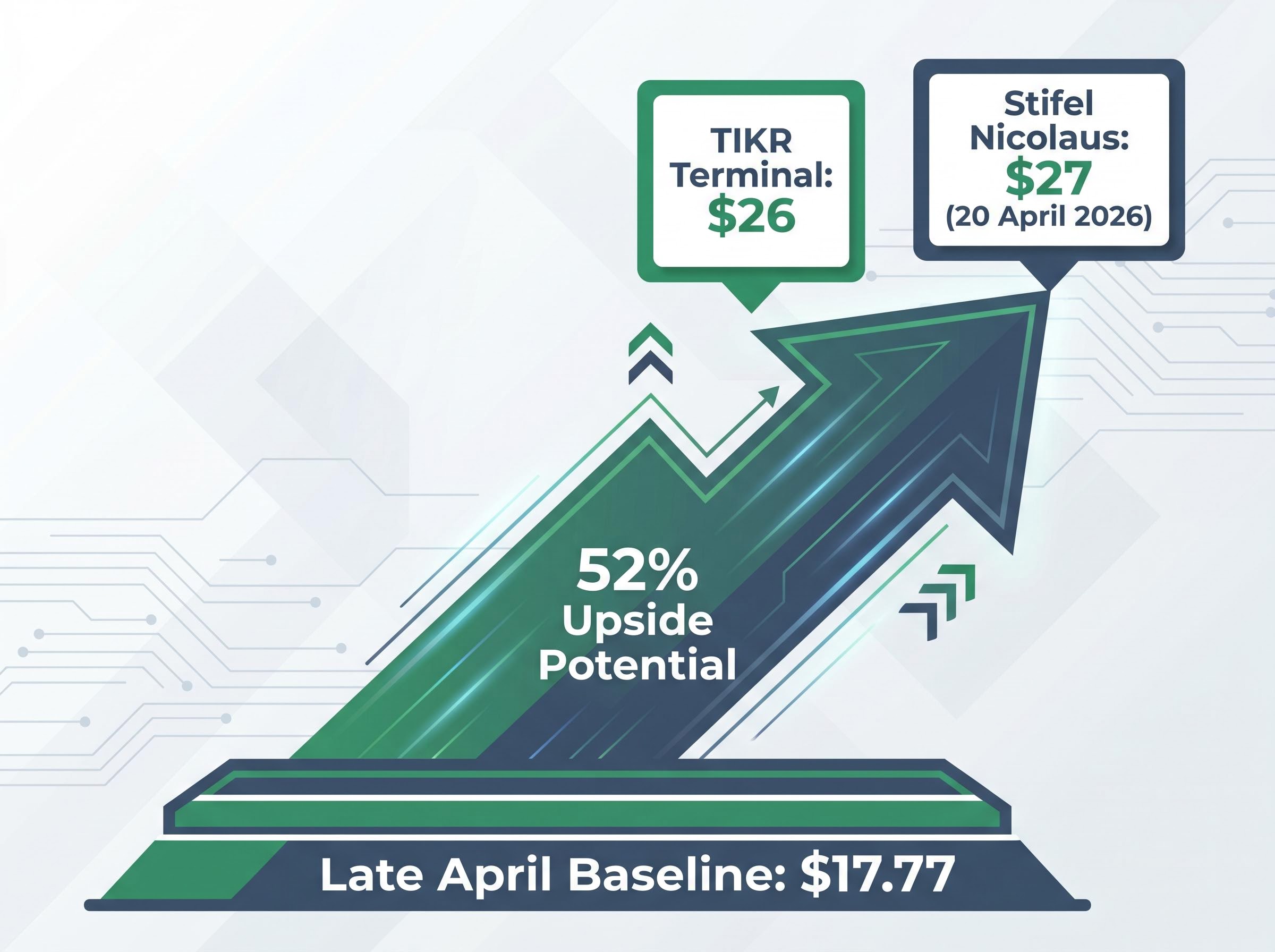
These targets imply a massive 52% upside potential from the late April baseline. However, these projections are heavily contingent on successful, Elliott-backed operational execution rather than baseline market growth.
Past performance does not guarantee future results. Financial projections are subject to market conditions and various risk factors.
Anchoring Expectations for the Elliott Era
The intervention by Elliott Management introduces a highly capable oversight committee, yet commercial investors must balance this leadership upgrade against difficult valuation metrics. The projected 52% upside offers substantial reward, but the current 21.72 P/E premium demands flawless execution from executives who have only held their seats since late March.
The upcoming 4 May earnings call stands as the definitive moment where abstract turnaround theories must meet concrete financial guidance. Until the new board outlines specific expenditure reductions and margin expansion strategies, the equity remains priced for perfection in an environment showing signs of booking softness.
For readers wanting to examine the specific strategic changes proposed by Elliott Management, our detailed coverage of the Norwegian Cruise Line activist takeover evaluates the new board’s mandate to address stagnant per-passenger yields and close the profitability gap with competitors.
This article is for informational purposes only and should not be considered financial advice. Investors should conduct their own research and consult with financial professionals before making investment decisions. Forward-looking statements are speculative and subject to change based on market developments and company performance.