Australian retail portfolios are undergoing a structural realignment. A close examination of current generational investing trends reveals a sharp departure from traditional stock picking, with Millennial wealth now overwhelmingly concentrated in diversified fund products rather than individual equities.
The local exchange-traded fund market has surged past $320 billion in funds under management as of April 2026. Younger investors act as the primary engine of this capital accumulation, fundamentally rewiring how domestic wealth accesses international markets.
This data-driven analysis evaluates how younger demographics are systematically abandoning domestic equity bias to capture global growth. The resulting allocation shift provides a modern blueprint for wealth building, demonstrating how digital-native cohorts utilise institutional-grade diversification to navigate macroeconomic uncertainty.
The Stark Divide in Portfolio Construction
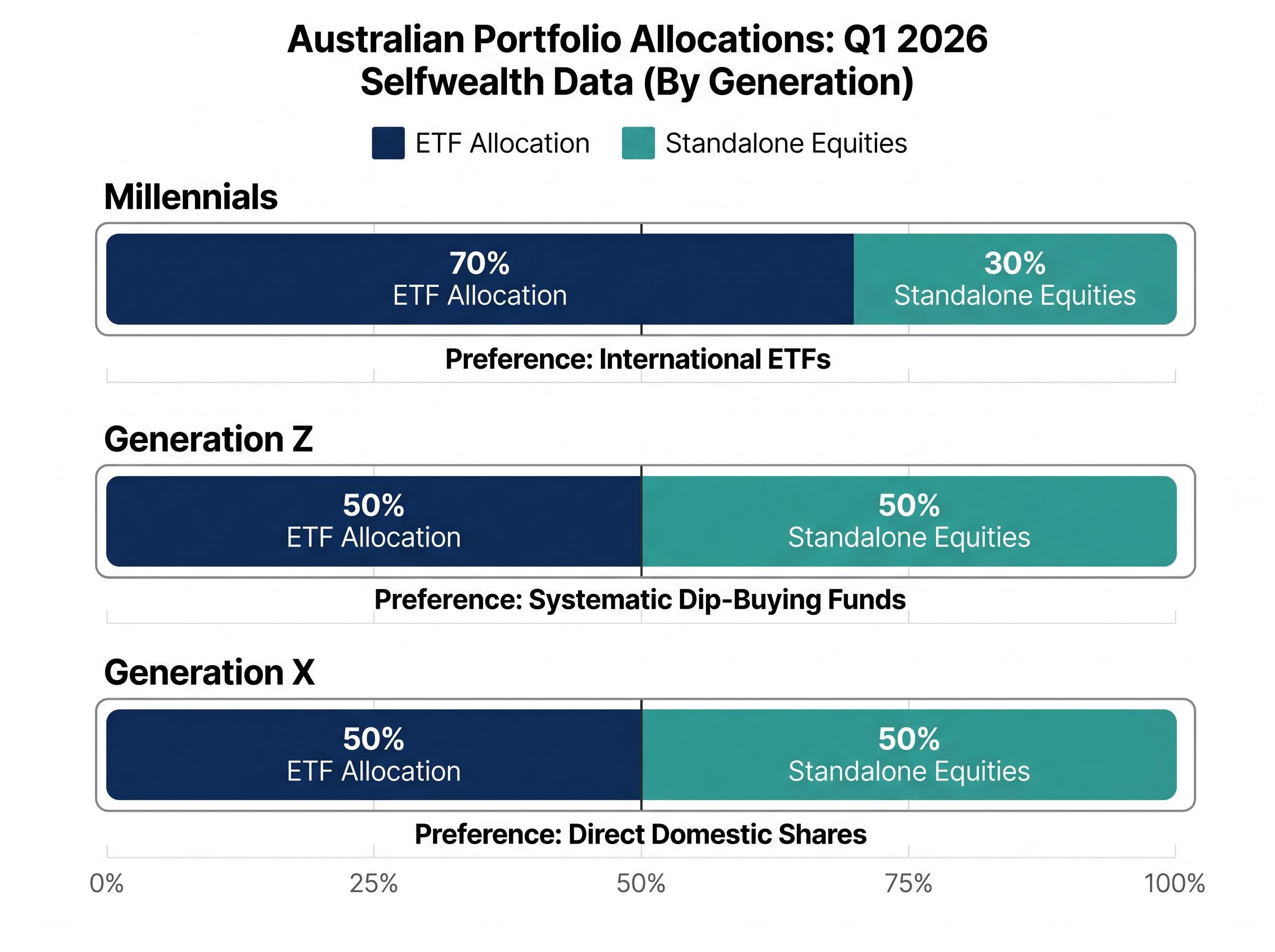
The allocation data from Q1 2026 exposes a statistical gulf between age cohorts. The dominance of exchange-traded products within younger portfolios represents a structural shock to traditional Australian wealth management rather than a gradual thematic shift.
According to Selfwealth platform data, Millennial accounts now allocate approximately 70% of their total capital to exchange-traded funds. This heavy concentration in diversified vehicles contrasts sharply with the strategies favoured by older demographics, who traditionally anchor their wealth in direct shares. Generation Z and Generation X investors maintain a distinct 50-50 split between standalone equities and diversified funds.
Research published by National Australia Bank (NAB) in April 2026 confirms the breadth of this adoption. The banking group reported that 40% of Generation Z and 34% of Millennials currently hold at least one exchange-traded product. Four of the top five investments across these younger cohorts are now diversified funds rather than individual company stocks.
These specific asset allocation models indicate that index-tracking products are no longer viewed as alternative or supplementary investments. They form the primary foundation for younger portfolios, offering readers a clear benchmark for evaluating their own capital allocation strategies against their peers.
| Generation | ETF Allocation Percentage | Standalone Equities Percentage | Key Preference |
|---|---|---|---|
| Millennials | 70% | 30% | International ETFs |
| Generation Z | 50% | 50% | Systematic Dip-Buying Funds |
| Generation X | 50% | 50% | Direct Domestic Shares |
When big ASX news breaks, our subscribers know first
Why the Exchange Traded Vehicle Won the Demographic War
An exchange-traded fund operates as a single security that tracks an entire index, sector, or commodity. By purchasing one unit on the Australian Securities Exchange (ASX), retail investors gain proportional ownership in hundreds of underlying assets.
This mechanism solves multiple historical barriers to international investing. Traditional offshore allocation required high brokerage fees, complex currency conversion, and fragmented tax reporting. A single ticker symbol eliminates this friction, allowing digital-native investors to deploy capital globally with the same ease as buying local bank shares.
Institutional analysis from State Street indicates that convenience and transparency are actively driving retail capital away from traditional active managers. The availability of nearly 500 distinct products on the ASX as of early 2026 provides investors with highly specific thematic exposures without the opacity of traditional unlisted managed funds.
Recent CFA Institute academic research validates this structural migration, confirming that passive index vehicles provide superior risk-adjusted returns when compared to high-fee active strategies over extended investment horizons.
For retail investors evaluating portfolio construction, these vehicles offer three distinct structural advantages:
Instant Diversification: A single transaction spreads capital across multiple companies, mitigating single-asset risk. Low Cost: Passive management structures compress management expense ratios well below traditional active fund fees. * Offshore Accessibility: Investors purchase global assets in Australian dollars, bypassing foreign exchange administration.
Escaping the ASX to Capture Global Tech and Healthcare
Digital-native investors are consciously rejecting Australian home bias. Capital flows demonstrate a clear migration of wealth leaving familiar domestic shores to target international growth sectors.
Selfwealth quarterly insights show that offshore-focused funds surpassed domestic equivalents as the most heavily acquired investment class in Q1 2026. This outward rotation aligns with a structural shift away from defensive assets, with safe-haven precious metals dropping in overall transaction volume during the quarter as optimism returned to global equities.
Beyond the Big Four Banks and Mining
The domestic market index suffers from profound concentration risk. Financial institutions and resource companies dominate the local exchange, limiting options for young wealth accumulators seeking exposure to future-focused industries.
Beyond simply accessing growth, many modern portfolios rely on geographic diversification via international ETFs to offset the vulnerabilities of a resource-heavy local exchange.
To bypass this limitation, younger cohorts deploy their capital into global technology and healthcare sectors. These innovation-heavy themes remain largely unavailable at scale on the domestic exchange, forcing investors to utilise international fund vehicles to capture the required growth trajectories.
This thematic rotation provides a critical benchmark for all investors. Portfolios with heavy domestic concentration risk underperforming a globalized index as innovation returns compound internationally.
Capitalising on Chaos and Macro Volatility
Younger investor cohorts systematically treat market contractions as strategic entry points rather than reasons to liquidate. This psychological framework turns macroeconomic instability into a wealth-building advantage.
NAB data reveals that Generation Z buy orders surged 49% on days when the broader market fell by more than 1%. This tactical application of dip-buying demonstrates a calculated, systematic approach to interest rate uncertainty and geopolitical friction.
Transaction metrics from Selfwealth further highlight this heightened sensitivity and rapid execution capability. User engagement on the platform dropped following a benchmark Reserve Bank of Australia rate increase. However, system transactions spiked surrounding United States trade duty declarations, illustrating how younger demographics actively trade macroeconomic headlines.
“Generation Z inherently understands the value of diversification and systematic dip-buying through ETFs,” said Gemma Dale, Director of SMSF and Investor Behaviour at NAB.
By executing purchases during periods of elevated volatility, these investors effectively lower their average entry prices. The strategy requires strict discipline and automated execution, relying on index recovery rather than speculative company rebounds.
Investors exploring ways to implement these automated purchasing systems will find our comprehensive walkthrough of dollar-cost averaging, which details how to mathematically smooth entry costs and manage the tax implications of periodic investing in Australia.
Tracking the Trajectory to a 380 Billion Dollar Industry
The aggregate impact of this retail capital rotation is fundamentally rewiring the Australian financial sector. What began as individual account preferences has scaled into a macroeconomic force.
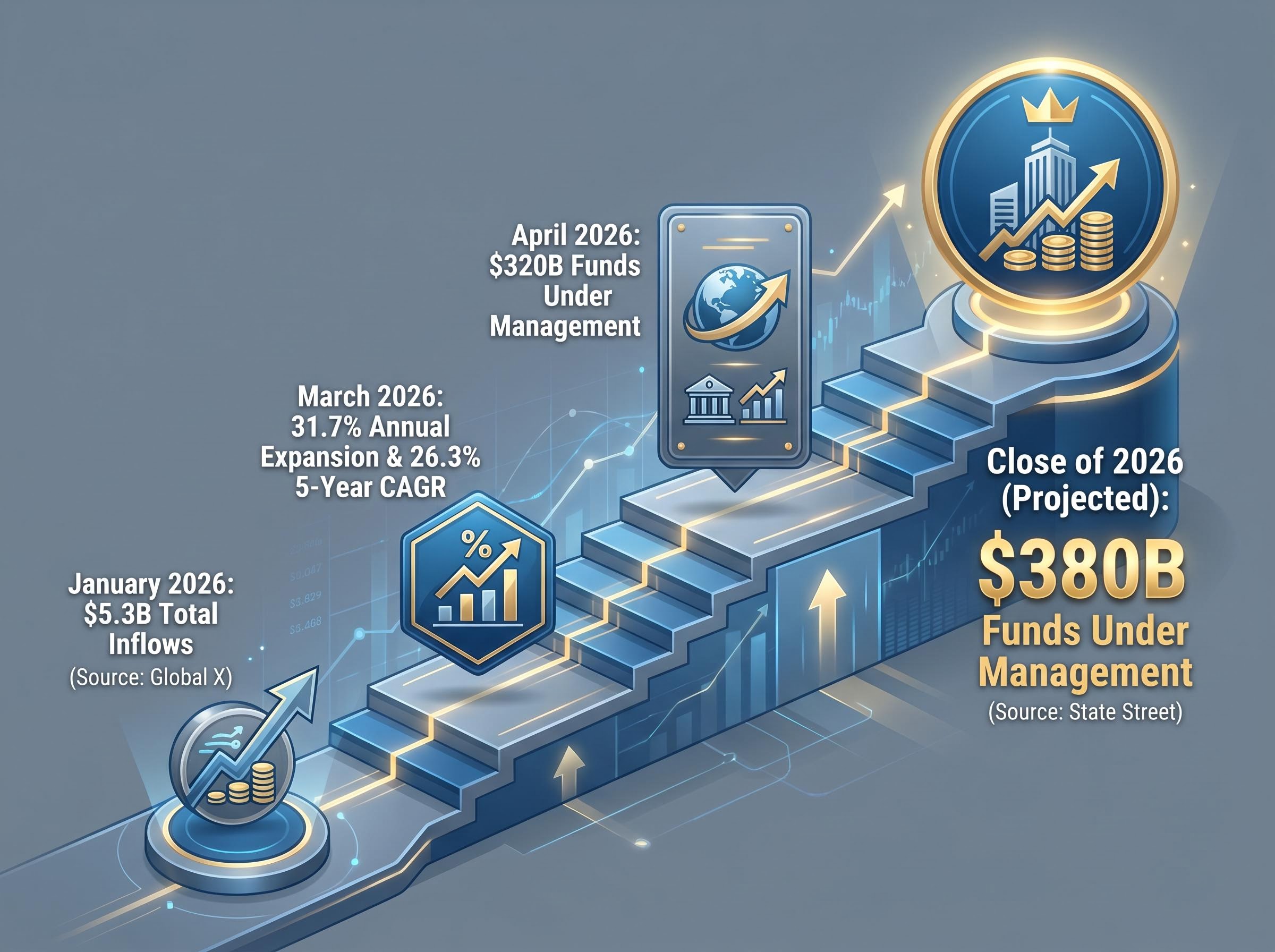
Global X market data notes a 31.7% expansion in the local fund market over the past year to March 2026, achieving a five-year compound annual growth rate of 26.3%. The momentum remains heavily sustained, with the sector recording $5.3 billion in total inflows during January 2026 alone.
This ongoing capital accumulation is further corroborated by official ASX monthly investment data, which consistently records sustained net inflows into passive equity vehicles across retail broker accounts.
State Street projects that the Australian exchange-traded fund market will reach $380 billion in funds under management by the close of 2026. This rapid accumulation of assets is forcing traditional active managers to rethink their product structures and fee models.
Based on current growth rates, industry projections indicate three likely market changes by the end of 2026:
- Traditional active managers will increasingly launch active exchange-traded products to stem capital outflows.
- The total number of available exchange-traded products will expand beyond 500 individual listings.
- Platform providers will accelerate fractional investing capabilities to capture smaller systematic deposits from younger cohorts.
The New Blueprint for Australian Capital Allocation
Millennials and Generation Z have permanently altered the baseline for local portfolio construction. The transition from domestic direct-share accumulation to global index building represents a structural market evolution.
The data from Q1 2026 proves that diversified, exchange-traded products now serve as the primary engine for modern wealth generation. Investors holding portfolios strictly concentrated in domestic equities face increasing opportunity costs as international innovation sectors continue to scale. Capturing the next decade of market returns will require all demographics to embrace the global diversification strategies currently championed by younger cohorts.
This article is for informational purposes only and should not be considered financial advice. Investors should conduct their own research and consult with financial professionals before making investment decisions. Past performance does not guarantee future results. Financial projections are subject to market conditions and various risk factors.