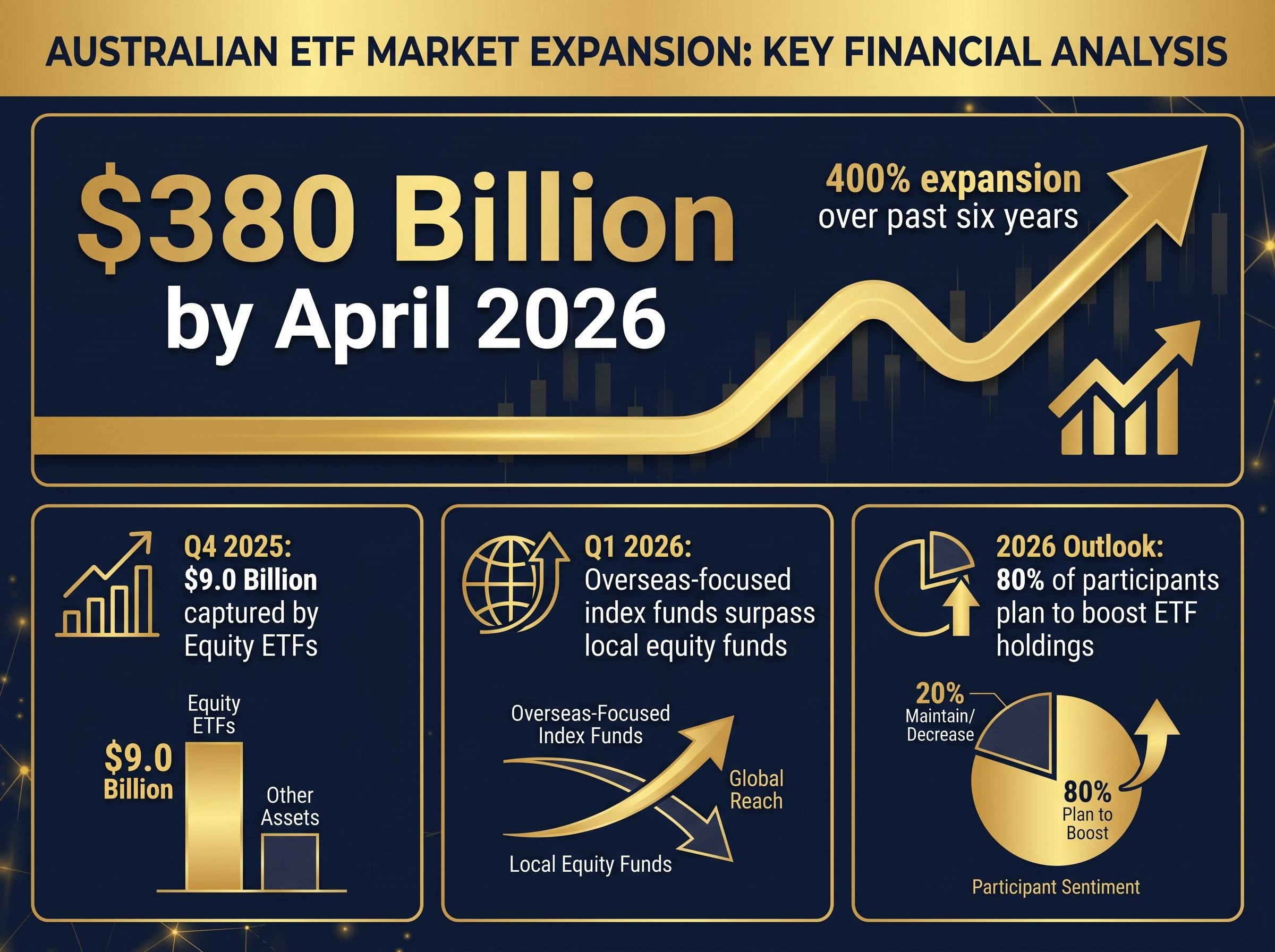
The Australian exchange-traded fund market is projected to reach $380 billion by April 2026, marking a 400% expansion over the past six years. This immense structural growth reveals the core components driving modern investor trends in 2026. Capital is decisively rotating away from traditional domestic equities and defensive positions.
In their place, retail participants are allocating heavily toward global growth and international diversification strategies. This structural transformation coincides with a complex macroeconomic environment characterised by stabilising geopolitics and higher interest rates. Different demographic cohorts are recalibrating their portfolios to navigate these exact conditions.
Market data indicates a clear departure from historical asset allocation models across all age groups. Understanding this new architecture of retail portfolios requires examining the distinct behaviours of these varying cohorts. The resulting analysis provides a detailed breakdown of how different generations are responding to evolving monetary policy and shifting international dynamics.
The Structural Shift to Global Exchange-Traded Products
The foundation of current retail strategy rests on a deliberate transition from active local stock picking to passive global index tracking. Exchange-traded funds allow participants to acquire broad market exposure through a single transaction, tracking specific indices rather than relying on individual companies. This mechanism removes the requirement for continuous individual equity monitoring while immediately broadening a portfolio’s geographical footprint.
Historically, domestic retail portfolios maintained high concentration in Australian financial and materials sectors. Participants are now intentionally moving capital offshore to mitigate this specific domestic market limitation. The Australian Securities Exchange lacks the depth of large-scale international technology and healthcare companies available in overseas markets.
The international technology sector offers exposure to artificial intelligence infrastructure and enterprise software companies that are entirely absent from the Australian index. Similarly, overseas healthcare funds provide access to late-stage pharmaceutical commercialisation and medical device manufacturing that domestic markets cannot replicate at scale.
Primary drivers pulling retail capital offshore include: Access to specialised growth equities unavailable domestically. Mitigation of concentration risk tied to the Australian financial sector. * Exposure to international healthcare and technology sector expansion.
Fund Acquisition Shift According to industry data, overseas-focused index funds officially surpassed local Australian equity funds as the highest-acquired category during the first quarter of 2026.
This rotation is supported by significant capital flows in recent months. Equity exchange-traded funds captured $9.0 billion in the final quarter of 2025. Furthermore, industry data shows that 80% of participants plan to boost their exchange-traded fund holdings throughout 2026.
Recent Betashares annual industry growth data confirms this momentum, noting that record breaking inflows consistently favour globally diversified products over traditional domestic indexes.
This educational baseline clarifies why international diversification is a primary objective for the modern retail participant. Exchange-traded products serve as the primary vehicle for achieving this structural variety, insulating capital from isolated domestic economic pressures.
When big ASX news breaks, our subscribers know first
Unwinding the Defensive Trade in Precious Metals
Capital allocation during the previous year was heavily defined by defensive posturing against international friction. Retail participants accumulated gold and silver at elevated rates to preserve wealth during periods of geopolitical uncertainty. As these international political frictions began to stabilise in late 2025 and early 2026, the justification for holding non-yielding safe havens diminished.
Observing how geopolitical conflicts reallocate capital provides crucial context, as shifting trade embargoes heavily dictate which asset classes capture incoming institutional liquidity.
The resulting timeline shows a rapid unwinding of this defensive trade. Acquisition behaviours for precious metals have fallen significantly compared to their previous peaks. The stabilisation of global tensions directly correlates with this capital flight from traditional safe havens.
The shift in portfolio construction over this brief period is distinct: Late 2025 Defensive Posturing: High concentration in physical gold exchange-traded funds, silver assets, and cash equivalents designed to weather geopolitical shocks. First Quarter 2026 Growth Orientation: Aggressive capital rotation into global financial sector equities, international technology funds, and alternative expansion-focused investments.
This liberated capital is actively flowing back into the broader market, finding homes in cyclical sectors. Some liberated capital is also finding indirect exposure to physical retail assets, as commercial retail property transaction volumes grew to $11.4 billion in 2025. Moving out of gold functions as a leading indicator for renewed risk appetite among retail participants.
By shedding defensive assets, participants are demonstrating a willingness to pursue yield in growth sectors despite a high interest rate environment. Industry analysts observe that this transition away from safe havens signals confidence in the broader economic trajectory.
Generational Fault Lines in Asset Allocation
The overarching trend toward international diversification obscures a deeply fractured market when analysed by demographic cohorts. Younger wealth accumulators are pursuing aggressive global strategies, while older participants remain focused on defensive yield preservation. These differing approaches represent rational responses to distinct phases of the wealth lifecycle rather than mere generational preferences.
Comprehensive ASX demographic investment data reveals that younger age groups prioritise capital growth through diversified funds, while older cohorts maintain their historical preference for direct share ownership.
| Generation | Primary Asset Vehicle | International Exposure Level | Defensive Asset Allocation |
|---|---|---|---|
| Generation Z | Equally split shares and index funds | High (Thematic focus) | Low |
| Millennials | Exchange-traded products | High (Broad market) | Low |
| Baby Boomers | Direct domestic equities | Low to Moderate | Moderate (7% median in gold) |
The Accumulation Phase: Gen Z and Millennials
Younger demographic groups are the primary drivers behind the rapid expansion of index-tracking strategies. Millennial account holders currently dedicate approximately 20% of their investment capital to exchange-traded products. This heavy weighting demonstrates a distinct preference for broad market tracking over individual company analysis, removing single-asset risk from their long-term wealth building.
Generation Z exhibits a slightly different but equally growth-focused approach. This cohort splits its holdings between individual company shares and index-tracking funds. Both younger demographics show an aggressive shift toward thematic and international products, utilising their long investment horizons to absorb near-term volatility.
The Income Preservation Phase: Baby Boomers
Older participants approach the current macroeconomic environment with a focus on capital protection and income generation. Baby Boomers continue to favour direct share ownership, maintaining a strong reliance on traditional domestic equities that offer steady dividend yields. Their allocation strategies are explicitly designed to fund retirement requirements through fully franked dividends, providing tax advantages that international equities do not offer.
Despite this traditional approach, there is a slow but steady integration of diversified funds into older portfolios. Baby Boomers maintain considerably lower exchange-traded fund exposure than younger cohorts, while holding a median 7% allocation to physical gold. This specific defensive weighting reflects their ongoing need to insulate retirement capital against unexpected market shocks.
Rapid Capital Responses to Macroeconomic Signals
Modern retail capital moves with unprecedented speed in response to monetary policy announcements. The reaction times in today’s market are highly compressed, with participants adjusting their positions within minutes of major economic headlines. This high-frequency retail trading behaviour is heavily influenced by domestic interest rate trajectories.
The Reserve Bank of Australia increased the cash rate by 25 basis points to 4.10% in March 2026. Following RBA borrowing cost elevations, immediate system engagement traditionally declines as participants pause to assess the implications for rate-sensitive domestic equities. Retail trading volumes in the domestic property and consumer goods sectors typically compress within hours of these monetary announcements.
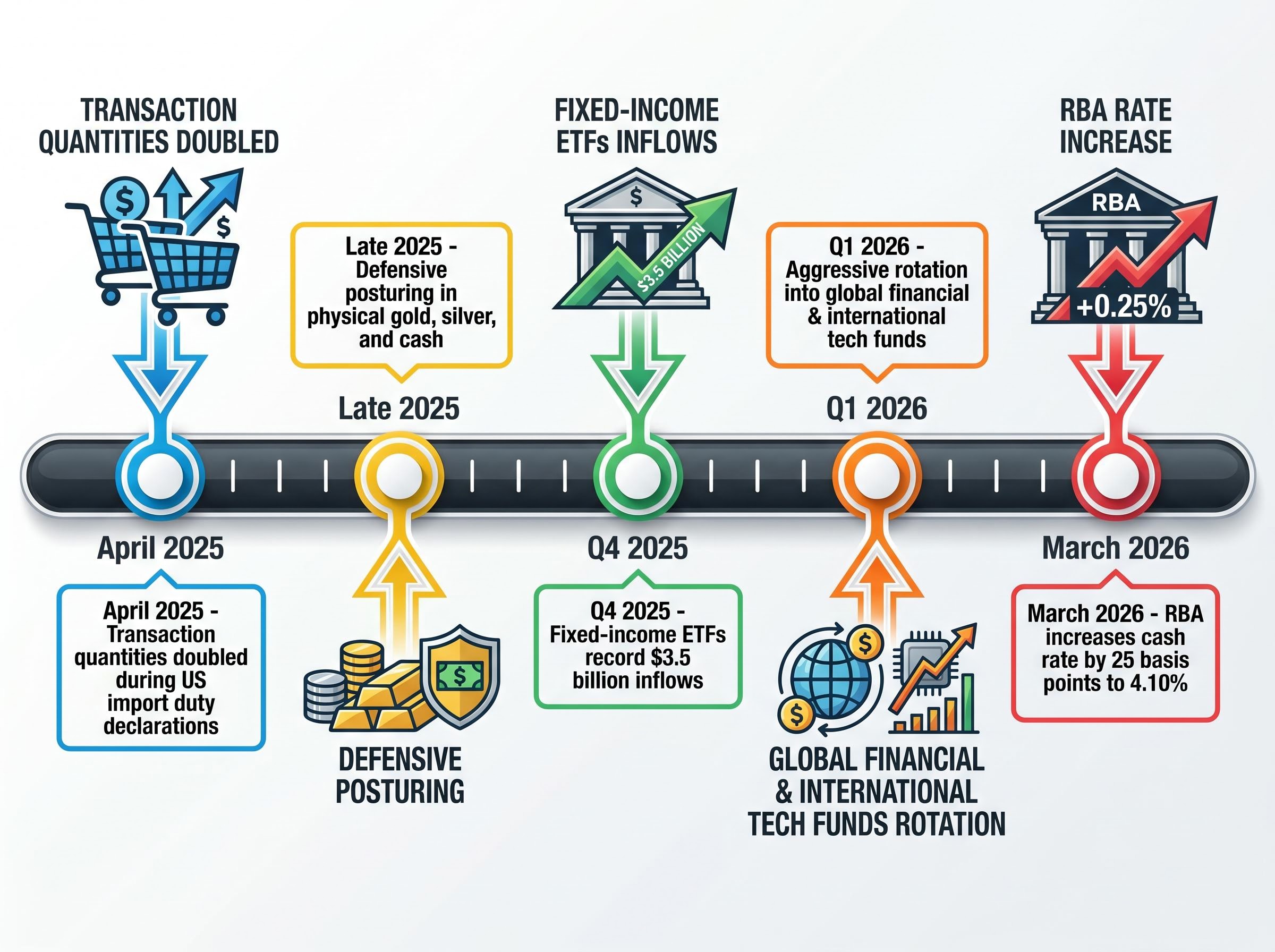
Conversely, fixed-income exchange-traded funds recorded $3.5 billion in inflows during the final quarter of 2025 as participants proactively sought higher yields ahead of further rate changes. This rotation occurs against the backdrop of a growing national consumer market, which was valued at approximately USD 293.38 billion in 2025 and is estimated to expand to USD 312.95 billion in 2026. Despite rising rates, consumer goods retailing revenue is growing at an annualised rate of 0.6% through the 2025-2026 period, reaching a total valuation of $271.3 billion.
Historical data confirms this hypersensitivity to macroeconomic news. According to industry data, transaction quantities previously doubled during the United States import duty declarations in April 2025. To counter this extreme reactive volatility, many participants are increasingly relying on automated investment tools.
Dollar-cost averaging provides a structural countermeasure against immediate macroeconomic shocks. Modern platforms offer several sequential automated setups to insulate long-term strategies from market noise:
- Daily micro-investments to capture immediate price fluctuations.
- Weekly scheduled transfers aligned with standard pay cycles.
- Biweekly allocations designed to smooth out mid-month volatility.
- Monthly bulk acquisitions timed to follow major economic data releases.
By implementing these automated schedules, retail participants remove the emotional urgency of trading on daily headlines. This programmatic approach ensures capital is deployed consistently regardless of the latest central bank announcement.
For readers wanting to optimise these automated schedules amidst rising costs, our comprehensive walkthrough of ASX portfolio inflation defence outlines specific frameworks for restructuring capital and establishing risk-efficient dollar-cost averaging processes.
The Maturation of the Australian Retail Portfolio
The Australian retail investor has fundamentally evolved into a globally minded, index-first market participant. While specific generations utilise different vehicles to achieve their financial goals, the overarching move toward structural diversification is universal. The domestic market is no longer viewed as the sole destination for wealth accumulation.
This structural maturation will be tested as the monetary environment continues to tighten. Current market pricing implies that over three additional Reserve Bank of Australia rate hikes are expected by the end of 2026. Portfolios positioned for international growth and buffered by fixed-income assets are strategically structured to weather these anticipated rate paths.
The projected $380 billion expansion of the exchange-traded market confirms that this outward-looking allocation strategy is a permanent fixture of the financial ecosystem. The modern portfolio is actively engineered to adapt to these macroeconomic pressures.
As central banks globally enforce restrictive monetary policies to combat ongoing supply shocks, this disciplined structural approach will remain essential for preserving domestic purchasing power.
This article is for informational purposes only and should not be considered financial advice. Investors should conduct their own research and consult with financial professionals before making investment decisions.
Past performance does not guarantee future results. Financial projections are subject to market conditions and various risk factors.