Retail platform transaction quantities experienced an increase during recent United States import duty declarations. This sudden surge highlights exactly how quickly retail money now moves in response to geopolitical friction. Australian investors face unprecedented macroeconomic volatility in early 2026, creating an environment where every news alert feels like an urgent mandate to act.
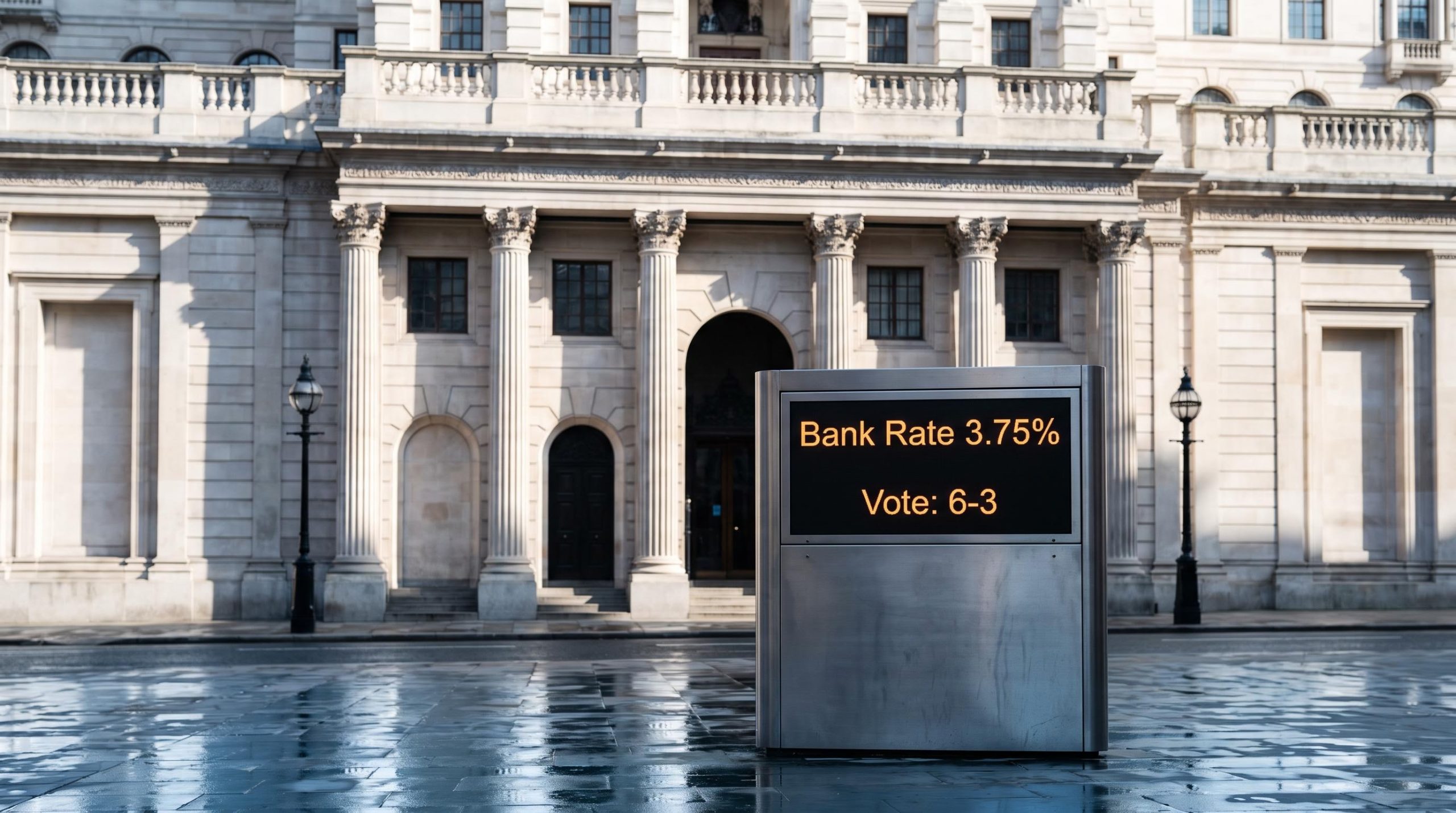
The Reserve Bank of Australia implemented a rate hike last month that immediately altered the trajectory of domestic equities. This event triggered sudden platform engagement drops followed by frantic, uncoordinated trading behaviours across retail accounts. Trying to manually time these constant market shocks creates significant portfolio drag and severe emotional fatigue.
A structural approach to dollar-cost averaging offers a clear pathway to step off the emotional rollercoaster of reactive dip-buying. Implementing an automated, disciplined investment framework helps neutralise market anxiety while maintaining consistent market exposure. By focusing on mechanical execution, investors can build wealth without reacting to every central bank announcement.
How Macroeconomic Headlines Triggered a Reactive Trading Boom
Retail trading speeds have evolved from delayed, considered responses into immediate fluctuations following major news events. This high-velocity environment forces manual traders into a constantly reactive stance, where milliseconds dictate entry prices. Last month’s Reserve Bank of Australia borrowing cost increase and recent global tariff announcements acted as the primary catalysts for this behavioural shift.
The difficulty automated pricing models face when attempting to process qualitative geopolitical risks creates sudden pockets of volatility that retail traders mistakenly view as routine buying opportunities.
Despite the headline panic regarding supply chains and inflation, buy orders still comprised approximately 75% of trades throughout late 2025 and into early 2026. This data shows that Australians are actively trying to catch falling knives rather than fleeing the market entirely. They are attempting to buy the dip on every negative announcement, treating volatility as a short-term trading opportunity rather than a structural risk.
Younger demographics drive a significant portion of this elevated trading volume. Market data reveals that millennial account capital is now dedicated to exchange-traded products.
Platform Engagement Metric Market data revealed a decline in system engagement immediately following the March 2026 Reserve Bank of Australia borrowing cost increase, reflecting sudden investor paralysis.
Understanding these market-wide statistics helps contextualise why frantic trading is part of a broader behavioural trap. A structural change is necessary to protect retail portfolios from headline-driven errors.
Several specific macroeconomic events triggered extreme volume spikes in Q1 2026: United States import duty declarations that temporarily threatened international supply chain stability. The Reserve Bank of Australia interest rate adjustment in March 2026 that defied previous market consensus. * Global manufacturing data releases that prompted immediate sector rotations.
When big ASX news breaks, our subscribers know first
The Psychological Cost of Constant Dip Buying
Retail investing continues to evolve rapidly beyond simple buy-and-hold methodologies. Generation Z investors, in particular, increasingly attempt to capitalise on intraday market dips rather than holding for long-term compound growth. This highly active approach carries a heavy cognitive and emotional burden.
Trying to perfectly time market entries during periods of intense geopolitical and economic friction causes significant psychological exhaustion. Industry insights from Stocks Down Under note the mounting emotional toll this ongoing volatility places on younger investors. The persistent anxiety of missing a market bottom often leads directly to impulsive decision-making.
Investors are also intentionally rotating capital away from traditional defensive assets, which inherently amplifies their exposure to this market volatility. Precious metal acquisitions have fallen as capital steadily rotates toward international growth equities. This aggressive shift toward high-beta technology names makes reactive trading even more punishing when macro shocks occur.
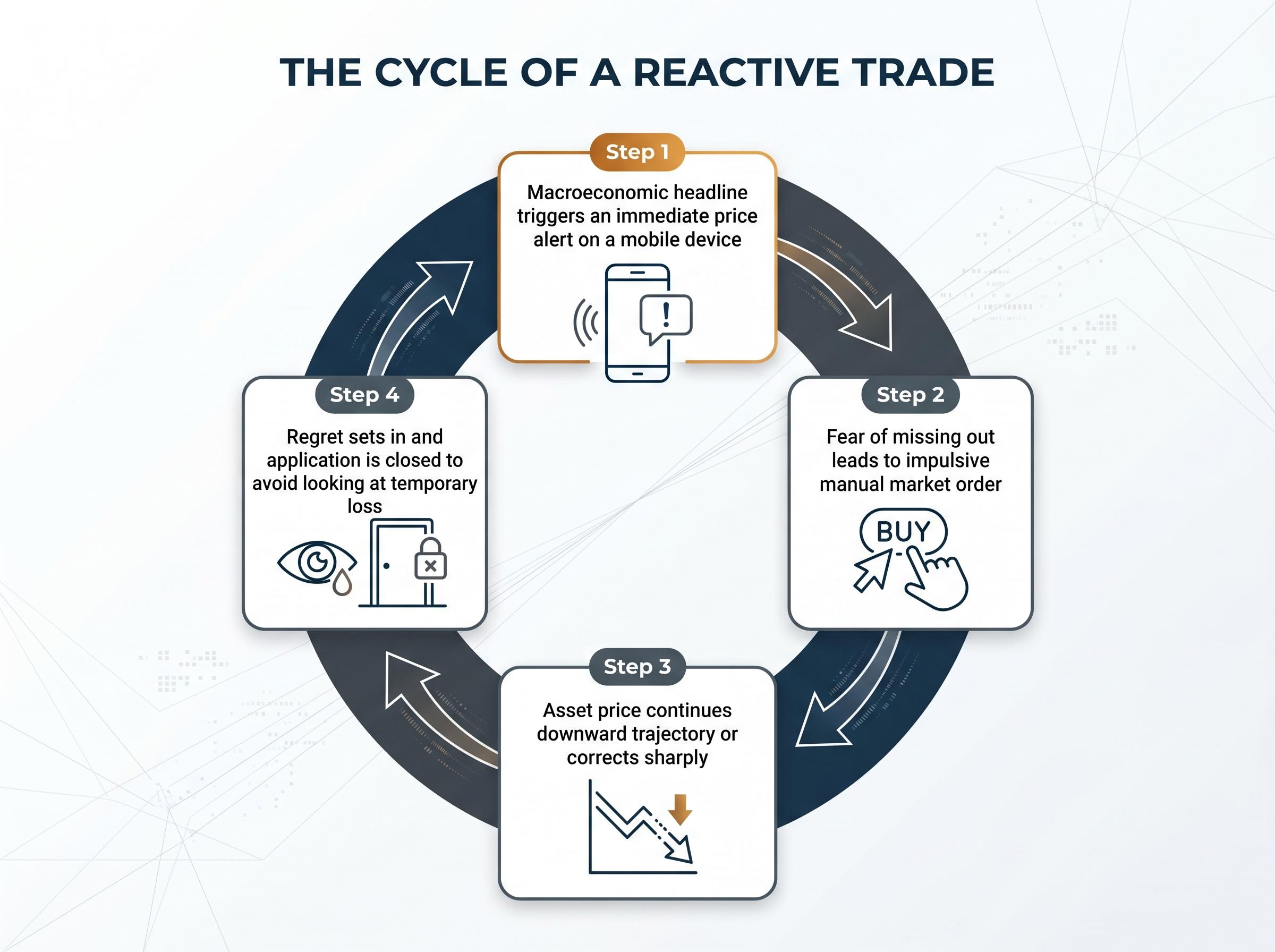
The typical psychological cycle of a reactive trade follows a predictable, damaging pattern:
- A macroeconomic headline triggers an immediate, unexpected price alert on a mobile trading device.
- The investor experiences a fear of missing out and manually executes an impulsive market order.
- The asset price continues its downward trajectory or corrects sharply in the following hours.
- The investor experiences subsequent regret and closes the application entirely to avoid looking at the temporary capital loss.
Relying purely on willpower and quick reflexes is an unreliable, unsustainable long-term strategy for building wealth in modern markets.
For investors ready to step away from short-term trading, our dedicated guide to ASX portfolio protection against inflation explores how to establish cash buffers and shift capital into businesses with structural pricing power.
Building a Circuit Breaker With Dollar-Cost Averaging
A mechanical approach successfully neutralises the emotional spikes associated with manual market timing. Consistent periodic purchasing acts as a predetermined circuit breaker that removes the burden of decision-making during stressful economic announcements. Investors simply allocate a fixed dollar amount to the same asset at regular intervals, regardless of the current share price or prevailing market sentiment.
Foundational behavioral finance research on dollar-cost averaging demonstrates that periodic investment schedules effectively reduce the cognitive load and potential regret associated with attempting to perfectly optimize market entries.
According to guidance from Betashares, this systematic approach is uniquely suited for investors who feel anxious about persistent market volatility. Automated regular contributions mathematically minimise the negative impacts of frequent, reactive trading. The investor completely bypasses the impossible need to accurately predict the next move from the Reserve Bank of Australia.
Psychological Benefit of Automation “Removing manual trade execution shifts the investor’s focus away from daily price fluctuations toward long-term unit accumulation, significantly reducing portfolio-related anxiety.”
The Mechanics of Price Smoothing
Fixed periodic investments interact dynamically with fluctuating share prices to automatically average the underlying entry costs. The mathematics of this strategy guarantee that the investor secures more units when prices fall and fewer units when prices rise. This naturally smooths out the severe peaks and troughs of the volatility curve over an extended timeline.
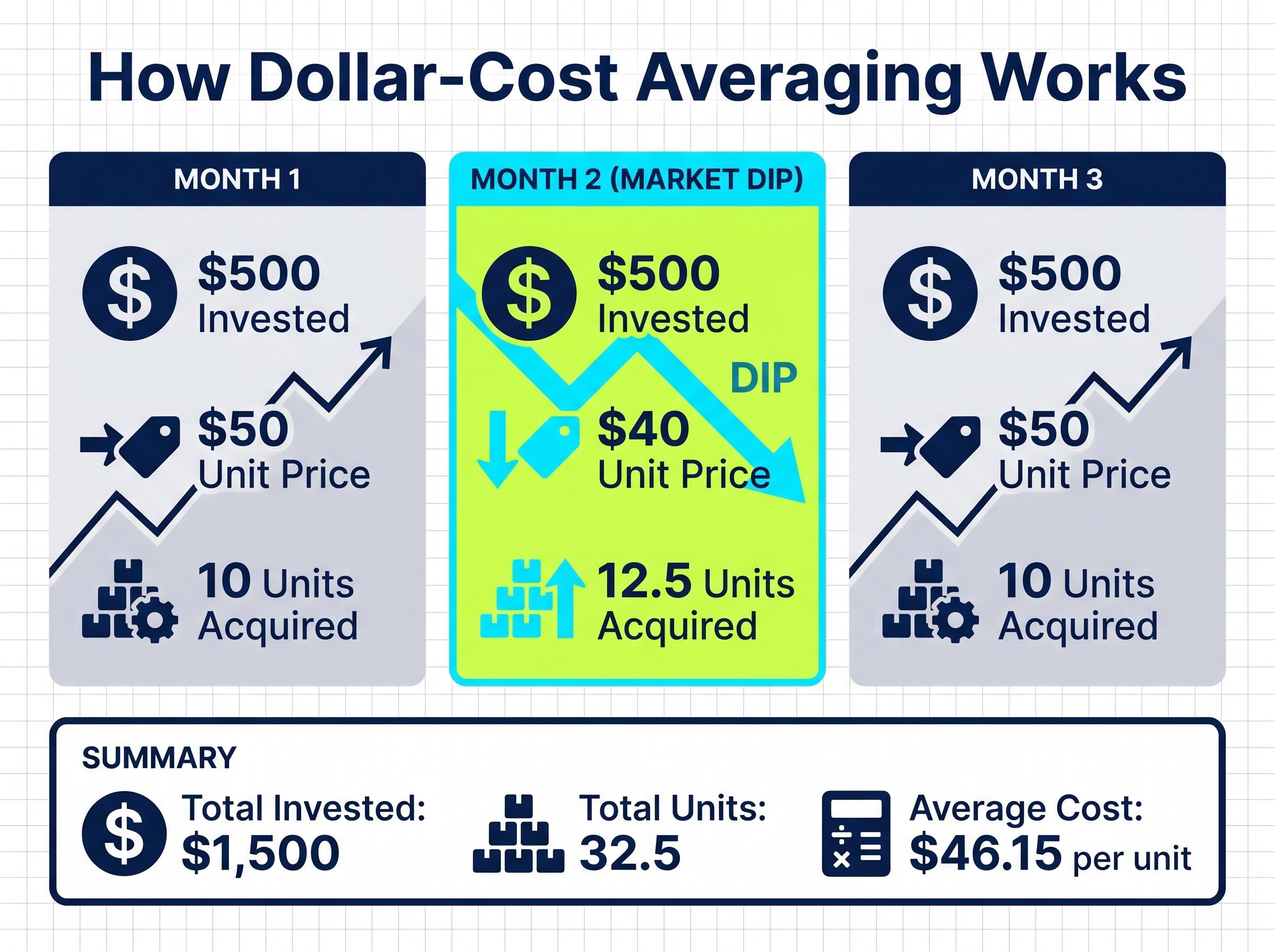
Consider a simple illustrative example where an investor allocates $500 per month to a specific broad-market index fund over a three-month period. In the first month, the fund trades at $50, allowing the automatic purchase of exactly 10 units. In the second month, a sudden macroeconomic shock drops the unit price to $40, allowing the identical $500 contribution to automatically purchase 12.5 units.
In the third month, the market stabilises and the price recovers to $50, yielding another 10 units for the portfolio. The investor spent a total of $1,500 to acquire 32.5 units, resulting in an average cost of $46.15 per unit. The automated process secured a lower average entry price entirely without requiring the investor to actively identify or manually trade the $40 market dip.
Implementing Systematic Accumulation on Australian Brokerages
The range of algorithmic assistance and visual strategy building available to Australian retail investors has expanded dramatically in 2026. Major platform providers now heavily promote their automated accumulation features over traditional manual order placement systems. Best practice dictates linking these algorithmic tools directly to paycheck cycles to ensure a seamless, uninterrupted cash flow into low-cost index funds.
The surging popularity of these features is evident across the sector, with prominent fintech platforms achieving structural profitability entirely through the widespread adoption of regular micro-investment tools.
Comprehensive market testing of over 100 brokers in 2026 identified Interactive Brokers as the premier platform for systematic purchasing in Australia. The platform provides advanced features that enable highly customisable, automated periodic investments into a vast array of exchange-traded funds. This infrastructure helps users navigate complex market volatility efficiently without monitoring daily price charts.
Local product providers also offer streamlined, purpose-built solutions for regular capital deployment. The Betashares Direct Auto Invest feature provides a seamless, zero-brokerage pathway directly into their suite of low-cost funds. This system allows beginner investors to build confidence gradually without ever attempting to time the market bottoms.
Conversely, traditional major platforms like CommSec and Selfwealth currently offer more restricted automation capabilities for the modern retail investor. These legacy systems often require manual scheduled execution or external banking workarounds to achieve similar results. Learning exactly which tools to activate today empowers investors to automate their wealth generation immediately.
| Brokerage Platform | Automation Capability | Ideal User Profile |
|---|---|---|
| Interactive Brokers | Advanced algorithmic assistance and automated periodic investments | Experienced investors seeking highly customisable deployment |
| Betashares Direct | Dedicated Auto Invest feature for low-cost fund routing | Beginner to intermediate ETF investors automating paycheck cycles |
| CommSec / Selfwealth | Manual scheduled execution required for most regular orders | Traditional buy-and-hold investors managing infrequent bulk purchases |
Navigating the Capital Gains Tax Complexities of Regular Investing
High-frequency automated purchasing creates a hidden administrative trap involving the tracking of multiple distinct transaction parcels. While the automated execution itself becomes effortless, the necessary accounting requirements compound significantly with every single algorithmic trade. Independent financial analysis heavily critiques the assumed absolute simplicity of automated purchasing specifically due to these complex reporting obligations.
The Australian Taxation Office strictly enforces general guidelines regarding the 12-month asset holding period required to receive the 50% Capital Gains Tax discount. Buying the exact same asset every week or month means every individual parcel carries a different, legally binding acquisition date. This severely complicates the mathematical calculation of the 12-month hold rule when the investor eventually decides to sell units.
The official ATO capital gains tax discount guidelines specify that individuals must retain beneficial ownership of the underlying asset for a full year, which creates significant administrative overhead for investors executing weekly automated share purchases.
Investors face a constant temptation to reactively alter or pause their automated plans during significant market shocks. Doing so scrambles historical data tracking and routinely leads to unseen tax inefficiencies if administrative records are not meticulously maintained. Organising an automated portfolio correctly from the very first deposit prevents substantial financial penalties during tax season.
Critical record-keeping best practices when managing automated weekly or monthly investments include: Utilising dedicated portfolio tracking software that natively calculates exact parcel acquisition dates. Maintaining consistent, unaltered investment intervals to heavily simplify quarterly reconciliation. Avoiding partial, reactive sell-downs of recent acquisitions that have not yet met the 12-month discount threshold. Exporting official broker transaction reports at the end of each financial year for secure, offline backup.
This article is for informational purposes only and should not be considered financial advice. Investors should conduct their own research and consult with financial professionals before making investment decisions. Past performance does not guarantee future results. Tax implications and financial projections are subject to market conditions, policy developments, and individual circumstances.
Reclaiming Strategy Over Emotion in Volatile Markets
Transitioning from frantic, headline-driven trading to a disciplined, automated approach fundamentally upgrades the retail investing experience. Macroeconomic shocks involving international tariffs and unexpected interest rate adjustments will undoubtedly continue to disrupt markets throughout 2026. However, the retail investor’s response to these systemic events can remain entirely mechanical, predictable, and detached from emotional panic.
Systematic accumulation deliberately turns inevitable market volatility into a mathematical advantage rather than a daily psychological burden. The absolute simplest way to break the exhausting cycle of reactive trading is to remove the manual execution requirement from the process entirely. Choose an appropriate, low-cost platform and set up one small automated transfer this week to begin building a resilient portfolio.