
United States digital health funding reached a record $14.2 billion peak in 2025. This massive capital injection was driven overwhelmingly by artificial intelligence platforms, structurally altering the core strategy of healthcare venture capital. Institutional investors are now forced to seek earlier entry points to avoid massive late-stage premiums that compress forward-looking returns.
In April 2026, founding partner Mary Minno publicly debuted Treehub, an accelerator programme backed by industry figures including Tim Draper and Anne Wojcicki. This Stanford-adjacent initiative aims to capture market momentum at the absolute earliest stage by targeting scientific founders directly from academia. The programme focuses exclusively on funding innovators before they establish formal corporate structures.
This analysis provides a rigorous examination of how pre-incorporation funding models are altering early-stage medical technology investments. By evaluating the mechanics of these hyper-early capital allocations, financial professionals can access a clear blueprint of modern medical innovation. The resulting framework demonstrates exactly what institutional investors value before a company even formally exists.
The Valuation Disconnect and the Artificial Intelligence Premium
The macroeconomic rebound in United States medical technology funding throughout 2025 established a highly competitive allocation environment. Digital health venture capital secured 482 deals representing a 35% year-over-year increase in capital deployed. This growth occurred despite a slight contraction in overall deal volume, indicating that more money was concentrated into fewer, highly valued opportunities.
The Rock Health digital health funding analysis details how the massive capital deployed across these transactions represents a significant structural shift in venture capital allocation strategies.
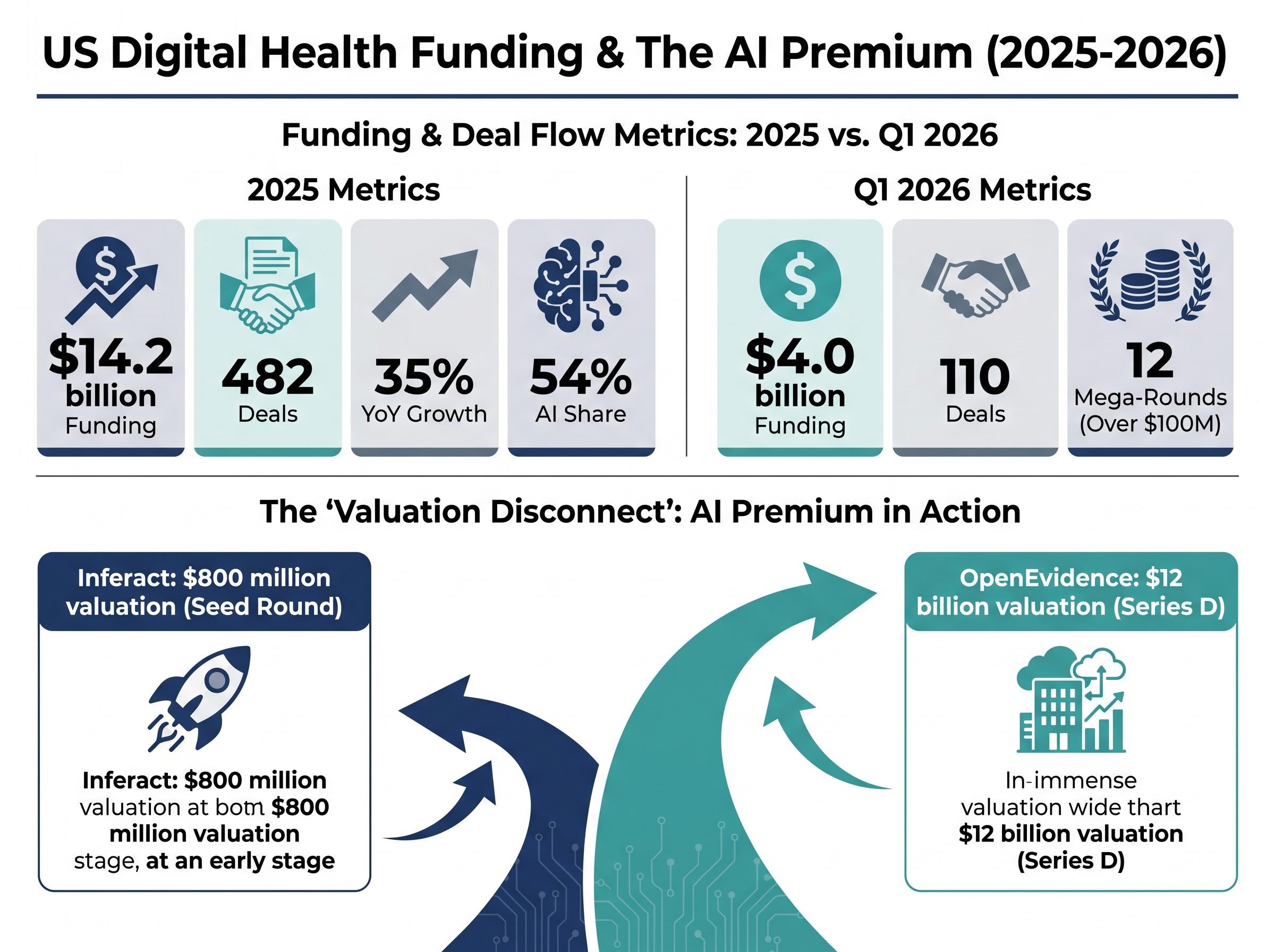
Artificial intelligence firms captured the vast majority of this institutional capital flow. These specific platforms commanded 54% of total funding and secured a 19% average deal-size premium compared to traditional healthcare software. The momentum accelerated further in Q1 2026, hitting $4.0 billion across 110 deals, driven significantly by twelve massive rounds exceeding $100 million each.
This sheer scale of market capitalisation creates a severe valuation disconnect for investors seeking reasonable entry points. Later-stage artificial intelligence integrations now carry outsized premiums that mathematically limit the upside for incoming capital. Standout valuations in early 2026 include Inferact reaching an $800 million valuation after its seed round.
Even more striking, OpenEvidence achieved a massive $12 billion valuation following its Series D raise. The gap between these premium late-stage prices and early-stage opportunities makes alternative funding models strictly necessary. Finding academic founders at the bottom of the market has transitioned from a niche tactical advantage to a highly lucrative requirement for competitive funds.
| Funding Period | Total Capital Deployed | Key Market Drivers |
|---|---|---|
| Full Year 2025 | $14.2 Billion | 35% YoY growth; AI commands 54% of total funding |
| Q1 2026 | $4.0 Billion | 12 mega-rounds; AI integration deal-size premiums |
When big ASX news breaks, our subscribers know first
Understanding Pre-Incorporation Medical Funding Mechanics
Transitioning from macroeconomic data to operational reality reveals how capturing founders before they form a legal entity fundamentally alters risk dynamics. A pre-incorporation funding model provides capital to scientific teams while their research remains within university environments and no formal capitalisation table exists. The AI Health Fund executes this specific strategy through a standard $100,000 introductory capital injection.
This hyper-early intervention secures intellectual property rights before formal commercial structures and external board members complicate the equity distribution. According to PitchBook trends from Q2 2025, there is a distinct investor shift toward scalable artificial intelligence platforms with strong regulatory alignment. Securing these assets pre-incorporation allows investors to dictate the regulatory and payer alignment strategy from day one.
The FDA artificial intelligence regulatory framework establishes strict premarket submission requirements that early stage founders must incorporate into their foundational algorithms before clinical testing begins.
The strategic advantage of this model is the direct pipeline to raw academic talent that traditional venture models often overlook. Financial professionals can leverage this structure to build significant equity positions at valuations far below traditional seed rounds.
Valuation Entry: Pre-incorporation models enter at the scientific concept phase, whereas traditional biotechnology requires established clinical data. Corporate Structure: Hyper-early funds help build the initial corporate entity, while conventional venture capital demands an existing, mature board of directors. Capital Allocation: Pre-incorporation funding focuses on validating the foundational algorithm, whereas traditional models fund expensive, multi-year clinical trials. Regulatory Planning: Early accelerators integrate regulatory strategies before product development begins, unlike traditional models that adapt to existing prototypes.
The Limitations of Traditional Biotechnology Frameworks
Conventional venture models typically demand mature institutional foundations before deploying capital. These traditional frameworks struggle to evaluate and fund pure academic concepts that lack seasoned management teams, often viewing raw science as an unquantifiable operational risk.
This structural hesitation has historically led to the misallocation of capital toward minor programmatic improvements rather than foundational biology. Traditional funds frequently back iterative software updates to existing medical systems because the commercial path is already proven. By demanding immediate commercial viability, these conventional models miss the opportunity to own the underlying intellectual property of major scientific breakthroughs.
Inside the Treehub Acceleration Engine
The abstract concept of pre-incorporation funding becomes tangible within the physical and operational reality of the Stanford-adjacent programme. The accelerator operates on a rigorous timeframe specifically designed to convert scientific discovery into commercial viability. Operating cycles are launched annually to maintain a consistent, highly vetted pipeline of medical innovation.
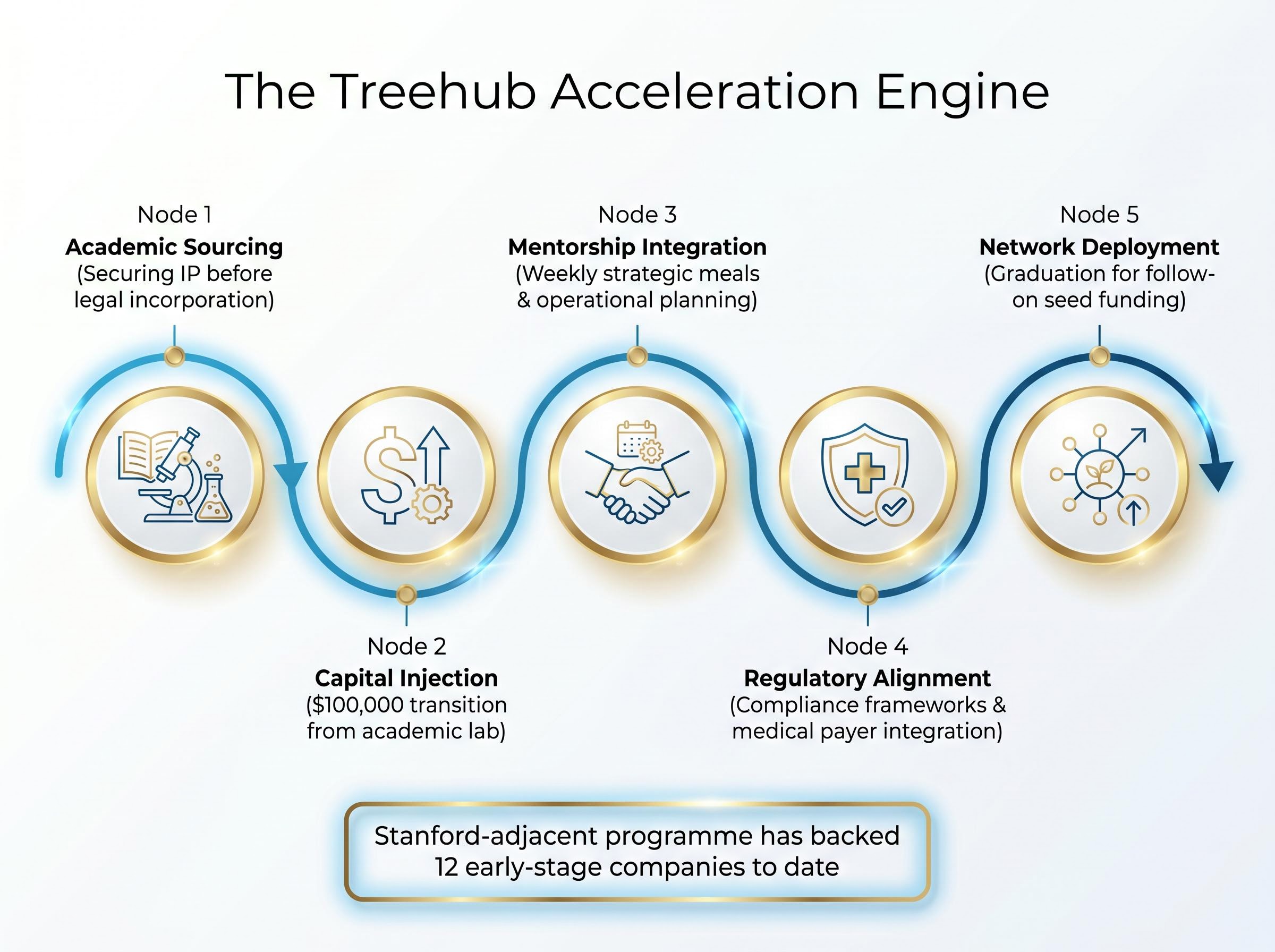
Raw scientific talent is immediately paired with mentorship from successful business builders and institutional purchasers. The validation brought by high-profile technology executives actively participating in the ecosystem actively mitigates early operational risk. Since its inception, the programme has already backed 12 early-stage companies, placing them into a highly structured environment.
Connecting founders with institutional purchasers early in the operational cycle is critical; for example, established clinical AI companies offering quantitative lung imaging analytics often require direct endorsements from global pharmaceutical giants to unlock full commercial scale.
Founding Philosophy “Bridging the gap between scientific discovery and commercial enterprise requires structural intervention before the science leaves the laboratory,” said Mary Minno, Founding Partner of the AI Health Fund.
This structured environment ensures that raw introductory capital is actively managed rather than passively deployed. The progressive operational stages systematically convert academic researchers into capable chief executives who understand unit economics and scalable distribution.
- Academic Sourcing: Identifying raw scientific talent and securing initial intellectual property agreements before legal incorporation.
- Capital Injection: Deploying the initial $100,000 to transition the founder out of the academic laboratory and into the operational programme.
- Mentorship Integration: Facilitating weekly strategic meals and operational planning sessions with experienced technology executives.
- Regulatory Alignment: Establishing immediate compliance frameworks and mapping the pathway for medical payer integration.
- Network Deployment: Graduating the incorporated entity into the broader institutional venture capital network for follow-on seed funding.
Decoding the Inaugural Portfolio Strategy
Theoretical investment theses require concrete portfolio execution to demonstrate exactly what top-tier investors currently value. The inaugural cohort of accelerated startups reveals a clear departure from incremental medical software updates. Instead, the fund’s focus rests entirely on scalable artificial intelligence solutions targeting complex, high-margin medical verticals.
Clair Health exemplifies this specific thesis through its ongoing development of uninterrupted endocrine and hormone tracking technology. In the highly fragmented maternal care sector, Nestwell Health operates as an IGNITE startup modernising virtual perinatal care. Both companies utilise artificial intelligence to translate continuous biological data into actionable clinical insights.
The demand for modern perinatal solutions is accelerating rapidly, as evidenced by established digital maternity care platforms successfully raising significant capital to fund direct commercial deployments across United States hospital networks.
According to company data, behavioural health is actively targeted by Diggy, which focuses on developmental platforms for vulnerable paediatric populations under the guidance of Dennis Wall. Furthermore, according to company data, predictive modelling for long-term medical progressions is anchored by Korda. By examining these real-world allocations, the broader market can reverse-engineer the exact healthcare sub-sectors currently viewed as highly lucrative by institutional capital.
| Company Name | Medical Vertical | Core Technology Focus | Current Operational Status |
|---|---|---|---|
| Clair Health | Endocrinology | Continuous hormone tracking wearable | Active AI Health Fund portfolio company |
| Nestwell Health | Maternal Care | Virtual perinatal clinic platform | Active IGNITE startup |
| Diggy | Behavioural Health | Paediatric developmental platforms | Early-stage development |
| Korda | Predictive Modelling | Long-term medical progression algorithms | Early-stage development |
Correcting Historical Capital Misallocations in Medicine
The pre-incorporation acceleration model represents a necessary correction in how the United States commercialises academic research. Historical capital misallocations frequently favoured minor software improvements over foundational biological breakthroughs due to the perceived safety of established business models. Directing funding toward raw science at the university level ensures that institutional capital supports scalable platforms capable of shifting medical paradigms.
The critical integration of these accelerated companies into existing medical networks post-programme will ultimately determine their commercial viability. As artificial intelligence continues to command premium market valuations, this hyper-early acceleration strategy is positioned to dominate medical technology investment through the remainder of 2026. Securing scientific founders before they incorporate remains the most effective mechanism for avoiding late-stage pricing premiums.
This article is for informational purposes only and should not be considered financial advice. Investors should conduct their own research and consult with financial professionals before making investment decisions.
Past performance does not guarantee future results. Financial projections are subject to market conditions and various risk factors. These statements are speculative and subject to change based on market developments and company performance.