
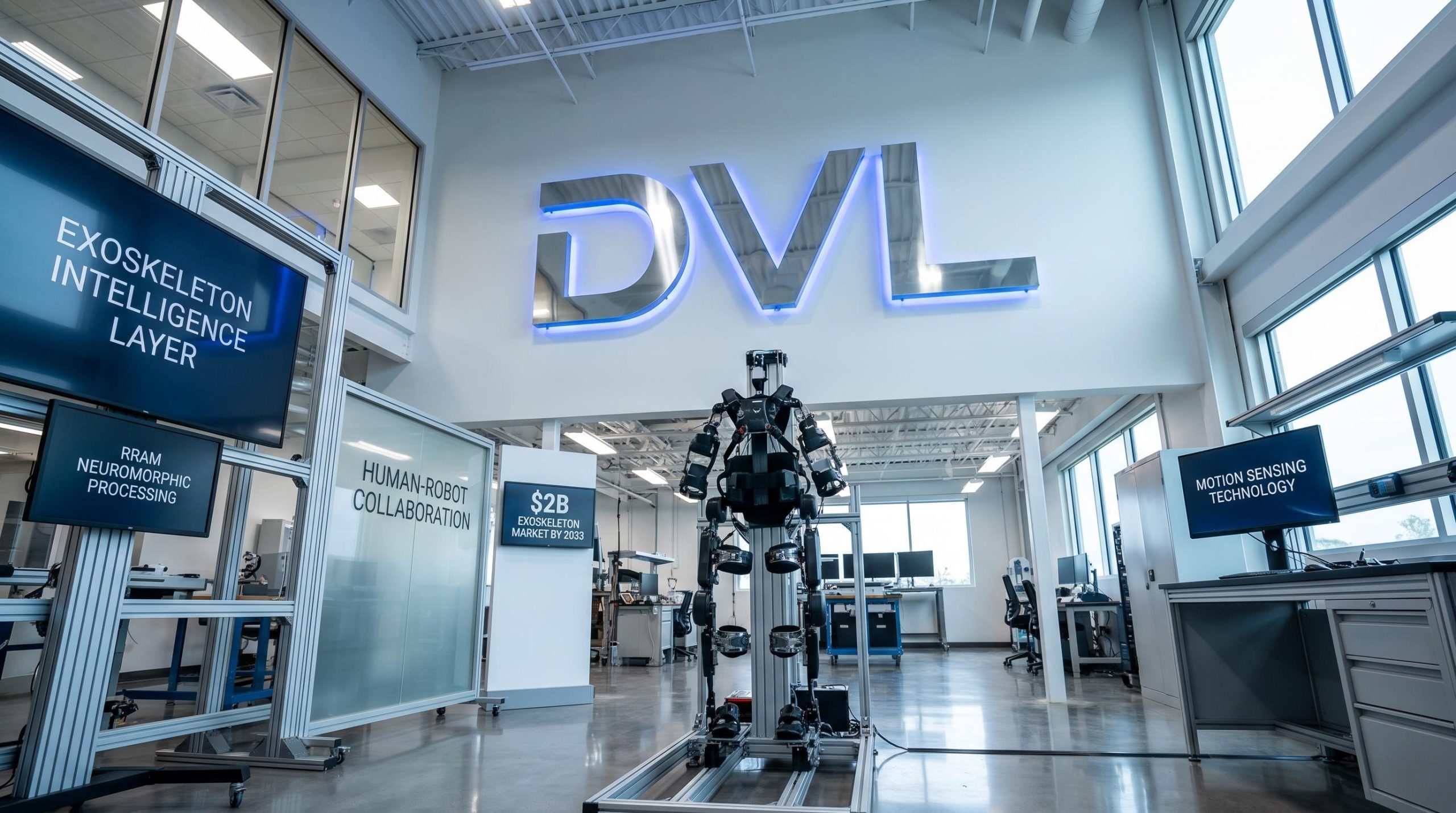
dorsaVi targets billion-dollar exoskeleton market with sensor and neuromorphic technology
dorsaVi has identified next-generation exoskeleton systems as a priority application for its wearable sensor platform and RRAM-based neuromorphic semiconductor programme. The strategic expansion leverages technology already in development, positioning the company to address a global exoskeleton market projected to exceed USD ~2 billion by 2033, up from US$590 million in 2025. The broader opportunity extends across collaborative robotics, surgical robotics, autonomous mobile robots, and defence systems, representing a combined addressable market exceeding USD 100 billion by 2030.
This is not a pivot but a direct extension of existing capabilities. The company is activating its medical-grade sensor intellectual property and neuromorphic computing programme across multiple high-growth verticals, maximising return on existing research and development investment rather than pursuing speculative new development.
When big ASX news breaks, our subscribers know first
How dorsaVi’s technology solves the exoskeleton intelligence gap
Powered exoskeletons are wearable robotic systems that augment human movement, strength, and endurance. These systems are transitioning from research environments into commercial deployment across defence, industrial, healthcare, and aged care sectors. The critical technology gap in current exoskeleton platforms is intelligence: the ability to sense, interpret, and respond to human movement in real time with guaranteed safety.
dorsaVi’s proprietary motion sensors function as the intelligence layer. The sensors capture high-fidelity biomechanical data including joint angles, force distribution, and movement patterns, providing the foundational data layer that tells the exoskeleton how the wearer is moving, where force is being applied, and when fatigue or injury risk is developing. This real-time motion sensing enables the exoskeleton’s control system to detect unsafe conditions such as overextension, asymmetric loading, or excessive force.
RRAM neuromorphic computing addresses the processor limitations inherent in current exoskeleton systems. Conventional processors are power-hungry, latency-prone, and often require cloud connectivity. dorsaVi’s RRAM-based neuromorphic semiconductor programme delivers ultra-low power, brain-inspired compute that processes sensor data and runs adaptive control algorithms at the edge. The architecture enables on-body processing without cloud dependency and power consumption suitable for battery-powered wearable systems.
Three commercial pathways identified
dorsaVi is pursuing three application pathways in the exoskeleton intelligence space: exoskeleton intelligence layers, human-in-the-loop robotic control, and fatigue-aware robotics.
| Pathway | Description | Target Sectors | Revenue Model |
|---|---|---|---|
| Exoskeleton Intelligence Layer | Sensors embedded in exoskeleton systems provide real-time movement intelligence for adaptive gait control, joint tracking, and force feedback to actuators | Rehabilitation, aged care, industrial exoskeletons | Licensing and OEM partnerships |
| Human-in-the-Loop Robot Control | Sensors combined with neuromorphic edge processing create closed-loop control where the exoskeleton responds to human input with mathematically guaranteed safety boundaries | Defence, industrial applications requiring augmented strength with precise control | RRAM chip integration enables on-body edge processing |
| Fatigue-Aware Robotics | Motion analytics detect fatigue patterns, asymmetric loading, and injury risk in real time; exoskeleton automatically adjusts assistance level based on wearer’s physical state | Workplace safety and compliance applications globally | Data flywheel model where continuous biomechanical data feeds AI models |
The fatigue-aware robotics pathway addresses mandatory workplace safety and compliance requirements, creating more predictable demand than discretionary technology purchases.

Target sectors driving exoskeleton adoption
Four key market segments are driving exoskeleton adoption:
- Defence & Military: Soldier augmentation, load carrying, and endurance enhancement programmes are active across the US, EU, and Asia-Pacific. Safety-certified human augmentation is a critical requirement in this vertical.
- Industrial & Construction: Reducing musculoskeletal injuries in heavy manual work is driving adoption as workplace safety compliance becomes mandatory. dorsaVi’s fatigue-aware analytics address direct regulatory needs in this segment.
- Rehabilitation & Healthcare: Powered exoskeletons for stroke recovery, spinal cord injury rehabilitation, and mobility assistance require sensor-driven adaptive control as the key differentiator.
- Aged Care: Assistive exoskeletons for elderly populations represent a policy-supported, high-growth market across Asia-Pacific, aligned with dorsaVi’s geographic positioning.
These are compliance-driven markets rather than discretionary spend categories, creating more predictable adoption cycles and revenue visibility.
Neuromorphic IP acquisition completed, Israeli partnerships in progress
dorsaVi has completed the acquisition of neuromorphic and in-memory processing intellectual property from The Technion, one of the world’s foremost research universities in electrical engineering, computer science, and nanotechnology. The acquisition strengthens the company’s proprietary portfolio in processing-in-memory and neuromorphic computing architectures, complementing the existing RRAM platform and the 22-nm development programme underway with ITRI and NTU.
The acquired IP provides additional depth in circuit-level design for memristor-based logic and in-memory computation, capabilities central to dorsaVi’s “Intelligence at the Ultra Edge” strategy. Following completion of the acquisition, discussions have commenced with commercial partners and venture capital firms based in Israel to progress development and commercialisation opportunities. Israel’s deep technology ecosystem in semiconductor design, AI hardware, and defence electronics presents a compelling environment for advancing dorsaVi’s neuromorphic capabilities toward commercial deployment.
The IP acquisition de-risks the development pathway by providing proven circuit-level designs. Israeli partnerships signal validation from a globally recognised technology hub known for commercialising advanced semiconductor and defence electronics platforms.
Platform extensibility beyond exoskeletons
Exoskeletons represent the entry point into a larger human-robot collaboration ecosystem. The technology stack dorsaVi is building for exoskeletons applies across multiple adjacent markets:
-
Collaborative Robots (Cobots): Sensor intelligence provides real-time human proximity and movement data to cobots, enabling safe, adaptive human-robot collaboration on factory floors, warehouses, and assembly lines. Neuromorphic edge compute enables on-device processing without cloud latency. Market opportunity estimated at ~USD 17 billion by 2033, with ~18% CAGR. Safety compliance is mandatory for every cobot deployment globally.
-
Surgical & Rehabilitation Robotics: Precision motion sensing and biomechanical analytics are essential for surgical robotic systems and rehabilitation devices. dorsaVi’s sensors can provide real-time patient movement feedback to surgical platforms and adaptive rehabilitation robots. Market opportunity estimated at ~USD 30 billion by 2030. Human-safety intellectual property is non-negotiable in healthcare robotics, creating premium pricing power.
-
Autonomous Mobile Robots (AMRs): Warehouse and logistics robots operating alongside human workers require real-time human detection and proximity awareness. Wearable sensors worn by workers create a direct safety communication layer with AMR fleets. Market opportunity estimated at ~USD 17 billion by 2030. Amazon, Ocado, and JD Logistics are scaling rapidly, with human-robot coexistence identified as the bottleneck.
-
Agriculture & Field Robotics: Agricultural robots working alongside human operators require gentle force control and human proximity awareness. Motion sensing and neuromorphic processing are directly applicable to safe, adaptive field robotics. Market opportunity estimated at ~USD 56 billion by 2030. Labour shortages are accelerating adoption, particularly in unstructured environments.
Defence applications extend beyond exoskeletons into human-robot teaming where soldiers operate alongside robotic ground and air systems. dorsaVi’s sensor and neuromorphic stack provides the real-time human state awareness that unmanned systems need to operate safely alongside personnel. This represents a multi-billion opportunity across AUKUS nations, with high barriers to entry favouring trusted technology partners.
The same technology stack serves multiple verticals, reducing single-market risk and multiplying commercialisation pathways.
CEO outlines strategic transformation
Matthew Regan, Group Chief Executive Officer
“I am incredibly excited about the strategic transformation dorsaVi is undertaking. By integrating our gold-standard motion data with our neuromorphic computing and RRAM architectures, we are effectively giving robotics a digital nervous system. We are shifting from being a sensor company to providing the essential intelligence layer that allows advanced machinery to synchronise with human intent. The market opportunity is immense, and dorsaVi is uniquely positioned. This is not a concept and is an executable roadmap that transitions our clinical-grade diagnostics into a scalable robotic control engine. We are solving the fundamental human-machine interaction problem, which unlocks immediate value for enterprise and defence clients globally.”
Management is framing this as an executable roadmap rather than speculative research and development, signalling commercial intent backed by existing technology capabilities.
Strategic outcomes and capital efficiency
dorsaVi’s exoskeleton and broader robotics strategy targets three stated objectives:
-
Commercial Entry: Capturing a first-mover position in the high-growth exoskeleton market by providing the real-time intelligence required for safe, adaptive control. The company is addressing the missing piece in current exoskeleton platforms.
-
Capital Efficiency: Maximising return on existing investment by activating the company’s medical-grade intellectual property and sensor heritage rather than pursuing speculative foundational development. Each component of the exoskeleton opportunity builds directly on capabilities dorsaVi already possesses or is actively developing.
-
Platform Expansion: Building competitive advantages that extend beyond wearables into the broader USD 100 billion+ robotics ecosystem, including cobots, surgical platforms, and autonomous mobile systems. The company is actively evaluating opportunities to accelerate its position in adjacent markets.
This strategy requires no new foundational technology development. The wearable motion sensors become the intelligence layer embedded in exoskeleton systems. The biomechanical analytics provide real-time movement quality assessment, joint angle monitoring, and force distribution analysis. The wearable data ecosystem enables automated multimodal data capture that feeds machine learning models. The RRAM neuromorphic chip delivers the ultra-low-power, brain-inspired edge processor. The motion analytics platform provides fatigue detection, injury risk prediction, and movement pattern analysis.
The capital-efficient approach leverages sunk research and development costs across multiple revenue opportunities rather than requiring significant new investment for a cash-intensive pivot.
Want the Next Healthcare Tech Breakout in Your Inbox?
Join 20,000+ investors receiving FREE breaking ASX news within minutes of release, complete with in-depth analysis. Click the “Free Alerts” button at StockWire X to get market-moving healthcare and tech announcements delivered straight to your inbox before the market reacts.