How Dual-Class Shares Put $24 Billion in Gulf Capital at Arm’s Length
23 hrs ago


In the year ending 31 March 2026, the Vanguard Total International Stock ETF (VXUS) returned 27.52% on a net asset value basis, outpacing several prominent U.S.-focused benchmarks during a period when international equities staged a recovery that most American investors barely registered. The VXUS ETF offers a single-ticket mechanism for accessing nearly 8,800 stocks across 47 markets outside the United States, spanning developed economies in Europe and Asia-Pacific alongside emerging markets from China to Brazil, all for an expense ratio of 0.05%. With U.S. valuations elevated by historical standards and a weakening dollar providing a mechanical tailwind for foreign-asset returns, understanding what VXUS owns, how it works, and where it fits in a portfolio has become a more pressing question for domestic investors than at any point in the past decade. What follows is a complete breakdown of the fund’s structure, holdings, costs, risks, and practical portfolio applications.
The case for staying home has been genuinely compelling. The S&P 500 delivered a cumulative total return of 305% over the ten years ending April 2026, a stretch of compounding that conditioned an entire generation of investors to treat international exposure as unnecessary. Warren Buffett, whose Berkshire Hathaway compounded at roughly 20% annually over six decades (as noted in his 2021 shareholder letter), built much of that record in U.S. equities.
Domestic equity concentration in the Magnificent Seven has become a structural feature of most U.S.-only portfolios: the top ten holdings of the Vanguard Total Stock Market ETF account for 31.60% of the portfolio, meaning investors who have never made an active sector call have nonetheless accumulated significant exposure to a narrow group of mega-cap technology names.
The S&P 500’s 305% cumulative return over ten years has made domestic-only portfolios feel like the only sensible approach for many U.S. investors.
That logic works until it doesn’t. U.S. equity valuations, by most measures, sit at their most expensive levels outside the dot-com era. Federal debt loads have expanded materially. Trade policy uncertainty, particularly around tariffs, continues to weigh on forward earnings visibility. None of these factors guarantee underperformance, but collectively they narrow the margin of safety that made ignoring the rest of the world feel costless.
The response is not to abandon domestic equities. It is to complement them. Even a 5% international allocation introduces meaningful geographic diversification, reducing dependence on a single economy’s earnings cycle and currency trajectory. For investors considering that step, the question becomes which vehicle delivers the broadest exposure at the lowest cost.
VXUS is a passively managed ETF that tracks the FTSE Global All Cap ex US Index, a benchmark containing 8,619 constituents as of 31 March 2026. In practice, this means the fund holds a representative sample of virtually every publicly listed company outside the United States, spanning large-cap multinationals, mid-cap regional leaders, and small-cap names that active managers rarely reach.
The fund launched on 26 January 2011, trades on NASDAQ under the ticker VXUS, and distributes income quarterly. Its 30-day SEC yield stood at 2.15% as of 31 March 2026, and assets under management had reached $582.3 billion, placing it among the largest ex-U.S. equity funds globally.
| Metric | Detail |
|---|---|
| Ticker | VXUS |
| Issuer | Vanguard |
| Inception | 26 January 2011 |
| Benchmark | FTSE Global All Cap ex US Index |
| Holdings | 8,794 stocks |
| AUM | $582.3 billion |
| 30-Day SEC Yield | 2.15% |
| Distribution | Quarterly |
VXUS holds 8,794 securities while the underlying index contains 8,619 constituents. This slight excess is unusual for a passive structure and likely reflects fund-specific inclusions such as American Depositary Receipts (ADRs) counted separately or multiple share classes of the same underlying company. Based on available data, this discrepancy does not appear to impair tracking performance. The fund’s 0.05% expense ratio contributes to minimal tracking error against its benchmark.
The fund’s largest position is Taiwan Semiconductor Manufacturing at 3.45%, a weighting that reflects the company’s dominance of global advanced chipmaking rather than any active bet by the fund’s managers. Below it, the top ten reads as a map of global industrial power: Samsung Electronics in South Korea, ASML Holding in the Netherlands, Tencent Holdings and Alibaba Group in China, and European pharmaceutical names like Novartis, AstraZeneca, and Roche.
| Company | Country | Weight (%) |
|---|---|---|
| Taiwan Semiconductor | Taiwan | 3.45 |
| Samsung Electronics | South Korea | 1.35 |
| ASML Holding | Netherlands | 1.27 |
| Tencent Holdings | China | 0.96 |
| SK Hynix | South Korea | 0.75 |
| Novartis | Switzerland | 0.72 |
| AstraZeneca | UK | 0.72 |
| HSBC Holdings | UK | 0.69 |
| Roche Holding | Switzerland | 0.69 |
| Alibaba Group | China | 0.69 |
No single holding exceeds 3.5%, consistent with the extreme breadth of an 8,794-position portfolio.
South Korea semiconductor exposure through EWY presents a concentrated alternative for investors who want targeted access to Samsung Electronics and SK Hynix rather than the diffuse weighting these names carry within a broad international fund; EWY surged 56.69% year-to-date through April 2026, driven almost entirely by AI memory chip momentum, though the launch of a pure-play DRAM ETF in the same period complicates the vehicle choice.
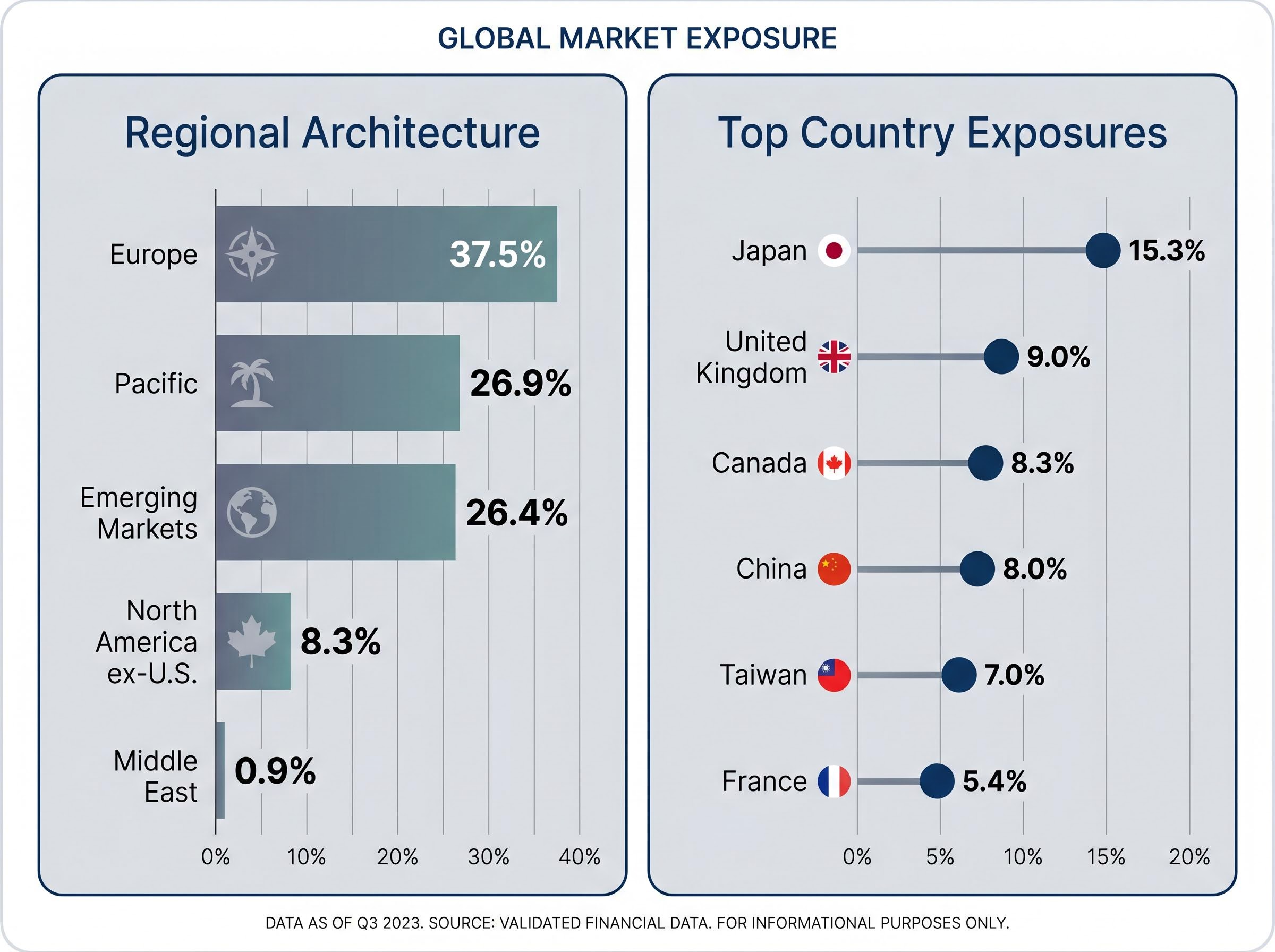
Beneath the headline names, the fund’s regional architecture tells a distinct story. Europe accounts for 37.5% of assets, making it the largest block. The Pacific region follows at 26.9%, emerging markets at 26.4%, North America ex-U.S. (predominantly Canada) at 8.3%, and the Middle East at 0.9%.
| Region / Country | Weight (%) |
|---|---|
| Europe | 37.5 |
| Pacific | 26.9 |
| Emerging Markets | 26.4 |
| North America (ex-U.S.) | 8.3 |
| Middle East | 0.9 |
| Japan | 15.3 |
| United Kingdom | 9.0 |
| Canada | 8.3 |
| China | 8.0 |
| Taiwan | 7.0 |
| France | 5.4 |
At the country level, Japan is the single largest weight at 15.3%, creating meaningful yen exposure. China and Taiwan together represent approximately 15% of the fund, a concentration that carries direct sensitivity to U.S.-China trade relations and Taiwan Strait developments.
At an expense ratio of 0.05%, the cost of owning VXUS is difficult to feel.
An investor with $10,000 in VXUS pays $5 per year in management costs.
That figure makes it one of the cheapest international equity funds available. But the cheapest option in the peer group is not always the broadest, and the differences in coverage matter more than the differences in cost at these levels.
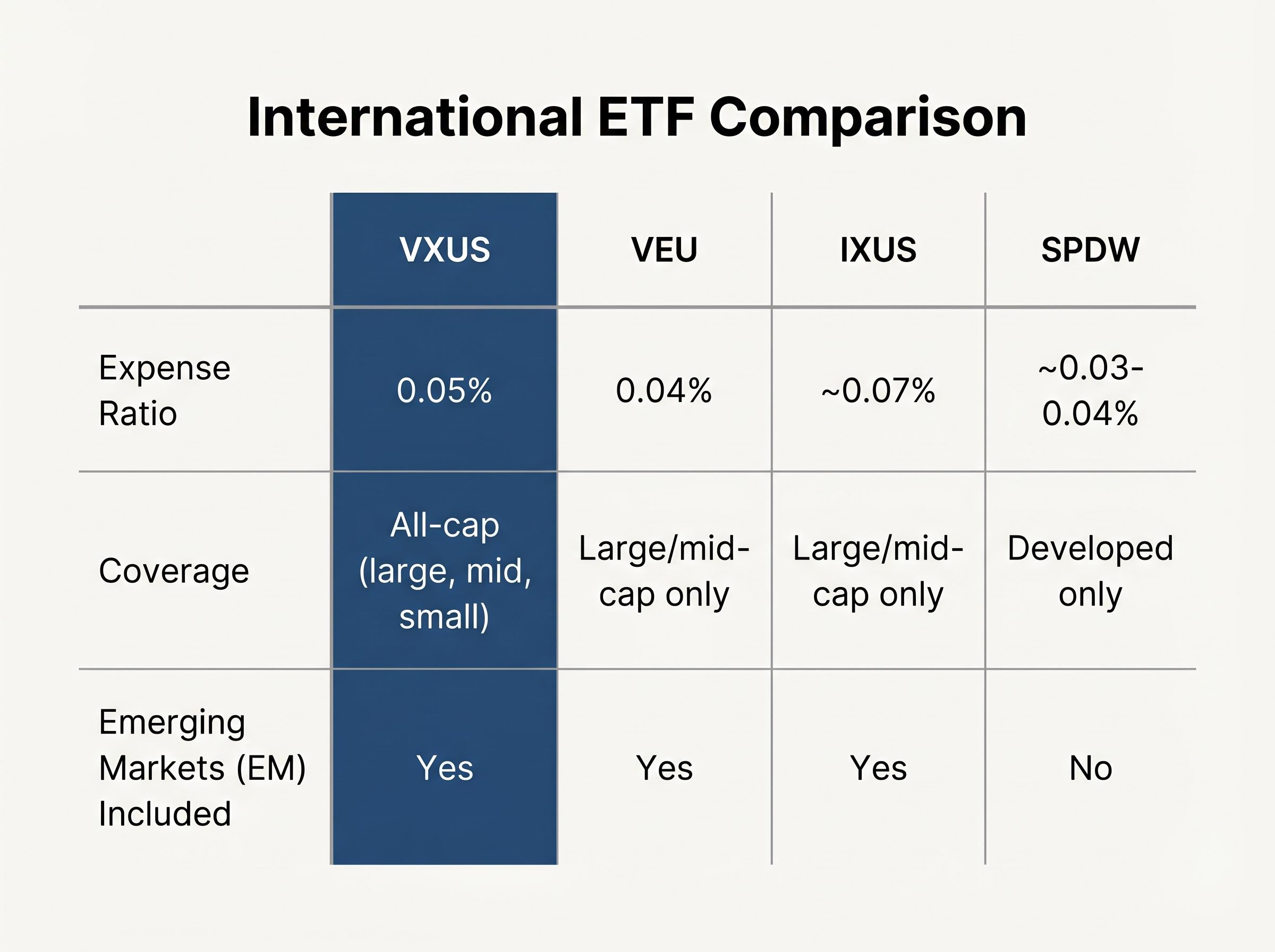
VEU, Vanguard’s other ex-U.S. offering, charges 0.04% but excludes small-cap stocks entirely, covering only large and mid-cap names. SPDW from State Street comes in at approximately 0.03-0.04% but removes emerging markets from the equation, a materially different risk and return profile. IXUS from iShares tracks an MSCI benchmark at roughly 0.07% and covers large and mid-cap developed and emerging market equities, but also omits small-caps.
| Fund | Expense Ratio | Coverage | EM Included | Benchmark |
|---|---|---|---|---|
| VXUS | 0.05% | All-cap (large, mid, small) | Yes | FTSE Global All Cap ex US |
| VEU | 0.04% | Large/mid-cap only | Yes | FTSE All-World ex US |
| IXUS | ~0.07% | Large/mid-cap only | Yes | MSCI ACWI ex USA |
| SPDW | ~0.03-0.04% | Developed only | No | S&P Developed ex-US BMI |
VXUS is the only fund in this peer group that combines all-cap coverage, including international small-caps, with both developed and emerging market exposure in a single vehicle. As of 27 April 2026, shares traded at $82.36, within a 52-week range of $63.23 to $84.48.
The same breadth that makes VXUS appealing also creates specific pressure points that investors should map before sizing a position.
Currency risk is the most pervasive. VXUS holds assets denominated in dozens of currencies, and every movement in those currencies against the U.S. dollar directly affects returns. The fund’s 15.3% Japan weighting alone means meaningful yen exposure, while 9.0% in the United Kingdom adds sterling sensitivity. In 2025-2026, a weakening dollar provided a mechanical boost to USD-denominated returns from foreign assets; that tailwind could reverse if dollar strength returns.
Geopolitical and emerging market risk concentrates in a specific area. China at 8.0% and Taiwan at 7.0% together account for roughly 15% of the fund, creating direct sensitivity to U.S.-China trade relations, Taiwan Strait tensions, and broader emerging market macro conditions. The total emerging markets allocation of 26.4% introduces higher volatility relative to developed-only alternatives.
The four primary risk categories to consider:
Analysts at Seeking Alpha rated VXUS a “Strong Buy” on 10 April 2026, citing diversification benefits and emerging market upside in a post-tariff recovery environment.
Risk transparency does not diminish the fund’s appeal. It sharpens the investor’s ability to size the allocation appropriately and anticipate volatility that is entirely consistent with what VXUS is designed to deliver.
ETF volatility metrics like beta and maximum drawdown reveal how a fund behaves during market stress rather than simply over an average full-cycle period, and for VXUS these numbers carry specific meaning: its 26.4% emerging markets weighting and concentration in Taiwan and China tend to amplify drawdowns relative to developed-only international alternatives.
VXUS works as a complement to domestic equity exposure, not a replacement. Even a modest 5-10% allocation introduces meaningful geographic diversification without dramatically altering a portfolio’s overall risk profile.
The appeal is simplicity. One purchase through any standard brokerage account (the fund is listed on NASDAQ) provides simultaneous exposure to approximately 8,794 companies across 47 markets spanning Europe, Asia-Pacific, and emerging economies. At a share price of $82.36 as of 27 April 2026, the barrier to entry is low for direct investment.
The fund’s return history offers useful calibration for expectations. International equities have spent much of the past decade underperforming U.S. markets, and the since-inception return reflects that imbalance. Recent years, however, suggest the international equity cycle can produce meaningful returns when conditions align.
Annualised total returns (NAV basis, as of 31 March 2026):
The contrast between the 5.99% since-inception figure and the 27.52% one-year return illustrates a point worth internalising: international and U.S. equity cycles do not move in lockstep. The periods where VXUS appears to lag are often followed by periods where geographic diversification earns its place in a portfolio.
Investors exploring how to reduce technology concentration within their domestic equity sleeve, rather than adding international exposure, will find our full explainer on the equal weight S&P 500 thesis, which examines why Societe Generale’s Chief U.S. Equity Strategist projects cap-weighted indexes will be constrained near 7,000 as hyperscaler free cash flow turns negative and how equal weight structures address that specific risk.
This article is for informational purposes only and should not be considered financial advice. Investors should conduct their own research and consult with financial professionals before making investment decisions. Past performance does not guarantee future results.
VXUS offers U.S. investors one of the most efficient mechanisms available for accessing the breadth of world equity markets outside the United States: nearly 8,800 stocks across 47 markets at a cost of $5 per $10,000 invested annually. The fund covers the full capitalisation spectrum, from Taiwan Semiconductor at the large-cap end to small-cap international names that no single active manager could replicate at this price point.
The macro backdrop adds urgency to the consideration. Elevated U.S. valuations, the mechanical advantage of a weaker dollar for foreign-asset returns, and a post-tariff recovery tailwind in emerging markets collectively make 2026 a particularly relevant moment to evaluate international exposure. Investors considering reducing U.S. concentration risk should review VXUS’s fund page on Vanguard’s website for current data and discuss portfolio allocation with a qualified financial adviser before making changes.
VXUS is the Vanguard Total International Stock ETF, a passively managed fund that tracks the FTSE Global All Cap ex US Index and holds approximately 8,794 stocks across 47 markets outside the United States, covering developed economies in Europe and Asia-Pacific as well as emerging markets including China and Brazil.
VXUS charges an expense ratio of 0.05%, which works out to approximately $5 per year for every $10,000 invested, making it one of the cheapest international equity funds available.
VXUS returned 27.52% on a net asset value basis in the year ending 31 March 2026, while its 10-year annualised return stands at 8.75% and its since-inception return from January 2011 is 5.99%, reflecting the historical underperformance of international equities relative to U.S. markets over much of the past decade.
The primary risks include currency exposure across dozens of foreign currencies (with the Japanese yen and British pound being the largest), geopolitical sensitivity from a combined China and Taiwan weighting of approximately 15%, and higher volatility from a 26.4% emerging markets allocation relative to developed-market-only alternatives.
VXUS is the only fund among its main peers that combines all-cap coverage (including international small-caps) with both developed and emerging market exposure in a single vehicle, while VEU excludes small-caps, SPDW excludes emerging markets entirely, and IXUS covers only large and mid-cap stocks.