
Why Orion Stock Fell 4.3% Despite 47% Profit Growth in Q1
3 mins ago


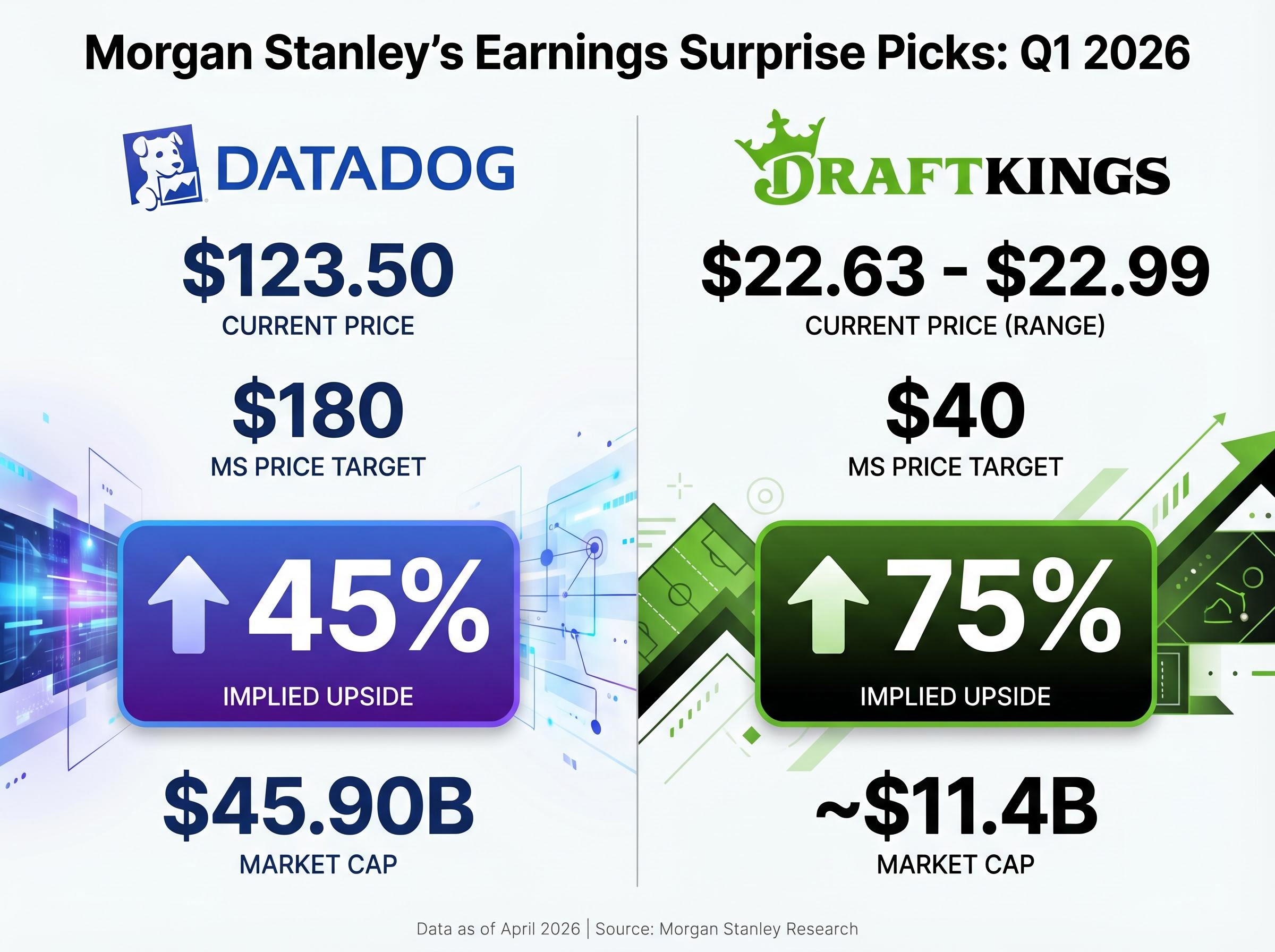
Morgan Stanley’s quantitative equity research team has flagged Datadog and DraftKings as two stocks positioned to beat Q1 2026 earnings expectations, with implied upside of 45% and 75% respectively from current trading levels. The call arrives as early Q1 2026 earnings data shows 88% of S&P 500 reporters beating EPS estimates, well above the five-year average of 78%, validating Morgan Stanley’s early-cycle economic thesis and creating favourable conditions for earnings surprises to translate into stock price appreciation.
This article breaks down Morgan Stanley’s specific reasoning on each stock, the key metrics investors should watch at their upcoming May earnings reports, and the risk factors that could derail the thesis.
The recommendation looks counterintuitive at first glance. Datadog has fallen roughly 15% over six months. DraftKings has collapsed 58% from its February 2025 high of $53.61. Yet Morgan Stanley’s conviction rests on analytical logic connecting macro positioning to stock-specific catalysts rather than momentum chasing.
The firm’s Earnings Surprise Composite methodology screens for overweight-rated stocks likely to beat on key performance indicators beyond simple EPS. The framework blends three components:
Chief U.S. Equity Strategist Mike Wilson has set a $7,800 S&P 500 price target based on 17% earnings growth, an early-cycle thesis positioning the economic environment for re-acceleration rather than deceleration. The forward 12-month P/E ratio of 20.9x as of 17 April exceeds both the five-year average of 19.9x and ten-year average of 18.9x, elevating the importance of earnings beats.
“The index remains vulnerable to another 5%-7% downside in my opinion, while crowded stocks could see double digit declines before a final low appears next month. But our favorable fundamental outlook can take hold again once this tactical pressure lifts.”
Beaten-down names with improving fundamentals fit the framework. Where valuation compression has overshot deterioration in operating metrics, the stock becomes a candidate for re-rating once quarterly results confirm the fundamental trajectory remains intact. Early Q1 2026 results validate the approach. Revenue beat rates reached 84% versus the five-year average of 70%. Blended earnings growth stands at 13.2%, marking the sixth consecutive quarter of double-digit year-over-year expansion.
Understanding Morgan Stanley’s screening framework helps investors evaluate whether these picks align with their own risk tolerance and whether the analytical approach applies to other positions they may hold.
Datadog traded at approximately $123.50 on 20 April 2026, down roughly 15% over six months. The stock carries a market capitalisation of $45.90 billion. Analyst Sanjit Singh maintained Morgan Stanley’s Overweight rating in April 2026 with a $180 price target, flagging the company as a top pick in the firm’s software AI list.
The thesis rests on observability’s growing importance in AI deployment. Operational complexity, not model intelligence, emerges as the primary barrier to reliable AI deployment at scale. When enterprises move from experimentation to production, the systems monitoring those AI applications become mission-critical infrastructure. Datadog’s platform provides real-time monitoring, analytics, and visibility into cloud applications and infrastructure, a function becoming increasingly essential as organisations deploy complex distributed systems.
AI’s contradictory impact on software business models (expanding total addressable markets while simultaneously compressing per-seat pricing power) explains why observability platforms like Datadog may be better positioned than traditional SaaS seat-based models, as infrastructure monitoring scales with workload volume rather than user count.
Datadog’s State of AI Engineering report analyzing LLM telemetry from over a thousand customers identifies observability gaps as the primary barrier to production AI deployment, with teams unable to track agent behavior, debug failures, or maintain reliability at scale.
The SaaS sector context matters. Between early January and late March 2026, the software sector experienced what participants characterised as the “SaaS Apocalypse”, a brutal period during which forward P/E multiples compressed to 22.7x, falling below historical decade-long averages. However, a pivotal shift emerged in early April 2026. Institutional investors aggressively rotated back into beaten-down cloud software names as enterprises moved past initial fears regarding AI-driven seat compression and recognised enduring value of fundamental systems functionality.
The software sector’s brutal drawdown during the SaaS Apocalypse period compressed valuations across the entire cloud software universe, creating conditions where fundamental earnings beats could trigger rapid multiple re-expansion as institutional capital rotated back into names where fear had overshot actual deterioration in operating metrics.
Microsoft emerged as the sector’s anchor through this turbulent period. Despite experiencing a 30% correction from 2025 highs, Microsoft’s reported $625 billion commercial backlog (nearly half tied to AI-integrated contracts) provided fundamental evidence needed to arrest the broader sector decline. By mid-April 2026, Microsoft shares began climbing again, supported by Azure growth stabilising in the high-30% range.
For fiscal year 2026, Datadog has guided for total revenue between $4.06 billion and $4.10 billion, reflecting approximately 19% year-over-year growth. Consensus price targets range from $178.87 to $180.77, implying approximately 39%-45% upside from current levels. Of the analysts covering the stock, 38 maintain buy ratings, 3 hold ratings, and 2 sell ratings.
Guggenheim’s characterisation: “Datadog emerges as a key AI beneficiary, positioned to capture observability demand as enterprises shift from AI experimentation to production deployment.”
Investors evaluating cloud software exposure need to understand whether Datadog’s AI observability positioning justifies paying current multiples or whether competitive pressures from New Relic, Dynatrace, and open-source alternatives undermine the thesis.
The core risk to Datadog’s AI observability thesis rests on whether AI capex translates into software vendor revenue at the pace bulls expect, or whether infrastructure buildout stalls before observability spending reaches material scale, a concern that has driven institutional skepticism across the entire AI software stack in early 2026.
Datadog is scheduled to report Q1 fiscal 2026 earnings before U.S. markets open on Thursday, 7 May 2026. Four key metrics will validate or challenge Morgan Stanley’s thesis:
Wall Street consensus expects Q1 2026 EPS of $0.06, down 25% year-over-year from $0.08 in the comparable prior-year quarter. This sequential decline reflects Datadog’s ongoing investment posture toward capturing market share in the rapidly expanding AI observability segment. The company previously provided full-year 2026 earnings guidance at $2.08 to $2.16, implying material earnings leverage as the year progresses.
Raised full-year guidance would likely trigger re-rating as investors recognise prior valuation compression may have been excessive.
DraftKings delivered its first-ever GAAP profitable year in fiscal 2025. Revenue grew 27% to $6.06 billion. Adjusted EBITDA tripled to $620 million from $181 million in the prior year. Yet the stock trades around $22.63 to $22.99, down 58% from its February 2025 high of $53.61.
Morgan Stanley maintained its Overweight rating on 8 April 2026 with a $40 price target (implying 75% upside), flagging upside potential to Q1 consensus estimates. The firm’s conviction reflects assessment that the dramatic divergence between DraftKings’ improving fundamental profitability and declining stock price has created what contrarian investors characterise as a capitulation opportunity at highly depressed valuations.
The stock’s collapse reflects three specific fears driving valuation compression:
For fiscal 2026, analysts project DraftKings will generate revenue of $6.5 billion to $6.9 billion and adjusted EBITDA of $700 million to $900 million. The company plans to allocate tens of millions in direct costs toward building its own prediction market platform, a strategic investment not anticipated to generate incremental revenues in fiscal 2026 but positioning DraftKings to capture share in the prediction markets segment once regulatory clarity emerges.
Consensus price targets average $35.84, implying 54.7% upside. Of the analysts covering the stock, 92.3% maintain bullish ratings. The current trading level represents a market capitalisation of approximately $11.36 billion to $11.41 billion.
| Metric | FY2024 | FY2025 | FY2026 Guidance (Midpoint) |
|---|---|---|---|
| Adjusted EBITDA | $181M | $620M | $800M |
| Revenue | $4.77B | $6.06B | $6.70B |
The profitability inflection is what research analysts characterise as “the cleanest profitability inflection in online gaming history.” The stock’s dramatic underperformance relative to improving fundamentals creates a potential entry point, but investors must assess whether prediction market competition represents existential threat or manageable disruption.
Kalshi, one of the leading prediction market platforms, generated $871 million in volume during the Super Bowl event window and secured a federal court ruling on 6 April supporting the firm’s regulatory positioning. Investors initially interpreted this as profoundly negative for traditional sports betting platforms.
However, at current DraftKings valuations representing 1.85x forward sales (compressed from prior multiples approaching 3.0x), market participants increasingly assess that the prediction market disruption narrative has been substantially priced into the stock.
Senator Richard Blumenthal introduced the Prediction Markets Security and Integrity Act, comprehensive legislation designed to address concerns regarding prediction market fraud, insider trading, and consumer protection. The bill enacts federally-enforced rules on insider trading and market manipulation, bans prediction market listings related to war and death, requires minimum federal standards for advertising, and reverses the CFTC’s attempt to preempt state gambling regulations.
Senator Blumenthal’s Prediction Markets Security and Integrity Act enacts federally-enforced rules on insider trading and market manipulation, bans prediction market listings related to war and death, requires minimum federal standards for advertising, and reverses the CFTC’s attempt to preempt state gambling regulations.
Passage of this legislation would create a more predictable competitive environment for traditional sports betting platforms like DraftKings relative to emerging prediction market competitors, potentially reducing tail risk narrative driving recent valuation compression.
Morgan Stanley’s own Q1 2026 results, reported on 21 April, validated the firm’s positioned view that financial sector earnings would surprise to the upside. The company posted EPS of $3.43 versus analyst forecast of $3.02. Revenue reached $20.58 billion. Trading revenue hit $10.7 billion, with stock traders generating $5.15 billion (up 25% year-over-year). Investment banking advisory revenues surged 74%.
RTX similarly validated Morgan Stanley’s framework. The aerospace and defense conglomerate delivered adjusted EPS of $1.78 (21% growth year-over-year) and revenue of $22.1 billion (up 9% year-over-year, 10% organically). The company raised 2026 adjusted sales guidance to $92.5 billion to $93.5 billion from prior $92.0 billion to $93.0 billion and raised adjusted EPS guidance to $6.70 to $6.90 from prior $6.60 to $6.80.
Three results from the 18-22 April reporting week demonstrate the framework’s real-time validation:
Capital One’s credit provisions and charge-offs signal consumer credit stress intensifying faster than anticipated, serving as potential early warning regarding consumer spending patterns. United Airlines delivered revenue beat but slashed full-year EPS guidance from $12-$14 to just $7-$11 (roughly 35% reduction at midpoint), undermining travel recovery narrative.
Seeing the framework validated in real time helps investors gauge whether Morgan Stanley’s calls on Datadog and DraftKings warrant conviction or scepticism heading into their May reports.
Datadog reports earnings on 7 May 2026 before market open. DraftKings is expected to announce Q1 fiscal 2026 earnings on or around 7 May or 14 May 2026. The specific dates and KPIs that will matter most require clear decision criteria before results arrive.
The Netflix Q1 2026 case demonstrates that earnings beats alone do not guarantee stock appreciation when forward guidance disappoints, a reminder that both Datadog and DraftKings face execution risk even if May results technically exceed consensus.
For Datadog, watch whether revenue growth remains in high-20s percent range, whether management articulates clear AI observability differentiation, whether customer retention metrics confirm durability, and whether raised guidance signals conviction in the AI infrastructure buildout thesis.
For DraftKings, watch handle volume growth from March Madness NCAA basketball tournament performance, hold rates confirming customer engagement trends, customer acquisition costs remaining disciplined, and stabilised or raised full-year fiscal 2026 guidance.
| Stock | Current Price | MS Target | Upside | Earnings Date | Key KPI to Watch |
|---|---|---|---|---|---|
| Datadog | $123.50 | $180 | 45% | 7 May 2026 | Revenue growth, AI observability commentary |
| DraftKings | $22.63-$22.99 | $40 | 75% | 7 or 14 May 2026 | Handle volume, guidance stability |
Position sizing considerations matter given binary outcomes. Both stocks carry material upside if May earnings confirm the thesis. Both face substantial downside risk if results disappoint or competitive pressures intensify faster than current valuations reflect.
Investors need clear next steps: what to watch, when to watch it, and how results will inform the decision to buy, hold, or avoid these positions.
Morgan Stanley’s earnings surprise framework has identified Datadog and DraftKings as two stocks where fundamental improvement has diverged from stock price, creating potential for re-rating if May earnings confirm the thesis. Datadog offers exposure to AI infrastructure buildout as observability demand accelerates. DraftKings offers contrarian deep value following its first-ever GAAP profitable year despite trading 58% below February 2025 highs.
The 7 May earnings reports will provide the first concrete test of whether AI observability demand (Datadog) and profitability durability (DraftKings) match Morgan Stanley’s expectations. Investors should establish clear decision criteria before earnings: what revenue growth rate, what guidance commentary, what profitability metrics would confirm conviction versus trigger reassessment. The upcoming weeks will prove decisive in determining whether Q1 2026’s strong start represents a foundation for sustained earnings growth or an unsustainable peak.
—
This article is for informational purposes only and should not be considered financial advice. Investors should conduct their own research and consult with financial professionals before making investment decisions.
Morgan Stanley's Earnings Surprise Composite is a screening framework that identifies stocks likely to beat earnings expectations by blending three components: Earnings Forecast Landscape, Earnings Quality measures, and Forecast dynamics, applied to stocks already rated Overweight by the firm.
Morgan Stanley analyst Sanjit Singh maintains an Overweight rating on Datadog with a $180 price target, citing accelerating AI observability demand as enterprises shift from AI experimentation to production deployment, a transition that makes Datadog's monitoring platform mission-critical infrastructure.
DraftKings dropped approximately 58% from its February 2025 high of $53.61 due to three specific fears: disruption from emerging prediction market platforms like Kalshi and Polymarket, state-level tax increases in key markets, and disappointing fiscal 2026 guidance that triggered a 12%-15% single-day decline in February 2026.
Datadog is scheduled to report Q1 2026 earnings before market open on Thursday, 7 May 2026, while DraftKings is expected to announce results on or around 7 May or 14 May 2026.
Investors should monitor whether revenue growth remains in the high-20s percent range, management commentary on AI observability differentiation from competitors, net dollar retention rates, and any changes to full-year 2026 revenue and profitability guidance.



