United Slashes 2026 Profit Outlook 40% as Iran War Hits Fuel
4 hrs ago


Oil prices surged nearly 6% on Monday as Iran closed the Strait of Hormuz for the second time in a week, responding to U.S. forces seizing an Iranian vessel over the weekend. The escalation comes as a fragile ceasefire between Washington and Tehran reaches its expiration date on 22 April 2026, with conflicting signals about whether diplomatic talks will continue. This article examines the weekend’s events, their immediate market impact, and what the ceasefire expiration means for global oil supply and prices.
Brent crude surged past $95 per barrel on Monday, gaining more than 5% in a single session as Iran’s decision to close the Strait of Hormuz reignited immediate supply disruption fears across global energy markets.
Brent crude surged above $95 per barrel, gaining more than 5% in a single session
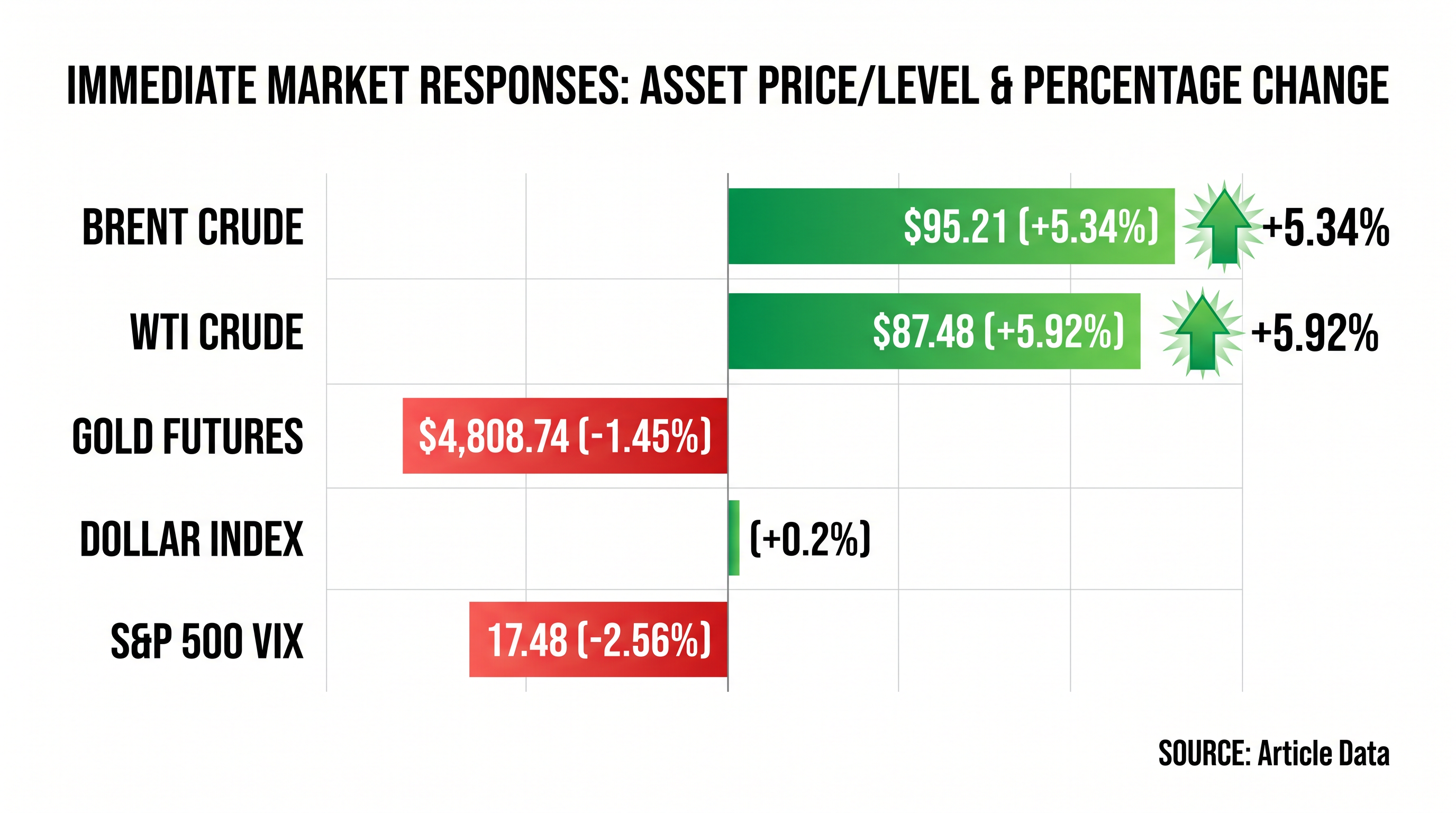
West Texas Intermediate (WTI) crude climbed to $87.48, up approximately 5.92%, while Brent settled at $95.21, marking a 5.34% gain. The sharp reversal followed last week’s brief price decline when Iran initially announced plans to reopen the strategic waterway. The weekend’s vessel seizure by U.S. forces erased that optimism within hours, with traders repricing geopolitical risk as the ceasefire’s expiration loomed. Energy markets had briefly stabilised in mid-April when Iran signalled the strait would remain open, pushing Brent back toward the low-$90 range. That relief proved temporary.
The International Energy Agency has characterised the ongoing Iran conflict as the greatest global energy security challenge in history, a crisis that began on 28 February 2026 and has now extended into its eighth week with no clear resolution path.
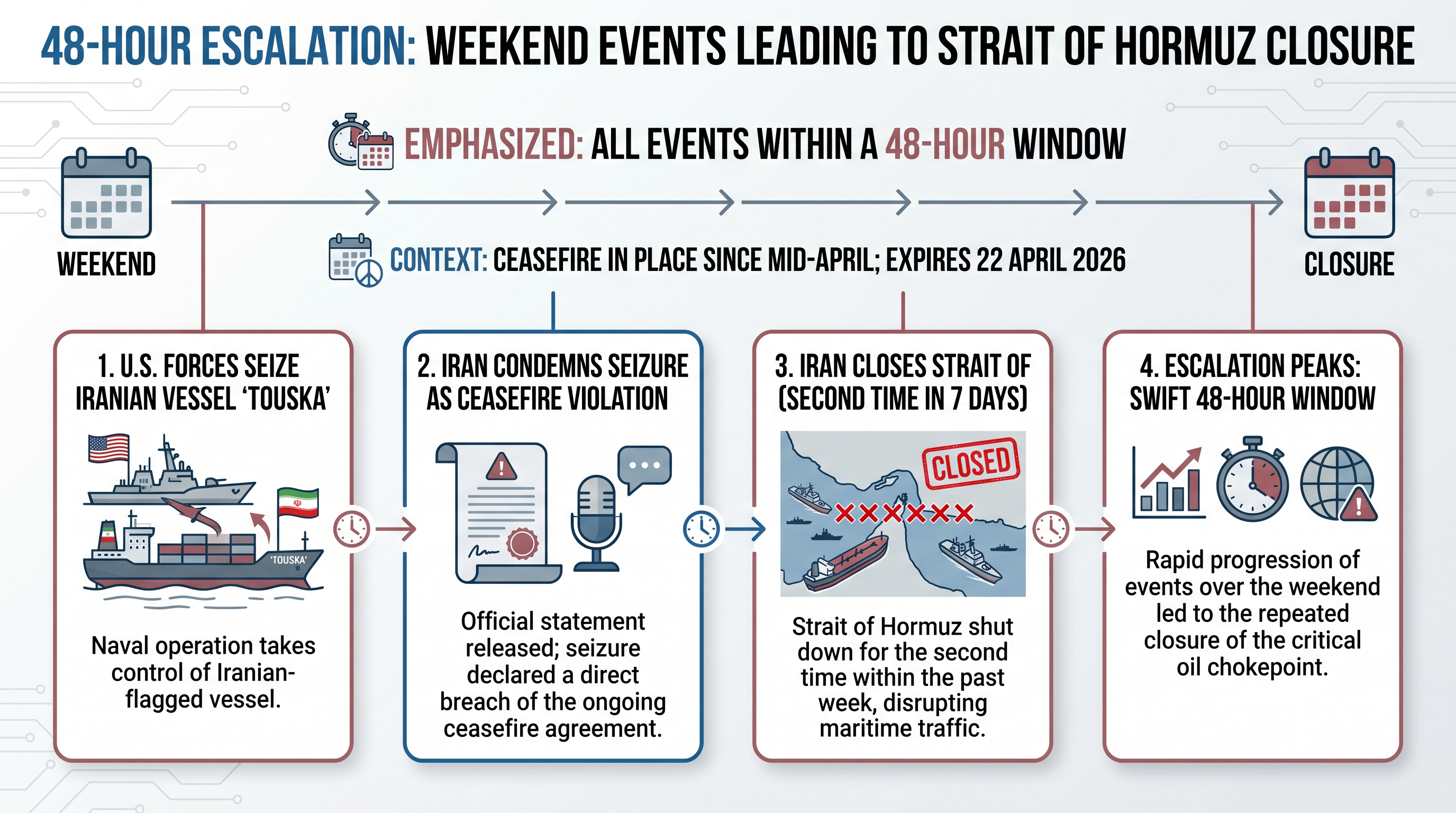
The rapid deterioration began when U.S. forces seized the Iranian-flagged vessel Touska as part of an ongoing blockade of Iranian ports. Iran immediately condemned the action as a direct violation of the existing ceasefire agreement, which had been holding since mid-April.
Tehran’s response came swiftly. Iranian authorities closed the Strait of Hormuz for the second time in seven days, halting tanker traffic through the world’s most critical oil chokepoint. The Islamic Republic’s official statement characterised the U.S. seizure as an act of aggression that warranted immediate defensive measures. The blockade implementation had already raised tensions before the Touska incident, but the vessel seizure served as the specific trigger that pushed Iran to shut down the strait entirely. The sequence unfolded over a 48-hour window, leaving energy markets with little time to assess whether the closure would be temporary or prolonged.
Washington and Tehran are sending contradictory signals about the ceasefire’s future as the 22 April deadline arrives. U.S. President Donald Trump stated that additional negotiations are planned in Pakistan, suggesting diplomatic channels remain open. Iranian state media, however, reported that Tehran has not agreed to participate in any new discussions, casting doubt on whether talks will proceed.
Reuters reporting on Iran-U.S. ceasefire negotiations from 21 April 2026 cites senior Iranian officials confirming that Tehran has not agreed to participate in new discussions, corroborating the contradictory signals between Washington’s stated plans and Iran’s actual position.
The conflicting accounts create genuine uncertainty about the ceasefire’s trajectory:
Neither side has publicly clarified the discrepancy. The contradictory statements from Washington and Tehran leave oil markets without a clear read on whether the ceasefire will hold, collapse, or be extended, directly affecting near-term price trajectories and supply expectations.
The diplomatic uncertainty creates direct consequences for Federal Reserve rate cut timeline recalibrations, as policymakers now face the dual challenge of slowing growth from equity market weakness and accelerating inflation from sustained energy price increases.
Approximately 20% of global oil transit passes through the Strait of Hormuz, making it the world’s most critical energy chokepoint. The narrow waterway connects Persian Gulf producers to Asian and European importers, handling millions of barrels daily that cannot be easily rerouted.
The EIA analysis of Strait of Hormuz oil transit volumes confirms that in 2022, approximately 21 million barrels per day flowed through the waterway, representing 21% of global petroleum liquids consumption, a figure that underscores why even temporary closures trigger immediate supply disruption fears.
When the strait closes, even temporarily, alternative routes through pipelines or longer shipping lanes cannot absorb the full volume. Asian economies, particularly China, Japan, and South Korea, rely heavily on Gulf crude delivered through Hormuz. European refiners also depend on the flow, though to a lesser extent given access to North Sea and Atlantic Basin supplies.
Historically, any credible threat to Hormuz operations has triggered immediate price spikes as traders factor in potential supply gaps. The 1980s Iran-Iraq war saw prolonged disruptions that reshaped global shipping patterns. More recent tensions in 2019 and 2021 produced short-lived closures that moved markets sharply before diplomatic resolutions restored flows. The current closure’s duration remains the key variable. A 48-hour disruption causes logistical headaches but limited structural damage. A multi-week shutdown would force importers to draw on strategic reserves and accelerate searches for alternative supply sources, both of which support higher prices.
The Hormuz crisis rippled beyond energy markets into currencies and safe havens, with the U.S. dollar recovering on demand for defensive assets after two weeks of declines. The dollar index and futures each climbed approximately 0.2% as investors rotated toward traditional safe havens amid renewed geopolitical uncertainty.
Gold futures fell 1.45% to $4,808.74 as the dollar’s strength weighed on the metal’s appeal. Silver futures dropped 2.35% to $79.923, extending the precious metals selloff. The S&P 500 VIX, a measure of expected market volatility, stood at 17.48, down 2.56%, suggesting equity markets absorbed the oil shock without panic.
Asian currency pairs reflected regional exposure to energy supply disruptions:
| Asset | Price/Level | Change |
|---|---|---|
| Brent Crude | $95.21 | +5.34% |
| WTI Crude | $87.48 | +5.92% |
| Gold Futures | $4,808.74 | -1.45% |
| Dollar Index | — | +0.2% |
| S&P 500 VIX | 17.48 | -2.56% |
The Korean won weakened 0.6% against the dollar (USD/KRW), reflecting South Korea’s heavy reliance on Gulf crude imports. The Japanese yen slipped 0.2% (USD/JPY), while the Australian dollar declined 0.2% (AUD/USD). The broader market response shows how geopolitical risk reprices multiple asset classes simultaneously, with safe haven flows affecting everything from currencies to precious metals as investors reassess exposure across portfolios.
For investors wanting to understand the multi-asset implications beyond the immediate oil spike, our full analysis of US-Iran tensions across oil, equities, and bonds examines the S&P 500’s five consecutive weekly declines, bond market responses, and correlation breakdowns as geopolitical risk reprices across portfolios.
With the situation highly fluid as the ceasefire expires, several specific developments will signal whether tensions escalate or de-escalate in the coming days. Market participants face genuine uncertainty about whether diplomatic channels can contain the crisis or whether further military actions will push oil prices higher.
Key variables to monitor include:
The range of outcomes spans from a ceasefire extension that allows strait reopening to further military confrontation that prolongs the closure. Knowing which specific developments to monitor helps investors assess incoming information rather than reacting to noise as the crisis unfolds.
The weekend’s vessel seizure and second Hormuz closure have pushed oil prices sharply higher and reignited uncertainty across global markets, with the ceasefire’s fate now the central question for energy supply. Market participants face a fluid situation where the coming days’ diplomatic and military developments will determine whether this crisis intensifies or resolves. The strait’s operational status and any official word on ceasefire extension or collapse will provide the clearest signals for oil price direction as traders navigate the week ahead.
This article is for informational purposes only and should not be considered financial advice. Investors should conduct their own research and consult with financial professionals before making investment decisions.
The Strait of Hormuz carries approximately 20% of global oil transit, connecting Persian Gulf producers to Asian and European importers. Even temporary closures trigger immediate price spikes because alternative routes and pipelines cannot absorb the full volume of diverted supply.
Brent crude surged to $95.21 per barrel, a gain of 5.34%, while WTI crude climbed to $87.48, up approximately 5.92%, in a single session following Iran's second closure of the strait in seven days.
U.S. forces seized the Iranian-flagged vessel Touska as part of an ongoing blockade of Iranian ports, prompting Iran to immediately condemn the action as a ceasefire violation and close the strait within a 48-hour window.
The ceasefire was set to expire on 22 April 2026, with contradictory signals from both sides: the U.S. indicated additional negotiations were planned in Pakistan, while Iranian state media reported Tehran had not agreed to participate in any new discussions.
Key signals to watch include the official ceasefire status after expiration, whether tanker traffic through the strait resumes, any confirmation of resumed negotiations, and further U.S. or Iranian military actions such as additional vessel seizures or naval deployments.