
SEC Moves to End Mandatory Quarterly Reporting After 50 Years
Apr 24, 2026


Defence Minister Richard Marles framed it as history in the making: A$425 billion over ten years, the “biggest peacetime increase in defence spending in Australia’s history.” Announced on 17 April 2026 with the release of the 2026 National Defence Strategy (NDS) and Integrated Investment Program (IIP), the commitment targets 3% of GDP by 2033-34, up from the current 2.8%. The scale is unprecedented, the timeline compressed, and the strategic stakes sharper than at any point since the Cold War.
This analysis examines whether the spending commitments match the strategic urgency articulated by government, what the money buys across six capability domains, and where analysts across the spectrum land on the question of adequacy. The investment reshapes Australia’s force structure from sea denial to long-range strike, yet expert disagreement persists on whether the pace matches the deteriorating regional security environment.
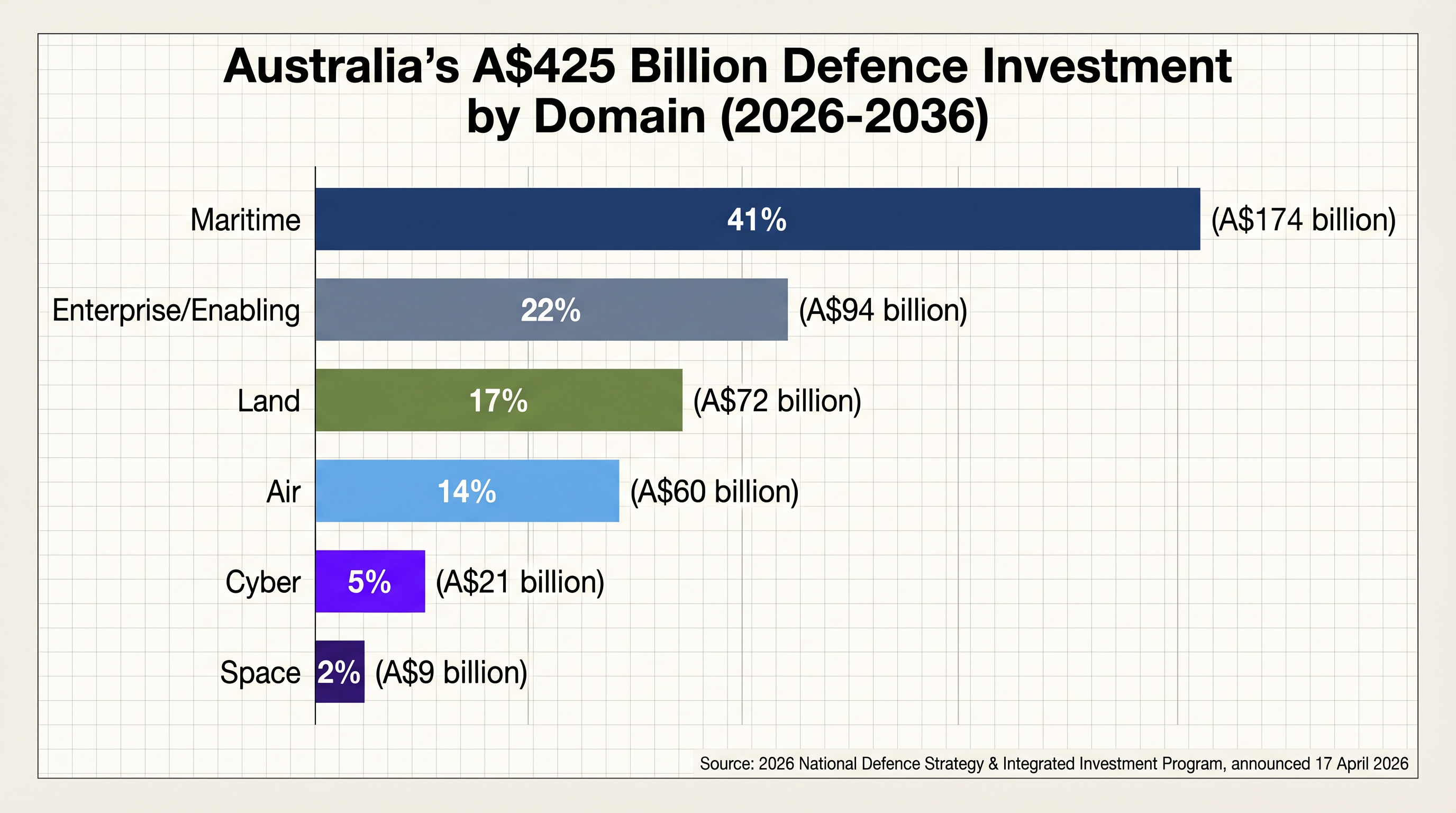
The Integrated Investment Program allocates the decade’s spending across six domains, and the proportions reveal the strategic calculus driving Canberra’s priorities. Maritime commands 41% of the total, a reflection of Australia’s geographic reality and the primacy of sea denial and undersea warfare in the Indo-Pacific. Enterprise and enabling capabilities take 22%, land forces 17%, air 14%, cyber 5%, and space 2%.
The 2026 National Defence Strategy and Integrated Investment Program published by the Department of Defence detail the official spending projections across six capability domains, with maritime commanding 41% of the A$425 billion allocation and enterprise and enabling capabilities receiving 22%.
The maritime allocation includes Australia’s single largest defence commitment: nuclear-powered attack submarines through the AUKUS partnership, costing up to A$96 billion. The surface fleet expands with eleven Mogami-class frigates from Japan, six Hunter-class frigates, and six large optionally crewed surface vessels equipped with up to 32 missile cells. Integrated air and missile defence draws between A$21 billion and A$30 billion over the decade, a direct lesson from Ukraine and Middle East conflicts. Unmanned aircraft, including the MQ-28A Ghost Bat, absorb up to A$8.1 billion.
The 2026 NDS allocates up to $8.1 billion to unmanned aircraft including the MQ-28A Ghost Bat, a prioritisation that reflects the European defence spending shift toward drones and away from traditional platforms observed during the Iran conflict, where low-cost unmanned systems proved more effective than legacy air defence architectures.
What stands out is not just the maritime dominance but the comparatively modest allocations to cyber (5%) and space (2%), domains that figure prominently in contemporary conflicts and modern deterrence frameworks. The distribution signals that Australia’s strategic priority remains conventional sea and air power projection, with emerging domains receiving investment but not parity.
| Domain | Allocation (%) | Indicative Value (A$ billion) | Key Programmes |
|---|---|---|---|
| Maritime | 41% | 174 | AUKUS submarines (up to A$96B), Mogami-class frigates, Hunter-class frigates, optionally crewed surface vessels |
| Enterprise/Enabling | 22% | 94 | Defence industrial base, logistics, infrastructure |
| Land | 17% | 72 | Littoral manoeuvre craft, northern operations capability |
| Air | 14% | 60 | Air mobility (A$34-41B), C-130J-30 Hercules, Super Hornet/Growler upgrades, integrated air and missile defence (A$21-30B), Ghost Bat drones (up to A$8.1B) |
| Cyber | 5% | 21 | Cyber capabilities, digital infrastructure |
| Space | 2% | 9 | Space-based surveillance, communications |
Understanding where the money flows reveals what capabilities Canberra prioritises and where potential gaps may emerge, particularly in domains like cyber and space that figure prominently in contemporary conflicts yet receive single-digit percentage allocations in a decade-long programme.
The aggregate allocation takes concrete form in specific platforms and strike systems that will define what Australian forces can credibly deter and defend against by the mid-2030s. The naval expansion centres on three vessel classes:
Together, these platforms more than double the surface combatant fleet at a cost between A$52 billion and A$65 billion, a fleet expansion that transforms Australia’s ability to contest sea control in the archipelagic approaches and broader Indo-Pacific.
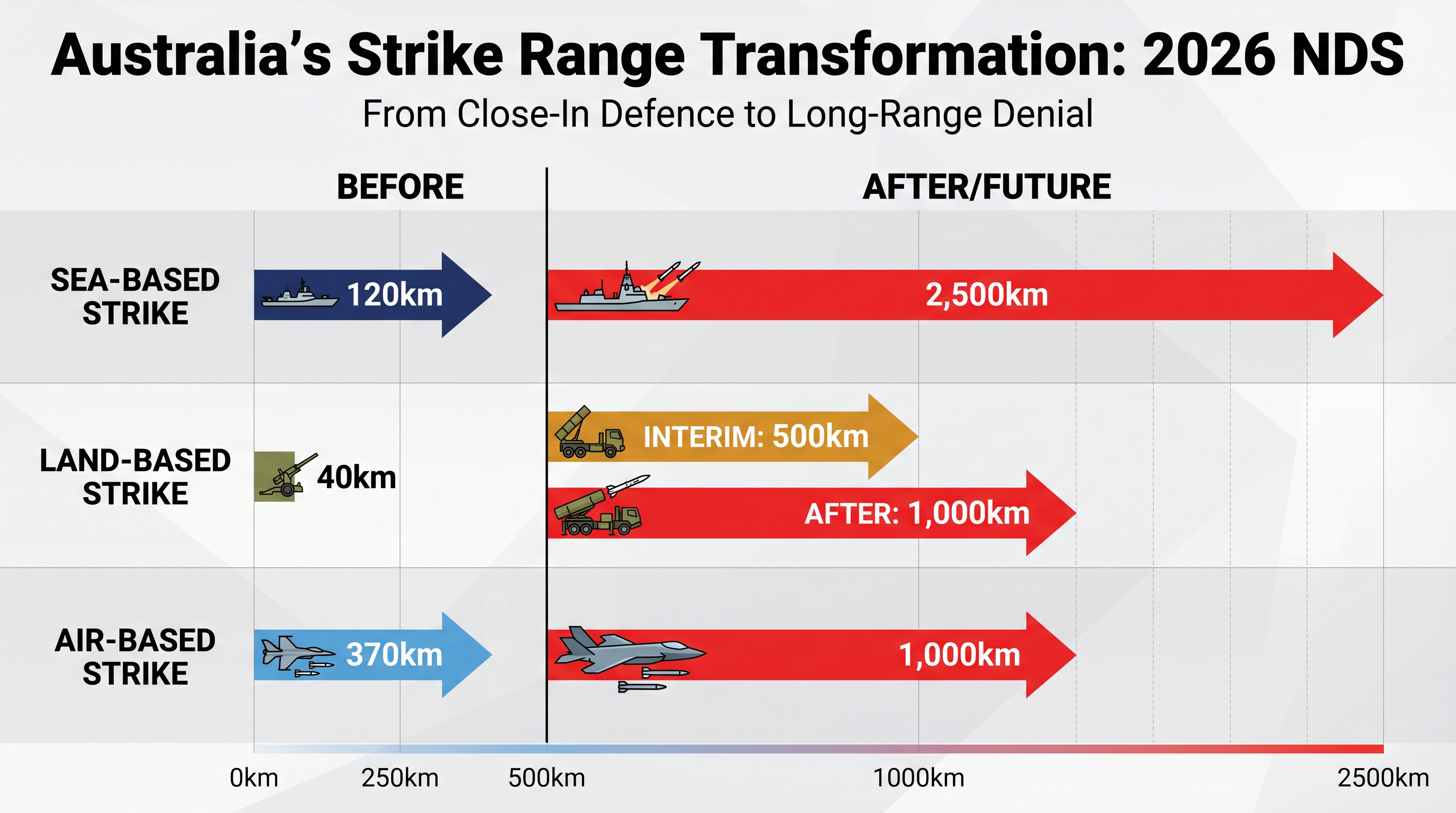
The strike range transformation is equally dramatic. The 2026 NDS specifies range expansions across three domains:
The shift from hundreds of kilometres to thousands reflects a fundamental recalibration toward long-range denial rather than close-in defence, enabling Australia to hold targets at risk across the maritime approaches without committing platforms to contested waters.
Air mobility receives between A$34 billion and A$41 billion, with 20 C-130J-30 Hercules transports replacing the retiring C-27J Spartans. Super Hornet and Growler fleets receive upgrades extending service to 2040. The Army’s littoral manoeuvre capability expands with craft designed for northern operations across archipelagic terrain. Medium-range air defence programmes commence in 2026, with South Korea noted as a potential supplier offering local production partnerships.
The Army’s littoral manoeuvre capability expansion, including craft designed for northern operations across archipelagic terrain, has already translated into major contracts such as Austal’s $4 billion Landing Craft Heavy contract awarded in February 2026 for eight vessels.
Defence Industry Minister Pat Conroy, February 2026 During a visit to the United Kingdom, Minister Conroy observed reactor module manufacturing for the AUKUS submarines, marking a tangible step in translating the multi-decade nuclear submarine commitment into physical infrastructure.
These platforms and strike ranges determine what Australia can credibly deter and defend against. The expansion from hundreds of kilometres to thousands reflects a fundamental shift toward long-range denial rather than close-in defence, a posture designed for the geography of the Indo-Pacific rather than continental defence.
The government’s confidence in the strategy’s direction confronts persistent analyst concern that the timeline lags the threat. Malcolm Davis, senior analyst at the Australian Strategic Policy Institute (ASPI), characterised the investment as moving in a “broadly sound direction” but questioned whether the urgency matches the deteriorating security environment. His assessment pointed to a shrinking preparation window: what was framed as a ten-year horizon may now be compressed to one or two years, particularly regarding Taiwan tensions.
Malcolm Davis, ASPI Senior Analyst “The ten-year preparation window has shrunk to possibly one or two years. The security environment is worsening faster than fiscal planning assumptions, and the Iran conflict is a clear signal that regional flashpoints are accelerating.”
Mick Ryan, senior fellow at the Lowy Institute and former Australian Army major general, framed the 2026 NDS as “continuation” rather than major departure. His analysis noted that spending increases remain “relatively modest” given the security challenges, with domain allocations largely unchanged from the 2024 strategy: maritime still commands 41%, enterprise and enabling 22%, land 17%, air 14%, cyber 5%, space 2%. The strategic evolution, in Ryan’s view, is incremental rather than transformational.
Davis observed that the security environment is worsening faster than fiscal planning assumptions can accommodate, citing the Iran conflict as evidence that regional flashpoints are accelerating beyond the strategy’s timeline projections.
Davis observed that the security environment is worsening faster than fiscal planning assumptions can accommodate, citing the Iran conflict’s designation as the greatest global energy security challenge in history by the International Energy Agency as evidence that regional flashpoints are accelerating beyond the strategy’s timeline projections.
Defence Industry Minister Pat Conroy countered the adequacy critique with comparative data. Australia’s 2.8% of GDP on defence already exceeds most NATO members except the United States and frontline states like Poland, and surpasses all like-minded Indo-Pacific nations. The 2026 commitment adds A$14 billion over four years and A$53 billion over the decade beyond previous projections, contributing to a total additional investment of A$30 billion over four years and A$117 billion over the decade when combined with the 2024 NDS.
The SIPRI Trends in World Military Expenditure 2024 report confirms that 18 of 32 NATO members met the 2.0% of GDP target in 2024, providing the comparative context for Defence Industry Minister Pat Conroy’s assertion that Australia’s 2.8% already exceeds most NATO members.
The defence budget is projected to grow at an average 7.6% annually over the ten-year window, a sustained fiscal commitment that Conroy argued reflects genuine strategic prioritisation rather than incremental adjustment. The question, as the expert division makes clear, is not whether the spending is substantial, but whether it arrives fast enough to match the pace at which regional conditions are deteriorating.
The 2026 NDS does not exist in isolation. It responds to what the document describes as “increasingly contested and uncertain” Indo-Pacific conditions, driven by major power competition and China’s military build-up. The strategy cites China explicitly as a key driver of regional anxiety, though detailed 2026 defence budget data for Beijing, Tokyo, Seoul, or New Delhi remains unavailable in public reporting. Global estimates position China as the top Asian defence spender with ongoing growth, but comparative regional spending trends post-April 2026 are not fully detailed.
Lessons from Ukraine and Middle East conflicts prompted the air and missile defence investments, translating observed vulnerabilities in those theatres into capability priorities for Australia’s own posture. The 2026 strategy broadens the definition of defence beyond military platforms to include:
This expanded aperture reflects a recognition that modern conflict involves disruption across multiple domains simultaneously, not just kinetic exchanges. The fuel security component, in particular, addresses a long-standing Australian vulnerability: heavy reliance on imported refined petroleum products and limited domestic refining capacity.
Australia’s spending decisions do not occur in isolation. Understanding the regional context, including what is known and unknown about competitor spending trajectories, helps assess whether the investment creates meaningful relative capability gains or simply keeps pace with regional arms competition.
The rhetoric of “self-reliance” threading through the 2026 NDS does not signal a pivot away from the United States. Defence Minister Marles stated explicitly that Australia will expand middle-power cooperation regionally, but no effective balance of power exists in the Indo-Pacific without continued American presence. The AUKUS nuclear-powered submarines, the largest single capability segment in the investment programme, reflect deep alliance integration rather than strategic autonomy.
Defence Minister Richard Marles “We will expand middle-power cooperation across the region, but the reality is that no effective regional balance of power exists without continued American presence and commitment.”
Richard Gray, ASPI resident senior fellow, argued that Australia could not readily substitute for US capabilities even if it chose to do so. Washington’s expeditionary power projection, global logistics networks, and intelligence architecture remain indispensable to Australia’s defence posture. The self-reliance framing, in Gray’s assessment, refers to reducing vulnerability to gaps in American coverage rather than replacing the alliance.
Malcolm Davis framed the self-reliance investments as burden-sharing rather than substitution. By expanding its own long-range strike, sea denial, and undersea warfare capabilities, Australia reduces demands on overstretched US forces and helps ensure sustained American engagement in the Indo-Pacific.
Malcolm Davis, ASPI Senior Analyst “Self-reliance investments share the burden with Washington and help ensure sustained US engagement. The goal is complementarity, not replacement.”
The heavy emphasis on undersea capabilities and long-range strikes aligns with AUKUS priorities and US strategic requirements for distributed denial networks across the first island chain. For readers concerned about US reliability or Australia’s strategic autonomy, the spending increase is designed to complement rather than replace the alliance, while potentially reducing vulnerability to shifts in American policy or resource allocation.
The cumulative picture that emerges from A$887 billion in total defence spending over the decade, with fiscal year 2035-36 alone reaching A$112.1 billion, is a trajectory that represents genuine strategic shift rather than incremental adjustment. The 3% GDP target by 2033-34 positions Australia among the highest per capita defence spenders in the developed world, comparable to frontline NATO states.
Yet three unresolved questions persist:
The central tension remains what it was when the strategy released: analysts acknowledge the direction is sound, the spending substantial, and the capability priorities defensible. The question is whether it moves fast enough. Malcolm Davis’s observation that the preparation window may have compressed from ten years to one or two captures the analytical concern. The government’s position, articulated through Marles and Conroy, is that Australia is spending more than peer nations, accelerating faster than prior plans, and balancing fiscal reality with strategic necessity.
What the numbers signal is a commitment to force structure transformation at a scale Australia has not attempted in peacetime. Whether that transformation can be delivered within the timeline that regional threats may impose is the bet the 2026 strategy makes.
The 2026 National Defence Strategy commits Australia to its largest peacetime defence investment, with A$425 billion over a decade targeting maritime dominance, long-range strike, and undersea warfare through AUKUS nuclear submarines, expanded surface fleets, and integrated air and missile defence. The 3% GDP target by 2033-34 positions Australia among the highest spenders globally. Whether the pace matches the strategic moment remains contested among analysts, with government confidence confronting expert concern that the ten-year timeline may have compressed to one or two years.
Readers tracking Australia’s evolving defence posture should monitor capability delivery timelines, defence industrial capacity announcements, and regional spending responses as the strategy moves from blueprint to reality over the coming quarters.
This article is for informational purposes only and should not be considered financial advice. Investors should conduct their own research and consult with financial professionals before making investment decisions.
The 2026 National Defence Strategy is a ten-year defence investment framework announced on 17 April 2026, committing A$425 billion to capability programmes across maritime, land, air, cyber, and space domains, with a target of reaching 3% of GDP by 2033-34.
Australia has committed A$425 billion over ten years under the 2026 Integrated Investment Program, with total cumulative defence spending projected to reach A$887 billion over the decade and fiscal year 2035-36 alone reaching A$112.1 billion.
The largest single commitment is the AUKUS nuclear-powered attack submarines at up to A$96 billion, followed by a surface fleet expansion including eleven Mogami-class frigates and six Hunter-class frigates costing A$52-65 billion, plus integrated air and missile defence at A$21-30 billion.
At 2.8% of GDP, Australia already exceeds most NATO members except the United States and frontline states like Poland, and surpasses all comparable Indo-Pacific nations, according to Defence Industry Minister Pat Conroy.
Analysts are divided: ASPI senior analyst Malcolm Davis warned the ten-year preparation window may have compressed to one or two years due to accelerating regional flashpoints, while the government argues the budget grows at 7.6% annually and already exceeds peer nation spending.