Washington Charges 38 Entities in $10M AI Crypto Fraud Sweep
Apr 24, 2026


SK Hynix shares jumped 3.37% on Monday after the company announced mass production of 192GB SOCAMM2 memory modules for NVIDIA’s next-generation Vera Rubin AI processors. The announcement arrives as the memory chip giant rides an unprecedented AI supercycle, with its share price quadrupling over the past year and its entire 2026 production capacity already sold out to major clients. This article examines what the SOCAMM2 production launch means for SK Hynix’s dominance in AI memory, its deepening NVIDIA partnership, and the competitive dynamics shaping the high-bandwidth memory market through 2026 and beyond.
SK Hynix commenced mass production of 192GB SOCAMM2 memory modules in April 2026, targeting NVIDIA’s Vera Rubin platform. System-on-Chip Attached Memory Module 2 (SOCAMM2) represents a high-capacity memory architecture designed to address bandwidth bottlenecks in large language model training and inference workloads that existing solutions struggle to serve efficiently.
The technology complements rather than replaces SK Hynix’s existing high-bandwidth memory lineup. Where HBM3E delivers 1.18 TB/s bandwidth per stack for AI accelerators, SOCAMM2 provides massive memory pools, up to 192GB per module, for applications requiring extensive data retention during complex AI computations. This architecture targets workloads where memory capacity, not just speed, constrains performance.
SK Hynix on SOCAMM2’s Purpose “SOCAMM2 addresses memory bandwidth limitations in next-generation AI systems by providing low-latency access to large-scale memory pools required for advanced large language model training and inference.”
The SOCAMM2 launch extends SK Hynix’s product portfolio across the AI memory spectrum:
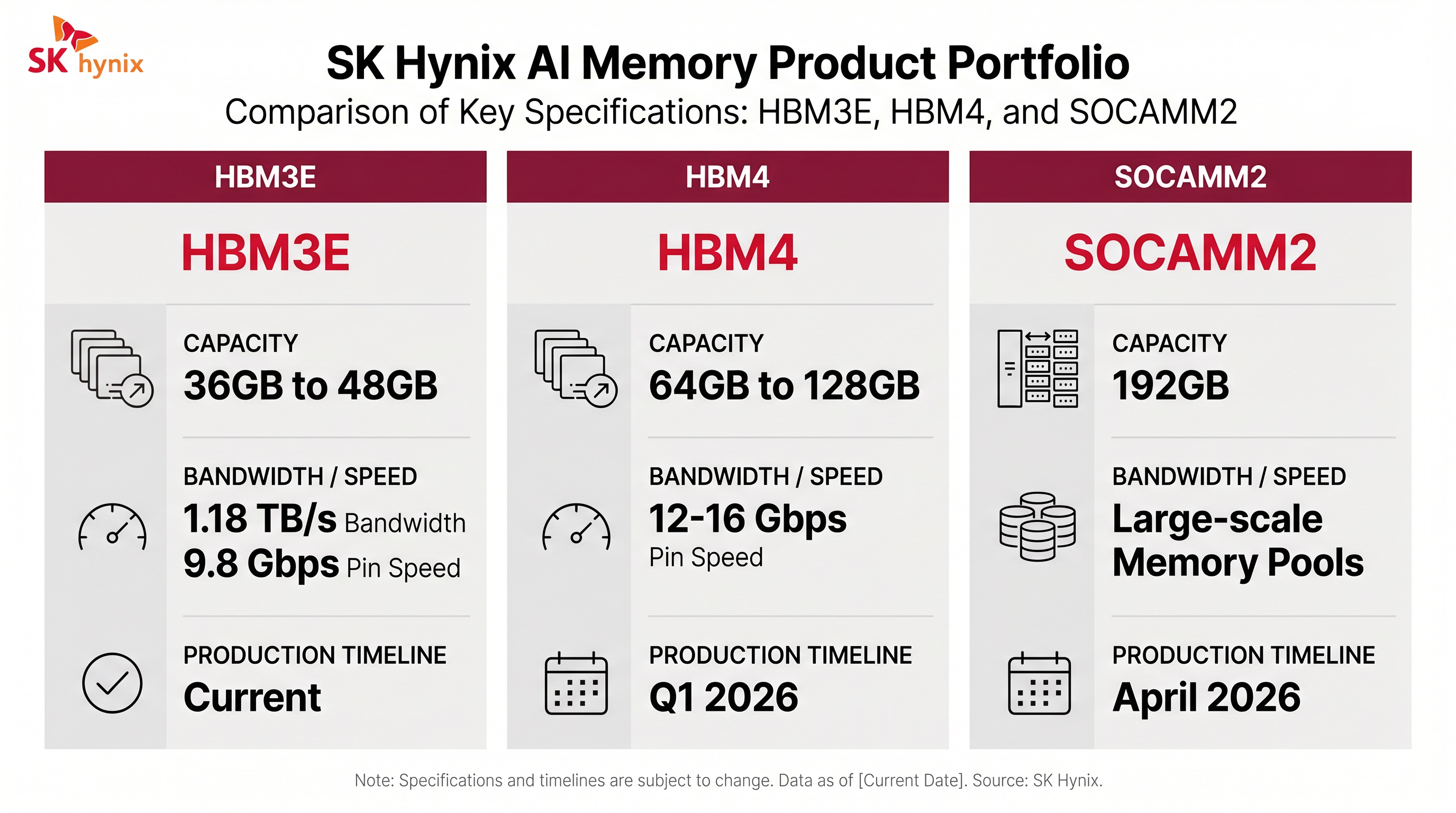
This diversification strengthens SK Hynix’s position as AI memory demands evolve beyond traditional high-bandwidth memory architectures. The company now addresses both speed-critical and capacity-critical workloads across NVIDIA’s AI computing roadmap.
High-bandwidth memory (HBM) functions as the data pipeline between AI processors and the information they process. When NVIDIA’s H100 or B200 accelerators train large language models or run inference queries, HBM supplies the constant stream of parameters, weights, and activations the chip requires. Without sufficient bandwidth, the processor stalls, waiting for data, and expensive computing capacity sits idle.
The technology stacks multiple memory dies vertically, connected through thousands of microscopic channels called through-silicon vias. This architecture delivers bandwidth conventional memory cannot match. SK Hynix’s HBM3E provides 1.18 TB/s per stack, roughly ten times the bandwidth of high-performance DDR5 memory. AI workloads that move terabytes of data per second during training runs depend on this throughput.
Only three companies manufacture HBM at commercial scale: SK Hynix, Samsung, and Micron. The technical barriers are formidable. Stacking 12 or more dies with sub-micron precision, managing heat dissipation across vertical structures, and achieving yields high enough for profitable production require years of process refinement. This manufacturing complexity creates the supply constraints driving current market dynamics.
| Specification | HBM3E (Current) | HBM4 (2026) |
|---|---|---|
| Capacity per Stack | 36GB to 48GB | 64GB to 128GB |
| Pin Speed | 9.8 Gbps | 12-16 Gbps |
| Bandwidth per Stack | 1.18 TB/s | 1.5-2.0 TB/s |
| Signalling Technology | NRZ | PAM-4 |
U.S. Big Tech companies, Alphabet, Microsoft, Amazon, and Meta, are projected to invest between $635 billion and $665 billion in 2026 on AI infrastructure. Data centres housing thousands of AI accelerators require HBM supplies that current production cannot meet. Annual HBM demand is growing at approximately 30% through 2030, whilst supply expansion lags behind.
The structural supply deficit in high-bandwidth memory has reshaped the AI memory chip investment landscape, with institutional capital flowing into memory-focused vehicles at unprecedented rates as investors seek exposure to multi-year capacity constraints.
The Gartner forecast projecting $2.52 trillion in worldwide AI spending for 2026, with AI infrastructure accounting for $401 billion, provides broader context for the scale of investment driving demand for high-bandwidth memory across hyperscale deployments.
Chairman Chey Tae-won, February 2026 “Chip shortages will persist through 2030, with supply potentially remaining 20% below demand. The gap between what AI infrastructure requires and what manufacturers can deliver will define this market for years.”
This structural deficit explains why SK Hynix, Samsung, and Micron all report sold-out capacity through 2026. The bottleneck is not demand uncertainty but manufacturing yield and scale.
SK Hynix has served as NVIDIA’s primary HBM supplier since 2024, a relationship that has deepened through successive product generations. The partnership extends beyond component supply to collaborative development of memory architectures optimised for AI workloads.
The integration timeline traces the evolution of this technical relationship:
Each generation reflects joint specification development. NVIDIA defines the memory characteristics its architectures require, SK Hynix engineers the manufacturing processes to deliver those specifications at scale, and both companies align production timelines to synchronise platform launches.
SK Hynix’s deepening relationship with NVIDIA mirrors broader trends in custom AI chip partnerships, where semiconductor suppliers co-develop architectures with hyperscale clients to optimise for specific workload requirements rather than producing commodity components.
The SOCAMM2 announcement demonstrates this co-development model. NVIDIA’s Vera Rubin platform targets inference workloads where massive parameter sets must remain accessible with minimal latency. SK Hynix developed SOCAMM2’s 192GB capacity specifically to address this requirement, a product roadmap decision driven by NVIDIA’s architectural needs.
SK Hynix’s entire 2026 production of HBM3E and HBM4 has been pre-purchased by major clients. NVIDIA represents a significant portion of this committed capacity, though the company maintains relationships with other AI platform providers and hyperscale cloud operators building AI infrastructure.
The sold-out status extends beyond SK Hynix. Samsung and Micron face identical supply constraints, with global HBM production unable to meet demand across the industry. SK Hynix’s approximately $67 billion capital expenditure plan through 2026 focuses on scaling manufacturing capacity, but new fabrication facilities require 18 to 24 months to reach volume production.
This capacity reality means SK Hynix cannot significantly expand its customer base in the near term. The company’s strategic focus centres on deepening existing partnerships, particularly with NVIDIA, where technical collaboration and supply reliability matter more than incremental volume gains.
SK Hynix controls approximately 50-62% of the high-bandwidth memory market as of late 2025, according to industry analyses from Counterpoint Research and PatSnap. This dominance stems from a manufacturing lead estimated at 12-18 months over Samsung and Micron, driven by superior production yields that translate directly into market share.
April 2026 market analysis indicating SK Hynix holds 70-80% of the HBM market provides recent corroboration for the company’s market dominance, with some industry sources placing its share even higher than the 50-62% range cited by Counterpoint Research and PatSnap.
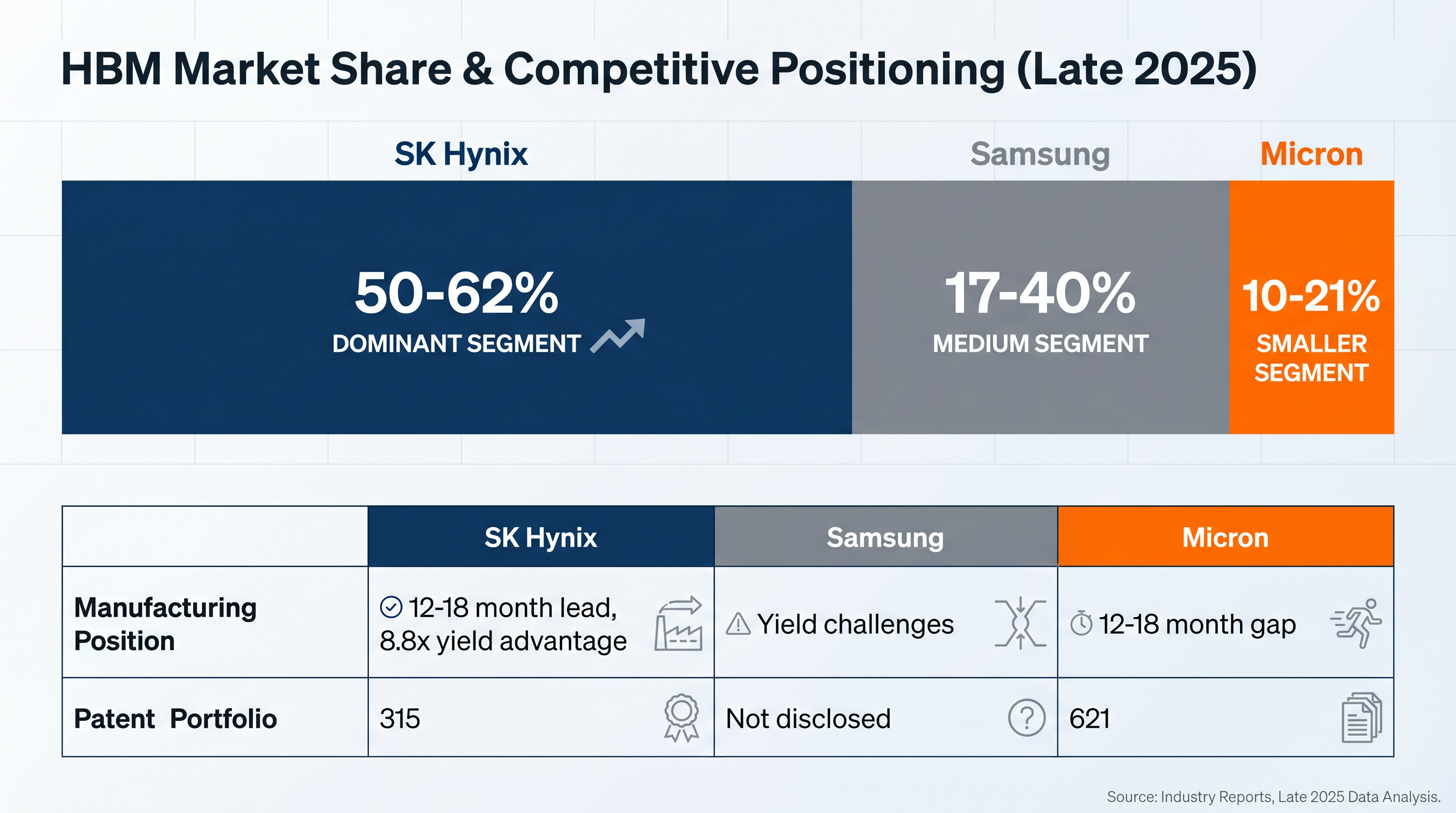
Industry reports indicate SK Hynix’s yield rates are approximately 8.8 times better than Samsung and Micron in some advanced HBM manufacturing metrics. Yield, the percentage of chips that pass quality testing, determines how much usable product emerges from each production run. Higher yields mean lower costs per chip and greater production volume from the same fabrication capacity.
This manufacturing advantage compounds over time. SK Hynix invested in HBM technology earlier than competitors, accumulating process knowledge that cannot be replicated through capital investment alone. Each production generation refines techniques for die stacking, thermal management, and defect reduction, expertise built through millions of units manufactured.
| Manufacturer | Market Share (Late 2025) | Manufacturing Position | Patent Portfolio |
|---|---|---|---|
| SK Hynix | 50-62% | 12-18 month lead, 8.8x yield advantage | 315 HBM patents |
| Samsung | 17-40% | Yield challenges in advanced nodes | Not disclosed |
| Micron | 10-21% | 12-18 month gap, yield constraints | 621 HBM patents |
Samsung holds 17-40% market share but lags in manufacturing yields for advanced HBM nodes. The company pursues aggressive capacity expansion, though sold-out production through 2026 limits near-term share gains. Samsung’s position reflects capital strength and customer relationships rather than yield parity with SK Hynix.
Micron occupies 10-21% of the market, varying by quarter, and pursues a differentiated competitive strategy focused on power efficiency and patent leadership. The company holds 621 HBM patents compared to SK Hynix’s 315, emphasising energy-efficient designs and advanced cooling technologies.
Micron’s competitive positioning centres on three differentiators:
Despite these strengths, Micron trails SK Hynix by 12-18 months in manufacturing maturity. The company invested over $1 billion in HBM capital expenditure in 2023 alone and is actively narrowing the technology gap, but yield improvements require sustained process refinement that takes years to achieve.
The competitive landscape remains stable in the near term because all three manufacturers face sold-out capacity. Market share shifts require not just product availability but manufacturing excellence that closes the yield gap. SK Hynix’s lead persists because competitors must match not only current production efficiency but also the continuous improvements SK Hynix implements with each generation.
SK Hynix delivered revenues of approximately $69 billion (₩97.1 trillion) in 2025, with operating profits reaching approximately $34 billion (₩47.2 trillion). HBM sales more than doubled during this period, driving the company’s record earnings and establishing the foundation for continued growth.
The financial performance reflects SK Hynix’s dominant position in the highest-margin segment of the memory market. The company achieved operating margins of 58% in Q4 2025, substantially outpacing competitors and demonstrating the pricing power created by supply-demand imbalances in AI memory.
2025 financial highlights include:
Analyst projections for 2026 estimate operating profits averaging around $70 billion, with some forecasts exceeding $100 billion (approximately ₩148 trillion based on current exchange rates). These projections from firms including Mirae Asset Securities and Daishin Securities reflect continued AI infrastructure investment and SK Hynix’s locked-in production commitments through 2026.
The company’s capital expenditure plan approaching $67 billion through 2026 supports scaling HBM manufacturing capacity and advancing next-generation technologies including HBM4 and beyond. This investment level signals confidence in sustained demand growth and positions SK Hynix to capture the majority of market expansion in coming years.
Chairman Chey Tae-won on Market Volatility “Despite the strong outlook, potential volatility risks exist in the AI memory market. Rapid technological shifts and evolving customer requirements could impact future performance, and investors should recognise that even exceptional market positions remain subject to industry dynamics.”
Chairman Chey’s warnings about market volatility connect to broader questions about AI infrastructure ROI, where sustained HBM demand depends not just on capital deployment but on whether AI applications generate sufficient economic returns to justify continued infrastructure scaling.
On the same trading day SK Hynix shares rose 3.37%, Samsung Electronics shares declined 0.69%, illustrating the divergent market perceptions of competitive positioning within the memory sector.
Several factors warrant investor attention despite the positive outlook. Customer concentration risk exists, with NVIDIA representing a substantial portion of SK Hynix’s HBM revenue. Any shift in NVIDIA’s product roadmap, competitive position, or AI accelerator demand directly affects SK Hynix’s growth trajectory.
Geopolitical factors, particularly trade restrictions or supply chain disruptions affecting semiconductor manufacturing, could constrain production or market access. The company’s manufacturing facilities are concentrated in specific regions, creating exposure to localised risks.
The concentration of advanced semiconductor manufacturing in specific regions amplifies geopolitical supply chain risks that affect the entire AI infrastructure stack, from foundry capacity through memory production to final system assembly.
Competitive dynamics remain fluid. Samsung and Micron are investing aggressively to close the manufacturing gap, and whilst yield advantages take years to eliminate, sustained competitor investment could gradually erode SK Hynix’s market share lead. Technological transitions, such as new memory architectures or AI computing paradigms that reduce HBM dependency, represent longer-term structural risks.
SK Hynix’s SOCAMM2 production launch reinforces its position at the centre of the AI memory supply chain, extending a partnership with NVIDIA that now spans multiple product generations and technology architectures. The company’s 50-62% market share, 12-18 month manufacturing lead, and sold-out production through 2026 provide substantial competitive insulation, even as Samsung and Micron pursue aggressive expansion.
With analyst projections pointing towards operating profits potentially exceeding $70 billion in 2026 and AI infrastructure investment reaching unprecedented levels, SK Hynix appears well-positioned to capture the majority of AI memory demand growth. However, Chairman Chey’s own warnings about volatility suggest investors should view the company’s exceptional position as subject to the same technological disruption risks that characterise the broader semiconductor industry.
This article is for informational purposes only and should not be considered financial advice. Investors should conduct their own research and consult with financial professionals before making investment decisions.
SOCAMM2 (System-on-Chip Attached Memory Module 2) is a high-capacity memory architecture providing up to 192GB per module, designed to serve AI workloads where memory capacity rather than raw speed is the constraint, whereas HBM3E focuses on delivering extreme bandwidth of up to 1.18 TB/s per stack for AI accelerator chips.
SK Hynix controls approximately 50-62% of the high-bandwidth memory market, holds a 12-18 month manufacturing lead over Samsung and Micron, and benefits from yield rates estimated at 8.8 times better than competitors in some advanced HBM metrics, giving it a durable cost and supply advantage.
Yes, SK Hynix's entire 2026 production of HBM3E and HBM4 has been pre-purchased by major clients including NVIDIA, meaning the company cannot meaningfully expand its customer base in the near term regardless of new demand.
Key risks include customer concentration with NVIDIA representing a substantial share of HBM revenue, geopolitical disruptions affecting semiconductor supply chains, and the possibility that Samsung and Micron gradually close the manufacturing yield gap through sustained capital investment.
Analyst projections from firms including Mirae Asset Securities and Daishin Securities estimate SK Hynix's 2026 operating profits will average around $70 billion, with some forecasts exceeding $100 billion, driven by continued AI infrastructure investment and locked-in production commitments.