Sun Pharma’s $13bn Organon Bid: 490% Premium Meets Rival Offer
7 hrs ago


Washington state regulators charged 38 entities in a coordinated enforcement action targeting fraudulent crypto trading platforms that allegedly stole approximately $10 million from investors through AI-related deception. The Washington Department of Financial Institutions, Division of Securities, brought the charges on 15 April 2026, marking one of the largest state-level crackdowns on AI-themed cryptocurrency fraud to date.
The scale of the enforcement reflects a broader surge in investment scams leveraging artificial intelligence terminology to lure cryptocurrency investors into unregistered securities schemes.
The Washington Department of Financial Institutions, Division of Securities, filed charges against 38 entities on 15 April 2026 for offering fraudulent securities token products without proper registration. The enforcement action alleges these platforms collectively defrauded investors of approximately $10 million. Some operations were based in Washington state, bringing them under the jurisdiction of state securities regulators.
The charges centre on a specific legal violation: offering securities without registration in violation of Washington’s securities laws. State regulators alleged the platforms marketed cryptocurrency investment products as AI-enhanced trading algorithms whilst failing to meet mandatory disclosure and registration requirements.
Key Enforcement Facts – 38 entities charged in coordinated action – $10 million in alleged investor losses – Charges filed by Washington Department of Financial Institutions, Division of Securities – Violation: Offering unregistered securities token products
This coordinated action represents a systematic regulatory response rather than a single-complaint investigation. The Washington Department of Financial Institutions consolidated cases across multiple platforms operating similar fraudulent models, enabling prosecutors to pursue charges against the full network of entities involved in the scheme. State securities divisions typically pursue such coordinated enforcement when evidence suggests a common operational pattern or network of affiliated bad actors.
Victims of AI-themed crypto scams typically encounter platforms promising automated trading returns powered by proprietary artificial intelligence algorithms. The pitch emphasises cutting-edge technology, high-frequency trading capabilities, and returns that purportedly exceed traditional investment vehicles. Marketing materials frequently feature technical jargon, algorithm performance charts, and testimonials from fabricated users.
Fraudsters leverage AI terminology to create false legitimacy for crypto investment platforms that have no genuine algorithmic trading capability. The Washington case involved entities that allegedly marketed securities token products with AI-related claims whilst operating fraudulent schemes designed to extract investor funds rather than generate returns.
The typical progression follows a recognisable pattern:
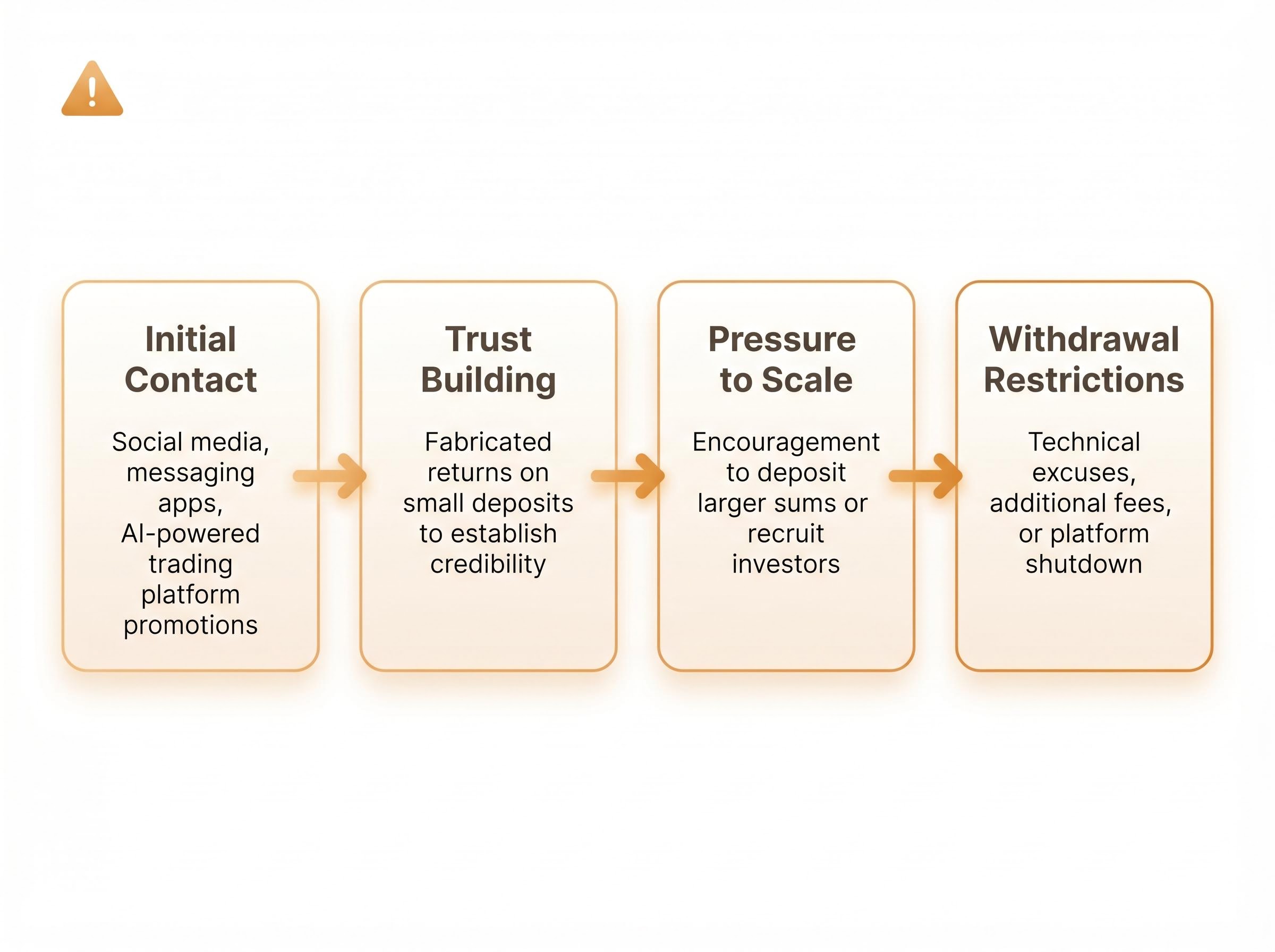
Unregistered Securities Violation The charged entities allegedly offered securities token products without registration, bypassing the disclosure requirements that exist specifically to protect retail investors from fraudulent schemes.
The rise of AI-themed scams targeting retail investors parallels the broader adoption of artificial intelligence in legitimate financial services. Fraudsters exploit public awareness of AI capabilities to mask schemes that have no genuine technological foundation.
For readers wanting to understand the broader context of AI-crypto fraud recruitment tactics, our comprehensive walkthrough of social media investment scam patterns examines how fraudsters use platform hopping, deepfakes, and pig butchering confidence schemes to funnel victims toward unregistered platforms, with over 8,800 state enforcement investigations originating on social media in 2024.
Securities registration exists to protect retail investors by requiring issuers to disclose material information about their business operations, financial condition, and risk factors. When platforms offer investment products without registration, they bypass the transparency framework designed to prevent fraud.
The Washington enforcement action centres on the violation of offering securities without proper registration. State and federal securities laws mandate that any entity offering investment contracts, including cryptocurrency-based products structured as securities, must register those offerings or qualify for a specific exemption. Registration requires detailed disclosure documents, financial audits, and ongoing reporting obligations.
The Washington enforcement action underscores why understanding foundational investing principles for retail investors matters before exploring any alternative asset class, as fraudsters specifically target investors who lack the baseline knowledge to distinguish legitimate securities offerings from unregistered schemes.
What securities registration requires:
Investors can verify registration status through the U.S. Securities and Exchange Commission’s EDGAR database for federally registered securities, or through individual state securities regulator databases for state-registered offerings. The absence of registration records for an investment platform offering securities products constitutes a significant red flag.
| Feature | Registered Offering | Unregistered Offering (fraudulent) |
|---|---|---|
| Disclosure documents | Required and publicly available | Absent or fabricated |
| Financial audits | Independent third-party verification | Unverified or non-existent |
| Regulatory oversight | SEC or state securities division monitoring | No regulatory supervision |
| Investor recourse | Legal protections and complaint mechanisms | Limited to fraud prosecution |
| Verification | Searchable in EDGAR or state databases | No registration records found |
Unregistered offerings inherently carry elevated fraud risk because they operate outside the disclosure and oversight framework. The registration requirement is not bureaucratic process, it is the primary mechanism through which regulators prevent fraudulent schemes from reaching retail investors.
The Washington enforcement action and similar cases reveal consistent warning signs that investors can use to identify fraudulent platforms before committing funds. These red flags appear across AI-themed crypto scams regardless of specific platform branding or marketing approaches.
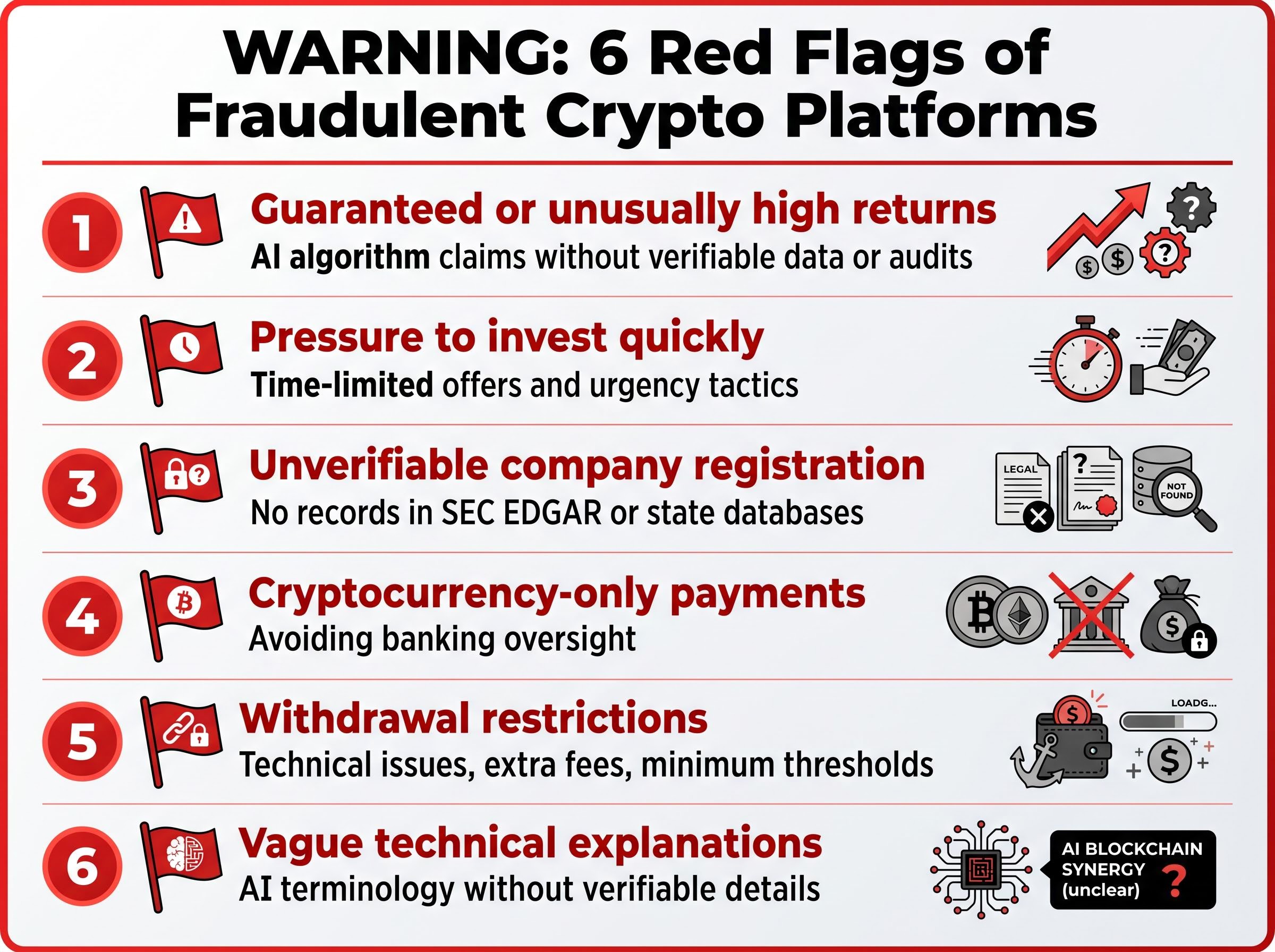
Top warning signs of fraudulent crypto platforms:
Verification Step Before investing, search the SEC’s EDGAR database at sec.gov/edgar and your state securities regulator’s database to verify registration status. Absence of records is grounds to avoid the platform entirely.
Investors who encounter suspected fraud should report it immediately to their state securities regulator and to the SEC’s complaint centre. Early reporting can prevent additional victims and support regulatory enforcement actions.
The verification steps before funding any crypto platform account include checking SEC registration databases, confirming FINRA broker records, and searching for enforcement actions, all of which can be completed in under ten minutes and provide the most effective protection against sophisticated fraud schemes.
Verification requires three specific checks. First, search the SEC EDGAR database for federal registration records using the company name and any alternative names or brands used in marketing materials. Second, check your state securities regulator’s database, accessible through the North American Securities Administrators Association portal at nasaa.org. Third, search for independent reviews and regulatory actions using the platform name plus terms like “complaint”, “fraud”, or “enforcement”.
The absence of registration records for a platform offering securities products means the platform is either operating illegally or the investment does not qualify as a security, both of which warrant extreme caution. Legitimate platforms provide clear registration information and welcome investor verification.
The coordinated 38-entity enforcement action represents a significant escalation in state regulatory response to AI-themed cryptocurrency fraud. The scale of the Washington Department of Financial Institutions’ action, targeting $10 million in investor losses across dozens of entities, signals that state securities divisions are prioritising these schemes despite the jurisdictional complexities of cryptocurrency-based fraud.
State-level enforcement plays a crucial role in investor protection where federal regulation remains incomplete. Whilst the SEC pursues major cryptocurrency exchanges and token issuers, state securities regulators can move more rapidly against localised fraud operations. The Washington action demonstrates that states possess legal authority over unregistered securities offerings regardless of cryptocurrency involvement.
Key takeaways about the regulatory response:
Significance of State-Level Enforcement State securities regulators can pursue unregistered offerings under state law regardless of federal regulatory status, providing a critical investor protection layer in the cryptocurrency sector where comprehensive federal frameworks remain under development.
Investors should expect continued regulatory attention to AI-crypto scams as enforcement agencies respond to the proliferation of these schemes. However, regulatory action occurs after investor harm. The primary protection remains investor due diligence and verification before committing funds.
The Washington enforcement action closed specific fraudulent operations but does not eliminate the broader pattern. Similar platforms continue to emerge using AI terminology and cryptocurrency payment structures to target new victims. Registration verification and red flag awareness remain essential investor protections.
Washington state regulators charged 38 entities on 15 April 2026 for allegedly defrauding investors of approximately $10 million through unregistered AI-themed cryptocurrency trading platforms. The enforcement action, brought by the Washington Department of Financial Institutions, Division of Securities, represents one of the largest state-level crackdowns on this category of fraud.
The case illustrates the persistent pattern of investment scams leveraging artificial intelligence claims to mask fraudulent securities offerings. Investors should expect regulatory attention to AI-crypto fraud to continue, but protection requires active verification steps before any investment commitment.
Verify any crypto investment platform through the SEC EDGAR database at sec.gov/edgar and your state securities regulator before investing. Report suspected fraud immediately to your state securities division and the SEC. Registration verification and red flag awareness remain the most effective defences against AI-themed cryptocurrency scams.
Investors seeking to rebuild portfolios after fraud losses with legitimate equity strategies will find our dedicated guide to fundamental analysis and KPI screening, which walks through Morgan Stanley’s methodology for identifying event-driven setups using company-specific operational metrics rather than generic marketing claims.
This article is for informational purposes only and should not be considered financial advice. Investors should conduct their own research and consult with financial professionals before making investment decisions.
An AI cryptocurrency scam is a fraudulent investment scheme where operators falsely claim to use artificial intelligence algorithms to generate trading returns, using technical jargon and fabricated performance data to attract victims into depositing funds on unregistered platforms that have no genuine trading capability.
You can verify registration status by searching the SEC EDGAR database at sec.gov/edgar for federally registered securities, or through your state securities regulator's database accessible via the North American Securities Administrators Association portal at nasaa.org.
The Washington Department of Financial Institutions, Division of Securities, charged 38 entities on 15 April 2026 for offering fraudulent unregistered securities token products marketed with AI-related claims, with alleged investor losses totalling approximately $10 million.
Key red flags include guaranteed or unusually high returns attributed to AI algorithms, pressure to invest quickly, no verifiable registration records in SEC or state databases, cryptocurrency-only payment requirements, withdrawal restrictions, and vague technical explanations that lack verifiable detail.
Yes, state securities regulators can pursue unregistered securities offerings under state law regardless of federal regulatory status, as demonstrated by Washington state charging 38 entities under its own securities laws without relying on federal action.