
How to Spot Fake Trading Platforms Before You Invest
Apr 21, 2026

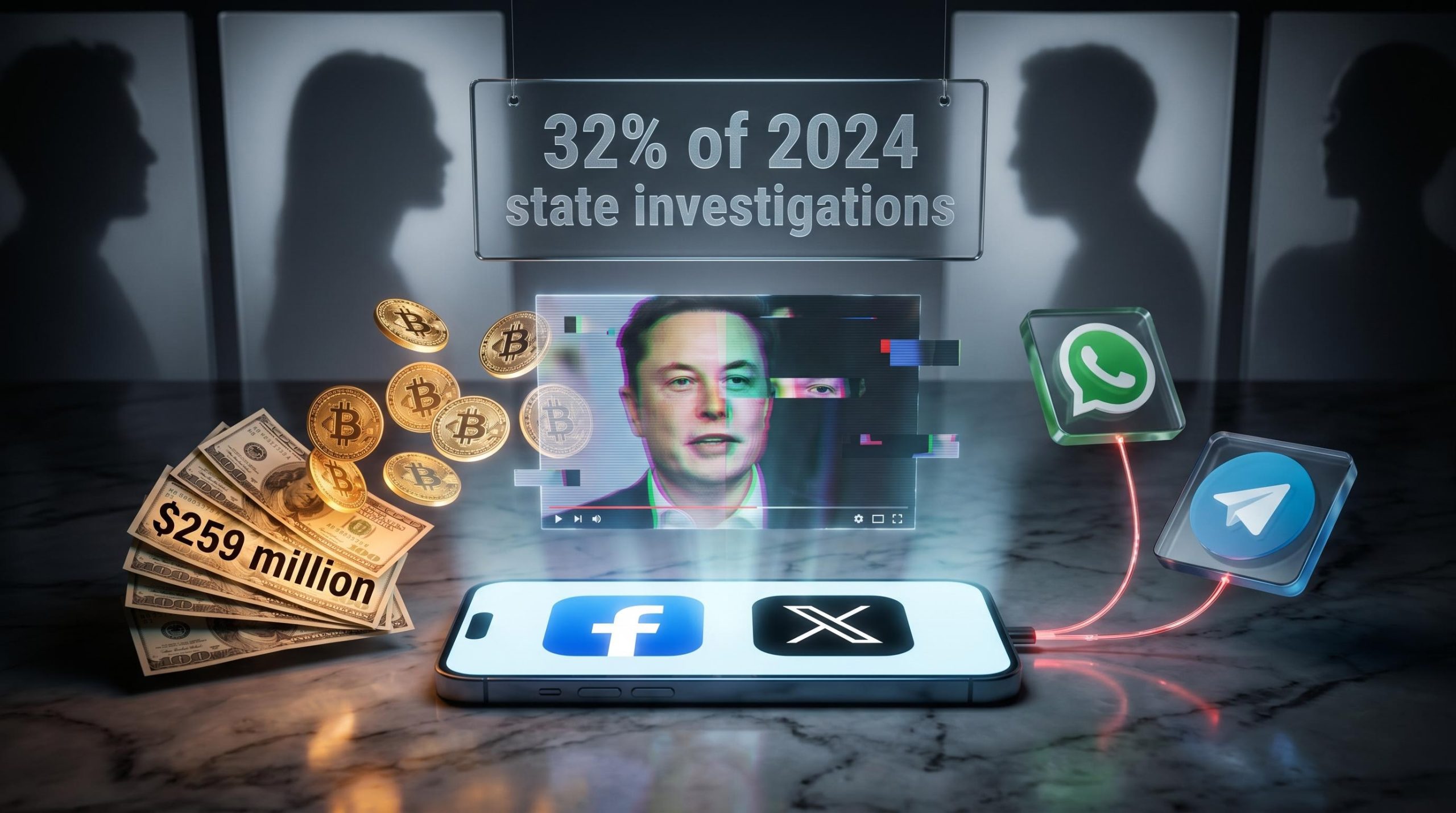
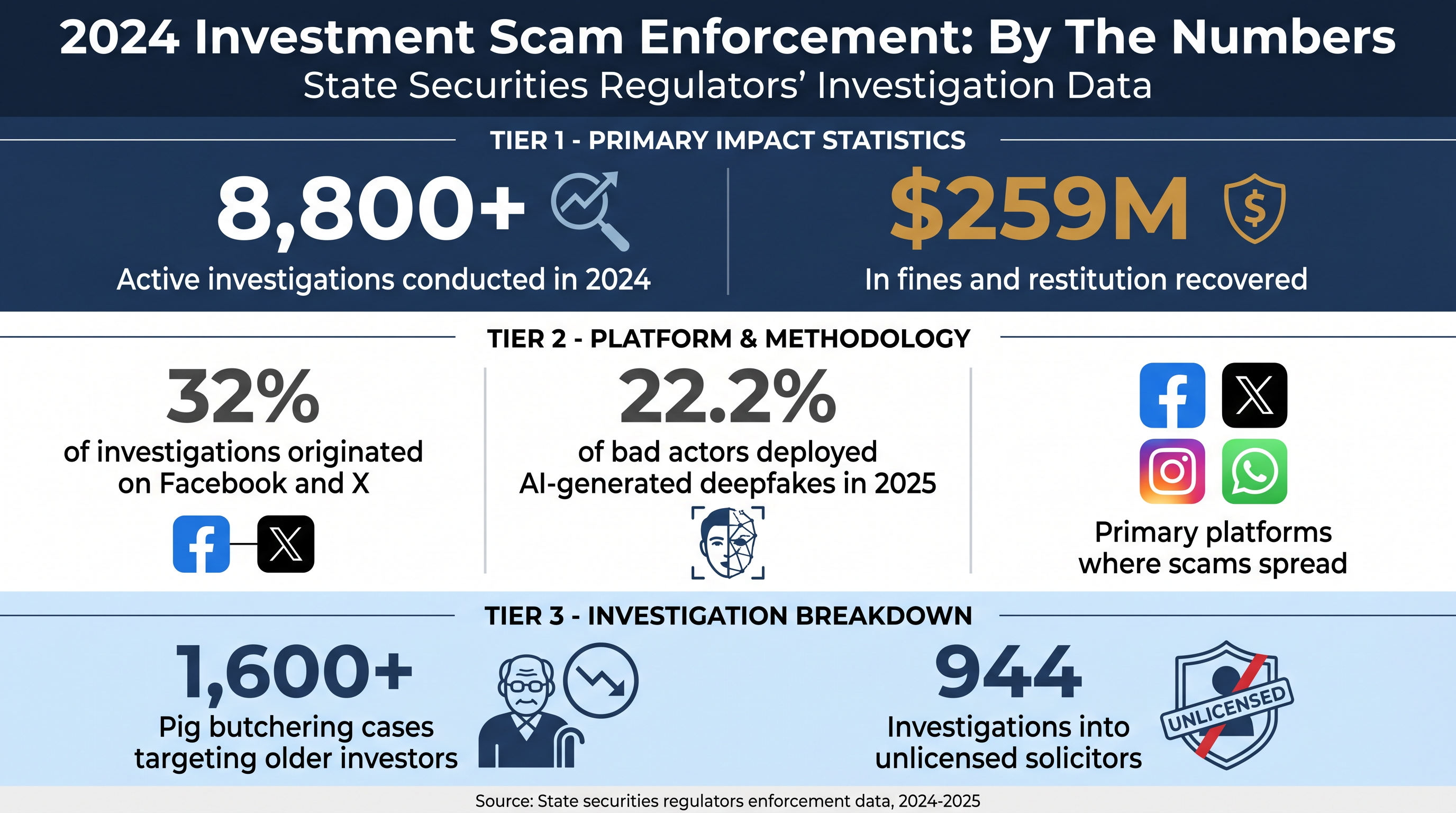
State securities regulators conducted over 8,800 active investigations in 2024, with nearly one-third originating on social media platforms like Facebook and X. Those investigations resulted in more than $259 million in fines and restitution, a figure that signals the escalating financial damage investment scams inflict when fraudsters exploit trusted platforms to target ordinary investors.
Scammers now deploy AI-generated deepfakes, impersonate celebrities and financial professionals, and move victims from public platforms to encrypted messaging apps where oversight cannot reach. This guide equips readers to recognise the specific tactics scammers use, verify investment opportunities before committing funds, and protect financial accounts from compromise.
Fraudsters concentrate their activity on platforms where trust and social proof operate as currency. Facebook, Instagram, WhatsApp, and X see the most investment scam activity, with 32% of 2024 state investigations involving scams that originated on Facebook and X specifically.
Scammers use deceptive advertisements featuring unauthorised images of recognisable figures to bait potential victims. Named figures impersonated in these ads include Cathie Wood (Ark Invest), Joe Kernen (CNBC), and Kevin O’Leary (CNBC). The ads promise guaranteed returns, insider tips, or exclusive access to investment opportunities that do not exist.
The critical transition tactic occurs when scammers move targets from public platforms to encrypted messaging apps like WhatsApp and Telegram. Platform moderation cannot intervene once the conversation shifts to encrypted channels, leaving victims isolated with fraudsters who can escalate pressure without detection.
32% of 2024 state investigations involved scams originating on Facebook and X.
Understanding where and how scammers operate helps readers develop immediate scepticism when encountering investment content on social media, particularly ads featuring celebrity endorsements or promises of exclusive access.
The rising appetite for high-risk speculative assets among American investors creates fertile hunting ground for scammers, who exploit enthusiasm for cryptocurrency and alternative investments by positioning fraudulent opportunities within narratives of outsized returns that align with genuine market trends.
Three scam types dominated 2024 enforcement actions, each with distinct hunting patterns that allow readers to recognise which one they might be encountering based on specific behavioural markers.
| Scam Type | Initial Contact Method | Trust Building Phase | Extraction Method |
|---|---|---|---|
| Pump-and-Dump | Fake investment group ads, celebrity impersonation | Early “profitable” tips build false confidence | Coordinated sell-off leaves victims holding worthless assets |
| Pig Butchering | Direct messages, dating apps, social platforms | Prolonged relationship cultivation over weeks or months | Gradual introduction of investment opportunities that drain savings |
| Cryptocurrency Fraud | Ads for fake trading platforms, AI trading bot promotions | Replicated legitimate trading interfaces to appear professional | Demands for payments via private wallets or Bitcoin ATMs |
Pump-and-dump schemes rely on fake investment groups that artificially inflate prices through coordinated buying, then sell off holdings in unison. Victims receive early tips that generate small profits, which builds false confidence before the major coordinated sell-off that leaves them holding worthless assets.
Pig butchering schemes (confidence scams) operate on extended timelines that distinguish them from faster-moving scams. Over 1,600 pig butchering cases specifically targeted older investors in 2024. Fraudsters cultivate relationships over weeks or months, gradually introducing investment opportunities that eventually drain victims’ savings. Victims often borrow from family members before realising funds are unrecoverable.
Cryptocurrency fraud uses fake trading platforms that replicate legitimate interfaces to appear professional. Scammers promote phantom AI trading bots or demand payments via private wallets and Bitcoin ATMs, payment methods that offer no recourse once funds transfer.
Cryptocurrency fraud uses fake trading platforms that replicate legitimate interfaces to appear professional, often featuring fabricated account dashboards that display artificial gains to maintain victim engagement through the early trust-building phase.
Recognising the specific pattern of a scam type allows readers to exit before significant financial damage occurs. Each scheme has distinct warning signs at different stages.
The SEC guidance on microcap stock fraud and pump-and-dump schemes details how coordinated promoters use false or misleading statements to inflate thinly traded stock prices before selling their holdings, a pattern that maps directly to the social media investment group tactics described above.
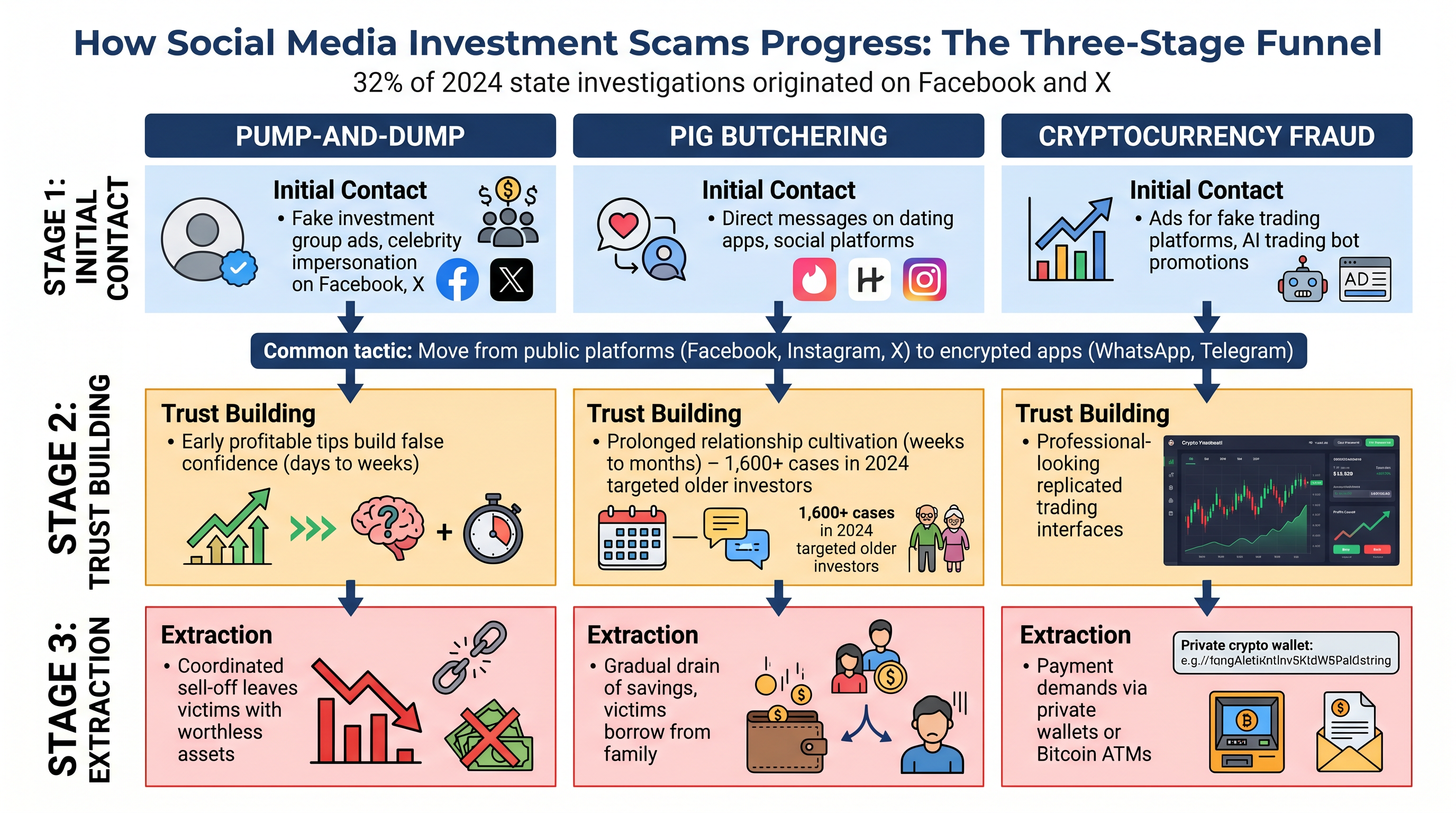
The pump-and-dump progression moves from ad engagement to group chat manipulation to coordinated sell-off. Scammers place deceptive ads featuring celebrity impersonations or guaranteed return claims. Victims who respond join private investment groups where early tips generate small profits. Those early wins build false confidence that encourages victims to invest larger amounts. The scammers then coordinate a mass sell-off, leaving victims holding assets that collapse in value.
Early profitable tips are bait, not evidence of legitimate opportunity.
Pig butchering schemes unfold over extended grooming timelines that can span months. Scammers initiate contact through direct messages on social platforms or dating apps, building romantic or friendship relationships before any investment discussion occurs. Trust cultivation happens gradually through consistent communication and emotional engagement.
Once trust is established, scammers introduce investment opportunities as casual suggestions. Victims make initial small investments that appear to generate returns, which encourages larger commitments. By the time victims attempt to withdraw funds, scammers impose endless withdrawal fees or fabricated requirements that prevent access. Many victims borrow from family members to meet these supposed requirements before realising the entire operation was fraudulent.
AI-powered fraud represents a qualitative escalation in scam sophistication that requires readers to adjust their verification standards upward. 22.2% of bad actors deployed AI-generated deepfakes in 2025, a figure that signals deepfake technology has moved from experimental to operational use across the fraud ecosystem.
22.2% of bad actors deployed AI-generated deepfakes in 2025.
Deepfake technology enables scammers to clone the appearances and voices of celebrities, fabricate video endorsements, and create synthetic “live” streams promoting fake investments. Hawaii’s April 2026 alert specifically flagged ongoing celebrity deepfake impersonations. Scammers also clone voices of trusted contacts, not just celebrities, allowing them to impersonate financial advisers or family members with convincing audio.
Deepfake celebrity endorsements often reference actual market-moving events in April 2026, such as the Strait of Hormuz reopening, to anchor fabricated investment opportunities in genuine news cycles and exploit the credibility legitimate events provide.
Legitimate public figures do not offer investment guidance through social media ads or promote obscure cryptocurrency platforms. Any video or audio content featuring a recognisable figure endorsing an investment opportunity warrants immediate verification.
Concrete detection methods include looking for visual irregularities (unnatural facial movements, mismatched lighting, edge artefacts around the subject), checking for audio-lip sync mismatches where spoken words do not align precisely with mouth movements, and performing reverse video searches to determine whether the footage originated from a legitimate source or has been manipulated.
Three deepfake detection steps:
Visual and audio “proof” can now be fabricated convincingly, which means verification must extend beyond surface-level authenticity checks.
Each red flag represents a specific decision point where the reader should pause or disengage. Multiple red flags appearing together dramatically increases fraud probability. Hawaii’s Office of Consumer Protection issued specific warnings in April 2026 that identify the most reliable indicators of fraudulent offers.
1. Guaranteed returns. No legitimate investment offers guaranteed profits. Markets carry inherent risk, and any claim of guaranteed returns signals fraud. Scammers use this language to bypass investor scepticism by eliminating perceived risk.
2. High-pressure urgency. Urgent deadlines, “limited-time” opportunities, or pressure to act immediately prevent victims from conducting proper verification. Legitimate investment opportunities allow time for due diligence.
3. Celebrity endorsements via ads. Public figures do not endorse specific investment opportunities through social media advertisements. Any ad featuring a celebrity promoting an investment platform or opportunity is unauthorised impersonation.
4. Cryptocurrency payment demands. Requests for payments via private wallets, Bitcoin ATMs, or other cryptocurrency methods indicate fraud. Legitimate financial institutions do not require cryptocurrency transfers for account funding or fee payments.
5. Money mule requests. Being asked to transfer funds, accept payments on behalf of others, or allow account use for third-party transactions signals participation in money laundering operations. These requests often appear after initial investment discussions.
6. Platform hopping. Attempts to move conversations from public platforms (Facebook, Instagram, X) to encrypted messaging apps (WhatsApp, Telegram) indicate scammers seeking to avoid platform moderation and create isolation. Legitimate advisers conduct business through registered channels.
7. Unlicensed solicitor contact. Investment offers from individuals without proper credentials or verifiable registration signal unlicensed activity. State regulators conducted 944 investigations into unlicensed solicitors in 2024, a category that represents one of the most common fraud patterns.
A mental checklist of red flags creates an automatic pause mechanism when encountering potential scams. Readers who can quickly identify warning signs avoid the emotional momentum that scammers exploit.
The FTC’s 2023 romance scam loss reporting documented $1.14 billion in consumer losses from romance-based fraud, with median individual losses of $2,000, figures that establish the financial scale of pig butchering schemes operating across dating apps and social platforms.
Verification transforms the reader from a potential target into an active investigator. A five-minute verification process can prevent losses that would take years to recover from.
Verification protocol (in order of execution):
If existing banks or advisers warn against an opportunity, this should prompt investigation rather than dismissal.
Hawaii’s Office of Consumer Protection guidance notes that spelling and grammatical errors in communications can indicate overseas-originating fraud, though professional scammers increasingly employ native speakers or editing tools to eliminate this tell.
Verification requires scepticism as the default position. Legitimate opportunities withstand scrutiny. Fraudulent ones collapse under basic verification.
Defensive measures and reporting channels complete the reader’s protection framework. Account security reduces the surface area scammers can exploit to gather information or initiate contact.
Account security measures:
Granting remote device access allows scammers to install malware, access stored passwords, monitor keystrokes, and drain financial accounts without further victim interaction. This represents extreme risk regardless of the stated justification for access.
Reporting channels:
Knowing where to report helps not only individual victims but contributes to enforcement efforts that protect future targets. State regulators use complaint data to identify emerging scam patterns and coordinate multi-state investigations.
Three-layer protection framework provides comprehensive defence against social media investment scams. First, recognise scam types and their patterns (pump-and-dump coordination, pig butchering grooming timelines, cryptocurrency payment demands). Second, identify red flags before engagement deepens (guaranteed returns, high-pressure tactics, platform hopping, unlicensed solicitors). Third, verify opportunities through official channels (FINRA BrokerCheck, independent professional consultation, complaint searches).
AI-powered fraud will continue evolving, making scepticism and verification habits more important than any single piece of advice. Deepfake technology, voice cloning, and synthetic media will become more sophisticated, which means surface-level authenticity checks will prove insufficient.
Share this guide with family members, particularly older relatives who are disproportionately targeted in pig butchering schemes and affinity fraud operations. Bookmark verification resources like FINRA BrokerCheck for future reference. Protective habits formed now create defensive reflexes that persist as scam tactics evolve.
This article is for informational purposes only and should not be considered financial advice. Investors should conduct their own research and consult with financial professionals before making investment decisions.
Social media investment scams are fraudulent schemes where criminals use platforms like Facebook, Instagram, and X to promote fake investment opportunities, often using celebrity impersonations or AI-generated deepfakes to appear credible before moving victims to encrypted messaging apps where they drain savings.
A pig butchering scam is a confidence fraud where a scammer builds a relationship with a victim over weeks or months through social platforms or dating apps before gradually introducing investment opportunities that drain the victim's savings; over 1,600 cases specifically targeted older investors in 2024.
Use FINRA BrokerCheck to confirm the individual or firm is registered, search the company name alongside terms like 'scam' or 'complaint' online, verify email domain authenticity carefully, and consult an independent financial professional who has no connection to the offer.
Key red flags include guaranteed return promises, high-pressure urgency tactics, celebrity endorsements in ads, requests for cryptocurrency payments via private wallets or Bitcoin ATMs, and attempts to move the conversation from public platforms to encrypted apps like WhatsApp or Telegram.
Check for unnatural facial movements, mismatched lighting, or edge artefacts around the subject; verify that spoken words align precisely with mouth movements; and perform a reverse video search to determine whether the footage originated from a legitimate source or has been manipulated.


