
How to Spot Social Media Investment Scams Before You Lose Money
Apr 21, 2026


A professional-looking trading dashboard shows your investment growing by 40 per cent in two weeks, your assigned adviser checks in daily with market tips, and you have already withdrawn a small profit to your bank account. Everything appears legitimate until you try to cash out your full balance.
Fake trading platforms have evolved dramatically in 2025-2026, leveraging artificial intelligence, deepfake celebrity endorsements, and sophisticated trust-building tactics that make fraudulent operations nearly indistinguishable from legitimate brokerages. U.S. consumers face an estimated $10 billion annually in losses from relationship investment scams alone, many of which funnel victims towards counterfeit trading websites. This explainer breaks down exactly how these scams operate, the warning signs that reveal them, and the verification steps that can protect your money before you invest.
The platforms victims encounter first are polished, functional, and designed to replicate every detail of legitimate brokerages. Fraudulent sites display real-time price feeds, offer mobile applications with smooth interfaces, and mirror the branding of established financial firms down to colour schemes and layout structures.
Scammers register domains strategically, often with subtle character substitutions that pass initial scrutiny. The tickmilleas.com case from late 2025 exemplifies this approach. Registered in November 2025, the site impersonated a legitimate financial firm and defrauded primarily U.S. victims via cryptocurrency wallets from a Myanmar-Thailand scam compound. The U.S. government pursued forfeiture of the domain, though victim counts were not disclosed.
Regulatory warning lists reveal the naming patterns scammers favour. New Zealand’s Financial Markets Authority (FMA) added multiple platforms to its warning list in 2026, targeting global investors including potentially U.S. users:
Impersonation of legitimate firms has surged. Chainalysis reported that impersonation tactics doubled from 2023 to 2024 and extended into 2026 with AI enhancements, making it increasingly difficult for investors to distinguish counterfeit operations from authentic platforms.
Chainalysis estimates $17 billion was stolen globally in crypto scams and fraud in 2025, driven by impersonation and AI tactics targeting U.S. victims.
The scam does not begin with the platform. It begins weeks or months earlier, with a contact on social media or a dating app. The scammer cultivates a relationship through daily communication, building trust before ever mentioning investing. Once confidence is established, the victim is directed to a fake trading platform.
FTC data on romance scam losses in 2023 documented the escalation of relationship investment fraud, with reported losses climbing to record levels as scammers refined the trust-building sequences that precede platform-based extraction.
The psychological manipulation follows a predictable sequence:
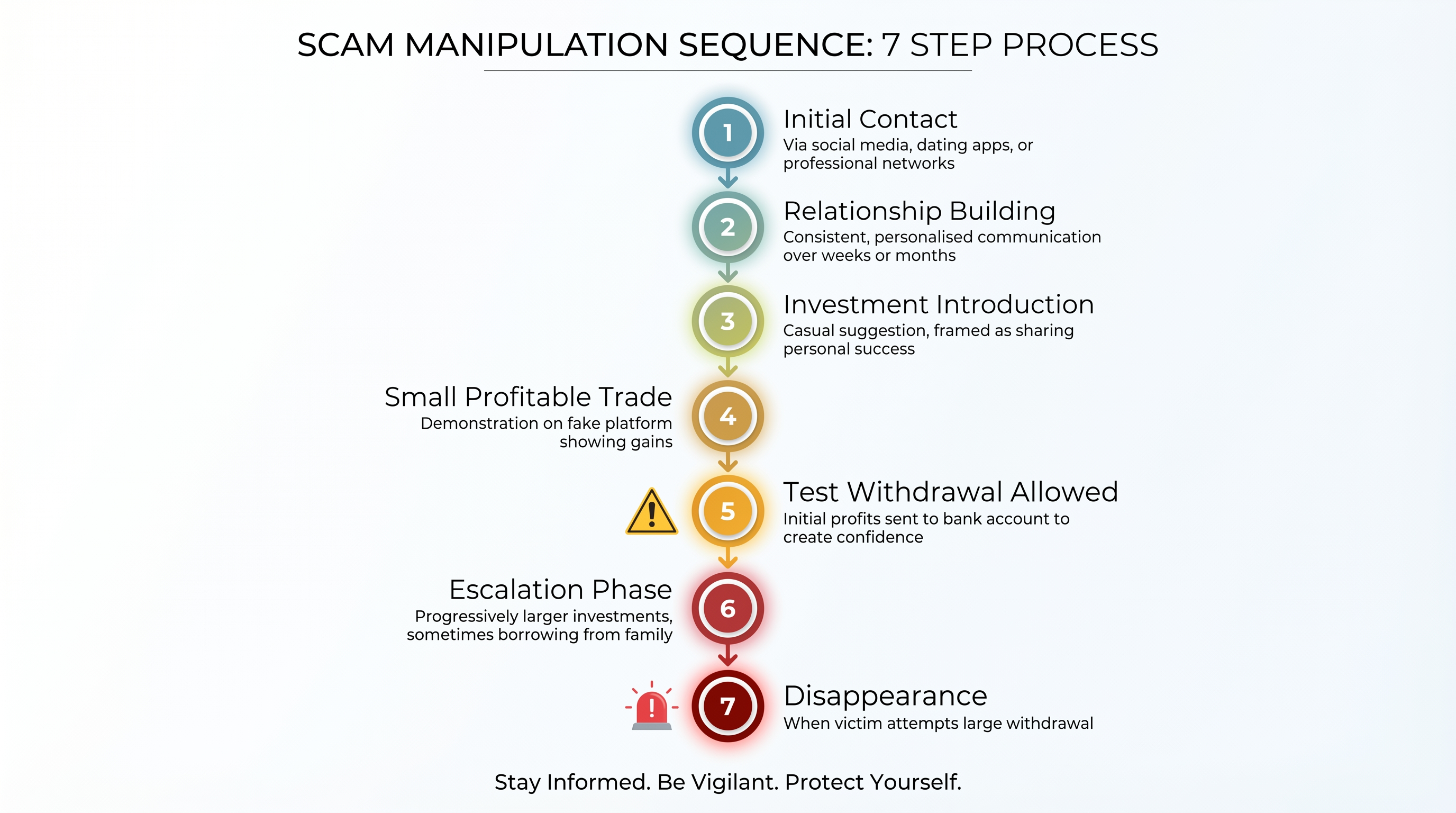
The small withdrawal strategy is the pivot point. Hawaiʻi’s Office of Consumer Protection (OCP) warned in April 2026 that scammers assign dedicated advisers who communicate daily, building credibility through consistent engagement. Victims see their initial deposits grow on polished dashboards. When they request a small withdrawal to test the platform, funds arrive in their bank accounts within days.
This manufactured success convinces victims the platform is legitimate. They deposit larger amounts, confident their money is safe.
The fee extraction phase begins when victims attempt significant withdrawals. They are told taxes, commissions, or verification fees must be paid before funds can be released. Hawaiʻi OCP cautioned that even after paying requested fees, scammers invent successive reasons to withhold funds. The requests continue until victims either run out of money or recognise the fraud, at which point scammers vanish entirely.
By the time victims reach this stage, recovery is typically impossible. The trust-building phase is when intervention can still prevent loss.
The willingness to engage with unverified trading platforms reflects broader speculative investment behavior among U.S. consumers, with nearly 4 in 10 Americans now allocating capital to high-risk assets despite limited understanding of underlying mechanisms.
Technological sophistication is no longer a signal of legitimacy. In 2026, it is a scam feature.
Fraudulent platforms engage in AI washing, falsely claiming AI-powered trading capabilities to appear cutting-edge and trustworthy. These platforms display fabricated trading dashboards that respond to market data in real time, creating the illusion of live trading activity. The growth metrics victims see are entirely manufactured.
Deepfake video endorsements have become a standard tactic. Scammers produce professional fake videos featuring celebrities and financial figures, including unauthorised use of well-known personalities in fraudulent advertisements. Hawaiʻi OCP issued a warning in April 2026 specifically citing deepfake technology proliferating on Meta platforms. South Florida was identified as a target region for social media deepfake endorsement campaigns.
The technologies scammers now deploy include:
AI and deepfake capabilities have eliminated traditional verification shortcuts. A professional video endorsement from a known figure no longer confirms legitimacy. The polish of the technology serves the fraud, not the investor.
Scammers exploit periods of capital reallocation following geopolitical events by positioning fake platforms as vehicles to capture trending investment opportunities, a tactic that intensified after the April 2026 ceasefire when $28 billion in net inflows moved into equity markets.
Fake trading platforms serve as the final extraction mechanism for multiple scam architectures. Understanding which playbook is being run helps investors identify red flags before committing funds.
Pump-and-dump operations begin with victims joining investment groups, often through social media advertisements promising exclusive membership access or guaranteed high-yield guidance. Early tips delivered to the group prove profitable, building confidence. Members see others reporting gains, reinforcing the group’s credibility. When the scammer has cultivated sufficient trust, the group receives a coordinated tip to invest heavily in a specific asset. Victims commit larger sums. The scammer sells at the inflated price, and the asset collapses. The platform may disappear, or simply stop responding to withdrawal requests.
Confidence scams follow a different operational sequence. The relationship precedes the platform. Victims are contacted individually, often on dating apps or professional networks. The scammer builds a personal connection over weeks or months before mentioning investing. Once trust is established, the victim is directed to a fake trading site that appears legitimate. The platform allows small withdrawals to validate its authenticity, then traps larger deposits.
| Fraud Type | Initial Contact | Trust Mechanism | Platform Role | Exit Strategy |
|---|---|---|---|---|
| Pump-and-Dump | Social media ads, investment groups | Early profitable tips, group validation | Executes coordinated trades, shows inflated gains | Asset collapse after scammer sells, platform stops withdrawals |
| Confidence Scam | Dating apps, professional networks | Personal relationship over weeks/months | Allows small withdrawals, traps larger deposits | Fee extraction phase, eventual disappearance |
Both approaches exploit the same psychological vulnerabilities through different operational sequences. Hawaiʻi OCP identified pump-and-dump operations, confidence fraud, and deceptive cryptocurrency schemes as primary fraud categories targeting U.S. consumers in 2025-2026. Fraudulent advertisements frequently redirect to news-style landing pages before capturing contact details, creating an appearance of editorial credibility.
The advisory relationship is the delivery system. Scammers position themselves as experienced traders willing to share insights with someone they care about. They suggest starting with a small amount on a platform they personally use. The victim creates an account, deposits funds, and sees the initial investment grow. The scammer provides daily market updates, reinforcing their role as a trusted adviser.
Professional-appearing sites replicate legitimate platform functionality, including account verification processes, customer support channels, and detailed transaction histories. The replication is comprehensive enough that victims have no reason to question authenticity until they attempt a significant withdrawal.
Verification steps provide the practical defence against sophisticated scams. These checks take minutes and can prevent catastrophic losses.
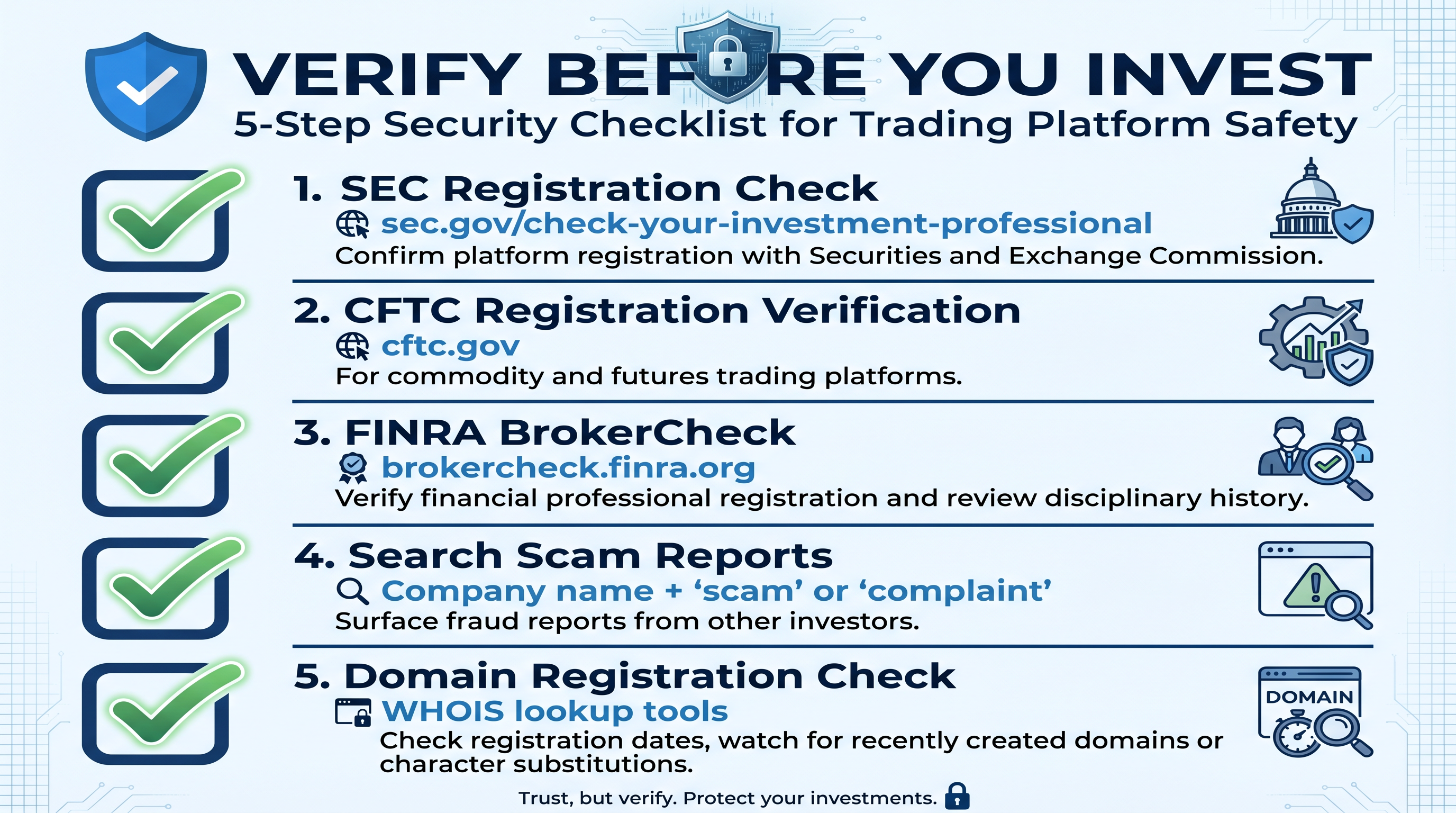
Before funding any trading account, execute the following verification sequence:
The SEC investor alert on online investment fraud outlines the regulatory framework for identifying fraudulent platforms, including verification procedures that investors should complete before funding accounts with any entity claiming to offer securities trading.
Scammers may impersonate licensed individuals and firms, requiring verification of actual contact channels. If a platform or adviser claims affiliation with a registered entity, contact that entity directly through publicly listed channels to confirm the relationship.
Red flags that should trigger immediate rejection:
Hawaiʻi OCP guidance emphasised that spelling errors and grammatical irregularities often indicate overseas fraud operations. Legitimate financial firms maintain professional communication standards across all customer interactions.
Knowing where and how to report helps limit total losses and contributes to enforcement actions that protect other potential victims.
If you suspect a fake trading platform or have already suffered losses, take the following actions:
Preserve all documentation before scammers disappear. Save screenshots of the platform interface, transaction histories, communication records, and any promotional materials or advertisements. Document the timeline of interactions, including dates of deposits, withdrawal requests, and fee payment demands.
Hawaiʻi OCP warned that requests for additional payments to release funds are a continuation of the fraud, not a legitimate requirement. No legitimate platform requires upfront fees to process withdrawals.
If you receive unexpected investment messages from friends or contacts, verify through a separate communication channel before engaging. Scammers frequently compromise social media accounts to target victims’ networks with fake platform recommendations.
Investors seeking exposure to market opportunities during periods of uncertainty should focus on legitimate strategies for navigating volatile markets, which rely on diversification and regulatory-protected instruments rather than unverified platforms promising guaranteed returns.
Fake trading platforms in 2026 combine professional design, AI-generated credibility signals, and sophisticated psychological manipulation to extract funds from U.S. investors. The technology has become more convincing, but the verification tools remain straightforward.
Every platform can be checked against regulatory databases before a single dollar is invested. The few minutes required for verification represent the most effective protection available. Verify registration with SEC, CFTC, and FINRA before funding any trading account. If something appears wrong, report it to the appropriate federal agency immediately.
This article is for informational purposes only and should not be considered financial advice. Investors should conduct their own research and consult with financial professionals before making investment decisions.
A fake trading platform is a fraudulent website designed to mimic a legitimate brokerage, displaying real-time price feeds and professional interfaces to convince victims their money is being invested, before blocking withdrawals and extracting additional fees.
You can verify a trading platform by checking SEC registration at sec.gov, CFTC registration at cftc.gov, and using FINRA BrokerCheck at brokercheck.finra.org, all of which confirm whether the platform is properly licensed to operate.
Key red flags include guaranteed returns, pressure to invest immediately, requests to communicate via WhatsApp or Telegram, instructions to deposit via cryptocurrency ATMs, and recently registered domains that closely mimic established firm names.
U.S. consumers lose an estimated $10 billion annually from relationship investment scams alone, while Chainalysis estimates $17 billion was stolen globally through crypto scams and fraud in 2025, with impersonation and AI tactics driving much of the increase.
Report the fraud to the SEC at sec.gov/tcr, the CFTC at cftc.gov/complaint, the FTC at reportfraud.ftc.gov, and the FBI Internet Crime Complaint Center at ic3.gov, and preserve all screenshots, transaction records, and communication logs before the scammers disappear.


