

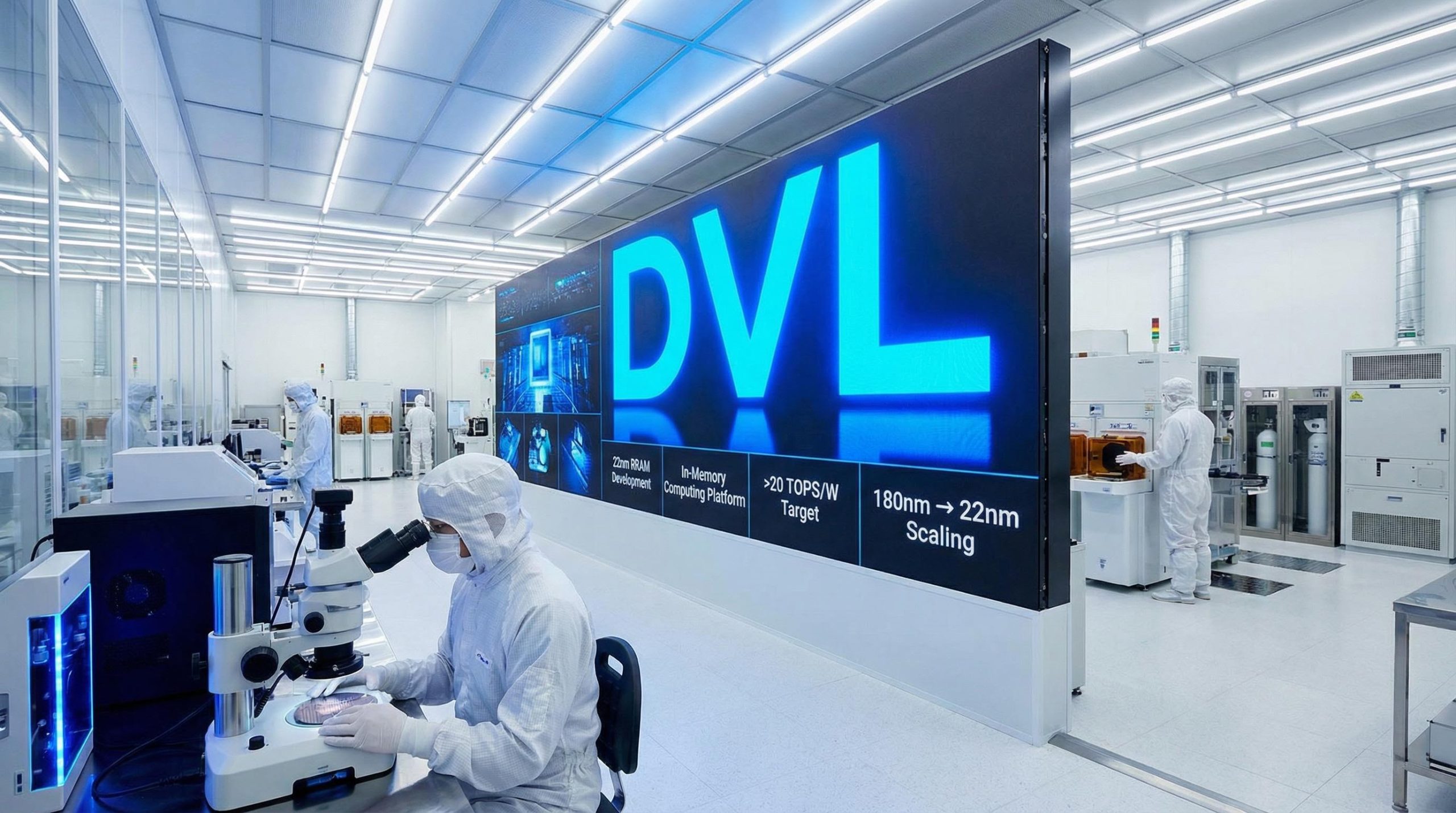
dorsaVi receives first RRAM test silicon as 22nm development program advances
dorsaVi (ASX: DVL) has received initial RRAM test wafers and commenced device-level evaluation as part of its dorsaVi RRAM 22nm development program. The milestone marks the first physical step in the company’s staged pathway toward a 22nm RRAM platform, transitioning from 180nm evaluation toward a commercially relevant advanced node. The program builds on 40nm RRAM devices previously developed with Nanyang Technological University (NTU), positioning the company within the emerging non-volatile memory sector gaining investor attention as AI infrastructure expands globally.
Physical receipt of test silicon demonstrates tangible R&D execution rather than conceptual development alone. The company’s RRAM roadmap targets memory constraints in AI infrastructure, where traditional DRAM and high-bandwidth memory architectures face scaling limitations as AI workloads intensify across data centre and edge computing environments.
Current testing activities are focused on three areas:
- Device-level performance assessment
- Material interface characterisation
- Integration considerations under manufacturing conditions
When big ASX news breaks, our subscribers know first
Why the memory industry is shifting toward in-memory computing
AI systems are increasingly bottlenecked by how fast data can move between processors and memory, not just compute power. Industry estimates suggest 70-90% of compute energy may be consumed by data movement. This phenomenon, often described as the “memory wall,” arises because modern AI accelerators require materially higher memory bandwidth and capacity than traditional computing devices.
Conventional architectures depend on frequent transfers of data between processors and external memory. As additional compute is added, these architectures experience diminishing returns. AI workloads scaling across data centres drive increasing energy consumption associated with data movement, higher latency and bandwidth requirements, and greater cooling and infrastructure demands in dense deployments.
In-memory computing represents an emerging architectural response. This approach enables calculations to happen where data is stored rather than shuttling data back and forth between processor and memory. The implications include lower power consumption, reduced latency, and smaller form factors for edge devices. Neuromorphic computing architectures similarly reduce reliance on large external memory bandwidth by enabling computation closer to the data source.
dorsaVi’s RRAM technology is designed specifically for these emerging architectures. The structural industry shift creates a tailwind for non-volatile memory IP developers as AI infrastructure expands.
Mathew Regan, Chief Executive Officer
“The rapid expansion of AI infrastructure is placing increasing pressure on power efficiency and memory utilisation across the computing stack. While much of today’s investment is focused on large-scale data-centre hardware, we believe the next phase of AI growth will become increasingly distributed, with intelligence embedded directly into physical systems operating at the edge and ultra-edge. Our RRAM-based in-memory and neuromorphic computing platform is being developed to reduce data movement and enable ultra-low-power, low-latency intelligence where efficiency is critical.”
Memory sector valuations signal accelerating investor interest
AI-driven demand is reshaping memory industry valuations. Market capitalisation expansion among memory companies reflects investor recognition of memory as a critical AI infrastructure layer. The following table presents growth figures across selected memory companies over the past year, illustrating the sector’s momentum as AI workloads intensify:
| Company | Market Cap Growth (1 Year) | Company Focus |
|---|---|---|
| SanDisk | ~1,020% | NAND flash memory and storage solutions for data centre and enterprise applications |
| SK Hynix | ~115% | DRAM and high-bandwidth memory (HBM) for AI servers and advanced computing |
| Micron | ~300% | DRAM, HBM and NAND memory for data centre, AI and automotive markets |
| Everspin | ~47% | Persistent memory technologies, including MRAM, for industrial and enterprise use |
Market cap expansion across memory peers demonstrates investor appetite for companies addressing AI memory constraints. dorsaVi’s RRAM and neuromorphic IP targets a complementary segment: ultra-edge applications in robotics, drones and autonomous systems, where memory requirements differ materially from data centre workloads.
Target applications driving structural memory demand
dorsaVi’s RRAM roadmap targets specific end markets: robotics, drones, autonomous systems, industrial devices, and medical wearables. These applications require different memory characteristics than data centre workloads due to tight power budgets, thermal constraints, small form factors, and real-time local processing requirements without reliance on cloud connectivity.
Ultra-edge devices face distinct constraints:
- Power: Battery-powered and always-on systems demand lower energy per operation
- Thermal: Industrial and safety-critical environments require improved reliability at elevated temperatures
- Size: Compact form factors limit memory array footprint
- Latency: Edge and reflex-driven applications require reduced decision latency
- Local decision-making: Autonomous systems must process multiple sensor streams and execute control workloads directly where data is generated
These sectors are emerging as major structural drivers of advanced memory demand over the coming decade. The memory characteristics required for ultra-edge applications differ from hyperscale data centre infrastructure, creating distinct development pathways for memory IP providers.
22nm RRAM targets meaningful performance improvements over 40nm baseline
The 22nm RRAM program targets lower write voltage, reduced latency, improved reliability and support for compute-in-memory operation relative to NTU’s current 40nm benchmark RRAM devices. The following table presents the performance comparison and practical implications for edge applications:
| Parameter | Current (40nm Node) | 22nm Goal | Key Impact |
|---|---|---|---|
| Write Voltage | 2.0 – 2.5V | <2.0V | Lower energy per write, supporting battery-powered and always-on systems |
| Write Latency (Array-Level) | 200ns @ 2.0V 50ns @ 2.5V |
100 – 200ns | Reduced decision latency in edge and reflex-driven applications |
| Endurance | >10M cycles | >10M cycles | Endurance customised to application, balancing performance, lifetime and energy efficiency |
| Retention | >10 years @ 85°C | >10 years @ 125°C | Improved reliability for industrial and safety-critical environments |
| Write-Verify | External | Integrated | Improved reliability and consistency across large arrays |
| AI and Neuromorphic Computing Enablement | Binary operation | Multi-state compute-in-memory macros | Enables ultra-low-power AI and neuromorphic processing |
| Compute-in-memory Array Efficiency | Not measured | >20 TOPS/W | Provides highly efficient building blocks for AI and neuromorphic computing applications |
Quantified targets provide measurable development milestones for investors to track. Higher TOPS/W efficiency and improved retention at elevated temperatures directly address ultra-edge application requirements. These improvements are intended to deliver higher performance per watt and more efficient AI and neuromorphic processing in power- and latency-constrained applications, including autonomous platforms that must process multiple sensor streams and execute control workloads directly where data is generated.
Integration with dorsaVi’s neuromorphic computing portfolio
RRAM fits within dorsaVi’s broader neuromorphic IP strategy as the memory fabric enabling local learning and inference at the edge. The architecture positions RRAM as more than a storage medium: it becomes an active computational element within neuromorphic systems.
The three-layer architecture operates as follows:
- RRAM provides the high-speed, low-voltage, non-volatile memory fabric
- Neuromorphic and Processing-in-Memory blocks use that fabric as dense arrays of “artificial synapses” for local learning and inference
- Ultra-edge devices (including robots, drones and wearable systems) execute critical control, safety and perception workloads directly where data is generated
The 22nm node is described as “neuromorphic-ready,” enabling tighter coupling of memory and compute IP. This transition from 40nm to 22nm is intended to support manufacturable, advanced-node silicon that can underpin ultra-edge use cases where power budgets, thermal constraints and form factor limitations preclude traditional GPU- and DRAM-heavy systems.
What comes next for dorsaVi’s RRAM development
dorsaVi is currently conducting early-stage characterisation of 180nm test devices. Insights from this phase are intended to inform subsequent optimisation and scaling steps as the company progresses its RRAM development roadmap toward a commercially relevant 22nm platform. Performance will be benchmarked against the 40nm RRAM devices developed with NTU.
The staged development pathway provides visibility on near-term milestones. The company has committed to keeping the market informed as these initiatives advance through further development, validation and commercialisation phases.
dorsaVi believes ongoing pressure on conventional memory supply, combined with accelerating adoption of edge-AI systems, reinforces the strategic relevance of its advanced-node RRAM roadmap. The dorsaVi RRAM 22nm development program positions the company to address memory constraints in applications where efficiency, latency and local processing capability are critical design requirements.
Want the Next Tech Breakthrough in Your Inbox?
Join 20,000+ investors receiving FREE ASX tech alerts within minutes of release, complete with in-depth analysis. Click the “Free Alerts” button at StockWire X to get breaking news and expert coverage delivered straight to your inbox the moment market-moving announcements drop.