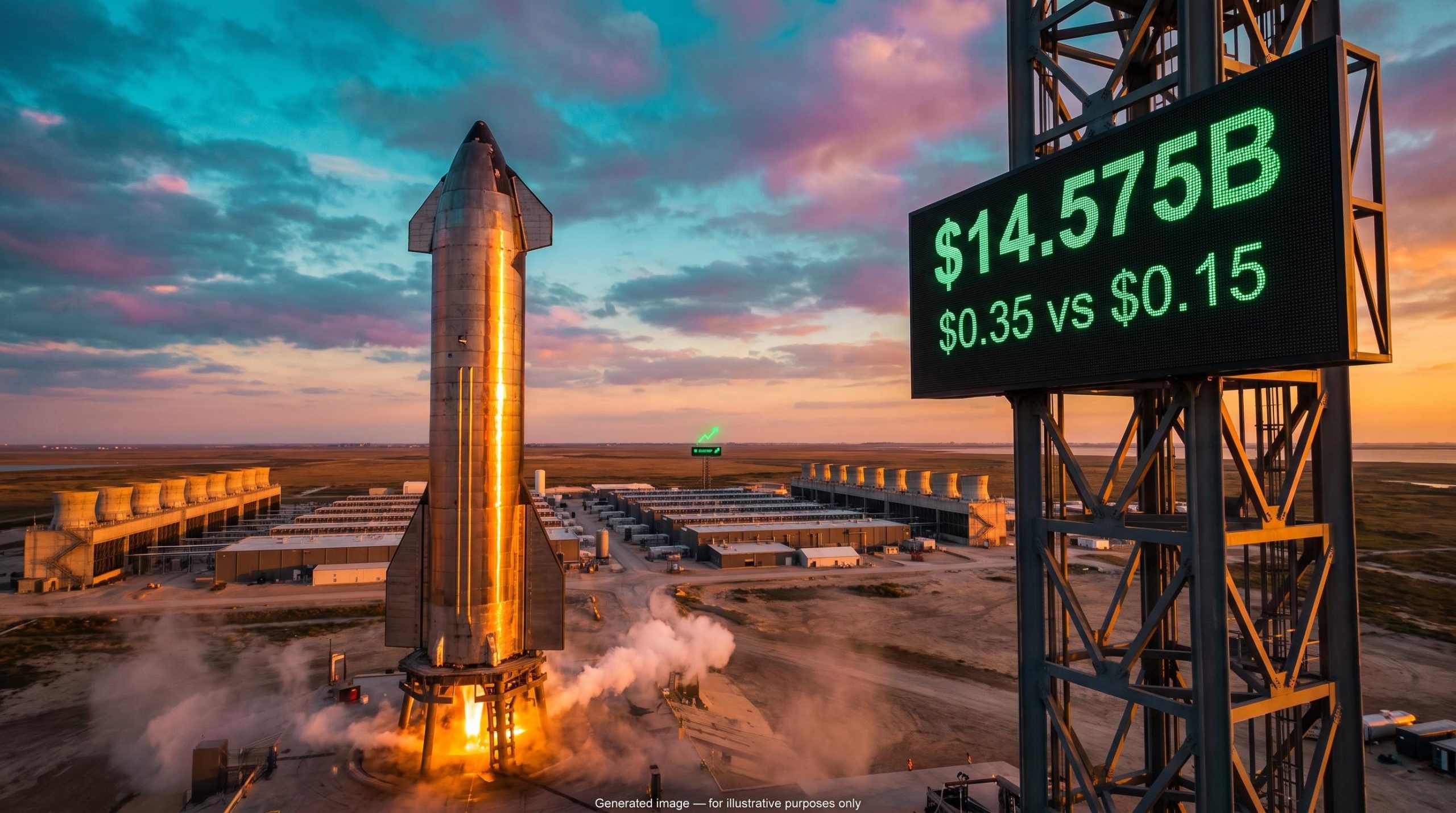
SpaceX reported $14.575B in third-quarter revenue against a consensus of roughly $12.87B, and adjusted earnings per share of $0.35 against the $0.15 analysts expected. Every headline line in the SpaceX Q3 2026 earnings release came in ahead of forecasts.
The quarter ended 30 September 2026, and results were released today, 20 October 2026. Operating income moved from a $273M loss a year earlier to a $2.8B profit.
Shares in SpaceX (SPCX) rose only about 1.5-1.6% in after-hours trading. A beat this large usually draws a stronger reaction, and the gap between the two is the real story. Consensus benchmarks differ slightly between outlets (CNBC cited $12.72B for revenue), but the reported figures do not.
Where did the beat come from? Super Intelligence overtakes Connectivity
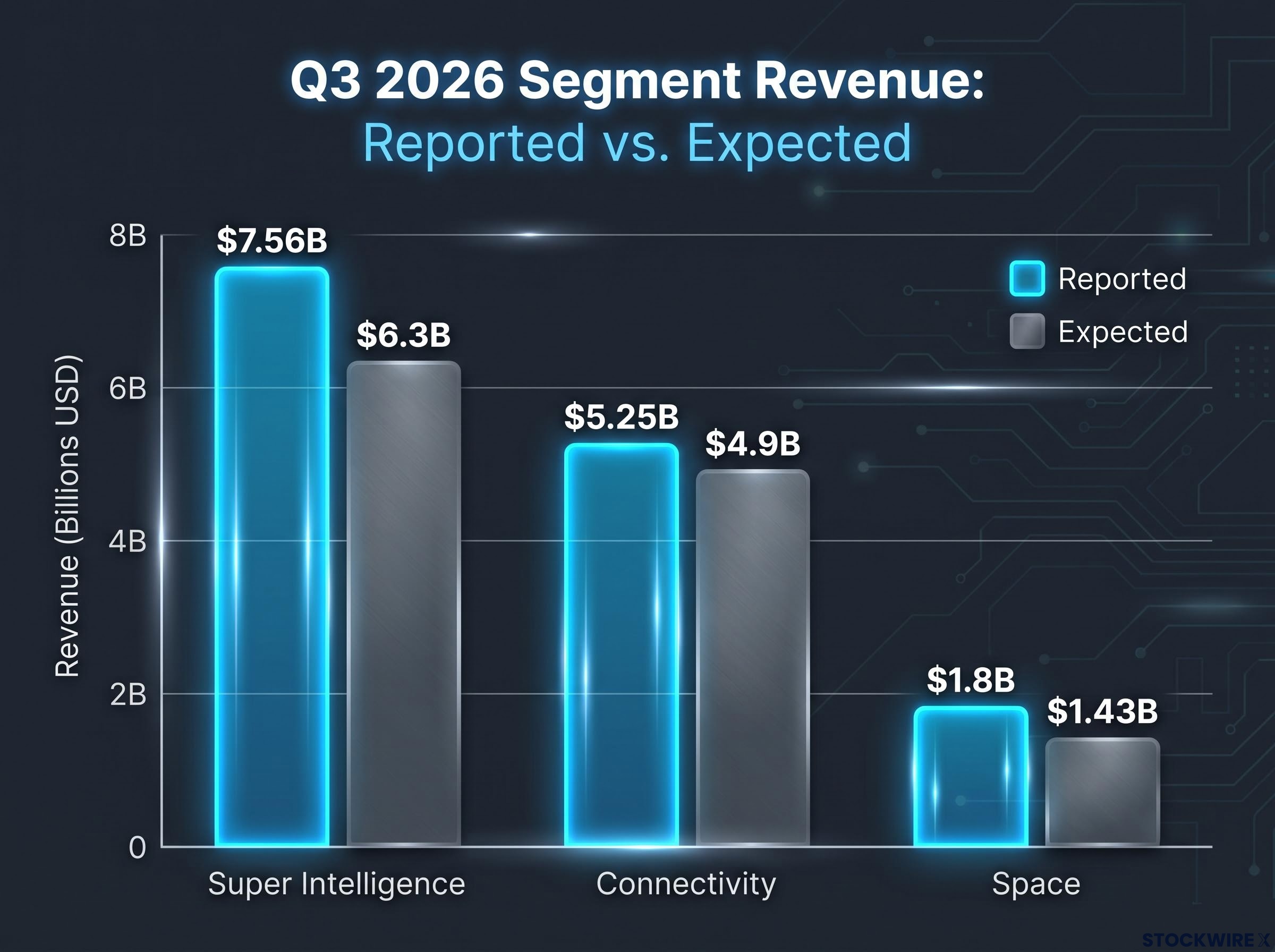
The biggest line in SpaceX’s results is no longer Starlink. Super Intelligence, the company’s AI compute and software segment, booked $7.56B in revenue against a $6.3B expectation and became the largest reported segment.
The group numbers cleared their bars by wide margins. Adjusted EBITDA (earnings before interest, tax, depreciation and amortisation, stripped of one-off items) shows how much cash the operations generate before financing and accounting charges.
| Metric | Reported | Consensus |
|---|---|---|
| Revenue | $14.575B (up 161% YoY) | $12.87B |
| Adjusted EPS | $0.35 | $0.15 |
| Net income | $4.404B | $1.88B |
| Adjusted EBITDA | $8.8B | About $6.59B |
| Operating income | $2.8B | $2.24B |
The operating swing matters more than the revenue figure. A year ago the core business lost money; this quarter it earned $2.8B.
Segment results against expectations
- Super Intelligence: $7.56B vs $6.3B expected, the largest beat in dollar terms.
- Connectivity: $5.25B vs $4.9B, with operating income of $2.4B, up 99% year on year.
- Space: about $1.8B vs $1.43B (some sources cited roughly $1.4B).
Connectivity remains the steady engine, lifted by Starlink consumer uptake and larger enterprise and government contracts.
CFO on the quarter SpaceX’s Chief Financial Officer pointed to “continued Connectivity momentum and a clear inflection in Super Intelligence.”
Super Intelligence now accounts for more than half of quarterly revenue. If you think of SPCX as a satellite stock, its results now lean more heavily on an AI business than on Starlink.
SpaceX now reports across four distinct revenue segments at very different maturity stages, which is why a single blended multiple fails to capture how a mature connectivity franchise and an early AI compute build-out should be valued.
When big ASX news breaks, our subscribers know first
What is $19.6B of capex buying, and can revenue keep pace?
The spending side held no surprises. Capital expenditure (capex), the money spent on long-lived assets such as data centres and equipment, totalled $19.6B, in line with forecasts.
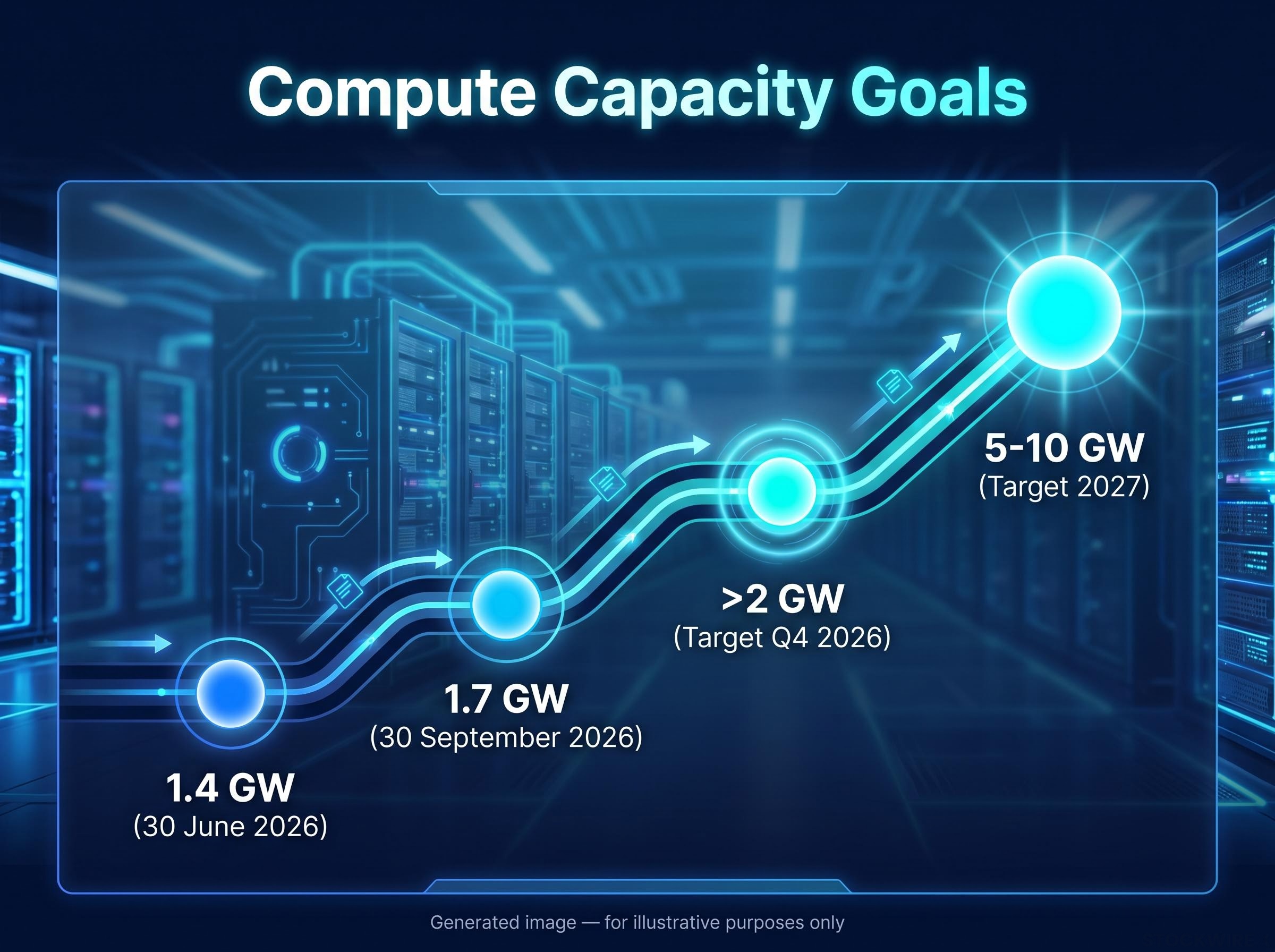
Of that, $16.4B went to Super Intelligence and AI infrastructure, which works out to roughly 84% of the total on reported figures. The money is turning into nameplate compute capacity, meaning the maximum power the installed computing hardware is rated to draw:
- 1.4 GW at 30 June 2026
- 1.7 GW at 30 September 2026
- More than 2 GW targeted on exiting Q4 2026
- 5-10 GW targeted on exiting 2027, according to reported company goals
Deutsche Bank analyst Edison Yu estimates SpaceX has line of sight to roughly 5-7 GW of power over several years and models about 6 GW by the end of 2027. That estimate sits at the lower end of the company’s own range, so the power needed for the full 2027 ambition is not yet visible.
SpaceX’s compute ambitions sit alongside hyperscaler AI spending that is projected near $725 billion in 2026, so the company is competing for power, chips and customers against the largest balance sheets in technology.
Then there is the cash.
Spending vs sales Q3 capex: $19.6B. Q3 revenue: $14.6B.
SpaceX spent more on buildings and hardware in the quarter than it brought in from customers. Bloomberg consensus reportedly implied free cash flow (cash left after operating costs and capex) of about negative $11.6B.
The profit headline and the cash burn are two sides of the same bet. A $2.8B operating profit does not mean the business funds itself; that depends on new compute being used and priced well enough to earn back what it cost.
Starship’s first paid launch: milestone or early test?
The Space segment carried a first of its own. Flight 14 lifted off from Starbase, Texas, on 28 September 2026, carrying 26 Starlink V3 satellites on what SpaceX describes as Starship’s first revenue-generating mission.
The economics explain the excitement. Each such launch offers about ten times the downlink capacity of a Falcon 9 Starlink launch, so one Starship flight could do the work of many smaller ones.
The fine print tempers the milestone. The payload was SpaceX’s own satellites, not an external customer’s, and the flight was still described as a test. Reuters reportedly noted an engine failure cut the mission short, although the satellites deployed; that account has not been independently confirmed.
What the milestone proves:
- Starship can deliver a full load of operational V3 satellites.
- The capacity-per-launch case is physically achievable.
What it does not yet prove:
- Reliable, repeatable reusable flights.
- Demand from paying outside customers.
Space revenue of about $1.8B beat its $1.43B expectation, but Starship’s cost advantage is not yet showing up in the numbers. For your purposes, treat it as an upside lever that still has to be demonstrated, not as something already earned.
For readers wanting the earlier Starship setback in context, our detailed coverage of the Starship abort and IPO price fall explains how an engine abort pushed shares below $135.
Why did SPCX barely move, and what do investors watch next?
Ahead of the release, the options market reportedly implied a move of roughly 6.8%-7.8% in either direction. That implied move is the swing traders were paying to protect against, based on option prices. The actual after-hours gain of about 1.5-1.6% came in well short of that.
Shares reportedly closed near $147.96 on 19 October. The reaction reads as positive, but not as a re-rating.
The muted move contrasts with the previous quarter, when a beat on revenue still produced a 7% after-hours selloff driven by capex and negative free cash flow, showing how differently the market has treated similar setups.
Bull and bear readings
Bulls point to $7.56B of Super Intelligence revenue and $2.8B of operating income as evidence that AI spending is already producing reported sales. Evercore’s Kutgun Maral lifted his target, and Deutsche Bank’s Yu views the Q4 compute target as achievable.
| Analyst | Prior target | New or current target | Stance |
|---|---|---|---|
| Evercore (Kutgun Maral) | $230 | $270 | Buy |
| Pivotal Research (Jeffrey Wlodarczak) | $220 | $230 | Not specified |
| Mizuho (Brett Linzey) | Not specified | $200 | Outperform |
StockAnalysis reports a 12-month consensus target of $222.71, and S&P Global cited a consensus implying about 84% upside. Treat both as reported estimates rather than certainties.
Bears focus on the cash burn, unproven returns on compute and the concentration in Super Intelligence. Consumer subscribers were reportedly 13.6M against a 14.2M Bloomberg expectation. Pre-earnings coverage from Schwab and Pepperstone warned that further spending increases could revive concerns about cash flow and valuation.
Five tests for the next report
- Compute utilisation: how much of the new capacity is sold and used.
- Free-cash-flow conversion: whether profit starts turning into cash.
- Power availability: whether procurement keeps up with targets.
- Enterprise-contract durability: whether large deals renew and grow.
- Reliable Starship operations: repeatable flights without failures.
The market is pricing SPCX on execution. Your next read of the stock should rest on these five tests, not on whether revenue beats again.
What the beat settles, and what it leaves open
The quarter settled one question: SpaceX can book operating profit alongside 161% revenue growth. It left open whether $19.6B a quarter in capex earns an adequate return.
The next checkable milestone is the target of more than 2 GW of compute capacity on exiting Q4. When the next report arrives, look first at cash conversion and utilisation, and treat the top line as the least informative number on the page.
This article is for informational purposes only and should not be considered financial advice. Investors should conduct their own research and consult with financial professionals before making investment decisions. Past performance does not guarantee future results. Analyst targets and company goals are forward-looking, speculative and subject to change based on market developments and company performance.