SpaceX raised $75 billion in a single day. Every prior initial public offering in history now looks modest by comparison.
On Friday 12 June 2026, Elon Musk’s rocket and satellite company made its Nasdaq debut under the ticker SPCX, pricing at $135 per share and closing the session up roughly 19%. By Monday 15 June, premarket trading had added a further 6.4%. The listing instantly placed SpaceX among the most valuable publicly traded companies on any exchange in the world, with a closing market capitalisation of approximately $2.1 trillion. What follows covers exactly how the trading session unfolded, what that valuation represents relative to historical benchmarks, what the company actually sells, what risks are already embedded in the price, and what retail investors should watch in the days ahead.
From $135 to $161 in a single session: how SPCX’s debut unfolded
The structural baseline came first: 555,555,555 shares priced at $135 each, with underwriters granted a greenshoe overallotment option on an additional 83.3 million shares.
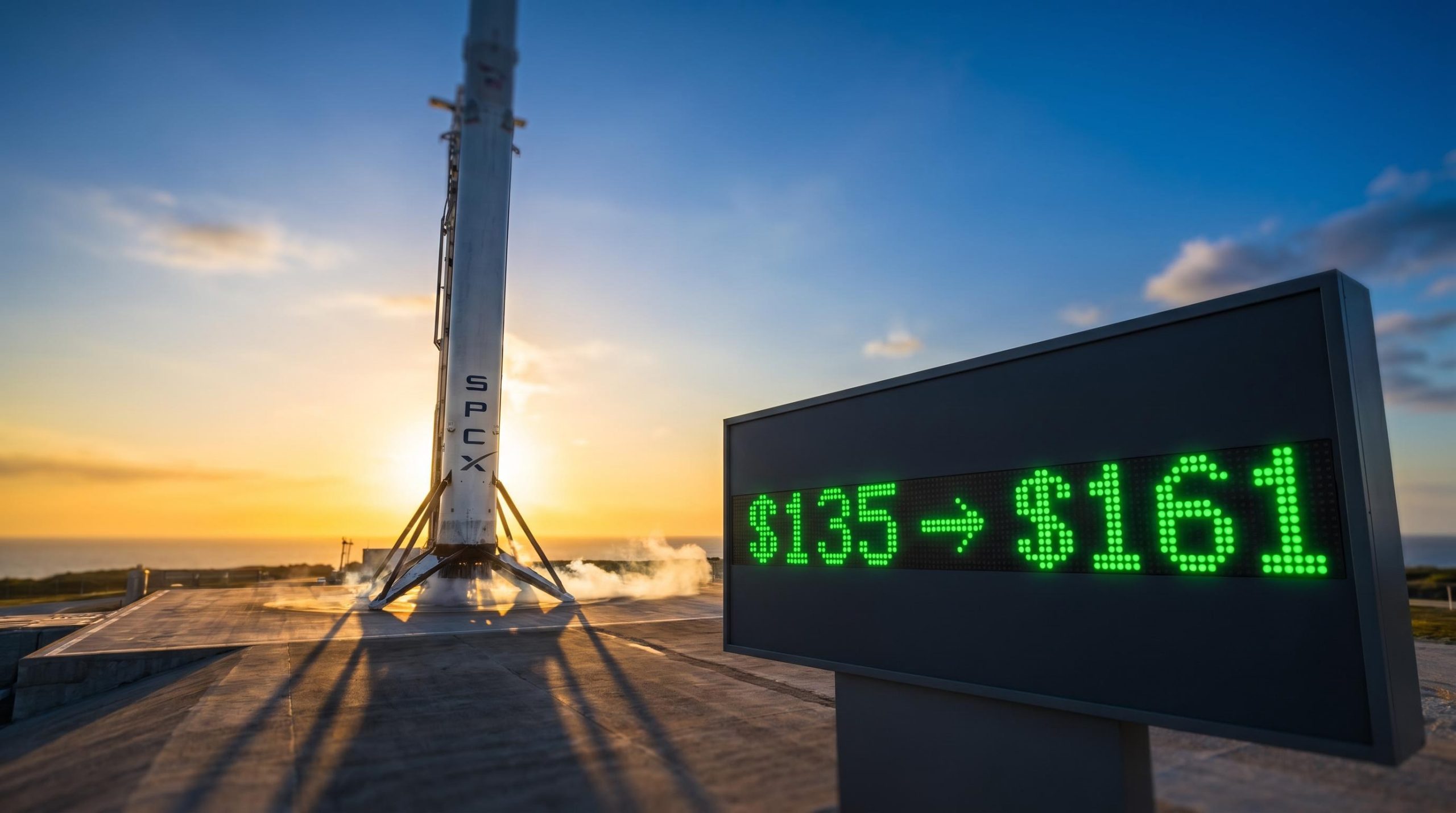
Then the market opened, and the momentum built quickly. SPCX printed its first trade at $150, roughly 11% above the offering price. Within hours, buyers pushed the stock to an intraday peak of $176.52. The ceiling had been tested. The session’s second half brought a measured retreat as profit-taking and price discovery pulled shares back toward a close near $161, locking in an approximately 19% first-day gain for IPO allocatees.
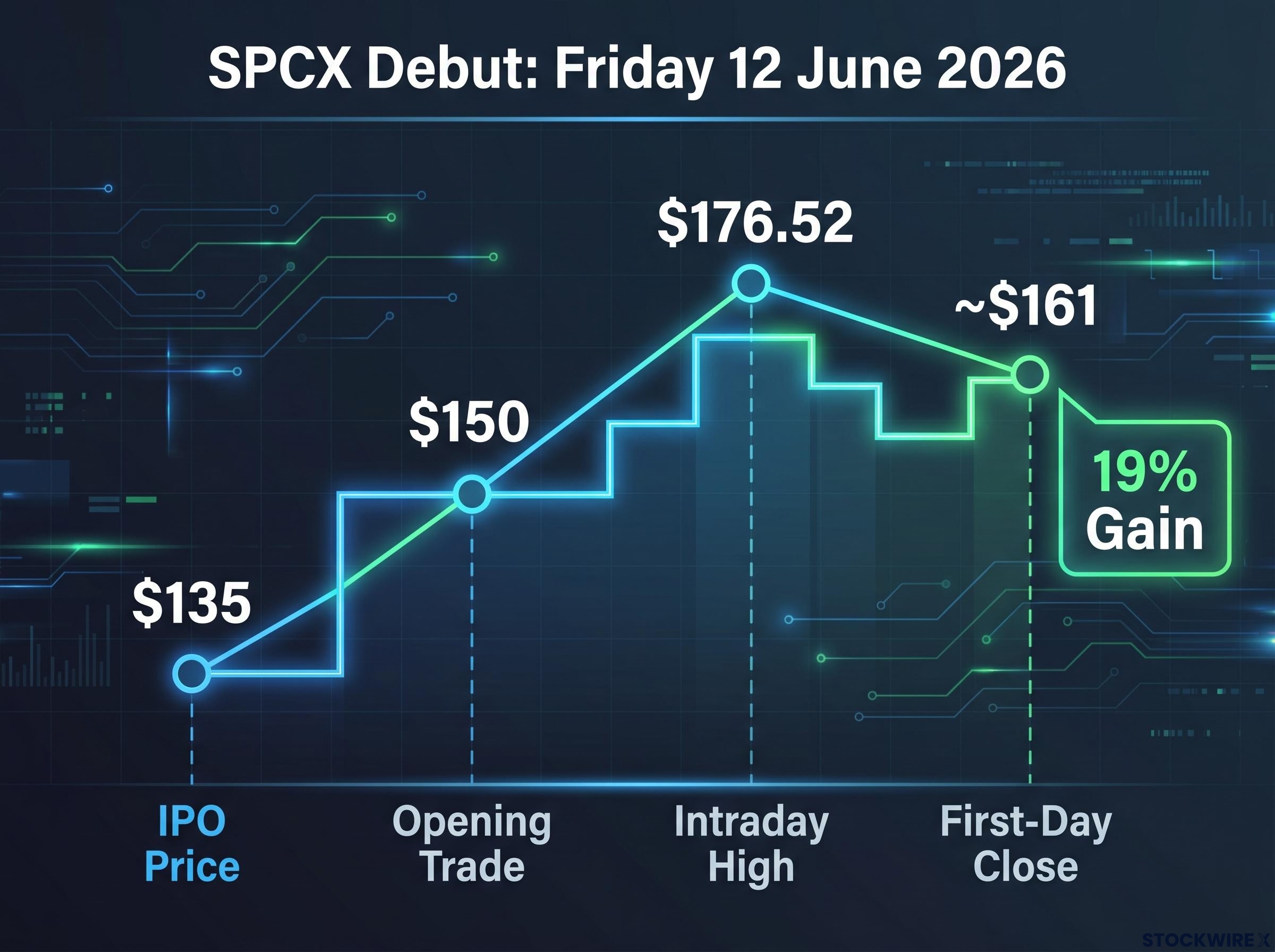
- IPO price: $135
- Opening trade: $150
- Intraday high: $176.52
- First-day close: approximately $161
First-day volume exceeded 500 million shares, approaching the approximately 580 million shares traded during Facebook’s 2012 Nasdaq debut, a benchmark that has stood for over a decade.
SPCX closed its first session at approximately $161, delivering a roughly 19% gain over the $135 IPO price.
The distinction between the intraday peak and where the stock settled matters. Retail investors considering an entry after a significant first-day pop are buying at the equilibrium the market found, not at the ceiling it briefly tested.
When big ASX news breaks, our subscribers know first
A $75 billion raise and a $2.1 trillion market cap: putting the numbers in context
The $75 billion raised on Friday is the largest IPO by dollar amount in history. The prior record belonged to Saudi Aramco, which raised approximately $25.6 billion in its 2019 listing. SpaceX nearly tripled it.
At the closing price of approximately $161, the implied market capitalisation reached roughly $2.1 trillion, derived from a fully diluted share count of approximately 13 billion shares. Only a low-single-digit percentage of total company equity changed hands in the offering itself, meaning the vast majority of shares remain held by insiders and pre-IPO investors. That places SpaceX in the same valuation tier as the world’s largest technology companies.
Analysts who have modelled SpaceX’s existing financials estimate a current fundamental value in the $100-200 billion range, placing roughly $1.8 trillion in priced-in optionality above that floor, a gap that reflects the market’s conviction about Starship commercialisation, orbital compute, and Starlink subscriber growth rather than verified earnings power today.
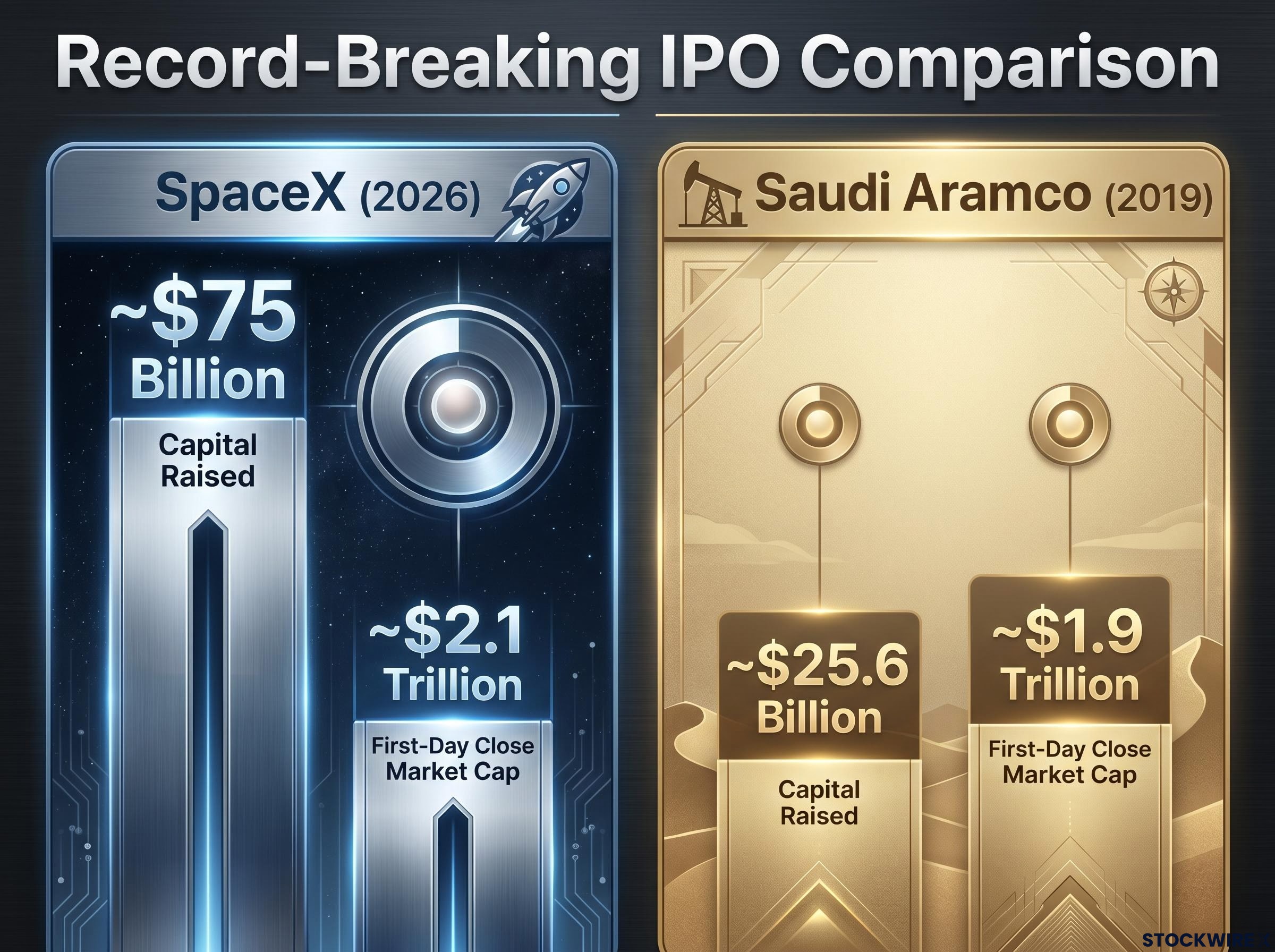
| Company | IPO Year | Capital Raised | First-Day Close Market Cap |
|---|---|---|---|
| SpaceX | 2026 | ~$75 billion | ~$2.1 trillion |
| Saudi Aramco | 2019 | ~$25.6 billion | ~$1.9 trillion |
Understanding that the IPO sold only a thin slice of the company is critical. The limited float explains why early price action can be volatile, and why lock-up expiry timelines will matter for future price behaviour as additional shares become available to trade.
What SpaceX actually sells: the business behind the valuation
The $2.1 trillion price tag rests on four business pillars, two of which generate revenue today and two that remain forward-looking bets.
- Starlink: A large broadband satellite constellation serving millions of users globally, functioning as the company’s primary recurring-revenue engine.
- Falcon 9: The dominant commercial orbital launch vehicle, holding a leading share of launches worldwide and serving as the primary existing cash-flow driver.
- Starship: A heavy-lift, fully reusable launch system that has not yet reached a sustainable operational cadence but is the enabling platform for the company’s most ambitious plans.
- Orbital infrastructure: A long-term vision for space-based AI data centres and computing infrastructure, currently at the conceptual stage.
Starlink and Falcon 9 are proven. They generate revenue and have done so for years. Starship and orbital infrastructure represent the speculative portion of the valuation, the options the market is pricing in at a premium.
SpaceX’s four revenue segments sit at very different maturity stages: launch services and Starlink broadband are generating cash today, while Direct-to-Cell wholesale infrastructure and orbital AI compute remain in early commercial rollout or conceptual phases, each requiring a separate valuation lens to assess fairly.
What Musk said on the JPMorgan livestream
Ahead of the Nasdaq listing, Elon Musk outlined three forward-looking commitments during a JPMorgan Chase livestream. He stated that SpaceX plans to deploy over 100,000 satellites into orbit, described ambitions to build space-based AI infrastructure including orbital data centres, and confirmed the company has been cash-flow positive since approximately 2015.
These remarks came from a company-sponsored event rather than a regulatory filing. The satellite and AI infrastructure targets represent stated ambitions, not verified guidance. Retail investors who understand which revenue streams are proven today versus which remain speculative long-term options are better positioned to assess how much of the $2.1 trillion valuation rests on conviction versus aspiration.
What retail investors entering now should know about the risks
The first-day close at roughly 19% above the IPO price, with Monday premarket adding approximately 6.4% (sourced from Investing.com, not yet independently confirmed across multiple outlets), means the stock has already moved substantially from its offering level. Enthusiasm and risk are proportional here.
- Valuation and priced-in optimism: A $2.1 trillion market capitalisation implies execution on ambitious milestones that are not yet achieved, including Starship commercialisation, mega-constellation deployment, and entirely new orbital businesses. Any visible stumble could drive sharp drawdowns.
- Early-trading volatility: Strong first-day gains on high volume often precede elevated volatility as short sellers enter, arbitrage participants arrive, and initial holders consider profit-taking.
- Float and lock-up dynamics: Because the IPO sold only a low-single-digit percentage of total equity, lock-up expiries over coming months will gradually increase the available share supply. If demand does not keep pace, downward price pressure may follow.
- Information quality and first earnings: SpaceX operated with limited public financial disclosure before the IPO. The first quarterly SEC filing will be the initial test of whether embedded expectations match reported results.
Investors entering after a significant first-day pop are paying for growth expectations that are already partially reflected in the price. Position sizing and time horizon matter as much as conviction.
Those who received shares at the $135 IPO price carry a built-in cushion. Those buying at current levels near $161 or above are purchasing a larger portion of the long-term growth story upfront.
What a SpaceX IPO means for first-time investors in space stocks
IPO shares are allocated to institutional and selected investors at the offering price, in this case $135, before the stock opens for public trading. Retail buyers on day one or after purchase in the secondary market at a premium to that price. The first public trade printed at $150, meaning the cheapest entry available to most retail investors was already 11% above what institutional allocatees paid.
The greenshoe overallotment option, covering approximately 83.3 million additional shares, allows underwriters to purchase extra stock to stabilise the price if it falls below the offering level in early trading. It functions as a short-term price floor mechanism, not a permanent support.
- IPO price versus market price: The $135 offering price is not the cost basis for a purchase made in the open market. Retail investors entered at $150 or above.
- What the greenshoe does: It gives underwriters a tool to support the stock near the IPO price during the first weeks of trading, reducing the risk of an immediate collapse below offering level.
- What high first-day volume signals: Over 500 million shares traded on day one, indicating broad participation but also potentially significant speculative short-term activity.
Reading the volume signal
The 500-million-plus share volume figure is striking, approaching Facebook’s approximately 580 million shares on its 2012 debut. High volume on day one confirms intense demand, but it does not distinguish between durable long-term positioning and speculative short-term trading. Facebook’s stock declined significantly in the weeks following its own high-volume debut before eventually recovering. That context is worth holding in mind when assessing whether SPCX’s early momentum persists or fades.
IPO cohort underperformance is a documented pattern across multiple market cycles, with Jay Ritter’s University of Florida database showing listings as a category trailing the S&P 500 over three and five year periods, a baseline worth holding alongside SPCX’s first-day momentum before drawing conclusions about the stock’s medium-term trajectory.
SPCX’s first full week and the signals worth tracking
Rather than watching the ticker with vague anxiety, retail investors can focus on four specific data points that will carry the most diagnostic value in the near term.
- Monday price action: Premarket trading showed an approximately 6.4% gain as of 05:45 ET on 15 June (Investing.com, single source, not yet independently confirmed). Whether SPCX holds above the $161 Friday close through the full Monday session is the first test of sustained demand.
- Volume trend through the week: If volume drops sharply while the price flattens or declines, it may indicate fading enthusiasm. Sustained volume alongside stable or rising prices is a more constructive signal.
- Analyst initiation reports: Underwriting banks and independent research firms are expected to initiate coverage in the coming days, providing the first formal Wall Street financial models covering Starlink subscriber growth, Falcon 9 launch cadence, and Starship capital expenditure timelines.
- First quarterly SEC filing: This will be the single most important medium-term data point, revealing actual revenue mix, profitability, and cash-flow trends across SpaceX’s business segments.
The first quarterly earnings filing will be the most significant repricing event on the horizon. It will show whether the $2.1 trillion valuation is supported by reported financial results or running ahead of them.
History was made on Friday; whether it stays that way is now up to the fundamentals
Three facts define the moment: a record $75 billion raise, an approximately 19% first-day gain to a closing market capitalisation of roughly $2.1 trillion, and a Monday premarket continuation signal suggesting demand has not yet faded.
The magnitude of this listing is genuine. SpaceX has entered the public markets at a scale that places it alongside the most valuable companies on earth. Whether it stays there depends on Starship reaching operational maturity, Starlink continuing to grow subscribers and revenue, and the first rounds of financial disclosure confirming that the embedded expectations are grounded in actual performance.
The commercial space economy reached approximately $630 billion in 2023 with 80% of revenues already generated commercially, meaning SpaceX is entering public markets as a scaled infrastructure provider rather than a frontier speculative bet, a distinction that shapes how analysts approach its long-term valuation versus early-stage sector peers.
For retail investors, the appropriate posture is neither rushing to buy nor avoiding the stock entirely. It is monitoring the specific signals outlined above, sizing any position to match individual risk tolerance, and waiting for the data that only the first quarterly filing can provide.
This article is for informational purposes only and should not be considered financial advice. Investors should conduct their own research and consult with financial professionals before making investment decisions. Past performance does not guarantee future results. Forward-looking statements attributed to company management are speculative and subject to change based on market developments and company performance.