The Reserve Bank of Australia raised the cash rate on 29 September 2026, and then the strangest thing happened. Bond yields fell. The share market rose. The Australian dollar slid to a two-month low. Every one of those moves is what you would expect after a rate cut, not a rate hike.
That contradiction is the story. The RBA’s fourth increase of 2026 lifted the cash rate to 4.60%, its highest level since October 2011. Yet the decision itself was almost beside the point. Investors were reading something else entirely: the gap between what the Board wrote down and what Governor Michele Bullock said out loud.
That gap moved hundreds of billions of dollars of assets within a single afternoon. Understanding how it works changes how you should read the next RBA meeting. The rate number tells you one thing. The full signal, statement plus press conference, tells you where policy is actually heading, and that is the signal worth positioning around.
What the RBA actually decided, and what it means at a 15-year high
The Monetary Policy Board voted unanimously to lift the cash rate by 25 basis points to 4.60%, effective 30 September 2026. This was the fourth increase of the year, taking 2026’s cumulative tightening to 100 basis points from a starting point of 4.35%. The next scheduled decision lands on 3 November 2026.
The Board justified the move on the materialisation of upside inflation risks, naming global energy prices, AI-driven demand pressures, and domestic capacity constraints. It kept an explicit conditional bias toward further tightening “if needed,” a phrase that would matter more than the hike itself.
| Metric | Value | Date/Context | Source |
|---|---|---|---|
| Cash rate target | 4.60% (+25 bps from 4.35%) | Effective 30 September 2026 | RBA statement |
| Year-to-date hikes | 4 hikes, +100 bps | 2026 total | CommBank |
| Historical comparison | Highest since October 2011 | 15-year high | WA Treasury Corp, TradingEconomics |
| Next meeting | 3 November 2026 | Rate update scheduled | RBA |
A rate level most borrowers have never navigated
The 15-year framing is not decoration. At 4.60%, the cash rate has climbed into territory that preceded the generation of debt most Australian households now carry. Borrowers who took on mortgages after 2011 have never operated a budget against a cash rate this high.
Here is what that means for you. The cumulative weight of 100 basis points of 2026 tightening, stacked on top of prior-cycle increases, has not yet fully passed through to household budgets and business balance sheets. That lagged transmission is now part of the RBA’s own calculation, and it resets the baseline for every asset you hold.
Policy is no longer playing catch-up. It is sitting in restrictive territory. The question has shifted from whether rates are high enough to whether they are high enough for long enough, and that distinction shapes everything from equity valuations to how you position fixed income.
When big ASX news breaks, our subscribers know first
How a press conference moved markets that a rate hike could not
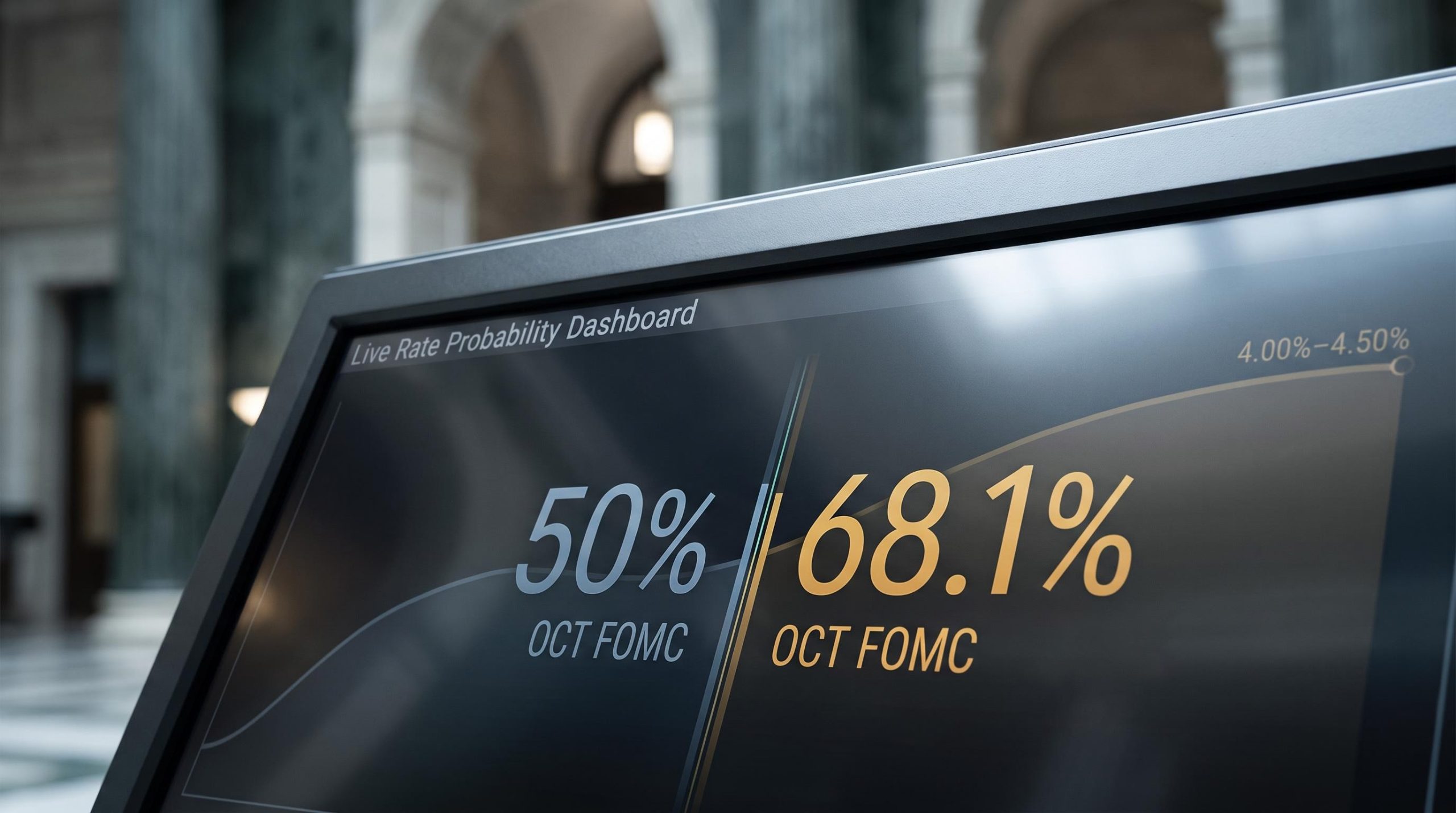
The written statement dropped at 2:30pm AEST, and the market read it as hawkish. The Australian dollar climbed toward 0.7021. Implied odds of a November follow-up hike briefly spiked toward 61%. For roughly half an hour, investors were pricing a Board that intended to keep going.
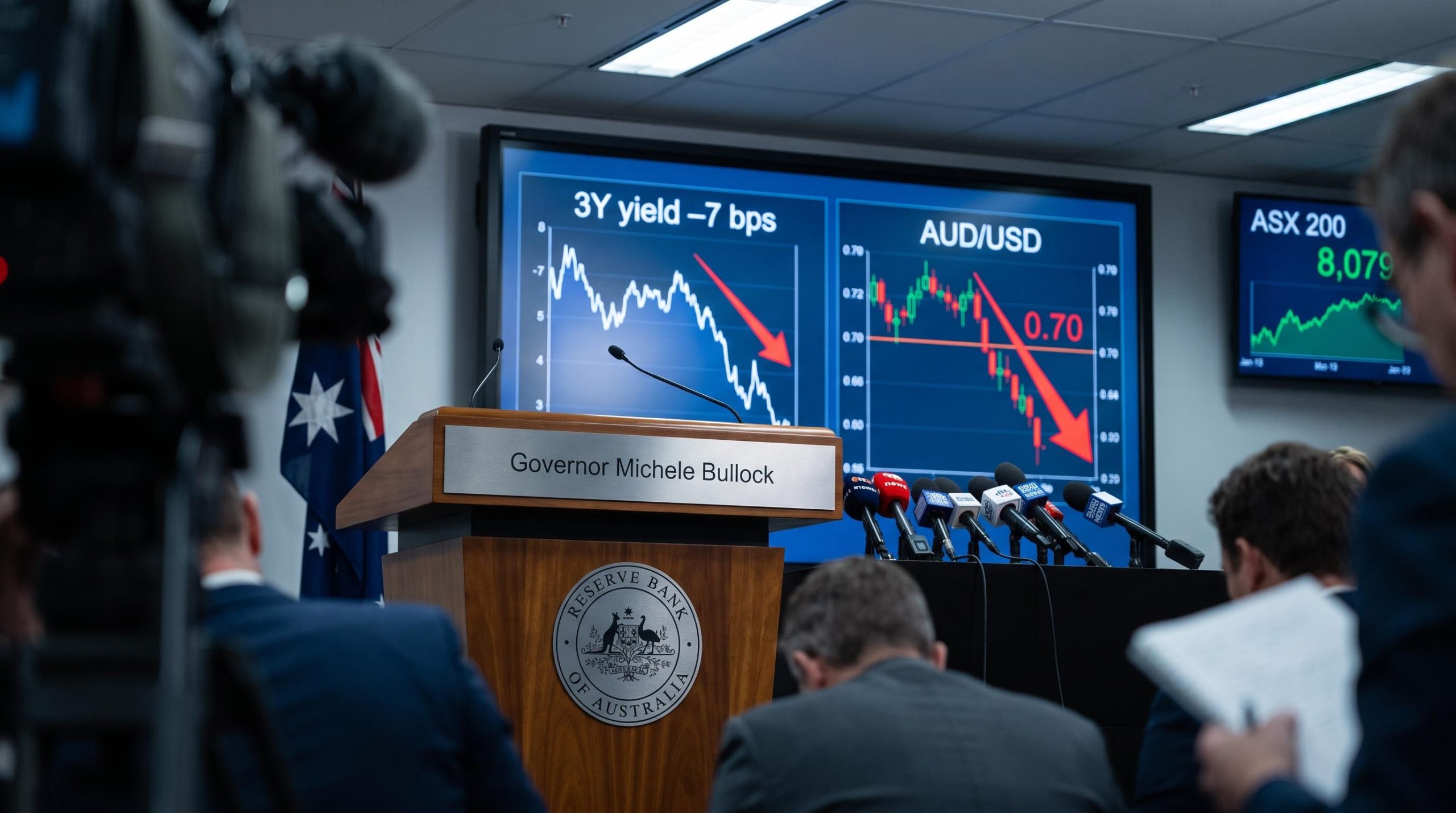
Then Governor Bullock stepped up to the microphone, and the same variables reversed. Where the statement emphasised upside inflation risks and an open door, her press conference leaned the other way: data dependence, slowing activity, an easing labour market, corrections in housing. Same institution, same hour, two different signals.
The pattern is not new: Bullock’s dovish press conference following the May 2026 hike to 4.35% triggered the same sector rotation dynamic, with rate-sensitive equities recovering intraday after the statement had already pushed them lower, establishing the template that played out again on 29 September.
Three assets, one press conference, three reversals
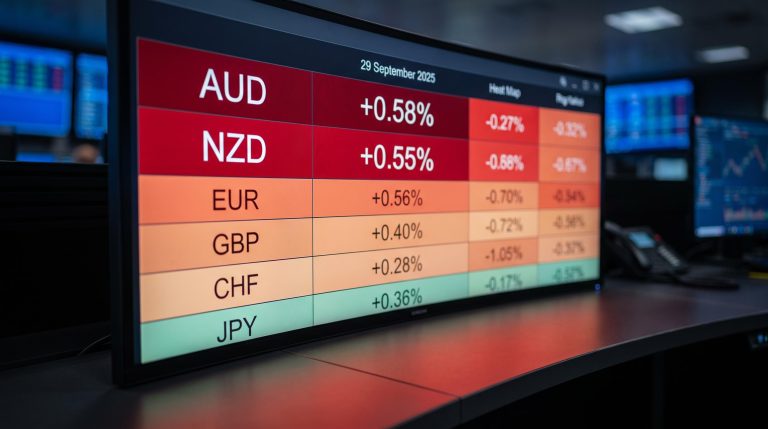
Once Bullock finished, three separate markets locked in the dovish read. The Australian dollar fell to around 0.6989, down roughly 0.4% on the session per Reuters, then broke below 0.70 to approximately 0.6984 by Wednesday morning, a two-month low. Three-year government bond yields dropped 6-8 basis points. The ASX 200 closed up around 30 points at 8,079, a gain of about 0.33%.
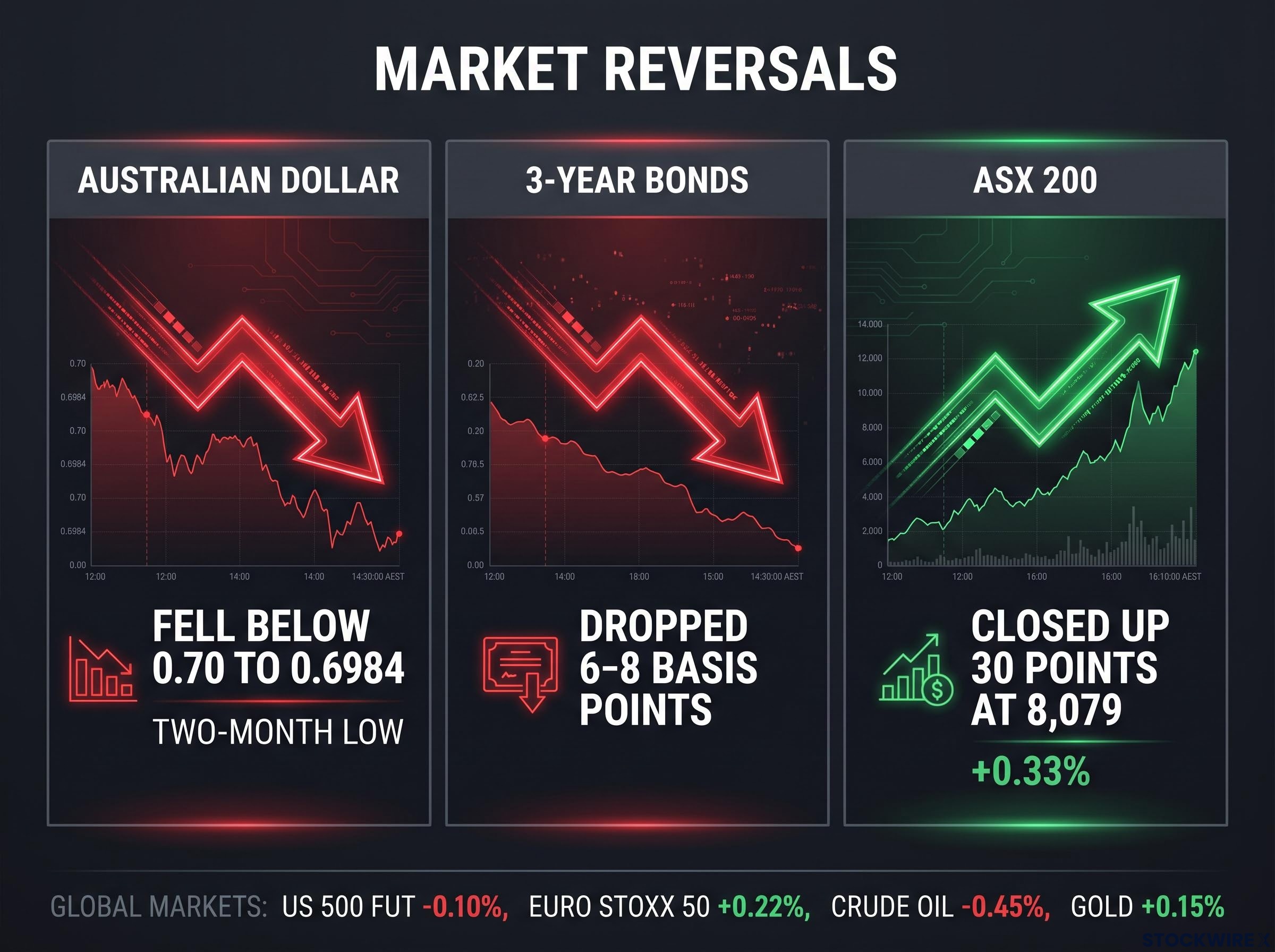
Post-conference, the Australian dollar broke below 0.70 US cents for the first time since early August, according to Briefs.co, as markets repriced the rate path on Bullock’s more cautious tone.
The full arc is worth tracing, because the ASX did not rise in a straight line. Intraday reporting from Admiral Markets put the index around 0.2% lower shortly after the announcement before it recovered into a positive close. The repricing was messy and it was not finished by the bell: index futures pointed to a 0.1% decline at Wednesday’s open.
Watch how the implied November hike odds moved across the afternoon:
- Pre-decision: approximately 51%
- Post-statement spike: approximately 61%
- Post-press-conference: settled around 43-46%
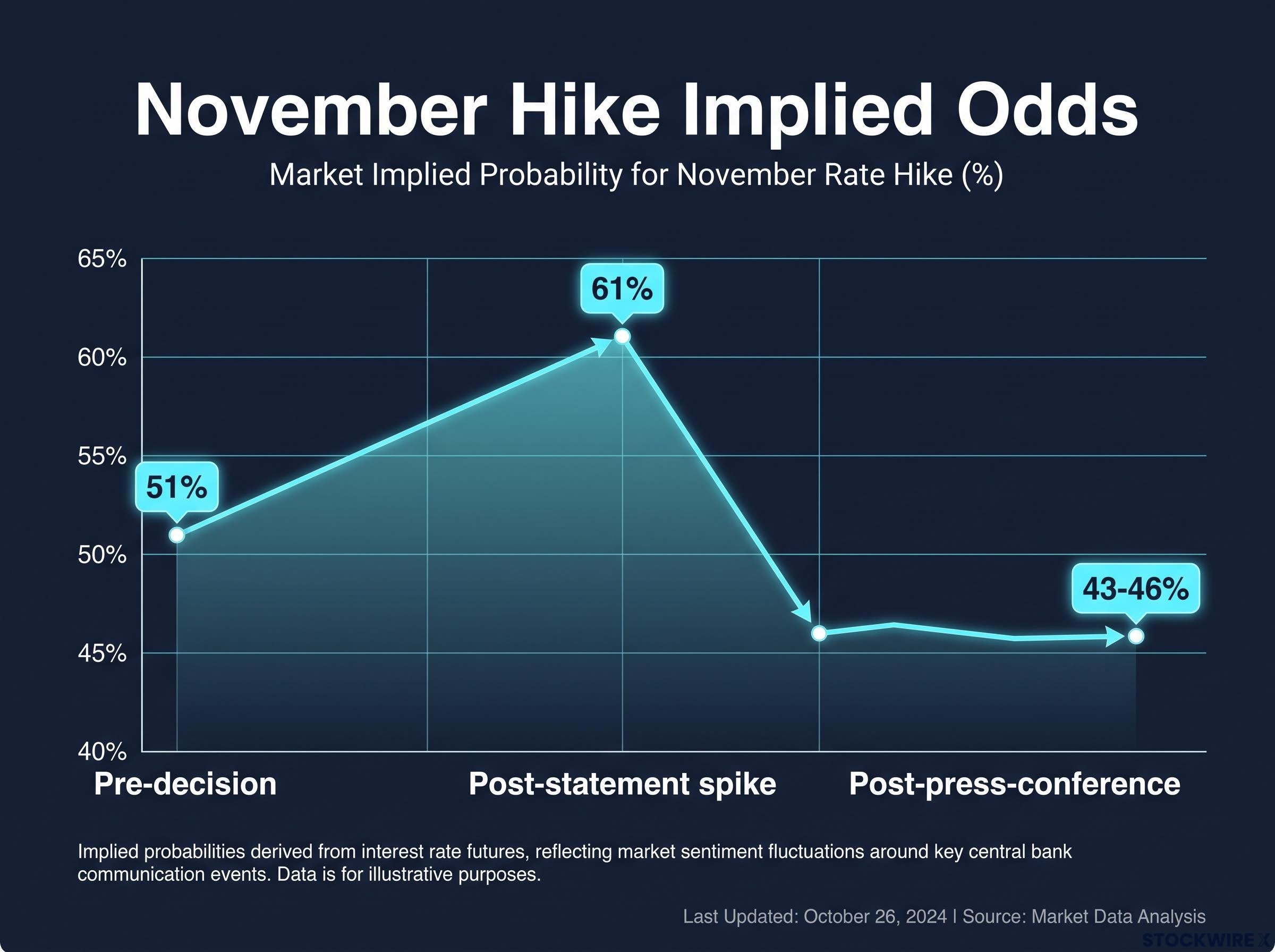
Here is what that sequence tells you. Three asset classes moved in the same direction, and all of them responded to the press conference rather than the rate decision itself. Governor Bullock’s spoken words now carry more market weight than the Board’s formal written statement. If you wait for the 2:30pm release and switch off before the press conference, you are reading only half the signal, and it is the wrong half.
Why markets believe the tightening cycle is at or near its peak
The pause interpretation is not wishful thinking. It is a convergence of named institutions reading the same data-dependence language and arriving at the same structural conclusion.
- Standard Chartered Global Research (via FXStreet) headlined its note “RBA seen on extended hold,” pointing out that the same statement citing upside risks also acknowledged slowing growth, an easing labour market, and falling housing prices.
- CommBank framed four hikes in a single year, plus the explicit “if needed” conditioning, as consistent with a pause while the Board assesses how prior tightening feeds through to households.
- Western Australian Treasury Corporation and TradingEconomics both noted that at a 15-year high, policy is already well into restrictive territory, which lets the Board wait for data rather than tighten mechanically.
- Straits Times economists expect that by 3 November, the evidence will show a cooling economy, sharper housing falls, a softer jobs market, and rising recession risks.
CommBank’s read centres on data-dependent conditioning: the “if needed” language is the phrase to watch in every subsequent RBA communication, because it is the switch between a pause and a resumption.
The core mechanism here is worth understanding, because it repeats across central banks. Near the peak of a cycle, policymakers tend to keep their written language hawkish to protect anti-inflation credibility, while softening their verbal guidance to avoid over-tightening. The Fed’s 2018-2019 pivot and the RBA’s own move toward a pause in early 2023 followed exactly this pattern, and in both cases bond yields fell and equities firmed even as the policy rate rose.
A hawkish hold in June 2026, when the Board kept the rate unchanged at 4.35% but refused to signal cuts, dragged the ASX 200 down 0.3% without a single basis point of actual policy change, which is precisely the mechanism now operating in reverse: a real hike paired with dovish verbal guidance producing equity gains.
The difference between a pause and a peak
This is the distinction that matters for your positioning, and the market pricing keeps the two apart. November odds settled below a coin flip at 43-46%. But markets were near-fully pricing a move by February 2027, with the peak rate still implied below 5%. Two-year ACGB (Australian Commonwealth Government Bond) yields sat above the cash rate, meaning some residual tightening was still baked in.
Read those numbers together and the message is clear. Markets are not pricing the end of the cycle. They are pricing a skip, a single meeting held rather than a hard stop. Whether that skip becomes a full peak depends heavily on one input: the CPI (Consumer Price Index, the main measure of inflation) release on 28 October.
That distinction changes your allocation logic. A skip that later resumes means fixed-income yields stay elevated and mortgage stress grinds on. A genuine peak opens a different playbook for rate-sensitive equities, REITs (real estate investment trusts), and long-duration bonds.
What could force the RBA’s hand before February 2027
The pause thesis is fragile, and the RBA’s own statement is the reason. The Board did not describe inflation as under control. It described upside risks as having materialised, which means it is operating on a premise that the data could break either way.
Four concrete channels could reopen the case for a November hike:
- Sticky services and energy inflation. Standard Chartered flagged these components as slow to recede, a persistent source of upside surprise.
- Fuel price pass-through to CPI. The West Australian framed the decision as a “double whammy,” with rising petrol prices squeezing household budgets and feeding headline inflation at the same time.
- AUD weakness as an import channel. With the dollar below 0.70, imported goods cost more in local terms, which can lift tradables inflation and complicate the path back to target.
- Labour market resilience. A stronger-than-expected jobs read would undercut the softening narrative the pause thesis depends on.
Global central bank divergence, most sharply illustrated in May 2026 when the RBA hiked to 4.35% while the Fed, ECB, and Bank of England all held, created a rate differential of up to 235 basis points that both supported the AUD and complicated the Board’s ability to slow down without triggering a currency reversal.
The West Australian’s “double whammy” captures the household reality: higher fuel prices hit the family budget directly and push up CPI simultaneously, reinforcing the RBA’s conditional hawkish bias.
Two near-term data points will set the November meeting’s probability. The ABS (Australian Bureau of Statistics) August CPI figure was due on 30 September, with attention on how much oil prices lifted the headline number. The 28 October CPI release is the pivotal input, and market pricing near-fully expects a move by February regardless of the November outcome.
Here is the read for you. The RBA’s explicitly conditional posture means every inflation print between now and 3 November is a live input, not background noise. The relief embedded in 29 September’s asset moves is provisional. It priced a softer rate path that has not been confirmed and will not be until late October, and positioning ahead of that release carries asymmetric risk in rate-sensitive assets.
What 29 September’s signal tells investors to watch next
The central finding is repeatable. The rate number has become less informative than the communication style around it. If you want to read the RBA’s intended path, Governor Bullock’s press conference tone is now a primary signal, not a secondary one, and treating it as a formality is how you get caught on the wrong side of a repricing.
Three dates define the next stretch:
- 30 September (ABS August CPI): The immediate read on whether oil prices are already lifting inflation.
- 28 October (CPI): The pivotal input. A print above expectations reopens the November hike case and pushes the AUD and bond yields back toward post-statement levels. A miss reinforces the pause and supports rate-sensitive equities and long-duration bonds.
- 3 November (RBA decision): With November odds at roughly 43-46% and the peak rate implied below 5%, this is a genuine coin flip that the CPI data will decide.
Standard Chartered’s “extended hold” is the base case, and CommBank’s data-dependent framing is the caveat attached to it. The two-year ACGB yield sitting above the cash rate is the market’s reminder that the ceiling is not guaranteed.
The practical framework is straightforward. The written statement anchors the risk assessment. The press conference reveals the intended path. The data between meetings decides whether that path holds. Positioning around RBA days now means holding through the full communication sequence, not just the 2:30pm announcement, and knowing which release matters gives you an edge over the next five weeks.
This article is for informational purposes only and should not be considered financial advice. Investors should conduct their own research and consult with financial professionals before making investment decisions.
Past performance does not guarantee future results. Financial projections are subject to market conditions and various risk factors. Statements regarding future rate paths are speculative and subject to change based on economic data and RBA decisions.