
What a Corporate Strategic Review Means for Shareholders

Key Takeaways
- A corporate strategic review is a formal, board-authorised process evaluating options such as a sale, merger, asset divestiture, capital partnership, or shareholder capital return to maximise shareholder value.
- Special Committees of independent directors lead the review to eliminate management conflicts of interest and carry fiduciary duties legally obligating them to act in shareholders' best interests.
- Independent financial advisors like investment banks are engaged to provide valuation analysis, identify potential acquirers or partners, negotiate terms, and deliver fairness opinions supporting board recommendations.
- Public companies must disclose the initiation of a strategic review as a material event under SEC requirements, while balancing transparency against protecting competitive negotiating positions.
- Strategic reviews do not guarantee a transaction — outcomes range from transformative deals to companies remaining independent, making it critical for investors to monitor process updates and manage position risk accordingly.
When Forum Markets (NASDAQ: FRMM) announced a corporate strategic review on 17 April 2026, the stock surged 120% in a single trading session. The dramatic price movement underscored investor interest in these formal evaluation processes, which can fundamentally reshape a company’s future. But what exactly happens when a board initiates a strategic review, and what should shareholders expect?
Forum Markets’ strategic review announcement provides detailed context about the company’s decision to form a Special Committee and the market’s immediate response to this corporate action, illustrating how investors react to these formal evaluation processes.
A corporate strategic review represents a comprehensive evaluation process where a company’s board of directors systematically assesses major strategic options to determine the best path forward for maximising shareholder value. This formal undertaking differs fundamentally from routine business planning or quarterly strategy discussions that occur within normal operations.
What Is a Corporate Strategic Review?
A corporate strategic review is a comprehensive evaluation process where a company’s board of directors systematically assesses major strategic options to determine the best path forward for maximising shareholder value. Unlike routine business planning, these reviews involve formal board authorisation, structured evaluation criteria, and often public announcement to shareholders.
Several common triggers prompt companies to initiate strategic reviews:
- Significant gap between market valuation and perceived intrinsic value (as FRMM cited, with a $48.14 million market capitalisation against higher assessed intrinsic value)
- Unsolicited acquisition interest from potential acquirers
- Persistently underperforming stock price relative to peers or sector benchmarks
- Activist investor pressure calling for board action
- Major industry changes affecting competitive positioning or business viability
- Leadership transitions creating opportunities to reassess strategic direction
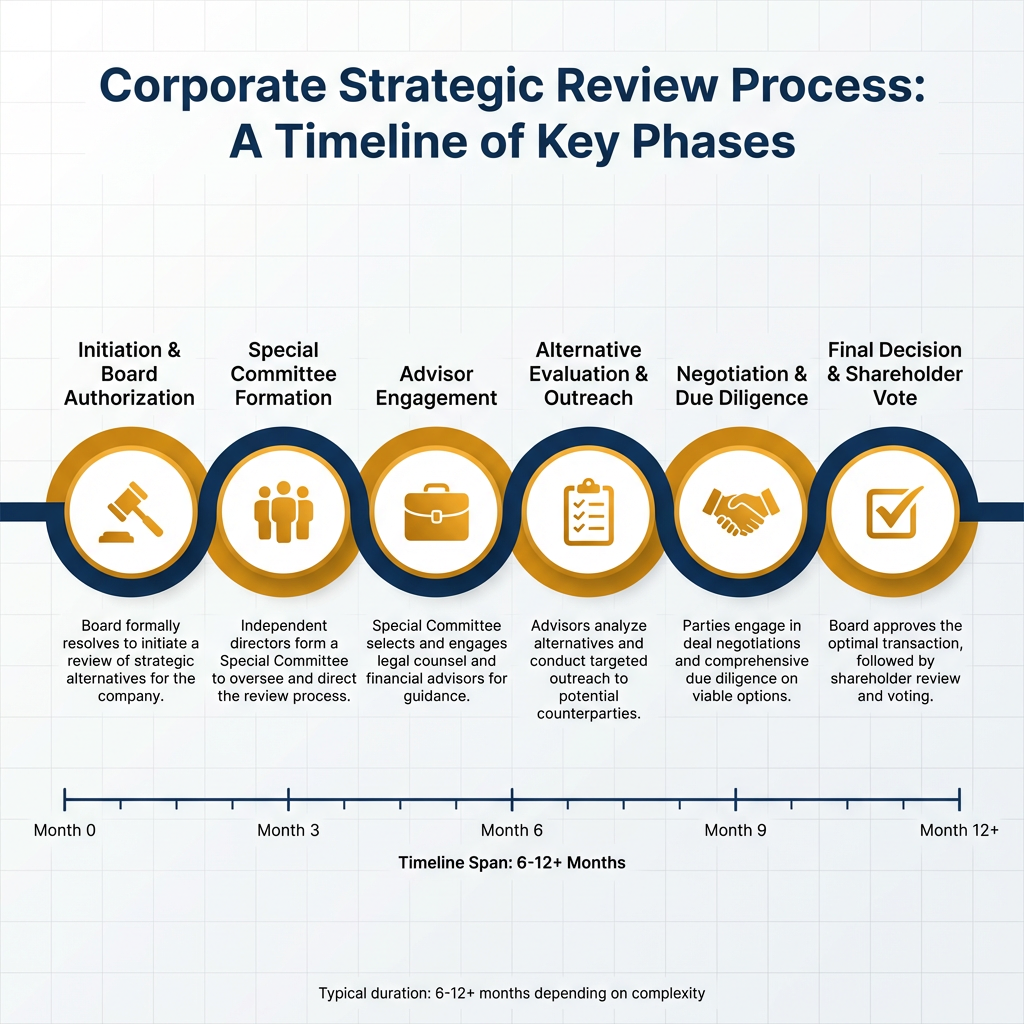
The formal, structured nature distinguishes these reviews from informal strategy discussions. Strategic reviews involve formal board authorisation, engagement of outside financial and legal advisors, defined evaluation criteria, and systematic assessment of alternatives. FRMM’s formation of a Special Committee and engagement of Clear Street Investment Banking exemplifies this structured approach, moving beyond internal deliberations to create an independent, professionally supported evaluation process.
When big ASX news breaks, our subscribers know first
The Role of Special Committees in Strategic Reviews
Companies form special committees of independent directors to lead strategic reviews because independence from management ensures objective evaluation, protects minority shareholders, and provides legal defensibility for decisions. The term “independent” means directors without material relationships to potential acquirers, significant financial interests that could create conflicts, or other ties that might compromise their judgement.
Typical special committee composition consists of 2-4 independent board members with relevant expertise in finance, mergers and acquisitions, or the company’s industry. FRMM’s committee comprises Angela Dalton, Michael Edwards, and Jason New, all independent directors tasked with evaluating proposals that could maximise shareholder value. This structure ensures that evaluation occurs separately from management’s operational responsibilities and potential conflicts.
Special committees typically receive broad powers and responsibilities:
- Authority to engage independent financial and legal advisors without management approval
- Power to solicit and evaluate proposals from potential acquirers or partners
- Responsibility to negotiate transaction terms on behalf of shareholders
- Duty to recommend (or reject) transactions to the full board based on shareholder interests
- Obligation to ensure fair process that treats all potential bidders equitably
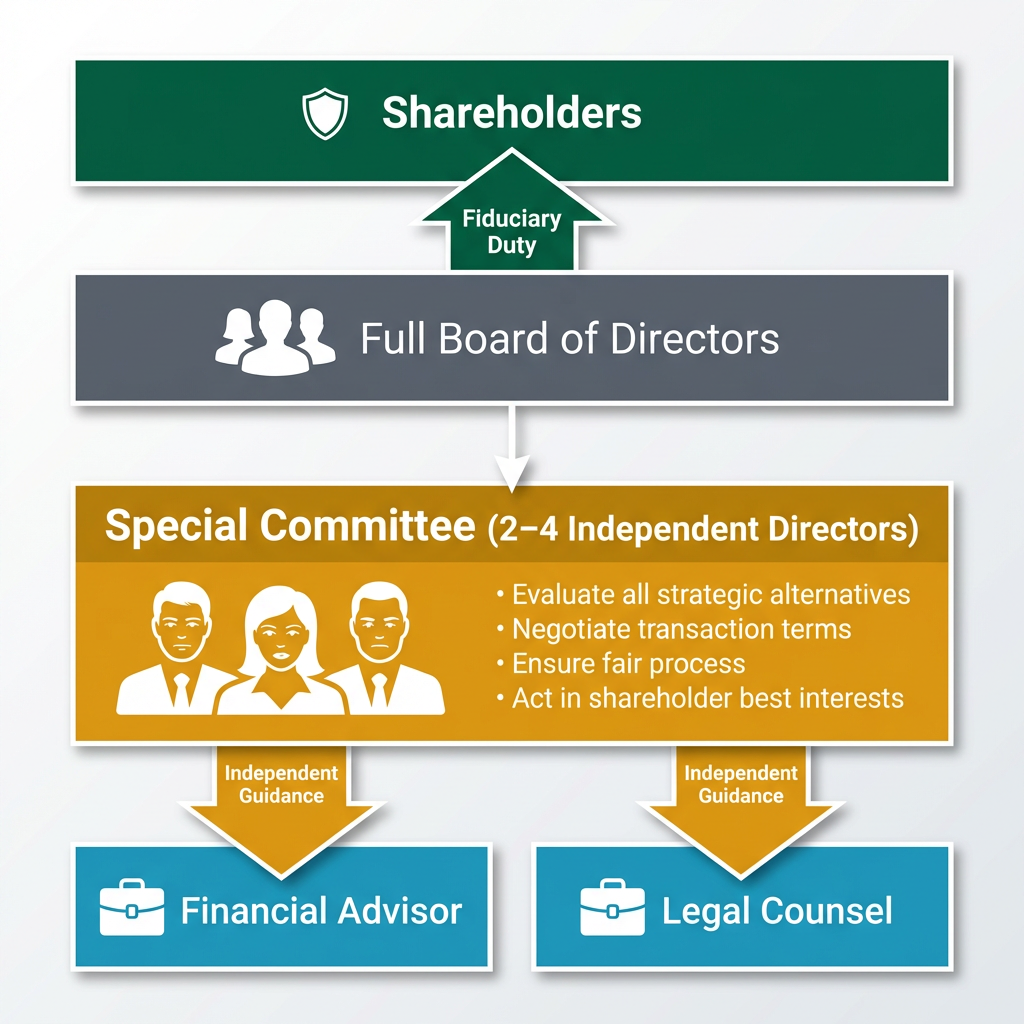
Committee members carry fiduciary duties under corporate law, meaning they have legal obligations to act in shareholders’ best interests rather than their own or management’s preferences. This duty shapes how they evaluate options, negotiate terms, and ultimately make recommendations to the full board. The fiduciary framework provides legal accountability and helps ensure that strategic decisions prioritise long-term shareholder value over other considerations.
Recent cases involving the real-world consequences of fiduciary duty violations highlight why independent oversight and proper documentation during strategic evaluations protect both shareholders and board members from legal challenges.
As detailed in the Harvard Law School Forum’s analysis of special committee fiduciary duties, directors face heightened legal scrutiny when evaluating strategic alternatives, with courts examining whether they acted with appropriate care, loyalty, and good faith in reaching their recommendations.
Strategic Alternatives Under Consideration
Strategic reviews typically evaluate a standard range of alternatives, though the specific options depend on company circumstances, market conditions, and board priorities. FRMM disclosed four primary alternatives under consideration, representing a comprehensive spectrum typical of these processes.
| Strategic Alternative | Description | When Most Appropriate |
|---|---|---|
| Sale of Company | Complete acquisition by another entity, with shareholders receiving cash or stock consideration | When a buyer can pay a premium reflecting full value and synergies exceed standalone potential |
| Merger with Private Company | Combination with complementary business to create larger, more competitive entity | When strategic synergies create value exceeding what either company could achieve independently |
| Asset Sale or Divestiture | Selling specific business units, product lines, or assets whilst retaining other operations | When individual parts command higher valuations than the combined entity (sum-of-parts value) |
| Capital Partnership | Strategic investment, joint venture, or partnership providing capital and operational support | When additional resources are needed without full sale, or when strategic alignment creates growth opportunities |
| Capital Returns | Dividends or share buybacks returning excess capital to shareholders | When cash reserves exceed operational and growth investment needs |
| Liquidation or Wind-Down | Orderly dissolution with asset distribution to shareholders | When no proposal meets valuation criteria and liquidation value exceeds going-concern value |
FRMM explicitly listed mergers with aligned private firms, potential sale of the company or significant assets, new capital partnerships, and distributing capital to shareholders if no proposal satisfies valuation criteria. This comprehensive range illustrates that strategic reviews genuinely evaluate all options, from transformative transactions to returning capital or maintaining independence. The board’s willingness to consider dissolution if alternatives fail to meet thresholds demonstrates the thoroughness expected in these processes.
How Financial Advisors Support the Process
Companies engage independent financial advisors because these firms bring transaction expertise, valuation capabilities, market knowledge, and buyer-seller relationships that most companies lack internally. Independence proves crucial for credible advice, as advisors without conflicts of interest can provide objective assessments of proposals and market opportunities. FRMM engaged Clear Street Investment Banking to provide valuation analysis and identify strategic opportunities.
Financial advisors perform several critical functions during strategic reviews:
- Conducting independent valuation analysis using comparable transactions, discounted cash flow models, and market-based methodologies
- Evaluating incoming proposals against fair value benchmarks to assess adequacy
- Identifying and contacting potential acquirers or partners who might have strategic interest
- Negotiating transaction terms on behalf of the special committee
- Providing fairness opinions to the board confirming that proposed transactions are financially fair to shareholders
- Supporting regulatory filings, due diligence processes, and documentation requirements
Understanding fundamental valuation methodologies helps investors assess whether proposals under strategic review reflect fair value for shareholders, particularly when comparing market capitalisation against intrinsic worth.
Advisor selection matters significantly. Committees typically choose firms without conflicts of interest (no existing relationships with potential acquirers that could compromise independence) and with relevant sector expertise. The advisor’s reputation adds credibility to the process, particularly when fairness opinions support board recommendations to shareholders. Established advisory relationships can also accelerate outreach to potential strategic partners or acquirers.
The next major ASX story will hit our subscribers first
Regulatory Requirements and Legal Considerations
Public companies conducting strategic reviews must comply with Securities and Exchange Commission disclosure requirements around material information. Companies must disclose the initiation of strategic alternatives processes to shareholders, as these represent material events that could affect investment decisions. However, companies balance transparency with protecting competitive positioning during negotiations, typically disclosing the process without revealing specific bidder identities or negotiation details until definitive agreements emerge.
FRMM referenced Rule 10b-18 safe harbour limits under the Securities Exchange Act of 1934 regarding potential share repurchases. This rule establishes conditions under which companies can repurchase shares without triggering market manipulation concerns. Buybacks during strategic reviews must comply with SEC rules governing timing, volume, manner, and price of purchases. Companies considering capital returns as a strategic alternative must navigate these requirements carefully.
The SEC’s Rule 10b-18 safe harbour guidance provides official regulatory details on the specific conditions regarding manner, timing, price, and volume that companies must satisfy when conducting share repurchases during strategic reviews.
Several legal considerations protect the company and board during strategic reviews:
- Maintaining proper documentation of the decision-making process to demonstrate fulfilment of fiduciary duties
- Ensuring fair process for all potential bidders, avoiding preferential treatment that could expose the board to shareholder litigation
- Obtaining fairness opinions from independent financial advisors before recommending transactions to shareholders
- Complying with proxy rules governing shareholder votes on material transactions
- Managing insider trading restrictions during periods when directors and officers possess material non-public information
These regulatory guardrails ensure that strategic reviews proceed fairly, transparently, and in accordance with securities laws designed to protect shareholder interests.
What Investors Should Watch For
Strategic reviews typically require several months to a year or more to complete, depending on process complexity, number of interested parties, and regulatory requirements. Companies usually continue normal operations during reviews, maintaining existing business strategies whilst the evaluation proceeds. FRMM stated it would pursue its existing business strategy and target revenue expansion during the review period, illustrating that strategic reviews occur alongside, not instead of, ongoing operations.
Investors should monitor several key signals during ongoing strategic reviews:
- Updates on advisor engagements or changes in professional support structure
- Announcements of definitive agreements, letters of intent, or non-binding proposals
- Proxy filings for shareholder votes on material transactions
- Changes in committee composition or board structure
- Company statements about strategic progress, timeline extensions, or process conclusions
Strategic reviews do not guarantee any particular outcome. Some result in transformative transactions whilst others conclude with companies remaining independent after determining that available alternatives fail to maximise shareholder value adequately. The process is designed to ensure all options receive thorough evaluation, with final decisions based on what the board determines best serves long-term shareholder interests.
Investors holding positions during strategic review periods face unique decision points about managing portfolio positions during uncertain periods, balancing the potential for transaction premiums against execution risk and timeline uncertainty.
> Important Disclosure
> This article is for informational purposes only and should not be considered financial advice. Investors should conduct their own research and consult with financial professionals before making investment decisions. Strategic review announcements do not guarantee specific outcomes, and stock prices can decline if processes yield no transaction or terms below market expectations.
Frequently Asked Questions
What is a corporate strategic review?
A corporate strategic review is a formal process where a company's board of directors systematically evaluates major strategic options — such as a sale, merger, asset divestiture, or capital return — to determine the best path for maximising shareholder value. Unlike routine business planning, it involves formal board authorisation, independent advisors, and public disclosure to shareholders.
What triggers a company to announce a strategic review?
Common triggers include a significant gap between market valuation and perceived intrinsic value, unsolicited acquisition interest, persistently underperforming stock price, activist investor pressure, major industry disruption, or a leadership transition that creates an opportunity to reassess strategic direction.
What is a Special Committee and why do companies form one during a strategic review?
A Special Committee is a group of independent board directors — typically two to four members — formed to lead a strategic review free from management conflicts of interest. Independence ensures objective evaluation, protects minority shareholders, and provides legal defensibility for any decisions or recommendations made to the full board.
Does a corporate strategic review guarantee a merger or acquisition outcome?
No — strategic reviews do not guarantee any specific outcome. Some result in transformative transactions like a sale or merger, while others conclude with the company remaining independent if available alternatives fail to adequately maximise shareholder value.
How long does a corporate strategic review typically take?
Strategic reviews typically require several months to a year or more to complete, depending on process complexity, the number of interested parties, and applicable regulatory requirements, while the company generally continues normal operations throughout the process.


