SEC Moves to End Mandatory Quarterly Reporting After 50 Years
Apr 24, 2026


Neobo Fastigheter delivered 5% rental income growth and slashed residential vacancy by 200 basis points in Q1 2026, yet net income contracted 23% as financing costs and prior disposals offset operational gains. The Swedish residential landlord’s mixed first-quarter results capture a tension playing out across the Nordic property sector: strengthening fundamentals at the building level while elevated interest rates and portfolio adjustments continue pressuring reported profitability.
This analysis unpacks Neobo’s Q1 2026 performance, examining what the vacancy turnaround signals about the company’s asset management capability and whether the earnings gap can narrow as financing conditions stabilise.
Neobo reported revenue of SEK 854M in Q1 2026, up from SEK 827M in the prior-year quarter, reflecting stable income generation capacity despite market volatility. Net income fell to SEK 442M from SEK 573M, a 23% contraction that overshadowed the revenue growth.
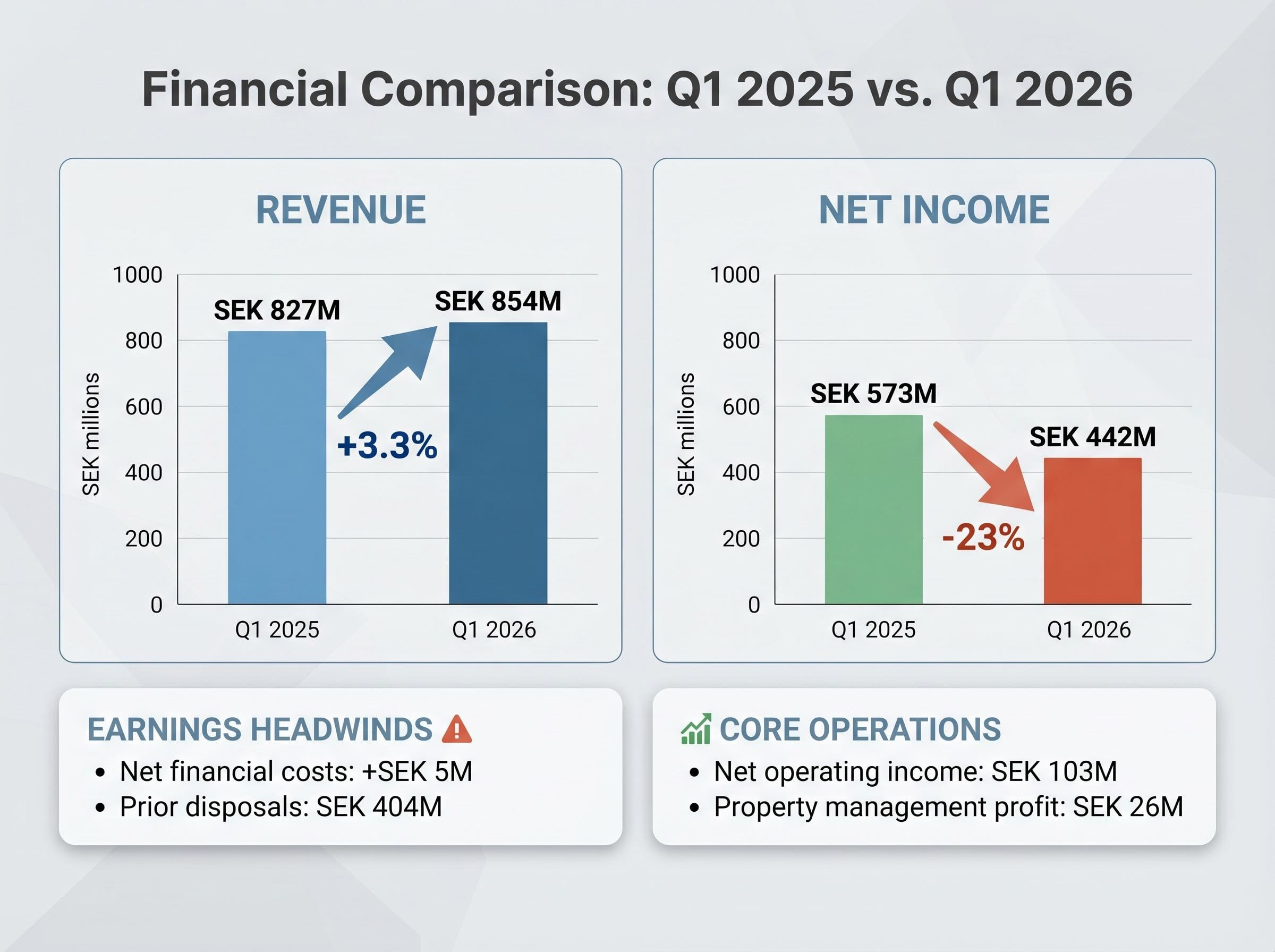
The divergence stems from two specific factors. Net financial costs rose SEK 5M following the expiry of interest rate swap agreements that had previously capped borrowing expenses. Property disposals totalling SEK 404M in the prior year removed income-generating assets from the base, creating a year-over-year headwind to reported profitability.
Core operational profitability held firm. Net operating income reached SEK 103M, and property management profit came in at SEK 26M. Per-share property management profit remained flat at SEK 0.19 as the company’s share buyback programme offset the disposal impact on the share count.
Net financial costs rose SEK 5M following the expiry of interest rate swap agreements, a timing-specific headwind as the company transitions to unhedged exposure on a portion of its debt stack.
The results demonstrate that rental operations are performing, but the company’s reported earnings remain sensitive to financing costs and portfolio composition decisions made in prior periods.
Neobo reduced residential vacancy from 6.6% to 4.6% during the quarter, a 200 basis point improvement that placed total occupancy at a company-record 94%. The achievement reflects deliberate asset management rather than market-wide tailwinds.
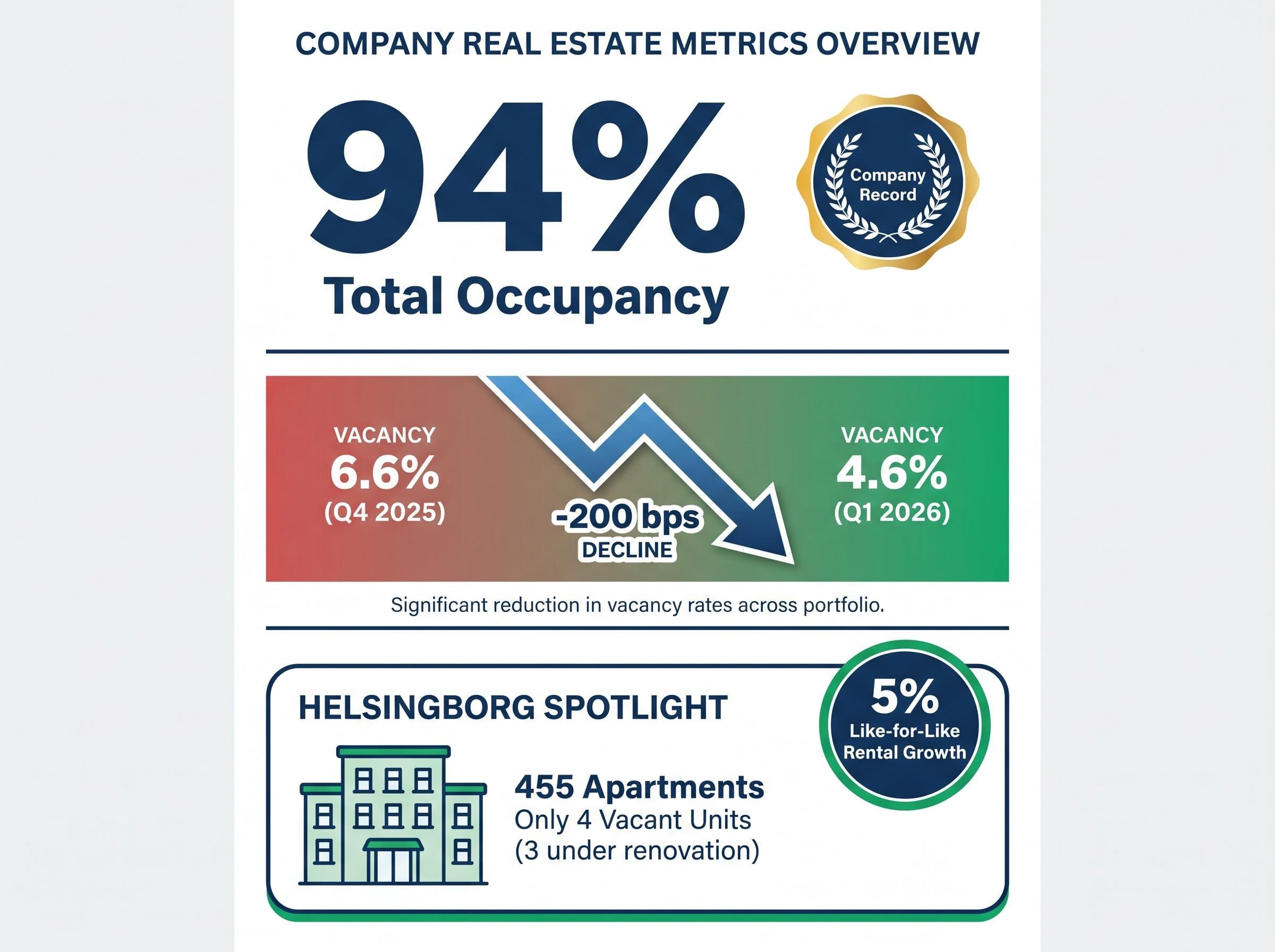
Helsingborg provides the clearest example of execution quality. Among 455 apartments in that market, only four units remained vacant at quarter end, with three of those under renovation. The occupancy metrics demonstrate Neobo’s capacity to fill units in competitive rental markets where structural undersupply supports landlord pricing power.
Like-for-like rental income growth reached 5% year-over-year, driven by three factors:
Helsingborg recorded only four vacant units among 455 apartments, with three of those under active renovation, demonstrating the company’s ability to maintain occupancy in competitive rental markets.
Residential rents increased 3.4% across the portfolio, while commercial space saw 0.9% growth. The improvement from 6.6% to 4.6% vacancy places Neobo within healthy Swedish residential sector benchmarks and directly supports rental income growth independent of market-wide rent negotiations.
Neobo deployed SEK 55M in property investments during Q1 2026, targeting value-enhancing upgrades that generate measurable returns. The company renovated 39 apartments company-wide, including 10 units in Helsingborg, with yield-on-cost metrics providing evidence of disciplined capital allocation.
Helsingborg renovations delivered yields above 5%, while energy efficiency projects across the portfolio generated yields of approximately 12%. Stockholm renovations produced the most striking outcome: rent uplifts of approximately 60% following refurbishment, reflecting both the scope of improvements and tight rental market conditions in the capital.
Helsingborg renovations delivered yields above 5%, while energy efficiency projects generated approximately 12% returns, demonstrating how yield-on-cost metrics for value-add property investments provide evidence of disciplined capital allocation when returns exceed borrowing costs.
| Location | Investment Type | Yield on Cost / Rent Uplift |
|---|---|---|
| Helsingborg | Apartment renovations | Above 5% |
| Portfolio-wide | Energy efficiency projects | Approximately 12% |
| Stockholm | Apartment renovations | Approximately 60% rent uplift |
These yield-on-cost figures matter because they demonstrate Neobo can generate returns on incremental capital that exceed its borrowing costs, supporting the case that renovation-driven rental growth can eventually translate to improved profitability. The 12% yield on energy efficiency projects is particularly relevant as European regulatory frameworks increasingly penalise energy-inefficient buildings.
Neobo’s loan-to-value ratio declined to 49.8% during the quarter, reflecting balance sheet strengthening through retained cash flow and stable property valuations. The company carries an average borrowing cost of 3.4% at quarter end, with SEK 5.9B in active interest rate swaps providing cash flow stabilisation on a portion of the debt stack.
The interest coverage ratio sits at 1.8x on a trailing twelve-month basis. The metric indicates adequate but not generous debt service capacity, contextualising the company’s sensitivity to financing cost movements.
Key balance sheet metrics include:
Portfolio valuation remained stable at SEK 13.6B quarter-over-quarter, with a net initial yield of 4.1%, indicating no material property value adjustments during the period.
For a mid-cap Swedish residential REIT, the sub-50% loan-to-value ratio and active hedging programme provide meaningful insulation against further rate volatility. The 1.8x interest coverage leaves limited margin for error if financing costs rise further, though the Riksbank’s commitment to hold rates at 1.75% through 2026 reduces near-term refinancing risk.
The Riksbank held its policy rate at 1.75% on 25 March 2026, with forward guidance signalling stability through the remainder of the year. The rate environment provides financing cost predictability that was absent through 2023 and early 2024, when Swedish property companies faced rapidly escalating borrowing expenses.
The Riksbank’s commitment to hold rates at 1.75% through 2026 creates financing cost predictability that reshapes real estate fund distribution yields in rate-stabilisation environments, where property companies can more confidently forecast cash flow available for distributions.
The Riksbank policy rate announcement of 25 March 2026 confirmed the decision to hold the rate at 1.75%, providing the financing cost predictability that Swedish property companies lacked during the 2023-2024 tightening cycle when borrowing expenses escalated rapidly.
Mortgage regulation changes implemented on 1 April 2026 increased the loan-to-value cap from 85% to 90%, reducing minimum down payments and expanding first-time buyer access to the owner-occupancy market. Early transaction data suggests accelerated activity in late March and early April as buyers capitalised on improved financing terms.
The Swedish Parliament mortgage regulation changes of 1 April 2026 raised the loan-to-value cap from 85% to 90%, expanding first-time buyer financing capacity and accelerating transaction activity in the owner-occupancy market as buyers capitalised on reduced down payment requirements.
Management expects surplus margins to recover through the remainder of 2026 as weather-driven costs normalise. Q1 2026 recorded approximately SEK 6-7M in weather-related expenses that are unlikely to recur at the same level in subsequent quarters.
Three key catalysts support the outlook:
The constrained residential transaction market limits both disposal and acquisition opportunities in the near term. Investment volumes recovered 28% in 2025 and remained robust into early 2026, but deal execution remains selective as buyers and sellers navigate price discovery in a stabilising but still-elevated rate environment.
Neobo Fastigheter’s Q1 2026 results present a company executing well at the property level while waiting for the macro environment to catch up. The 200 basis point vacancy reduction and 5% rental income growth demonstrate asset management capability. The 23% net income decline reflects financing headwinds and prior disposals that are largely non-recurring.
Investors evaluating Swedish residential exposure should monitor Neobo’s H1 results for evidence that surplus margins are recovering as management expects, and watch whether the improved occupancy metrics translate to improved property management profit as weather costs normalise.
This article is for informational purposes only and should not be considered financial advice. Investors should conduct their own research and consult with financial professionals before making investment decisions.
Neobo Fastigheter reported Q1 2026 revenue of SEK 854M, up from SEK 827M in the prior year, while net income fell 23% to SEK 442M from SEK 573M, driven by higher financing costs following the expiry of interest rate swap agreements and income lost from prior property disposals.
Net income declined because net financial costs rose SEK 5M after interest rate swap agreements expired, and property disposals totalling SEK 404M in the prior year removed income-generating assets from the portfolio, creating a year-over-year drag on reported profitability.
Neobo reduced residential vacancy from 6.6% to 4.6% during Q1 2026, a 200 basis point improvement that brought total portfolio occupancy to a company record of 94%.
The Riksbank held its policy rate at 1.75% on 25 March 2026 and signalled stability through the rest of the year, providing Neobo with financing cost predictability and reducing near-term refinancing risk given the company's 1.8x interest coverage ratio.
Neobo's Q1 2026 capital programme generated yields above 5% on Helsingborg apartment renovations, approximately 12% on energy efficiency projects, and rent uplifts of approximately 60% on Stockholm refurbishments, all exceeding the company's average borrowing cost of 3.4%.