On paper, Marvell Technology is paying about $1,132 for every Lumentum share. At a Marvell price near $171, the 4.5 Marvell shares each Lumentum holder would receive are worth roughly $765, about 32% below that headline.
Marvell announced the $115 billion, all-stock Lumentum acquisition on 2 November 2026. MRVL fell roughly 10%-13% that day, and the slide deepened over the following sessions.
Some traders bought call options, which are contracts that gain value if a stock rises, with expiries running as far out as 2028.
This covers why the market punished the Marvell Lumentum deal, what those call buyers need to break even, and a set of tests you can apply to any large stock-funded merger.
Why did Marvell’s stock fall so hard after the Lumentum announcement?
The first blow landed on announcement day. Reports differed on the size of the drop, but every source pointed in the same direction.
| Measure | Result | Source |
|---|---|---|
| MRVL, 2 November intraday | About 10% lower | Yahoo Finance |
| MRVL, 2 November | 12.7% to nearly 13% lower | ChartMill, CNBC |
| Lumentum, 2 November | 15% to 18.6% lower | Reuters-related reporting, ChartMill |
| MRVL, extended decline | Over 30% below the 28 October close; over 25% in a week | Tasty Life |
| MRVL versus all-time high | More than 47% below about $329.73 | Tasty Life |
The stock also broke below its 200-day moving average, which is the average closing price over the past 200 trading days. MRVL had not traded below that level since roughly February or March.
The deal terms behind the dilution
The $115 billion figure is enterprise value, which includes debt. Equity value is about $102.5 billion. The implied $1,132 per share was a 23.9% premium to Lumentum’s unaffected close on 28 October. After the deal closes, Marvell holders would own about 67% of the combined company and Lumentum holders about 33%.
Share dilution compounds quietly over time, and the gap between total earnings growth and per-share value is where large stock-funded deals tend to be judged, particularly when the acquirer issues stock at a weak point in its own cycle.
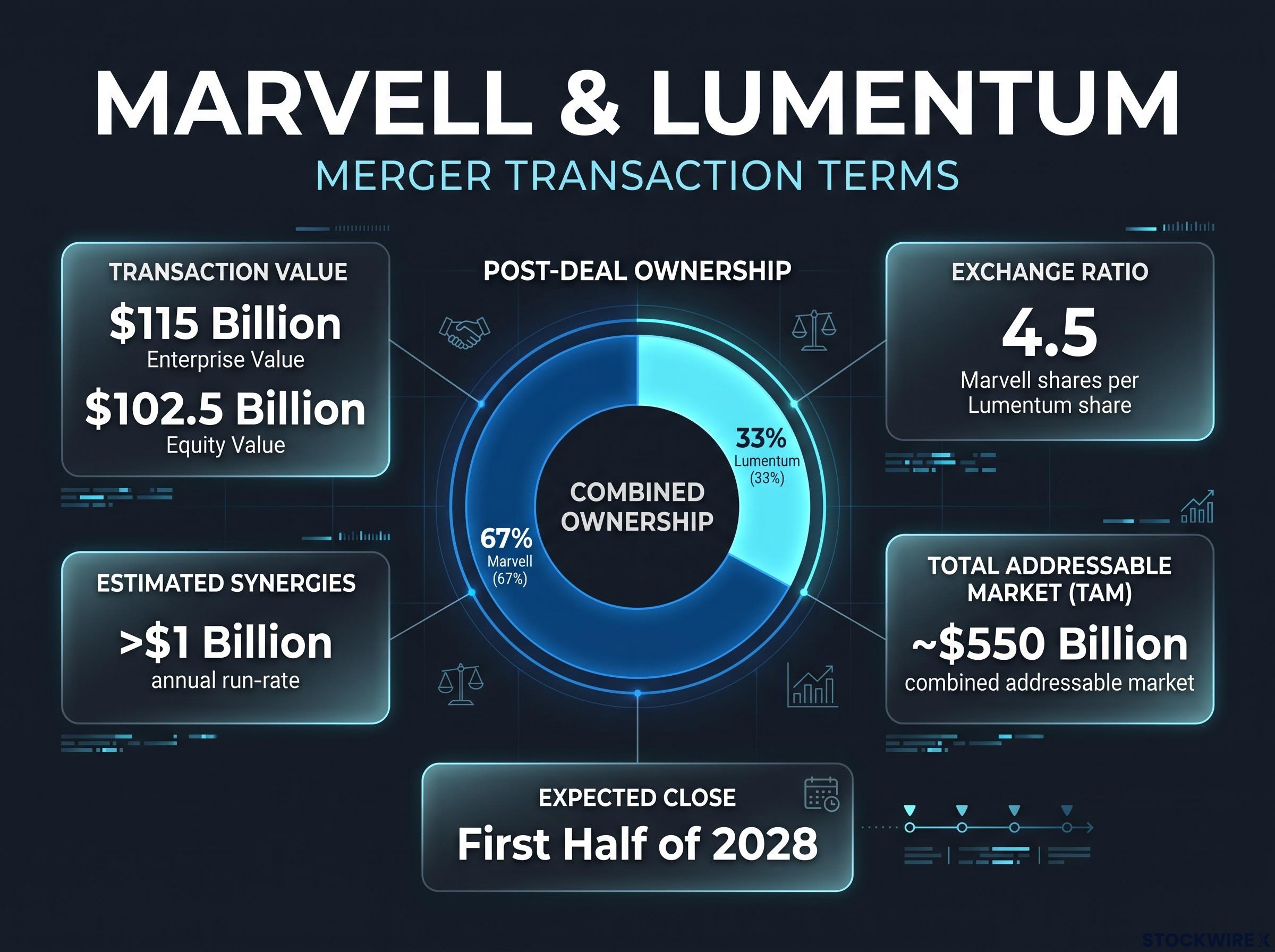
Management points to more than $1 billion in annual run-rate cost synergies, first-year non-GAAP EPS accretion and a combined addressable market of about $550 billion. Completion is expected in the first half of 2028. Morningstar holds a $360 fair value for Marvell and a $750 valuation for Lumentum. Its concern is that Marvell may be overpaying for a cyclical or supply-constrained asset that had climbed about 148% this year before the news broke.
IG Group’s Axel Rudolph called the deal an “enormous bet”. TheStreet Pro’s Chris Versace argued that strategic fit alone does not prove the deal creates value. The market appears to be weighing three drivers:
- Dilution: Marvell is issuing a large number of new shares, so each existing share has a smaller claim on future earnings.
- Price paid: the premium sits well above Morningstar’s valuation of Lumentum.
- Execution: synergies arrive only after a long wait and a complex integration.
Why Lumentum fell despite the premium
The exchange ratio is fixed at 4.5 Marvell shares. As MRVL falls, the value Lumentum holders will actually receive falls with it. The announced price is a moving target, and Marvell’s own share price is part of what it is paying. Each leg down in MRVL cheapens the offer, and that cheaper offer feeds back into Lumentum’s price. That is why the damage compounded rather than stopping after a single day.
When big ASX news breaks, our subscribers know first
What are the bullish call buyers betting on?
Against that selloff, one cluster of trades stood out. A Tasty Life presenter reviewing the options tape reported six bullish call purchases, all made at the ask price, within 43 minutes as MRVL slid from about $191 to $182. Expiries ran from November 2026 to June 2028.
Breakeven tells you what each buyer needs. It equals the strike price plus the premium paid, and the stock must reach it by expiry for the trade to profit.
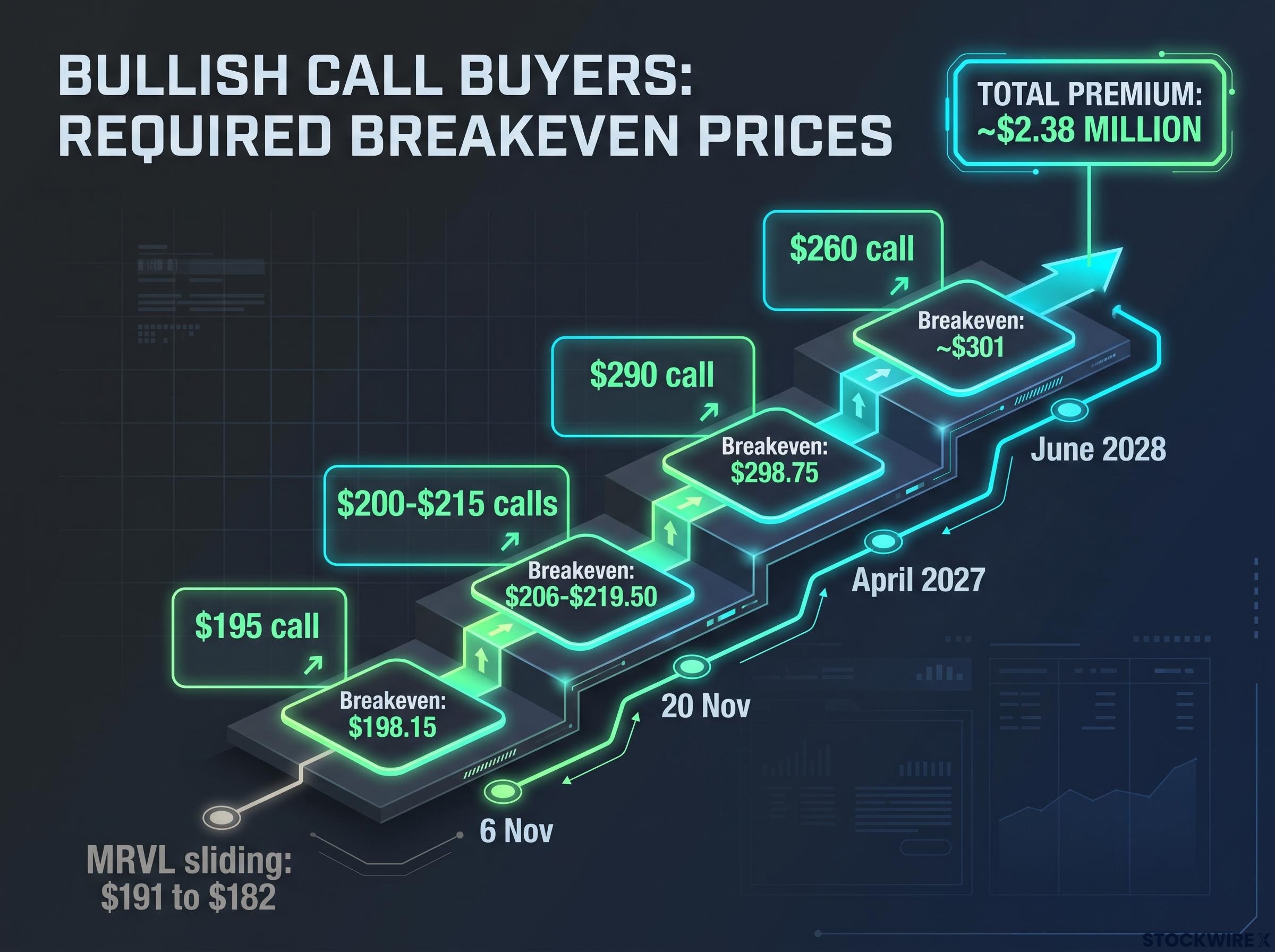
| Expiration / strike | Approx. breakeven | Implied view |
|---|---|---|
| 6 November, $195 call | $198.15 | Quick bounce |
| 20 November, $200 calls | $206-$207 | Selloff overdone |
| 20 November, $215 calls | $219.50 | Sharp short-term rebound |
| April 2027, $290 call | $298.75 | Earnings outweigh dilution |
| June 2028, $260 call (largest) | About $301 | Recovery beyond deal close |
Short-dated bets
According to the presenter, the November buyers see the selloff as overstated and partly recoverable within weeks. They need MRVL at roughly $198-$220, which is well above where it last traded.
Long-dated bets
The April 2027 and June 2028 buyers need about $299-$301. The presenter reads them as betting that investors will eventually focus on combined earnings power rather than dilution. The June 2028 contract also expires after the expected close.
These buyers need a meaningful rebound to profit. Stabilisation alone would not be enough. Each trade could also be a spread leg, a hedge, a volatility play or simply noise.
The scale check About $2.38 million of total premium, set against a $115 billion deal.
No independent verification of these specific trades was found. Treat them as one presenter’s account of a few traders’ expectations, not as proof that the selloff is wrong.
Options positioning in the target was already aggressive before the deal, including one large Lumentum call trade that paid $28.8 million in premium for a breakeven well above analyst consensus, a reminder that the optical supply story drew heavy bullish conviction.
How do you judge a large, dilutive, stock-funded merger?
The Marvell case gives you a lens you can reuse on the next big deal.
Dilution and price paid
- How much ownership do you give up? Marvell holders drop to about 67%.
- Is the price above standalone value? The $1,132 implied price sits well above Morningstar’s $750.
- Does accretion come from real operating profit? EPS accretion is not the same as value creation. Cost cuts or a richly valued acquirer share price can lift EPS even when a deal fails to earn its cost of capital.
Synergies and integration
- Are the synergies credible and timely? The $1 billion-plus in synergies only begins after a first-half 2028 close.
- How hard is the integration? Marvell must combine custom chips and connectivity with a major optical business.
- How sensitive is the price to the acquirer’s stock? With a fixed 4.5 ratio, every move in MRVL changes the cost of the deal.
| Precedent | Structure | Lesson |
|---|---|---|
| AMD-Xilinx | 1.7234 AMD shares per Xilinx share; completed 14 February 2022 | Scale can arrive alongside dilution and a long integration |
| Broadcom-VMware | Completed November 2023 | Filings warned that integration failures could hurt results and the share price |
No consistent event study of acquirer performance after these deals was available, so the lessons are qualitative. Run the tests yourself rather than leaning on management’s accretion claim or the stock’s first reaction.
Broadcom’s 10-K filing lists the integration risks it faced after VMware, including preserving customer relationships, merging financial systems and diverting management attention, which are the same pressure points Marvell would face with Lumentum.
What could still move the outcome before the deal closes?
According to Marvell’s 2 November 8-K filing, the deal needs approval from shareholders of both companies and from regulators. Management expects the benefits to arrive between 2027 and early 2028. Until then, these are the signposts worth tracking:
- Shareholder votes at both companies.
- Regulatory and antitrust review, which could delay the close or impose conditions.
- Customer concentration, since both companies rely on a small number of large data-centre buyers.
- AI capital spending sentiment, which drives demand for both businesses.
- Lumentum’s pricing, which Morningstar flagged as partly driven by tight supply.
Throughout that wait, the fixed ratio keeps the effective price moving with MRVL. Nvidia has reportedly invested $2 billion in each company this year, which points to their strategic relevance, although that figure and its timing were not independently confirmed. Analyst estimates are still shifting, and there is no clear Street price range yet.
The bull case needs durable AI-connectivity growth and synergies large enough to offset dilution. The bear case is that Marvell is issuing stock at a weak point in the cycle to buy a recently re-rated asset at a rich premium. Each signpost above shifts either the price Marvell pays or the earnings the combined company can deliver.
Buying stock at a weak point in the cycle is a judgement about semiconductor cycle timing, and Truist’s work suggests chip shares have typically peaked about a quarter after revenue growth, not before it.
What to watch as Marvell tries to turn a falling stock into a winning merger
So far, the market has weighted dilution, price and execution risk above management’s synergy case. A small group of call buyers is betting on a long recovery. The next tests are the shareholder votes, the regulatory review and where MRVL trades relative to the 4.5 exchange ratio, which sets what Lumentum holders actually receive.
Use the six tests to form your own view before treating either the selloff or the call buying as the answer.
These statements are speculative and subject to change based on market developments and company performance. This article is for informational purposes only and should not be considered financial advice. Investors should conduct their own research and consult with financial professionals before making investment decisions.