Diplomatic talks meant to reopen one of the world’s most important oil shipping lanes have lost momentum at exactly the wrong moment, with a critical U.S. inflation reading just two days away.
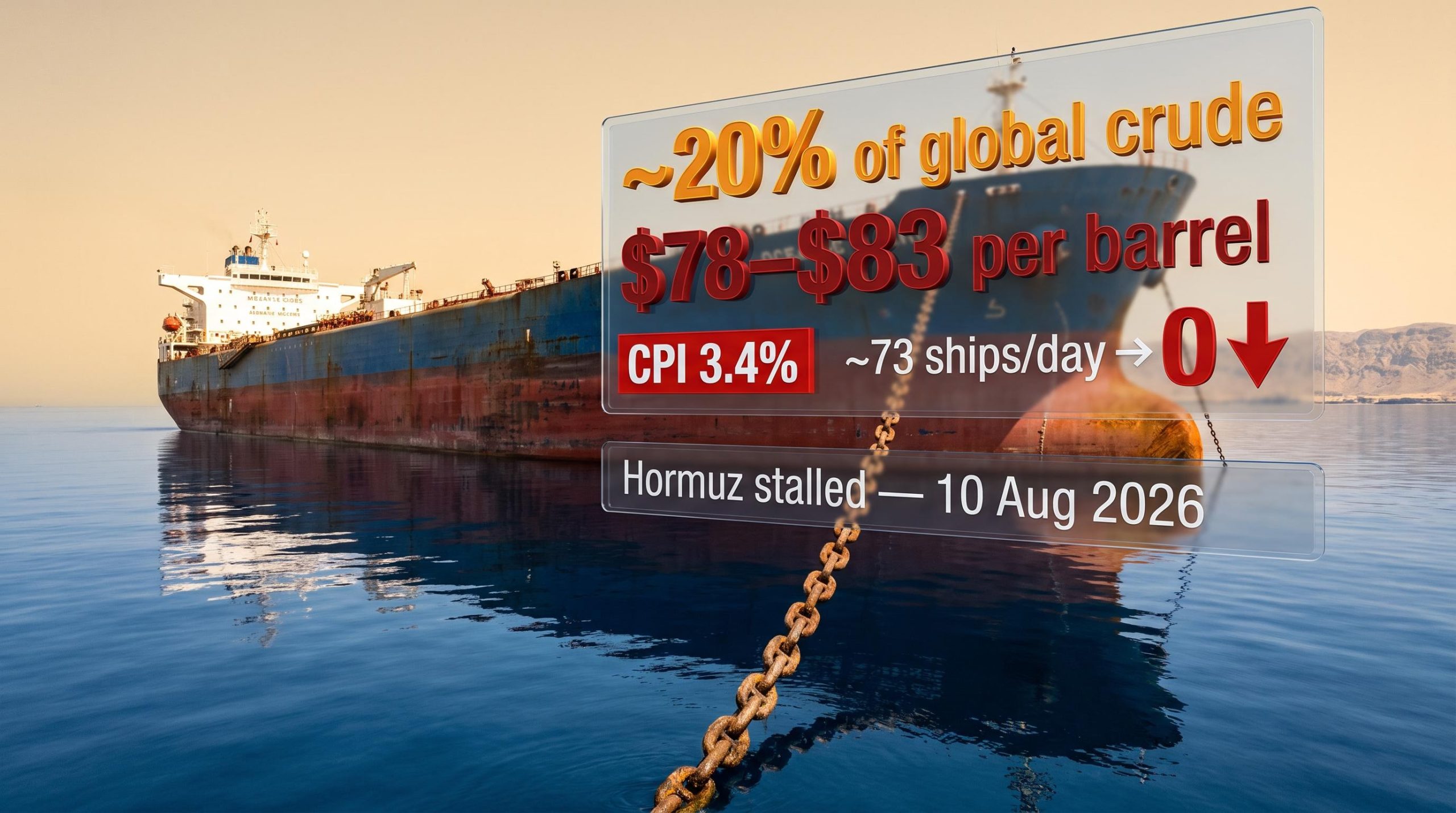
Oman-mediated negotiations between Iran and the United States stalled as of Monday, 10 August 2026, with Iran presenting new conditions and both sides trading contradictory signals about whether any deal is close. The Strait of Hormuz, which normally carries roughly one-fifth of globally traded crude oil, has been effectively shut to commercial shipping since late February. Six months of disruption have transformed what looked like an acute shock into a persistent structural drag on energy prices and, by extension, U.S. inflation.
Here is the causal chain from the stalled talks through to the 12 August Consumer Price Index (CPI) print, and what it means for how the Federal Reserve is likely to act next. If you are watching energy markets, inflation data, or rate-sensitive assets, the next 72 hours matter.
What actually stalled, and why the “final stages” language is misleading
Last week’s optimism was hard to miss. Iranian officials described Oman-mediated negotiations as being in their “final stages.” Markets took the cue. Crude dipped. Headlines suggested a deal was close.
By Monday, the substance underneath that language told a different story. Iran’s Foreign Minister Abbas Araghchi publicly stated that no direct U.S.-Iran dialogue is underway, and that Tehran will not initiate direct talks while it considers Washington to be in breach of the June interim agreement. Messages are moving only through intermediaries.
Araghchi’s position, stated publicly on 10 August: No direct dialogue with the United States is underway. Tehran will not initiate direct talks while Washington is treated as breaching the June interim agreement.
The Oman channel concerns narrow technical details: shipping lane coordinates and corridors, not a full political settlement. Iranian officials have said explicitly that an Oman-brokered agreement alone would not reopen the strait or return it to pre-war status. The list of unresolved sticking points explains why:
- Inspection regimes for transiting vessels
- Fees and tolls on commercial shipping
- Restrictions on U.S. and Israeli vessels
- War damage compensation
- The broader military conflict itself
Iran’s conditions for full reopening go further still: the U.S. must end its naval blockade, withdraw forces, and meet additional demands. In a note published on 10 August, analysts at Vital Knowledge described the overall tone from the Middle East as discouraging, pointing to the absence of a formal Hormuz announcement and a fresh set of Iranian demands put to Washington.
The Hormuz toll negotiations add another layer of intractability to the stall: Iran’s proposed 7% cargo-value levy would cost approximately $11.2 million per VLCC crossing, and the three parties involved, Iran, Oman, and Washington, hold incompatible positions on whether any fee regime should be mandatory or voluntary.
The gap between “final stages” and that list of unresolved conditions tells you that the diplomatic language is running well ahead of the diplomatic reality. Any near-term reopening announcement deserves scepticism until the specifics accompany it.
When big ASX news breaks, our subscribers know first
Why the Strait of Hormuz is so difficult to replace or reroute around
The Strait of Hormuz sits between the Persian Gulf and the open ocean. Under normal conditions, approximately one-fifth of all globally traded crude oil and significant liquefied natural gas (LNG) volumes pass through it. There is no equivalent alternative route capable of absorbing that volume.
The EIA world oil transit chokepoints analysis identifies the Strait of Hormuz as the single highest-volume oil transit point on the planet, with no alternative route capable of handling comparable throughput, a structural reality that underpins the persistence of the current price pressure.
| Metric | Normal conditions | Current status |
|---|---|---|
| Daily ship transits | ~73 ships per day | Virtually zero commercial traffic |
| Share of global crude affected | ~20% | Constrained since late February 2026 |
| Duration of disruption | N/A | ~5.5 months (late Feb to 10 Aug 2026) |
Iran began closing and attacking shipping in late February 2026. The strait has remained virtually shut to commercial traffic since then, making this a six-month-old shock with no clear end date.
Even a partial Oman deal would not immediately normalise flows. Regional officials have repeatedly stressed that a technical agreement on shipping corridors would not automatically reopen the waterway. The combination of scale (one-fifth of global crude) and the absence of a viable bypass route means there is no market mechanism that can substitute for a diplomatic solution, which is why oil prices remain sensitive to every negotiation signal.
How a shipping lane closure becomes a gasoline price and then a CPI number
The transmission mechanism from Tehran to the petrol pump to the inflation report runs through a direct, traceable chain:
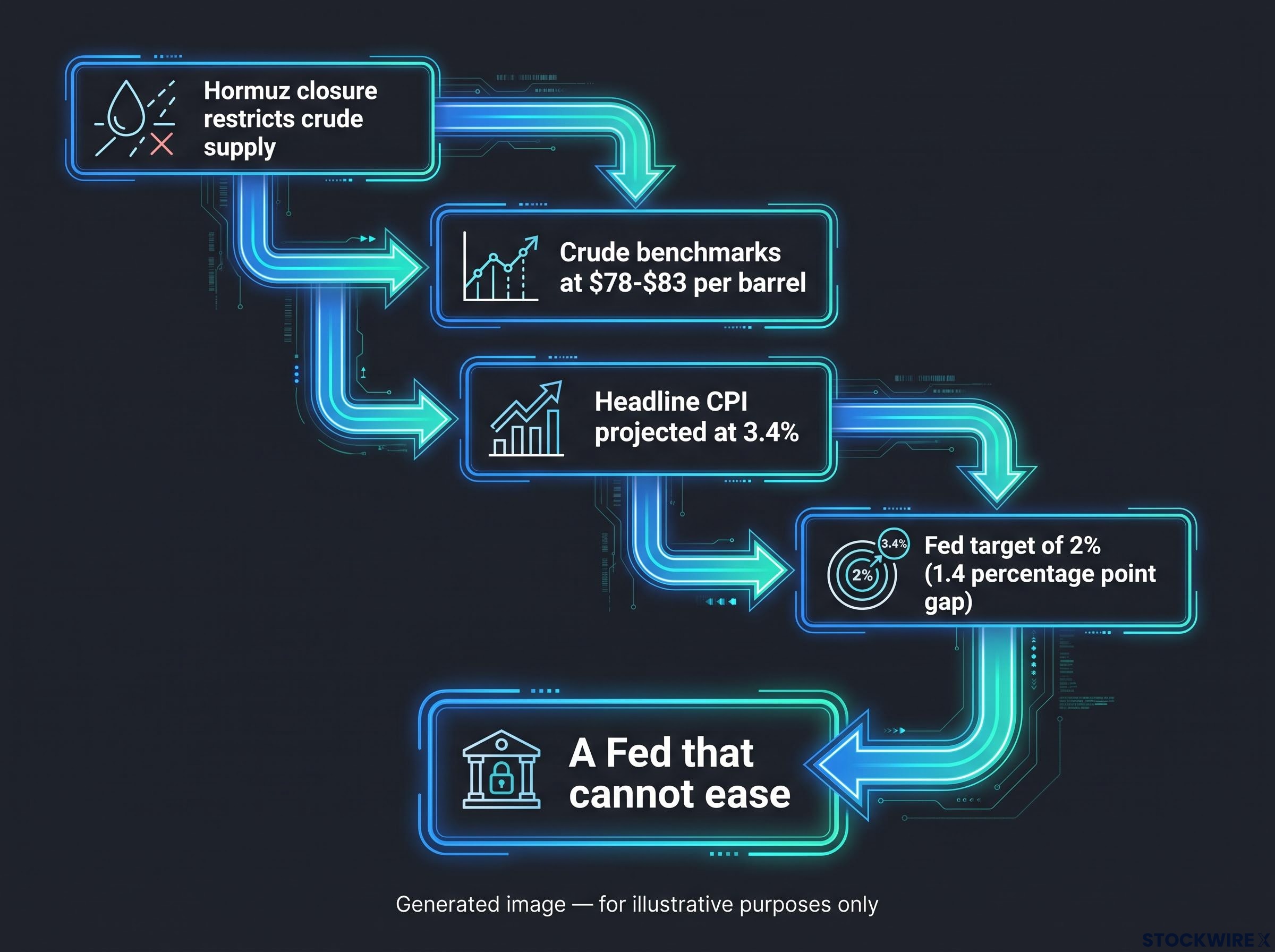
- Hormuz closure restricts crude supply from the Gulf, removing roughly a fifth of globally traded oil from accessible markets.
- Crude benchmarks remain elevated, with recent prices sitting in the $78-$83 per barrel range amid ongoing uncertainty.
- Gasoline and diesel prices follow, as refiners pass through higher input costs.
- Transportation and logistics costs rise across the economy, because fuel is an input to virtually every supply chain.
- Headline CPI remains sticky above target, because energy costs feed into plastics, chemicals, manufacturing, and the price of moving goods to shelves.
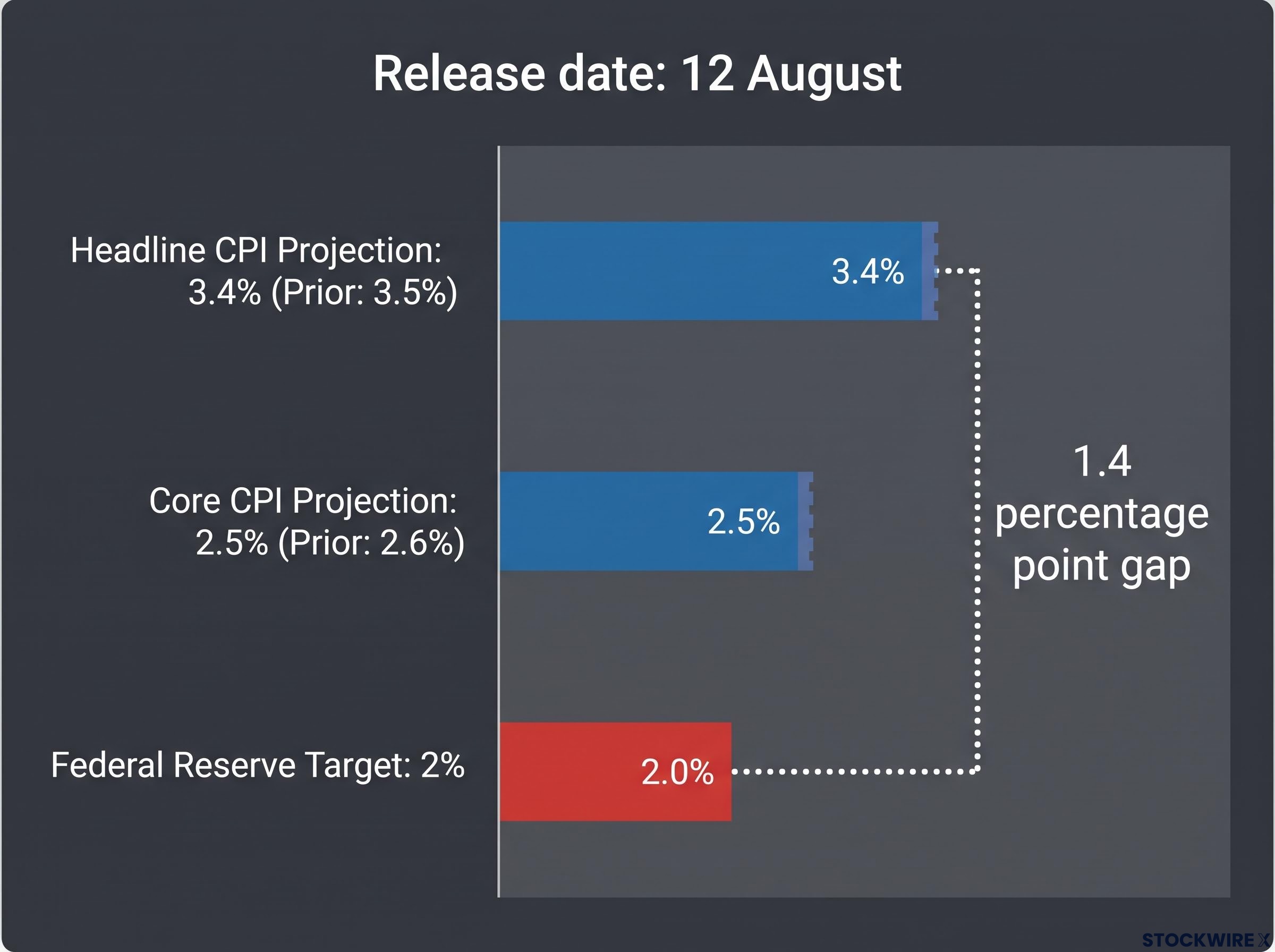
The 12 August CPI release covers the twelve months ending July 2026. Consensus forecasts put headline inflation at 3.4%, a slight retreat from the 3.5% recorded in the prior period. When food and energy are stripped out, the core measure is expected to slip to 2.5% from 2.6%.
Projected headline CPI: 3.4%. The Federal Reserve’s target: 2%. The gap of 1.4 percentage points represents the structural inflation problem that six months of Hormuz disruption has helped entrench.
That modest projected decline from 3.5% to 3.4% illustrates the problem. Six months of Hormuz disruption has not produced a price spike that reversed itself. It has created a floor that disinflation is struggling to break through. Elevated gasoline costs linked directly to the Iran conflict have been specifically identified as an upward driver of headline inflation.
The headline-core CPI divergence is the diagnostic signal investors need to read correctly: in May 2026, headline reached 4.2% while core held at 2.9%, a 1.3 percentage-point gap that confirmed the inflation spike was geopolitical and supply-driven rather than a sign of economy-wide overheating, the same structural pattern now visible in the July projections.
This article is for informational purposes only and should not be considered financial advice. Investors should conduct their own research and consult with financial professionals before making investment decisions.
Why the Federal Reserve cannot simply raise rates to fix an oil shock
The Fed’s primary tools, interest rates and balance-sheet policy, act on demand. They influence borrowing costs, spending, and investment. The Hormuz shock is supply-driven: a physically closed shipping lane restricts output regardless of how much or how little American consumers spend. Monetary policy cannot reopen the strait.
That creates a no-win trade-off. Tightening further risks slowing the economy and weakening the labour market. Failing to act on persistent above-target inflation risks letting expectations become unanchored. At 3.4% headline and 2.5% core, both CPI readings sit at a considerable distance above the Fed’s 2% target, leaving policymakers with limited room to manoeuvre.
The oil risk premium embedded in current crude benchmarks is itself a structural problem: the IEA projects a two-year supply chain recovery timeline even under a best-case resolution, meaning the $78-$83 per barrel range reflects not just present scarcity but a long decompression curve that monetary policy cannot shorten.
The likely posture is caution: keeping policy relatively tight while watching both the CPI data and Hormuz developments before committing to a path change.
What to watch in Fed language after the 12 August release
Market participants will scrutinise whether Fed officials describe elevated inflation as energy-driven and temporary, or as evidence of broader price pressures. The distinction matters because it signals how policymakers are incorporating the geopolitical scenario into their reaction function.
The FOMC meeting structure itself is under active review: Fed Chair Warsh is considering cutting annual meetings from eight to six, a change that would concentrate rate decisions into fewer, higher-stakes windows and amplify the market impact of each CPI print as a policy trigger in the intervals between sessions.
The three possible CPI outcome scenarios and what each implies for the Fed:
- Above consensus (above 3.4%): Reinforces the case for keeping rates higher for longer, pressuring long-duration bonds and growth stocks.
- In-line (3.4% headline, 2.5% core): Confirms the slow-grind disinflation narrative but does not give the Fed cover to ease.
- Below consensus: Could support risk assets, but is unlikely to shift the underlying narrative as long as Hormuz remains effectively closed.
For anyone holding rate-sensitive assets, the practical implication is clear: the Fed cannot use the supply-shock nature of the problem as cover to ease, because headline inflation is running 1.4 percentage points above target with no clear path down.
The signals that would actually change this picture
Two categories of signal matter most in the coming days: developments on Hormuz and the Wednesday, 12 August CPI print.
| Signal type | Source | What it looks like | Oil price implication | Rate-sensitive asset implication |
|---|---|---|---|---|
| Positive | Hormuz / CPI | Credible framework for shipping corridors; headline CPI at or below 3.4% | Downward pressure on crude | Modest relief for long-duration bonds, growth stocks |
| Negative | Hormuz / CPI | New attacks, walk-back of “final stages” language; headline CPI above 3.4% | Renewed crude risk premia | Further pressure on rate-sensitive names |
Specific Hormuz-related signals to monitor this week:
- A credible framework meaningfully increasing safe shipping volumes through the strait
- New Iranian demands or explicit walk-backs from prior diplomatic language
- Any further attacks on commercial shipping
- Shifts in U.S. posture statements regarding naval presence or sanctions
The asymmetry here matters for positioning. The conditions for a meaningful oil price relief rally require both a credible Hormuz deal and confirmation from CPI data. The conditions for further upside crude pressure require only one of several negative signals to materialise.
What the stall changes, and what investors should not assume it has resolved
The causal chain is direct: no durable Hormuz deal means constrained supply, means elevated energy prices, means stickier headline inflation, means constrained Fed flexibility.
The core loop: Stalled negotiations → restricted supply → $78-$83 crude → 3.4% headline CPI → a Fed that cannot ease. Each link depends on the one before it, and the first link, diplomacy, showed no progress on Monday.
Six months of disruption has shifted this from a temporary shock into a structural headwind. Even a partial deal would not immediately undo the inflation path already established, because the cumulative months of elevated energy costs are already priced into inflation expectations and the current CPI trajectory.
The gap between projected headline CPI at 3.4% and the Fed’s 2% target represents 1.4 percentage points of structural inflation that Hormuz has helped entrench. Crude benchmarks remain in the $78-$83 range with an upside risk bias as long as talks remain stalled.
A diplomatic resolution announcement, if it comes, will not immediately translate into lower petrol prices or a Fed pivot. The correct posture is informed vigilance: treat partial progress as proportional rather than as the binary switch that markets keep hoping for.
Past performance does not guarantee future results. Financial projections are subject to market conditions and various risk factors.